Canister!
Small items that don’t warrant full posts of their own:

- Please welcome to the world of Civil War blogging Matthew Stewart, of The War Bureau.
- Al Mackey has put up an interview with Tony Horwitz, author of the 1990s best-seller Confederates in the Attic. Horwitz’ depiction of the fringier elements of the “heritage” community, done back in the olden days before anyone ever imagined things like Facebook and Twitter, has held up pretty well.
- The first season of Mercy Street comes to an end on Sunday evening. It has its problems, but its fictional story is better grounded in historical events than a lot of what gets passed off as non-fiction documentaries. I hope it gets picked up for more episodes.
- The Virginia Flaggers put up their eleventy-third Confederate Battle Flag the other day, this one dedicated to Wade Hampton, who abandoned Columbia, South Carolina to Uncle Billy Sherman 151 years ago this week without a fight. This flag is located on I-95 south of Petersburg, across the highway from the Bexley Mobile Home Park.
- Just when you got to where you could say, “Texas Board of Education” with a straight face again, along comes Mary Lou Bruner.
- Do you suppose this proud Texas flagger understands that Sam Houston was a Unionist who opposed secession, and accurately predicted disastrous defeat for the Confederacy?
- Supreme Court Associate Justice Antonin Scalia passed away last weekend, after three decades on the nation’s highest court. Although Scalia prided himself as an “originalist,” who insisted on reading the Constitution as he thought the Founders did more than two centuries ago, even he believed the legality of secession was a long-settled issue.
- It’s a lot of fun watching the heritage crowd argue about whether a native-born Canadian or a New York real estate mogul from Queens are the most supportive of Confederate symbols.
- Meanwhile, a poll taken back in December showed Governor Nikki Haley with an 81% approval rating among likely South Carolina GOP primary voters, and 84% among self-identified Tea Party supporters. Looks like the odious Kirk Lyons is gonna need a lot more airplanes.
Got any more? Put ’em in the comments below.
______
“The Fall of Charleston” by Shovels & Rope

Early on the morning of February 18, 1865 — 151 years ago today — Union troops onshore and in the blockading fleet off Charleston noticed that the Confederates at Fort Sumter had not hoisted a flag above the battered remnants of the post. The monitor U.S.S. Canonicus moved slowly closer, and fired two rounds into the fort from her 15-inch Dahlgren smoothbores. The Union bluejackets waited for the inevitable response. Instead, there was only the sound of the wind and water.
The Confederates were gone. Charleston had fallen.
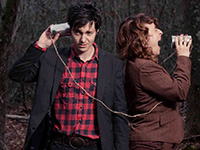 Here’s a track from the album Divided and United by Shovels & Rope, the Charleston husband and wife duo of Michael Trent and Cary Ann Hearst. You can read more about them and their recording of “The Fall of Charleston” here, or hop over to NPR for a mini-concert. A contemporary broadside of the lyrics is available here.
Charleston is taken, and the rebels put to rout;
And Beauregard the chivalrous, he ran to save his bacon—
When he saw General Sherman’s “Yanks,” and “Charleston is taken!” With a whack, rowdy-dow, A hunkey boy is General Sherman, Whack, rowdy-dow, Invincible is he! This South Carolina chivalry, they once did loudly boast,
That the footsteps of a Union man, should ne’er pollute their coast.
They’d fight the Yankees two to one, who only fought for booty, But when the “udsills” came along it was “Legs, do your duty!” With a whack, rowdy-dow, Babylon is fallen, Whack, rowdy-dow, The end is drawing near! And from the “Sacred City,” this valiant warlike throng;
Skedaddled in confusion, although thirty thousand strong—
Without a shot, without a blow, or least sign of resistance,
And leaving their poor friends behind, with the “Yankees” for assistance! With a whack, rowdy-dow, How are you, Southern chivalry? Whack, rowdy-dow, Your race is nearly run! And again o’er Sumter’s battered walls, the Stars and Stripes do fly,
While the chivalry of Sixty-one in the “Last ditch” lie;—
With Sherman, Grant and Porter too, to lead our men to glory,
We’ll squash poor Jeff’s confederacy, and then get “Hunkydory!” With a whack, rowdy-dow, How are you, neutral Johnny Bull? Whack, rowdy-dow, We’ll settle next with you!
__________

Damn Yankees!

The Spring 2016 issue of the Civil War Monitor is now available to subscribers online, and should be appearing in mailboxes and newsstands soon. As usual, it’s got a lot of good stuff inside:
- “Damn Yankees: How Confederates Defined and Demonized Their Northern Opponents,” by George C. Rable.
- “The Wilderness Revisited,” by Stephen W. Sears.
- “Medals of Honor: A Portfolio of Heroes,” profiles of seventeen recipients of the Medal of Honor.
- “Travels: A Visit to Spingfield,” by Christian McWhirter and Samuel Wheeler.
- “Faces of War: A Death Far from Home,” by Ronald S. Coddington.
- “A Reconstruction Bookshelf,” by Brooks Simpson.
- “Ulysses S. Grant and the Long, Hard Slog,” by Mark Grimsley.
- “The Unintended Expert: How a Chance Encounter Led Garry Adelman to a Second Career in Civil War History,” by Jenny Johnston.
Now would be a good time to subscribe to the Monitor, y’all.
_________
Do the Guinness People Know About This?
One of my readers brings this to my attention:
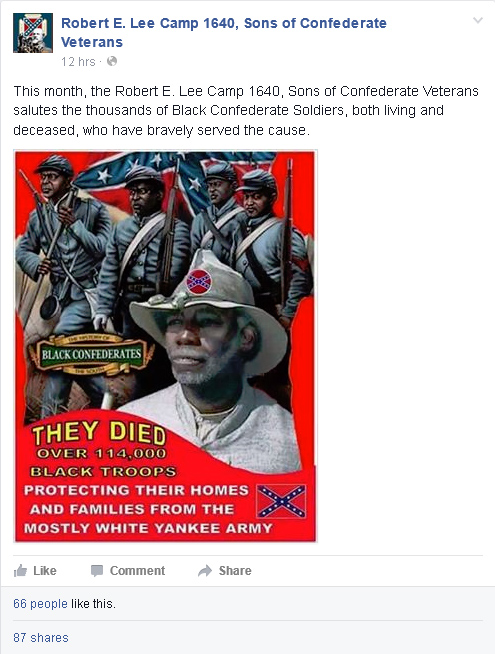
This line was interesting:
This month, the Robert E. Lee Camp 1640, Sons of Confederate Veterans salutes the thousands of Black Confederate Soldiers, both living and deceased, who have bravely served the cause.
“Living” black Confederate soldiers? Do tell.
______
Mercy Street, Episode 4
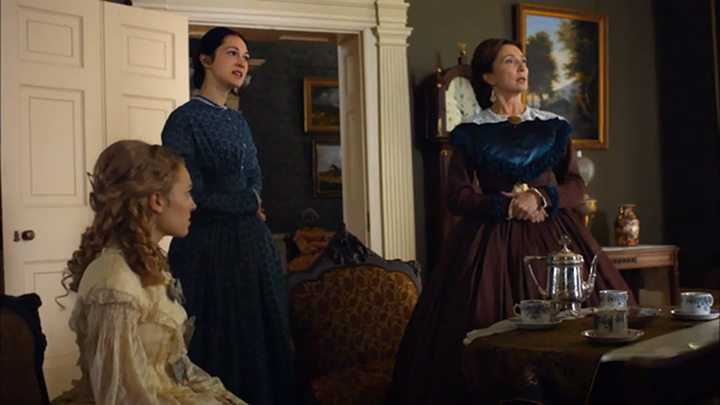
Alice, Emma, and Jane Green react angrily to the news that the occupying Federal officers will be using their home for a fancy ball.
Thoughts on the fourth episode of Mercy Street, which brings us two-thirds of the way through the first season. Spoilers follow.
Dumb as a Box of Rocks

The soldiers in the historic photo — “OUR Black Brethren,” according to the flier — are the men of Company E, Fourth U.S. Colored Troops, photographed at Fort Lincoln, Washington, D.C. in November 1865. They are veterans of hard-fought actions at Petersburg, Chaffin’s Farm/New Market Heights, and Fort Fisher. It’s one of the best-known images of U.S. Colored Troops in the entire war.
They are not Confederates.
So the question becomes:
__________
“Why Texans Fought,” Houston CWRT, February 18
 Charles David Grear, author of Why Texans Fought in the Civil War, will be speaking to the Houston Civil War Round Table on Thursday, February 18, 2016. Non-members are welcome to attend. The cash bar opens at 6 p.m., dinner is at 7, with the Dr. Grear’s presentation to follow. As always, reservations are required. The charge for dinner is $30, with a limited number of lecture-only seats for $10. Call Don Zuckero at (281) 479-1232 or email him at Reservations-at-HoustonCivilWar-dot-com by 6:00 PM the Monday preceding the Thursday meeting. The Hess Club’s address is 5430 Westheimer, a short distance west of the Galleria. The club is situated on the corner of Westheimer Way and Westheimer Court. Free, convenient, and handicap-accessible parking is across the street.
Mercy Street, Episode 3

Alice Green (AnnaSophia Robb) discovers her beau, Tom Fairfax (Cameron Monaghan), at Mansion House. Mercy Street deals not just with the physical trauma of war, but the psychological trauma as well.
A few thoughts on the third episode of Mercy Street, which brings us to the halfway point in the first season. Minor spoilers follow.
Mercy Street, Episode 2
 Now we know why the real-life Anne Reading was re-imagined as a fictional Ann Hastings. Ahem.
I was surprised at Ann Hastings’ reaction to the efforts to open the windows to get fresh air on the wards, because her mentor, Florence Nightingale, was as committed to fresh air and sunlight as anyone possibly could be. Here is what Nightingale had to say about ventilation in her Notes on Hospitals (3rd edition), published during the Civil War:
3. Deficiency of Ventilation. — The want of fresh air may be detected in the appearance of patients sooner than any other want. No care or luxury will compensate indeed for its absence. Unless the air within the ward can be kept as fresh as it is without y the patients had better be away. What must then be said when, as in some town situations, the air without is not fresh air at all ? Except in a few cases well known to physicians, the danger of admitting fresh air directly is very much exaggerated. Patients in bed are not peculiarly inclined to catch cold,* and in England, where fuel is cheap, somebody is indeed to blame, if the ward cannot be kept warm enough, and if the patients cannot have bed-clothing enough, for as much air to be admitted from without as suffices to keep the ward fresh. No artificial ventilation will do this. Although in badly-constructed hospitals, or in countries where fuel is dear, and the winter very cold, artificial ventilation may be necessary, it never can compensate for the want of the open window. The ward is never fresh,and in the best hospitals at Paris, artificially ventilated, it will be found that, till the windows are opened, the air is close. A well-waged controversy has lately been carried on upon this very point, in Paris. Eminent authorities in England had decried the pavilion system, on the ground that the atmosphere of a certain Paris pavilion hospital was ” detestable,” not because of the pavilion architecture, but because of its artificial ventilation defying the best pavilion building to ventilate its patients. What is all that luxury of magnificent windows for but to admit fresh air? To shut up your patients tight in artificially warmed air, is to bake them in a slow oven. Open the Lariboisiere windows, warm it with open fires, drain it properly, and it will be one of the finest hospitals in the world.
Natural ventilation, or that by open windows and open fire-places, is the only efficient means for procuring the life-spring of the sick — fresh air. But to obtain this the ward should be at least fifteen to sixteen feet high, and the distance between the opposite windows not more than thirty feet. The amount of fresh air required for ventilation has been hitherto very much underrated, because it has been assumed that the quantity of carbonic acid produced during respiration was the chief noxious gas to be carried off. . . .
One would think the inference in people’s minds, from these just (and unjust) terrors, would be to remove instantly every hindrance to the foul air being carried off ; but, instead of that, their inference is to shut it up or to run away from the sick.
One would think that the first and last idea in constructing hospitals would be to contrive such means of ventilation as would be perpetually and instantly carrying off these morbid emanations. One would think that it would be the first thing taught to the attendants to manage such means of ventilation. Often, however, it is not even the last thing taught to them.
I’m beginning to think — or at least hope — that Ann Hastings is ultimately going to be revealed in the end as an impostor, who never got closer to the Crimea than reading The Times.
Silas Bullen will probably die violently, mourned by no one, because that’s how these shows work.
__________
Jefferson Davis’s America Conference, Rice University, February 19-20
From the School of Humanities, Rice University in Houston:
Description:
In 1890, W. E. B. Du Bois pointed to Jefferson Davis as “a representative of civilization” as it had developed over the previous century. Scholars have often remembered the 19th century as the Age of Emancipation, as an age of liberal nation-building or even as the Age of Lincoln. But according to the latest scholarship, 19th-century American civilization was dependent on slave-based capitalism, racism and imperial conquest. Seen in that light, Jefferson Davis, as a soldier in the Mexican-American War, a U.S. secretary of war and senator, a Mississippi cotton planter, and leader of a slaveholding breakaway republic with imperial ambitions of its own, was much more than an anomaly.
This conference coincides with the completion of “The Papers of Jefferson Davis” documentary editing project. A group of leading American historians will look unblinkingly on the 19th-century U.S. as a nation in which Jefferson Davis, more than Lincoln, was in many ways the typical figure. Like Du Bois in 1890, we “wish to consider not the man, but the type of civilization which his life represented,” with papers on the forces — territorial expansion, slavery, capitalism, nationalism, Civil War memory and empire — with which Jefferson Davis’s life intersected at crucial moments in U.S. history.
Location:
Herring Hall 100
Schedule:
Friday, Feb. 19
7 p.m. Keynote opening address: Amy S. Greenberg, Penn State University: “From Mexico to Washington: Jefferson Davis’s 1848”
Saturday, Feb. 20
9 a.m. Kimberly Welch, West Virginia University: “Black Litigants: Rethinking Race and Law in the Cotton South, 1800–1860”
10 a.m. Caitlin C. Rosenthal, University of California, Berkeley: “Slavery’s Scientific Management: Plantation Accounting and American Capitalism”
11:30 a.m. Matthew Karp, Princeton University: “Architects of Empire: Jefferson Davis, the Proslavery South, and the U.S.
2 p.m. Robert E. Bonner, Dartmouth College: “Jefferson Davis and the Reactionary Atlantic”
3:30 p.m. K. Stephen Prince, University of South Florida: “Robert Charles in Jefferson Davis’s America: Race and Violence in Jim Crow New Orleans”
5 p.m. Closing keynote address: William J. Cooper, Louisiana State University: “Jefferson Davis and His Country”
______




 Dead Confederates, A Civil War Era Blog


18 comments