Garrison Gives Up on Colonization
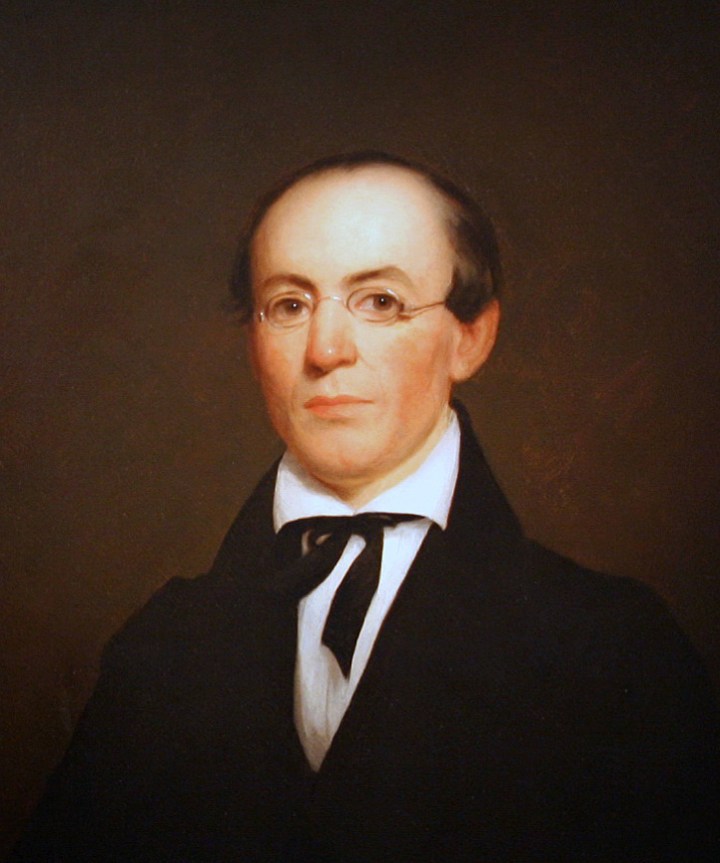

I happened upon this item from just the fourth issue of William Lloyd Garrison’s abolitionist paper, The Liberator, from January 22, 1831:
Garrison is writing here five years before the Alamo and the Texas Revolution, and thirty years before secession and Sumter.
Notice also that for Garrison, using a “compulsory process” of colonization of African Americans, free or (formerly) enslaved, was a deal-breaker. Like Lincoln, whose interest in colonization schemes waffled back and forth over the years, before finally being rejected completely, it was always a matter of voluntary resettlement rather than expulsion.
From the online collection at Fair-Use.org, that includes what looks to be the entire 35-year run of The Liberator. Check it out.
__________
Garrison portrait via National Portrait Gallery.


But Is His Torch Still at Thy Temple Door?

In Maryland, they’re looking to remove the phrase “northern scum” from their official state song. And yes, like the Mississippi state flag, it was a decades-after-the-fact embrace of Confederate symbolism as an official representation of the state:
“Maryland, Oh Maryland,” which is sung to the tune of “O Tannenbaum,” wasn’t adopted as the state song until 1939, although it was penned in 1861. The AP reports it is unclear why the song was adopted at that particular historical moment but notes there had been two recent lynchings in the state and the NAACP was then advocating for equal pay for black teachers.
“By enshrining a Confederate war anthem, the General Assembly may have been seeking symbolically to challenge such efforts,” according to the AP.
Could be.
______
A Quick Note on Robert E. Lee’s Orderly
I bought Al Arnold’s book and have now read it. These comments apply to the Kindle version; if the print version differs, someone speak up.
The book’s subtitle is A Modern Black Man’s Confederate Journey, which seems about right, because it’s largely a stream-of-consciousness narrative of the author’s beliefs and thoughts on history, faith, culture, and his discovery of his Confederate heritage. Detailed discussion of his ancestor, Turner Hall, Jr., occupies only a small section in the center of the book. What Arnold knows or concludes about Hall seems to be entirely based on brief newspaper items from the 1930s and 40s when Hall attended several veterans’ reunions. There are no nineteenth-century documents cited that I see in telling Hall’s story.
The connection to Nathan Bedford Forrest seems to be that Hall, in his final years, possessed a sum of Confederate currency that he said was given him by Forrest. Arnold concludes that Hall must have been owned by Forrest at some point before the war, during the future general’s slave-trading days. Arnold speculates that later, while acting as a body servant to two unnamed Confederate soldiers during the war, he encountered Forrest and the general gave him the money “as part of a dynamic relationship that had been forged between the slave master and the slave.”
Arnold acknowledges that Forrest and Lee did not meet during the war. His source for his ancestor’s service to Lee is a 1940 Hugo, Oklahoma Daily News story that mentions that Hall was an orderly for Lee and was present at Appomattox. Arnold speculates that “Turner would have traveled with his Confederate comrades throughout the theater of the war and at some point been introduced to General Robert E. Lee. . . I gather he was likely introduced to Lee as ‘one of Bedford’s slaves.'”
These issues of substantive content aside, Arnold could have used a proofreader, just for consistency. Frederick Douglass is referred to twice as “Fredrick Douglas.” There is mention of both the “Battle of Brice Crossings” and the “Battle of Brice’s Crossroads.” At least twice he includes a citation to a 1919 manuscript by Charles Wesley, “The Employment of Negroes as Soldiers in the Confederate Army,” and gets both the title of the article and the spelling of the author’s name (“Wesle”) wrong. In one paragraph, Arnold gives the plural of orderly as orderly’s and orderlies.
Some of it is just plain weird, like when Arnold explains that “Nathan Bedford Forrest was like the one white boy back in the neighborhood that could really jump. . . the Larry Bird of basketball.” He lists Robert Smalls, who stole the steamboat Planter and turned it over to the U.S. Navy, and William Tillman, an African American seaman from New York who led the capture of the Confederate privateer Jeff Davis, in a section called, “Black Confederates on Record.” Arnold says that “slavery existed over three hundred and ninety-six years under the American flag” before being ended in 1865. Some materials cited in the book have parenthetical source notations, but there’s no bibliography or index.
It’s a very odd book, and much more about Al Arnold’s thoughts and beliefs than about the life of Turner Hall, Jr. It’s similar in some ways to the late Anthony Hervey’s Why I Wave the Confederate Flag, Written by a Black Man, although more explicitly grounded in Arnold’s faith and optimism. If that’s your thing, fine, but there’s not much there for a researcher to find useful.
Dick Dowling, Kirby Smith, and the Future of Confederate Monuments

Sunday afternoon I attended the annual Dick Dowling Statue Ceremony in Houston. I had the pleasure of speaking at this event two years ago, with an essay called, “Dick Dowling and the Immigrant’s Call to Arms.” The weather was a lot nicer on Sunday than it was in 2014.
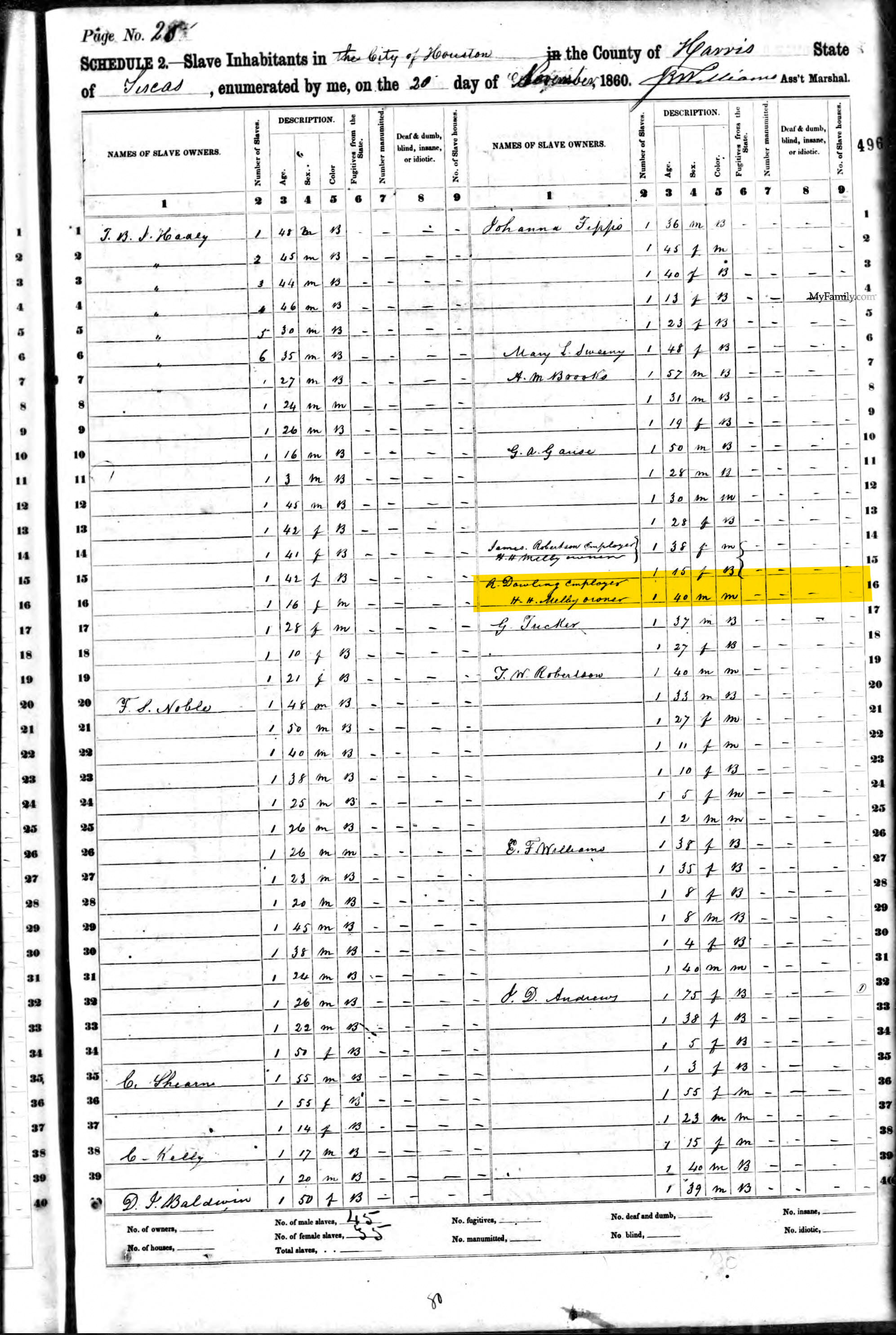
The keynote address this year, “Apologies, Amnesia, and Forgiveness: The Irish, the Brits, and the Confederates,” was written by Judge Mark Davidson, who currently oversees asbestos litigation cases around the state. (Judge Davidson wasn’t able to attend in person, and the address was presented very ably by his wife and son.) As you might surmise from the title, it took on the current pushback against Confederate iconography, and used the 2011 state visit by Queen Elizabeth to the Irish Republic as an example of reconciliation between parties with a fraught and violent history. It was a novel argument, but more disappointing was rest of the address, which jumped from one worn cliché to another — erasing history, most soldiers didn’t own slaves, political correctness run amok, and so on. When it did get into specific historical detail, there were problems; the judge asserted that census records showed that Dowling didn’t own slaves, which is true in only the narrowest sense; the census shows that Dowling actually hired someone else’s slaves to work for him (see here and here).
I really do wish that the judge had made a stronger, affirmative argument for Dowling, specifically. As I said in a post a couple of months back, Dick Dowling was deeply embedded in the civic and cultural life of Houston in the 1860s, entirely apart his wartime service and the Battle of Sabine Pass. The volatile, contentious discussions we’re having now in this country about Confederate monuments are, in my view, a good and healthy thing; it’s worth taking a step back every couple of generations and asking, is this what we really honor?, does this person’s life reflect values we hold dear? There is no single answer, of course; the answer in every case must necessarily be different. One community will reach a different answer than the next one, and that’s fine. But we should never be afraid to ask those questions, or to challenge long-held assumptions.
This is where, I believe, the Confederate Heritage™ community has come unmoored and is completely adrift. They demand that no one ask such questions, or challenge those assumptions. The move to replace the statue of E. Kirby Smith in Statuary Hall in the U.S. Capitol is a good example. Instead of making an affirmative case in support of retaining Smith’s likeness by citing why he is — and should be — relevant to Floridians in 2016, the “defense” of Smith’s statue was reduced to carping about “HEROS and VILLANS,” and screaming about how the removal of the statue “dishonors” American veterans. It’s funny how, when it’s a Confederate monument under consideration, they want Confederates to be thought of as U.S. veterans, but go absolutely out of their ever-lovin’ minds when someone proposes placing a battlefield monument to actual U.S. veterans — at least when those U.S. veterans were mostly African Americans.
So here’s my suggestion — if you want to save Confederate monuments, take them one by one and make an actual case that will convince the general public in that community — people who are skeptical or indifferent to the nonsense that passes for “truth” in heritage circles. Do your research, and get after it.
______
Agnes E. Fry and Virginius: A Tale of Two Runners

Sidescan view of the shipwreck discovered in late February near the mouth of the Cape Fear River. Image via North Carolina Department of Natural and Cultural Resources.
You’ve probably heard by now that nautical archaeologists in North Carolina have discovered the remains of a large, iron-hulled vessel (above) off the mouth of the Cape Fear River, near Fort Caswell. They believe it’s a blockade runner, and know of three that were lost in that general area. One article, passed along by my colleague Ed Cotham, says they’re leaning toward the ship’s identity as being the steamer Agnes E. Fry, a 559-ton sidewheel steamer wrecked on December 27, 1864.
If this is the wreck of Agnes E. Fry, there’s quite a story behind the ship. She was built by Caird & Company at Greenock, and launched in 1864. She was a large vessel, 237 feet long by 25 feet in beam, with a depth of hold of 13 feet. She made two successful runs into Wilmington, the first from Nassau in late September 1864, and the second from Bermuda in November. She was lost on her third attempted voyage into Wilmington, two days after Christmas 1864.
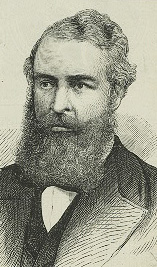 The ship was named for the wife of her commander, Confederate Navy Lieutenant Joseph Fry (right). Fry was appointed Midshipman in the U.S. Navy in 1841, and received his commission as Lieutenant in 1855. He resigned his commission in the U.S. Navy on February 1, 1861. In Confederate service, he commanded C.S.S. Ivy at New Orleans and fought at the Head of the Passes in October 1861. He was captured while commanding Confederate batteries at St. Charles, Arkansas in June 1862. After his exchange, he was appointed to “special service” by the Confederate government, serving as commander of the government-owned runner Eugenie. From a posthumous biography:
In the spring of 1864, [Captain Fry] was stationed for some time at St. Thomas, [sic.] Bermuda, as government agent for the Confederate Navy; after which he was sent to Scotland to bring out a new blockade-runner, building on the Clyde, which, in honor of her future commander’s wife, was named the Agnes E. Fry.
While in Scotland a pleasant little incident occurred to Fry, the recital of which may serve to vary the monotomy of these saddening reminiscences of the days of the Confederacy.
Standing at his window one day, humming a favorite air, Fry unconsciously raised his voice until he finally sang aloud the closing verses of “Partant pour la Syrie.” He hears an echo! The song is repeated in a clear soprano voice, with an unmistakable French accent! Looking in the direction of the voice, he perceives upon an adjacent balcony a group of elegantly dressed ladies and noble-looking gentlemen, evidently foreigners. As he descended the stairway, he met upon the landing a gentleman in magnificent uniform, who saluted him courteously as he passed on. Upon inquiry he ascertained that the gentleman was Plon-Plon, the Prince Napoleon! It will be remembered that Queen Hortense was the reputed author and composer of the charming chansonette which Fry was singing, and his thus singing it while standing in such close proximity to the group of French travelers, was evidently regarded by them’ as a delicate personal compliment, which was as delicately acknowledged.
Returning home in charge of “the finest ship that ever entered Wilmington harbor,” Fry made several successful trips with her. To show the high esteem in which he was held, and the absolute confidence placed in his skill and ability, I venture to make the following extract from a letter addressed to Mrs. Fry by one of the owners of the vessel: —
Richmond, October 8, 1864.
“… A telegram from Wilmington advises me that the fine steamer A. E. Fry had returned safely to Bermuda, after four unsuccessful attempts to run through the blockade into the former port. The ship is owned partly by the firm of Crenshaw Brothers, in connection with the government, and is commanded by your husband, Captain Joseph Fry. I have not been informed of the circumstances, but am satisfied that the skill and good judgment of Captain Fry have saved the ship from capture or destruction. …”
In November he made a successful run into the harbor, and on the 10th wrote from Smithville, near Wilmington, thus:
Many vessels have arrived here since I first left Bermuda, and it is also true that many have been lost trying to get in. God has watched over our safety, and prospered us wonderfully. I have been chased over and over again; . . . have had the yellow fever on board; have headed for the bar about seven times in vain. … I never was so happy in my life as when I at last arrived, and thought I should be with you in three or four days; nor so miserable as when I found they wanted me to try and go out again immediately, by which I lose my chance of coming home. But I am bound to do it. I am complimented on having the finest ship that ever came in, named, too, after her whom I love more than all the world beside. The owners are my personal friends, and are pledged to take care of you in my absence, or in case of my capture. She is a vessel they especially want me to command, and although I would not leave without having seen my family for twice her value, still duty requires that I should do so.
He telegraphed at once for his family, and they remained for some time at Smithville.
On the 5th of December, 1864 [just after his second run out of Wilmington], he wrote from Nassau:
“I am here safe and sound, and the ship, named after the idol of my heart, is paid for; thanks to the dear God whose providence has crowned my efforts with success. … I am afraid will be disappointed at my not getting to Bermuda, but you and I, dearest, will thank le bon Dieu that I am safe here. I am trying to get back soon, doubtful as it looks. Colonel Crenshaw is expected here daily. I hope he will arrive before I leave; I should like to have him see my ship as she looked this morning!”
After three [sic.] successful trips, the Agnes was unfortunately run ashore by her pilot, and sunk in the Cape Fear River, where she now lies.
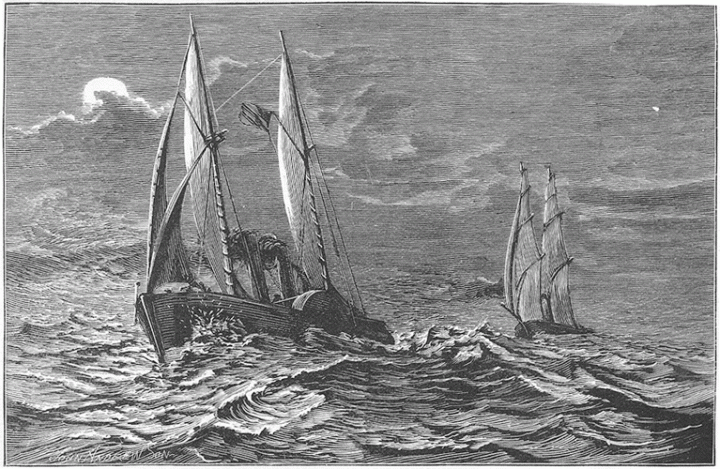
Pursuit of Virginius by the Spanish gunboat Tornado, October 30, 1873.
At the end of the war, Fry was commanding the gunboat C.S.S. Morgan as part of the Mobile Squadron, bottled up at the north end of Mobile Bay. He surrendered on May 4, 1865, and was paroled six days later.
Some years after the war, Captain Fry got involved in decidedly more dangerous for of smuggling, bring men, arms and supplies to insurgents fighting to overthrow the Spanish colonial government in Cuba. In 1873 he took command of the steamer Virginius in Jamaica, with a load of insurgents and munitions bound for the southern coast of Cuba. (Virginus was, herself, the former blockade runner Virgin, trapped at Mobile after August 1864 and subsequently surrendcered there in April 1865.) Almost immediately after sailing, though, Virginius was intercepted by the Spanish gunboat Tornado. Captain Fry surrendered, and with his ship and crew was taken to Santiago. There, within a few days, the local Spanish authorities tried the men for piracy and convicted them. Most of them, including Captain Fry, were were quickly executed before the Spanish Governor General in Havana or other international consuls could interfere. The executed mens’ corpses were beheaded, and the bodies trampled by cavalry horses.
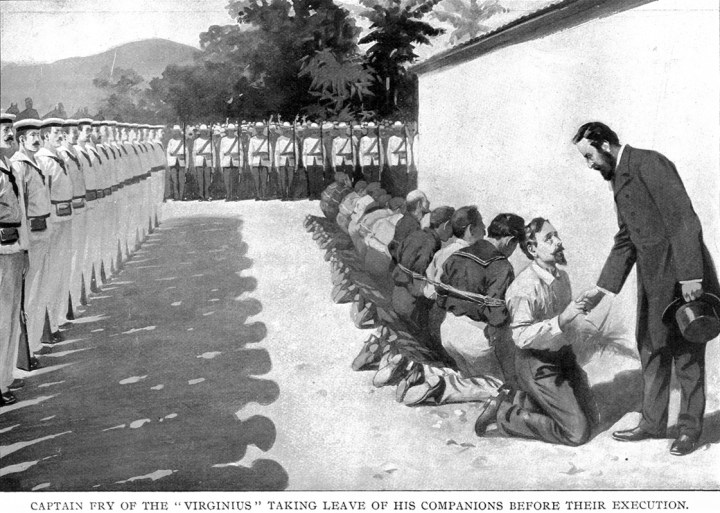
The drumhead trial and execution of Captain Fry and his crew would form part of the foundation of lingering tensions between the United States and Spain over Cuba for the next 25 years, until the Spanish War of 1898. Captain Fry and his crew were seen by many in the United States and Europe as martyrs to the cause of Cuban independence, victims of the brutal and arbitrary Spanish colonial system.
We remember the Maine, but not so often Captain Joseph Fry and his crew.
_____
Taking Blockade Runner on Sea Trials
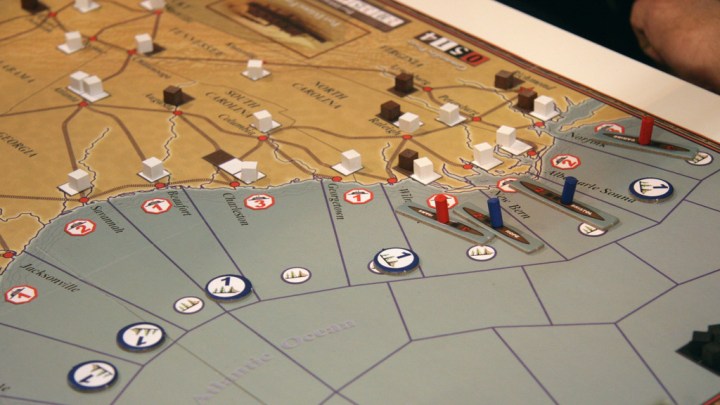
Image by Daniel Danzer, via BoardGameGeek.
Recently I had the opportunity to play a game of Blockade Runner, a board game published by Numbskull Games in 2010. In Blockade Runner, 2-6 players take on the role of blockade-running merchants, building fleets of runners, carrying cargoes between Confederate and neutral ports, evading the Federal blockade, and generally scrambling to make a big profit. The winner at the end of the five year-long turns is the player with the largest combined value of shipping plus his cash-in-hand. Importantly, Blockade Runner shouldn’t really be considered a war game; although it’s set during the conflict of 1861-65, the point of the game as in real-life Civil War blockade-running is to rake in the cash. We had a full complement of six players for our game, only three of whom might be considered CW buffs. Three of us, myself included, had not played the game before. You can read a detailed description of the game here.
Each player starts out with two ships and a small amount of money in 1861. Each turn, a player can perform four (or sometimes five) separate actions, which might consist of buying and loading cargo, moving one’s ships on the board, selling and unloading cargo, or using one of his action cards. Each player gets three cards, that are replaced with new ones as they’re used, that add much of the flavor to the game. There are cards that improve the defenses of a specific Confederate port, provide insurance to cover the loss of a captured runner, or put a pilot on board a runner, that increases that ship’s movement ability.
Each ship can carry one, two or three units of cargo, although the larger vessels can only be obtained during the course of the game when the player accumulates enough cash to purchase one. Each port, Confederate and neutral, begins each turn with a limited amount of cargo available for loading — cotton and tobacco in the Confederacy, and war materiel and “black market goods” in the neutral ports. (This last designation of “black market goods” is of great annoyance; in reality, there was nothing remotely secret or clandestine about the civilian goods brought in through the blockade, right to the end of the war.)
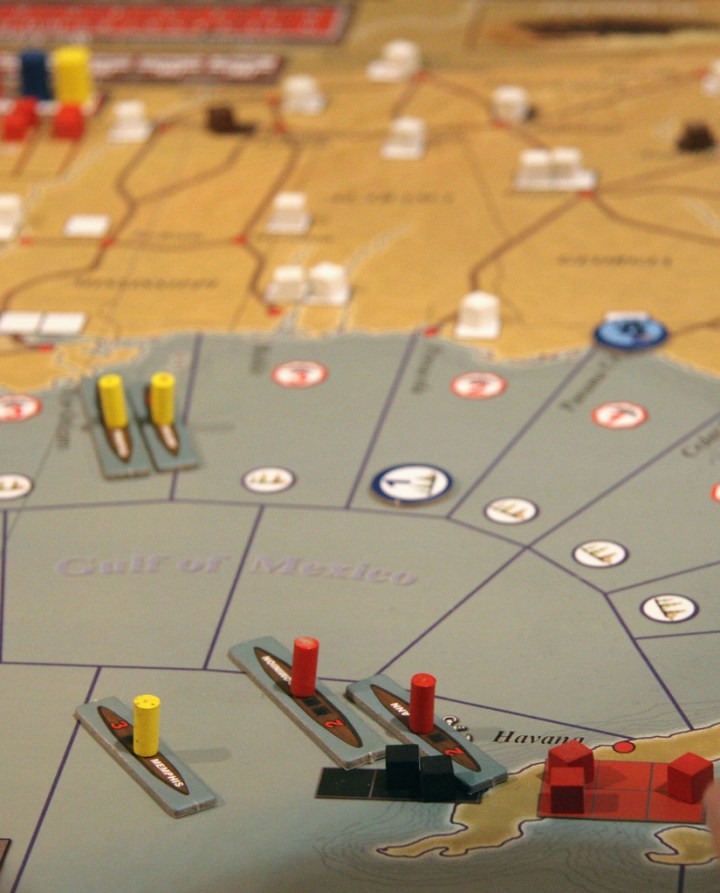
Three runners ready to load in Havana. Image by Daniel Danzer, via BoardGameGeek.
These four commodities are handled rather ingeniously in the game. Although players can purchase and load cargoes at a fixed price throughout the entire game, there is a limit on how much can be had in each port, especially in the Confederacy, where no port contains more than three units — the capacity of a single, large runner. Players finding themselves in a Confederate port with insufficient cotton or tobacco to load can pay extra to have it shipped from inland areas by rail, but that eats into the profits on the other end of the trip. Once arriving at the player’s destination, the cargo can usually be sold at a tidy profit, but the exact price is determined by how many units of that particular cargo have been landed previously in that turn. The price drops steadily as more and more of a given commodity is landed and floods the market. In the game we played, the sale price of cotton and tobacco dropped steadily over the course of the game, leaving black market civilian goods landed in Confederate ports as the only commodity that maintained its price. Rather ingeniously, the designers placed two restrictions on inbound cargoes, that both improve gameplay and the historicity of the game — (1) players carrying cargoes into the Confederacy must bring in as many units or war materiel as civilian goods, or pay a steep fine, and (2) war materiel is free to load in a neutral port, but the player only receives a small fee for transporting it into a Confederate port.
Because the United States’ blockade of the Confederacy is handled automatically, with a strong element of randomness, there can be some distinctly unhistorical events in the game. For example, during the first turn, representing 1861, the Navy put all of its blockading forces in the Gulf of Mexico, leaving the Atlantic seaboard essentially wide open for blockade running. The city of Houston fell to the Yankees in (IIRC) 1862, but Galveston remained open throughout the war. Later in the game, the United States deployed its one roving roving squadron for two turns (years) in a row at Key West. While Key West was an important operational base during the conflict, in game terms it’s useless as a deployment point because the blockade runners generally will either operate in the Gulf to the west, or in the Atlantic to the east, without transiting between those two regions. New Orleans remained open to runners from Cuba through the end of the war in 1865.
But the things that Blockade Runner gets wrong (or just odd) are insignificant compared to what it gets right, which is the big picture. The game is necessarily highly abstracted, but the structure and mechanics of it work very well in recreating the objectives and challenges that faced those who entered this risky venture. One of the marks of a well-designed game is that its structure gently pushes players into making the same sort of analyses that their historical counterparts did. This is exactly what happened when we played Blockade Runner; as the war dragged on the price of both cotton and tobacco dropped as players brought out increasingly large cargoes, while the price of civilian goods brought into the Confederacy remained high. This prompted players to focus solely on bringing in those cargoes, calculating that even with the hefty fine it was the only way to make a significant profit. Players began running bigger risks as the game progressed inexorably to the end of the war, scrambling to squeeze out that last bit of profit before the end of the 1865 turn. The game also captures well the chance or real economic catastrophe that stalked real blockade runners. The player in our game who was the most aggressive, buying a new ship the moment he had sufficient cash in hand in the second turn, led through the whole game until the final turn, when his largest ship was captured. As I recall that single loss, ship and cargo, amounted to around $80,000. He wasn’t entirely wiped out, but he went from a commanding lead at the beginning of the turn to finishing it a distant third in the roll of a single, eight-sided die. C’est la guerre, ya’ll.
Our game took about three hours, not including set-up time; it would have gone a little faster if all of us had been experienced players. There’s also a good bit of what our generous host referred to as AP — “analysis paralysis” — that causes a delay while players try and figure out their best course of action. Still, it’s great fun and gives players a good sense of how real blockade-running during the Civil War was carried out. If you ever get a chance to play, I recommend it.
______

SCV Uses Time Travel to Protect Confederate Monuments
From the usual suspects:

In fact, the second image is a photo by P. Kevin Morley of the Richmond Times-Dispatch, taken at a rally held in July 2012. That rally — need it be said? — was not “the result” of the vandalism to the Jefferson Davis monument that happened in 2015. Either the SCV invented a time machine and traveled three years back into the past to protect Confederate monuments in Richmond, or somebody’s fibbin’.
Of course, if it’s the latter, it wouldn’t be the first time.
_____

Wednesday Night Concert: Warren Zevon, “Mr. Bad Example”

“Of course I went to law school, took a law degree.”
Of course.
______
Taking Stock of Mercy Street
On Sunday evening PBS aired the final episode of the first season of Mercy Street. I haven’t heard whether the series will be picked up for more episodes, but since the first six only carried the viewer through the late spring or early summer of 1862, there’s a lot of the war left to go. Spoilers follow.




 Dead Confederates, A Civil War Era Blog

9 comments