Spam, Spam, Spam, Eggs, Sausage and Spam

The other day Michael Lynch made a note of how much spam he gets through the comments section of his blog. My experience is much the same; most of the spam gets weeded out automatically and I never see it, but a few slip through every day that I delete manually. You can pretty much tell them at a glance, because they (1) never refer specifically to anything in the post, and (2) always include at least one link to whatever product or service they’re advertising. Here’s a representative sampling — sans links — of spam I’ve gotten in the last few days:
Simply wish to say your article is as astounding. The clarity on your post is just excellent and i can suppose you are knowledgeable on this subject. Fine along with your permission allow me to clutch your RSS feed to stay up to date with drawing close post. Thank you 1,000,000 and please carry on the gratifying work. Its like you learn my thoughts! You seem to understand so much approximately this, such as you wrote the ebook in it or something. I think that you just can do with a few % to force the message home a little bit, however other than that, this is wonderful blog. An excellent read. I will definitely be back. I like your fantastic web site, I was searching for this all over. best regards La vita non è tutto birra e birilli Your disadvantage of used bucket trucks mostly is their performance. They could be regarding cheap however, not in good and so the upkeep charges and also reconditioning from it would likely sum it up to a different bucket truck too. Your bucket truck has numerous components that needs to be managed which means you needs to be contemplating these things now. This can be risky too in the event the past proprietor failed to specify how much time and exactly how frequent the18 wheeler was utilized. This blog has inspired me to start working on my own blog Hi {That is a valid point|This is an interesting article|} {Can you post more?|Can you post about private student loans?|} Thanks Keep working, nice post! This was the information I had to know. My wife and i ended up being absolutely thankful Michael could finish up his investigation from your ideas he made out of your site. It is now and again perplexing to just find yourself giving out secrets which other people may have been making money from. And we fully grasp we have got the blog owner to thank for that. The entire explanations you made, the simple website menu, the relationships your site assist to promote – it’s got many overwhelming, and it is helping our son and the family consider that the subject matter is entertaining, and that’s highly vital. Thank you for all the pieces! If a new article is posted or if any changes occur on this site I’m interested.
And my personal favorite:
are you sick of possums?
I honestly cannot say I’m sick of possums, although they’re not a special problem here in town. (I was surprised one evening a couple of months ago to find one poking around on my front porch, though.) Anyone care to guess which of these originally included a link to a catalog for what used to be euphemistically referred to as “marital aid devices”?
No, it’s not the possum one.
_____________________

Do You Know These Men?
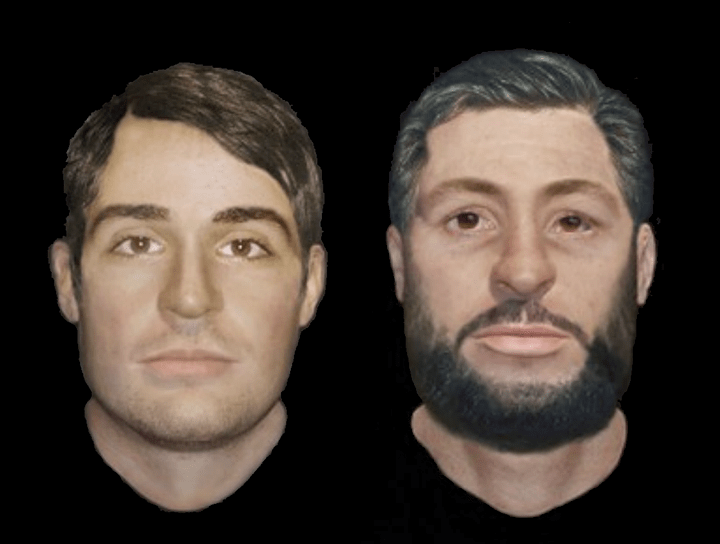
My new post on the Civil War Monitor is up at, um, the Civil War Monitor.
In addition, Brooks Simpson has a new post up at the Library of America site on the first “Clash of Ironclads.” Good stuff.
___________

U.S.S. Monitor Modeling
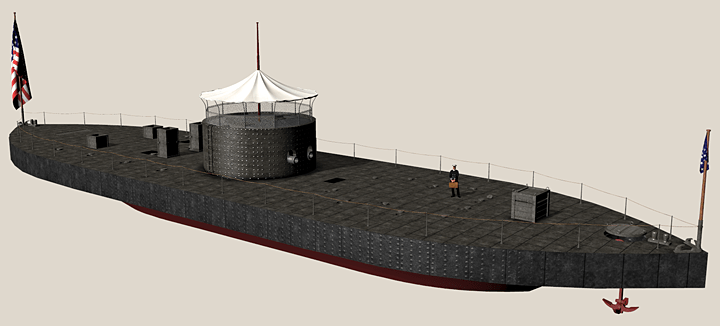
With the sesquicentennial of the Battle of Hampton Roads just a few days away, I’m hoping to get my digital model of U.S.S. Monitor finished soon. (Good thing the U.S. Navy was depending on Ericsson’s Monitor, and not mine.) It still needs a fair amount of work — especially at the stern, where I haven’t even started with the rudder assembly — but she’s starting to look good topside. It’s hard to see in most images, but all the deck porthole covers and coal scuttle covers are removable. The finished model, I hope, will be configurable to the different stages in her very brief naval career. A few more images in higher resolution are available here.
Renders of my earlier Virginia model are here. That one also needs some additional detailing.
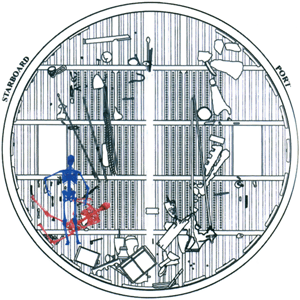 And this, from the new issue of America’s Civil War:
When [Monitor] went to the ocean floor in 1862 it took 16 sailors with it. Two sets of remains were recovered with the turret when it was raised in 2002.
Along with painstakingly identifying and preserving all the mechanical parts of the wreck, members of the Monitor National Marine Sanctuary believe the human remains might be identified, as well. “we’re actively trying to do genealogical work work and forensic archaeology to identify those individuals and identify descendants of those individuals,” archaeologist Joe Hoyt told WDBJ-TV in Roanoke, Va.
That would be cool. As I recall, with her deck awash, the only way out of Monitor was up through the top of the turret (below). Is one of the sets of remains recovered in the turret that of Third Assistant Engineer Robinson Woollen Hands? It’s a possibility.
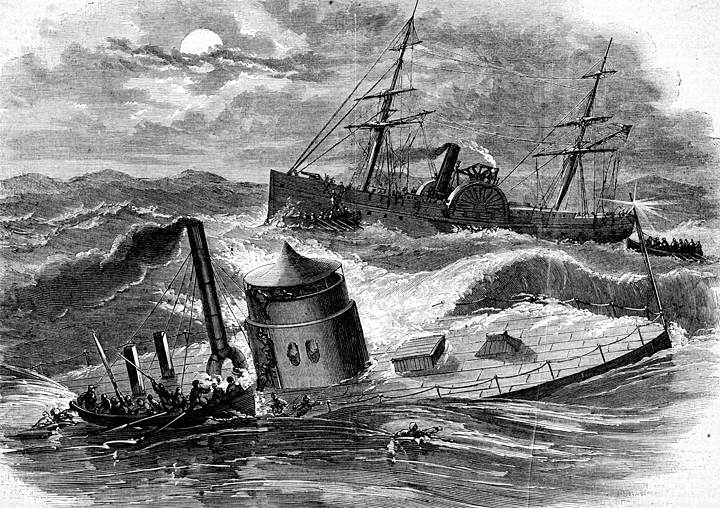
Earlier posts about Monitor:
- The Third Assistant Engineer
- U.S.S. Monitor Turret Revealed
- Monitor’s Screw
- You’re All Invited to the Keel-Laying
________

Talkin’ Blockade Runners. . .

I’ll be speaking at the March 19 meeting of the SCV’s John Bell Hood Camp No. 50, at Shrimp & Stuff Restaurant in Galveston (7 p.m., in the private dining room). My talk will be a preview of my March 27 presentation at the Houston Museum of Natural Science, “For-Profit Patriots: Civil War Blockade Running on the Texas Coast.”
I appreciate the invitation, and am looking forward to it.
_____________
Image: Digital model of the blockade runner Will o’ the Wisp, wrecked at Galveston in February 1865.

Texas Confederate Pension Files on Ancestry


As anticipated, the Texas State Library and Archives Commission’s Confederate pension records are now available online at the subscription genealogy website Ancestry.com. Hard copies will still be available for order as before but, in keeping with a policy change last fall, researchers will be notified of the cost and must send in their payments before the library staff will make the copies. The actual cost is still appallingly, scandalously low.
The correct section at Ancestry is difficult to find, and is not yet indexed in their military pensions catalog. Use this link to go directly to that section, and be sure to select Texas for the state, as below:

The page reproduced above is a more-or-less random example from the files. It’s an affidavit in support of the 1913 application of Mary Ann McKinney of Mesquite, Texas. Her late husband, Eli Harris McKinney, had served in the 17th Alabama Infantry, and to support her application she submitted this affidavit from two men from Alabama who testified that Eli “was a good soldier and served as such untill [sic.] the close of the war.” (Eli’s CSR, available through Fold3, shows him enlisting in September 1862 and being surrendered with Joe Johnston’s army in North Carolina in April 1865.) Eli had died in 1881, ten years after his marriage to Mary; she began receiving a pension in March 1914 and continued to receive it until her own death in Ranger, Texas in August 1922. Mary McKinney’s application also provides an important reminder about Confederate pensions: they were issued by the state in which the applicant lived, not the state he was born in, or of the unit in which he served.
The Texas State Library and Archives Commission had an efficient and inexpensive system for providing these materials before, but efforts to put these materials online (even on a paid subscription site) are really opening doors for both professional and avocational researchers. Records that used to take weeks or months to obtain by postal mail can now be retrieved in minutes. How damn cool is that?
____________

Discovering the Civil War at the Houston Museum of Natural Science
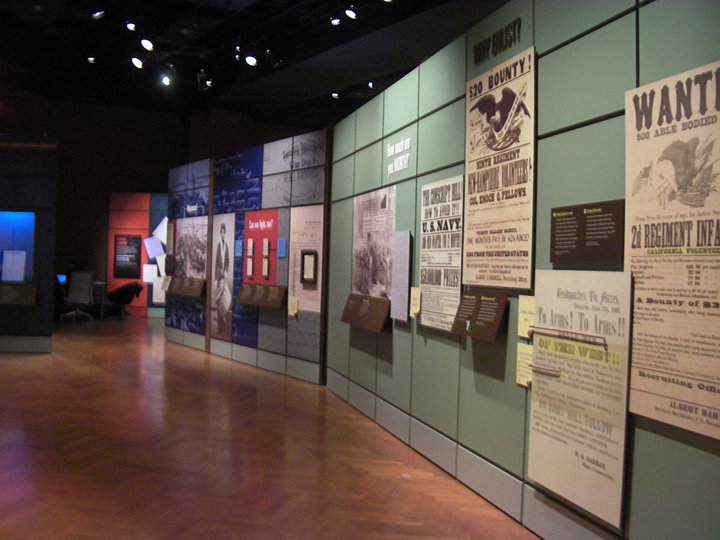
The Discovering the Civil War exhibition at its previous venue, the Henry Ford Museum. Via here.
On Saturday the fam and I took the afternoon to visit the exhibition, Discovering the Civil War, currently at the Houston Museum of Natural Science (HMNS). The exhibit runs through April 29, and is produced by the U.S. National Archives and Records Administration and the Foundation for the National Archives. It’s hard to do a compelling museum exhibition based almost entirely on documents and images; people want to see stuff, and that’s understandable. This particular exhibit succeeds pretty well, I think, in part because the documents they’ve included are genuinely compelling, and do a very good job of telling the story. The exhibition includes, for example, facsimiles of the 1861 Corwin Amendment, the Emancipation Proclamation, and the original text of the 13th Amendment ending slavery in the United States, bearing the signatures of Speaker of the House Schuyler Colfax, Vice President and President of the Senate Hannibal Hamlin, and President Lincoln. (The original holograph copy of the Emancipation Proclamation will be on exhibit on February 16-21.)
One of the common complaints among Southron Heritage™ folks is that the limitations of the Emancipation Proclamation “isn’t taught in school” or “you never hear about that” or some such. So I almost laughed out loud when, not a minute after stepping into the first section of the exhibit, an HMNS guide stepped up to explain to us and others some of the featured documents in the show, and drawing very careful distinctions between the limited, wartime scope of the EP, and the permanent, legislative accomplishment of the 13th Amendment.
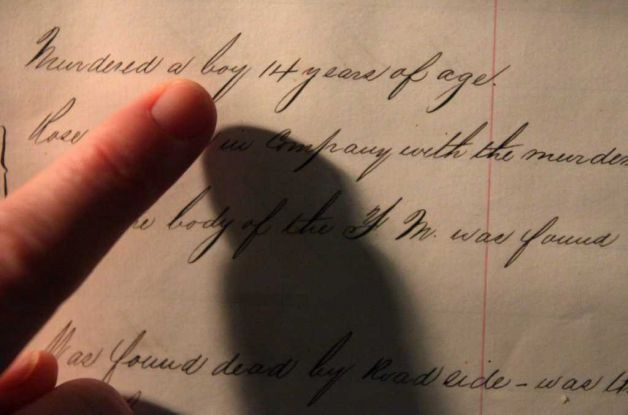
A curator at the Houston Museum of Natural Science points to entries in the Freedmen’s Bureau “Texas Record of Criminal Offences” from 1868. Photo: Mayra Beltran / © 2011 Houston Chronicle
The exhibit doesn’t only cover the war years; it goes back into the decades-long tensions over slavery and other sectional issues that led to the war, and devotes considerable space to the postwar period, including the creation of veterans’ groups like the GAR and UCV, reunions, monuments, and so on. It was in the area on the Reconstruction period that I came across a particularly chilling artifact, a big ledger in which the officers of the Freedmens’ Bureau in East Texas recorded assaults and murders of African Americans, attacks believed to be part of the terror campaign led by the Ku Klux Klan and allied groups to limit the new citizens’ participation in the electoral process and to intimidate anyone who challenged the pre-war power structure. The pages on display opened to 1868, the year such depredation came to a climax, in anticipation of that year’s general election. The the neatly-penned columns of names of the victims, alleged perpetrators, and nature of the crime — almost all listed simply as “homicide” — were deeply unsettling.
There is some hands-on material, including a section where visitors are asked to view an illustration from a wartime patent application, and then guess what the object is. The HMNS has also set up a kids’ discovery room, about halfway through, where young visitors can try on period costumes and work puzzles involved Civil War-era cryptography.
The museum has also appended a display at the end of the NARA exhibit, focusing on Texas during the war, with lots of arms and other artifacts from local units. These are, I believe, materials from the John L. Nau III, Civil War Collection. The recent recovery of artifacts from the wreck of the U.S.S. Westfield is discussed, as well.
Finally, there’s an extensive series of public presentations being given on different aspects of the conflict, including one on the recovery of the U.S.S. Westfield artifacts on March 27, and one by myself on March 27, “Patriots for Profit – The Blockade Runners of the Confederacy.” Hope to see y’all there.
_______________

The 7th Virginia Electric Calvary at Spotsylvania
Something new today. Guest blogger Cole Grinnell is a scientist, writer, and actor who works, when he works, out of Baltimore, Maryland. He should have a blog, but strangely, he doesn’t.

The 7th Virginia Electric Calvary at Spotsylvania: Reflections on a Modern Attempt at Battlefield Traversing
by Cole Grinnell
It is a crisp, windy late spring day in Spotsylvania. A random patchwork of clouds and clear sky drifts over an open plain, casting shadows like roving armies maneuvering below. We stand facing small overgrown V of earthworks, scarcely more than a hundred yards long, and listen to ranger describe the shear brutality of this place. He describes nearly a solid day of constant hand to hand fighting, thousands of men filling in and tamping down the bodies of the dead and dying, soldiers overcome with mad surges of energy abandoning their rifles, and fighting for hours with hatches and knives, people so utterly exhausted from endless combat that their legs had forgotten their function and they had to be pulled from the trenches by their comrades. We stood and listened to the last of this, his final words carried out over the trench line by the wind; a deafening silence was felt in our chests. We look on ahead, over onto the field, where the Union men rushed to open the breach and finally crush the army that had dragged them all over Virginia. We look behind, in to the trees, where Confederate regiments surged forward, one at a time, to try and and buy their compatriots behind them enough time to construct new defenses. We look to our left, up the road from where we had just come, to see a Segway humping a tree.
Everyone Knows the Past was Sepia-Toned

Corey has an interesting post up, tracing the history of efforts to locate the exact location of the famous “Harvest of Death” photos, taken shortly after the Battle of Gettysburg. Corey highlights John Cummings’ recent findings (here and a follow-up here), and asks what his readers think. I don’t know, myself — I’ll have to give it more study — but it did get me thinking about colorizing historic, black-and-white photos.
It’s a practice that’s ubiquitous now; there are entire cable teevee series based largely on retroactively colorizing historic footage, presumably to lend some brilliant new insight into the past. Mostly this technique results in a very poor-quality product, and sometimes it’s not even necessary. Here are two images of the destruction of U.S.S. Arizona, on the left a still frame from actual color footage of the blast, and on the right, a still frame from the video linked above, a colorized version of a black-and-white print of the same footage. (I’ve “flopped” the right frame left-to-right; the footage is also usually shown reversed.) In neither case is the footage very clear, but the original color frame is far more natural than the artificial one on the right:

The practice is even more prevalent in print media; historical magazines do it all the time, presumably because they feel it makes the publication more visually appealing.
I was also reminded of the pitfalls of colorizing images by this article about Swedish artist Sanna Dullaway, who’s taken some of the best-known portraits and news images, shot originally in black and white, and colorized them. Her colorized image of Lincoln appears at the top of this post; other subjects include Winston Churchill, Albert Einstein, the summary execution of a Viet Cong prisoner during the Tet Offensive, and the famous V-J Day kiss in Times Square.
 But her own rendering of the famous “Harvest of Death” image points out one of the obvious limitations of the practice; she gets the uniform colors really, badly wrong. Such errors can be obvious, in cases like this, but in most cases the viewer could have no idea what’s correct. The blue coat, brown vest and scarlet necktie of Lincoln (right), don’t strike me as very plausible — though perhaps they’re more believable than the Great Emancipator’s self-evident spray tan. (Knocking down the color saturation of the image would take care of that distinctly Boehner-like orange glow.)
I’m ambivalent about the practice, myself; I don’t really object to it on grounds of authenticity, if it’s make clear that such an alteration has been made, but it’s rarely done very well. (Sanna Dullaway is much better at it than most Photoshop hacks like me, but even hers are of mixed effectiveness.)
So what do you think? Do colorized images — still or moving — have a place in historical interpretation? What cautions or disclaimers should accompany them? What are the pitfalls, and the benefits? And most important, are there any really good colorizing tutorials out there? 😉
______________
Images: Colorized Lincoln image by Sanna Dullaway. U.S.S. Arizona images by (left) U.S. Naval Historical Center and (right) The Military Channel.

Hearing the Rebel Yell

One of my readers points to this Smithsonian article on motion picture and audio recordings of old Civil War soldiers, shot in the early 20th century. In particular, this is a great video showing a group of old Confederate veterans recreating the famous “rebel yell.” Waite Rawls and the folks at the Museum of the Confederacy made their own effort at recreating the rebel yell, using a couple of recordings like the one above, remastered and remixed into a multitude of voices.

_______________

Looking In From the Outside, Black Confederates Edition
 Leslie Madsen-Brooks, an assistant professor of history at Boise State University, has put up an essay on the online discussion over BCS. It’s interesting to see an outsider’s view of this business. For those who’ve followed the discussion for a while, it covers a lot of familiar territory, and a lot of familiar names. For folks who are new to the subject, it gives a pretty good lay of the land, and a useful introduction to the characters involved.
And boy howdy, are there some characters. 😉
h/t Kevin Levin and Brooks “Perfesser” Simpson
_______________
Image: Unidentified young soldier in Confederate uniform and Hardee hat with holstered revolver and artillery saber, Library of Congress.





 Dead Confederates, A Civil War Era Blog


8 comments