McDonnell’s Office Silent on Civil War Month Proclamation

Readers will recall that, last September 24, Virginia Governor Bob McDonnell announced that beginning in April 2011, that state’s Confederate History Month will be replaced by Civil War in Virginia Month. Needless to say, he caught hell for it at the time, and months later there was still grumbling from the usual suspects. Here is what McDonnell said in September:
I was far less successful in capturing the full meaning of our history when, four months later, I issued a proclamation concerning Confederate History Month. My major and unacceptable omission of slavery disappointed and hurt a lot of people, myself included. Young people make mistakes, and I suppose sometimes young administrations do as well. Ours was an error of haste and not of heart. And it is an error that will be fixed.
Next April our office will issue a “Civil War in Virginia” proclamation commemorating the beginning of the Civil War in our state.
This proclamation will encapsulate all of our history. It will remember all Virginians—free and enslaved; Union and Confederate. It will be written for all Virginians.
Well, it’s April 1, 2011. I called the Governor McDonnell’s office late Friday afternoon and the gentleman who answered the phone professed no knowledge one way or another whether such a proclamation would be forthcoming. He suggested I keep checking the website or sign up for e-mail notices to see when — and if — such a proclamation is made.

Update, April 6: The governor’s proclamation is out, and at first read, it hits just the right note:
Civil War History in Virginia Month
WHEREAS, the month of April is most closely associated with Virginia’s pivotal role in the American Civil War; it was in April 1861 that Virginia seceded from the Union following a lengthy, contentious and protracted debate within the Commonwealth, and it was in April 1865 that the War was essentially concluded with the South’s surrender at Appomattox. In the four years that fell between those momentous months, Richmond served as the capital of the Confederacy, and it was on Virginia soil that the vast majority of the Civil War’s battles were fought, in places like Manassas, Malvern Hill, Fredericksburg, Chancellorsville, the Wilderness, New Market, Cold Harbor, and Petersburg, locations now forever linked with the indelible history of this perilous period; and
WHEREAS, the largest wartime population of African-American slaves was in Virginia, yet through their own acts of courage and resilience, as well as the actions of the United States army and federal government, they bequeathed to themselves and posterity a legacy of freedom; and
WHEREAS, slavery was an inhumane practice that deprived people of their God-given inalienable rights, and the Emancipation Proclamation and the Civil War ended its evil stain on American democracy and set Virginia and America on a still-traveled road to bring to fruition the great promises of the Declaration of Independence, the Constitution, and the Bill of Rights, and ensure that all Americans have the opportunity to enjoy equally the blessings of liberty and prosperity; and
WHEREAS, the military leadership and tactics of Virginians like Confederate Generals Robert E. Lee and Thomas J. “Stonewall” Jackson and Union General George Henry Thomas are still studied, analyzed and discussed today; the heroism of brave individuals like William Harvey Carney, who was born a slave in Norfolk, gained his freedom through the Underground Railroad, and received the Medal of Honor for his valor as a Union soldier at the battle of Fort Wagner, inspires us through the ages; and the Commonwealth is the final resting place of thousands of Union and Confederate soldiers; the many cemeteries in which they lie reminding us of the cost and pain of the War and telling the stories of those who fought; and
WHEREAS, following the War, Virginia began the difficult process of returning to a nation that was, in many ways, born within her borders; that transition was aided by the actions of leaders like General Robert E. Lee who set the strong personal example of reconciliation and grace crucial in helping the people of Virginia return peacefully to the Union, instructing Virginians to “….abandon all these local animosities and make your sons Americans.”; and former Dinwiddie County slave Elizabeth Keckley who returned to Virginia as a guest of President Lincoln and expressed forgiveness and conciliation stating: “Dear old Virginia! A birthplace is always dear, no matter under what circumstances you were born”; and
WHEREAS, the General Assembly of Virginia created the Virginia Sesquicentennial of the American Civil War Commission in 2006 “to prepare for and commemorate” the Commonwealth’s participation in the war; and
WHEREAS, from 2011-2015 a diverse and growing Commonwealth will host innumerable public events, lectures, re-enactments, seminars, and remembrances covering every aspect of the war, and no state is more closely connected to this pivotal period of American history, and therefore no state is better suited to host visitors seeking to learn about the Civil War, the Confederacy, slavery, emancipation and the full history of our United States, and for that reason Virginia encourages visitors from across the country and the world to visit the Commonwealth during this period,
NOW, THEREFORE, I, Robert F. McDonnell, Governor of Virginia, do hereby recognize April 2011 as CIVIL WAR HISTORY IN VIRGINIA MONTH, and urge all Virginians to participate in commemorations of the war’s 150th anniversary and reflect upon the lives of the courageous men and women of those difficult times by attending seminars and conferences, and by visiting battlefields, cemeteries, exhibitions, historical markers, libraries, museums and historical sites throughout the Commonwealth, and by taking part in a diversity of events and activities that highlight our shared history and heritage, as we strive to enact the vision laid out in the preamble to the United States Constitution of “a more perfect union.”
Good on Governor McDonnell. Let the fireworks begin — in every sense of the word.
_______________
Image: Virginia Gov. Bob McDonnell addressing an audience at Norfolk State University on September 24, 2010, during which he announced that the state’s former observance of Confederate History Month would be replaced by Civil War in Virginia Month. Photo by Adrin Snider, Daily Press.

He’s Just Sayin’ What We’re All Thinkin’
 History professor, Civil War blogger, marathon runner, restaurant critic and all-around smart-ass Keith Harris goes there: WTF is up with Tom Berringer’s beard in Gettysburg?
Also, recent additions to the read pile:
- Wild Rose: Rose O’Neale Greenhow, Civil War Spy by Ann Blackman
- The Civil War: The First Year Told by Those Who Lived It, by Brooks D. Simpson, Stephen W. Sears, and Aaron Sheehan-Dean (Eds.)
- The Bloody Shirt: Terror After the Civil War by Stephen Budiansky
- The Lost Cause: The Confederate Exodus to Mexico by Andrew F. Rolle
_______________

End of the Southern Strategy?
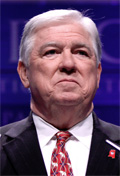 Politico has the story:
Haley Barbour, the Mississippi governor and likely 2012 Republican presidential aspirant, has recently made a series of missteps involving race and the Civil Rights Movement. He seemed unclear about basic historical points.
But he has now made a forthright declaration about the events swirling around what some Southerners still call the War of Northern Aggression. “Slavery was the primary, central, cause of secession,” Barbour told me Friday. “The Civil War was necessary to bring about the abolition of slavery,” he continued. “Abolishing slavery was morally imperative and necessary, and it’s regrettable that it took the Civil War to do it. But it did.”
Now, saying slavery was the cause of the South’s Lost Cause hardly qualifies as breaking news — it sounds more like “olds.” But for a Republican governor of Mississippi to say what most Americans consider obvious truth is news. Big news.
Given that Barbour has managed over the last few months to step directly from cow pie to cow pie on the issue of the South and race, it’s interesting to see him make a statement that is both explicit and succinct, and seemingly not open to nuance or backpedaling. I don’t think this statement will help him much on the national scene, but we’ll see. He’s already catching hell from in some quarters over his statement that he’d veto a license plate honoring Nathan Bedford Forrest; this won’t help.
Update: That didn’t take long. The League of the South has branded Barbour a “quisling” for this statement, which it further described as “despicable.”
____________________

North Carolina SCV Has Its Story; Is Sticking to It
 A couple of folks have pointed me toward a recent article in the Wall Street Journal, about efforts in Virginia and North Carolina, tied to the Civil War Sesquicentennial, to compile a more accurate count of each of those states’ war-related deaths. So far, researchers in North Carolina are estimating that state’s count as being roughly 20% less than the usually-accepted estimate of 40,000, while the total number of deaths now documented for Virginia troops is more than double an early count of around 15,000. (Be sure also to check out the additional features.)
It’s not surprising at all to me that modern researchers are coming up with different numbers than various compilers did 100+ years ago. What does surprise me is the disinterest in, or outright hostility to, the idea of doing such work in the first place:
With the 150th anniversary of the Civil War beginning in mid-April, that small number could spark a big controversy between two states with rivalries that date back to the great conflict. Some Civil War buffs in North Carolina have already accused Mr. Howard of attempting to diminish the state’s heroism and the hardship it suffered. “Records were a whole lot fresher 150 years ago,” says Thomas Smith Jr., commander of the North Carolina Sons of Confederate Veterans, who is suspicious of Mr. Howard’s new count.
“I don’t care if Virginia has two people more who died, or a hundred more,” says Michael Chapman, a 55-year-old videographer from Polkton, N.C., who used to head up the local Sons of Confederate Veterans camp. He calls the recounts “irrelevant.”
I don’t buy the “fresher” argument at all. A written record is a written record, and remains as accurate or reliable (or not) over the passage of time. They don’t go stale; that’s why we archive them.
Certainly it’s possible that some records available a century and more ago have since been lost or destroyed, but against that we now have easy access to electronic records, digital copies, online newspapers, easy cross-referencing, and indexed census rolls, which earlier generations never had access to. In my view, the benefits of the latter far outweigh the limitations of the former. No count will be absolutely accurate, of course, but there’s no question that researchers now have far better capability to do the work than did their predecessors in the 1860s. Unless there’s something very fundamentally flawed with the modern researchers’ methodology — which is not alleged — their work should be able to get us closer to the real answer, to the extent that it’s knowable at all.
Michael Chapman has weighed in on his state’s sesquicentennial program before, and shown himself to be somewhat less than even-tempered on the subject. (You really have to read through the whole comments thread to get the full effect.) But still, progress is progress, and this time he didn’t refer to those who have differing views as Nazis, or compare North Carolina Unionists to al Qaeda sleeper cells. Baby steps, Michael, baby steps.
What I don’t quite get is that these two men, one a current state commander in the SCV, and the other former local camp commander, are both dismissive (if not openly hostile) to this effort to get a more accurate count of their state’s war dead. To me, that’s a no-brainer. And while they may or may not be speaking officially for the North Carolina SCV, they do seem to offer their roles in that group as their authority on the subject. Their objections seem not to be methodological, but to the idea of doing the work at all.
Why would that be, exactly? And would they be opposed to this work if it were showing more North Carolina casualties, rather than fewer?
Update: The lead researcher on the North Carolina project, Josh Howard, notes in the comments below that the Leonidas L. Polk SCV Camp of Garner, North Carolina, and one of its members, Charles Purser, have actually provided substantial assistance in the effort to obtain an accurate count of North Carolina’s war dead. Credit where it’s due.
_________________
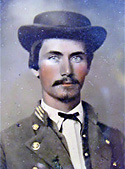
Image: Captain Jesse Sharpe Barnes, Co. F, 4th North Carolina Infantry, killed on May 31, 1862, at Seven Pines, Virginia. Library of Congress.

Brief Updates

Things have been busy of late here, and postings limited. So here are a few quick updates.
If you haven’t heard, Kevin’s blog, Civil War Memory, was selected for digital archiving by the Library of Congress as part of their efforts to document the Civil War Sesquicentennial. How cool is that?
A week ago Friday, long after normal business hours, I e-mailed the Texas State Library in Austin to request a Confederate pension file. The official turnaround time is 4-6 weeks, but this Friday (five business days) I got an e-mail that the copies were already in the mail. Props to the library staff in Austin.
I’ve added two new blogs to the roll at right, Civil War Medicine (and Writing) and Notre Dame and the Civil War. Both are written by Jim Schmidt, a Civil War historian who’s published several very well-received works, including Notre Dame and the Civil War: Marching Onward to Victory, Lincoln’s Labels: America’s Best Known Brands and the Civil War, and the edited volume, Years of Change and Suffering: Modern Perspectives on Civil War Medicine. Welcome to the blogroll, Jim. It’s because of people like Jim that my Amazon purchases ran to thirteen damn pages last year.
Finally, just up the road a ways, a Reconstruction-era Freedman’s settlement has been formally added to the National Register of Historic Places.
______________
Image: Sketch of a “double-ender” Union gunboat by A. R. Waud. Library of Congress.

120 Years of Black Confederates
 The existence of black Confederate soldiers has been asserted — and flatly refuted — longer than I’d imagined. From the St. Louis Republic, August 16, 1891:
On the much disputed question as to whether the South ever enlisted negro [sic.] soldiers, General Shelby writes to a friend denying that it was ever done. He himself, he says, solicited General Kirby Smith to allow him to enlist 10,000 negroes and move into Kansas, but General Smith’s reply was, “No; we will win or go to the grave before we enlist the negro.” “I thought it was a mistake,” says General Shelby, “in our leaders not placing blacks in the field, nor have I changed my opinion.”
I’ve said it before: real Confederates didn’t know about black Confederates.
____________________
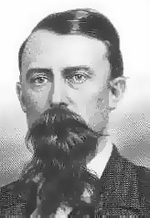
Image: Joseph O. Shelby, via the Mid-Missouri Civil War Roundtable.

“Those who voted against secession. . . thought they were doing right”
 In February 1861, Texas voters went to the polls to vote on secession from the Union. The measure passed overwhelmingly, with 46,153 votes in favor, and 14,747 votes against.
One hundred fifty years ago today, on March 19, 1861, this item appeared in the Galveston Civilian and Gazette Weekly:
New converts are proverbially overzealous and intolerant. A majority of the secessionists in Texas have become such within the past few months. While many of them are puzzling their wits for test oaths and means of punishing the non-conformists and luke-warm, and freely apply the epithet of traitor, and would gladly apply the punishment due to treason, to persons who voted as they themselves would have done a few months since, the Marshall Republican, which was a secession paper in 1859 and has continued so ever since, says:
Now that the election is over, we hope the friends of secession will exercise moderation and good feeling towards those who voted against the Ordinance. It is not only their duty to do so, but the highest considerations of patriotism enjoin it. We want union among ourselves, and we can achieve that desirable end in no other way than by conciliation, and the examples of these fraternal feelings, which one Southern man ought to express for another. It should be borne in mind, that all men cannot think alike. Those who voted against secession, no doubt thought they were doing right; and now that this act has been consummated, will give their [steadfast?] efforts to sustain the rights, honor and interests of the State. To all such as these we tender the right hand of fellowship. Let us bury all past dissensions, forget everything leading to alienation, and stand together as a band of brothers.
Beneath the flowery language of patriotism and allusions to Shakespeare, there’s no tolerance for dissent or remaining loyalty to the Union in this passage. None. Past mistakes can be forgiven — “those who voted against secession, no doubt thought they were doing right” — but there is no room going forward for any such lingering sentiment. The tone of this communication may be loftier than those of the Committees of Safety, but the message is the same: dissent will not be tolerated.
________________
Image: Unidentified member of the Knights of the Golden Circle, Marshall, Texas, c. 1861, Lawrence T. Jones III Texas photography collection at Southern Methodist University. The Knights were a secretive organization created in 1854, proposed to establish a slaveholding empire encompassing the southern United States, the West Indies, Mexico, and parts of Central America.

Looking Closely at Old Photos
 One of the (many) things to love about the online collections at the Library of Congress is that many of the images there are made available in high- or very-high resolution, in TIFF format. The glass plate negatives used at the time often captured far more detail that is apparent when the image is reproduced in a book, or at a size that fits conveniently on a computer monitor.
Not long ago I used a Library of Congress image of the ferry connecting Mason’s Island (now Theodore Roosevelt Island) to Georgetown. But looking more closely at that image, I keep coming back to one of the privates at the landing, standing guard while his colleagues check the passes of people coming off the ferry. There’s nothing particular about his pose; he’s standing in profile, facing to the left, seemingly oblivious to the photographer capturing his likeness. But even though I know next to nothing about period firearms, his weapon strikes me as unusual. Is that a patch box on the stock? What sort of bayonet is that? Do these details provide clues as to his unit?
And what’s up with the cut of those trousers?
_______________

Grant’s Poisoned Chalice

Bloggers really are a shameless bunch, snatching an idea from one of their colleagues, and running off on a new tangent with it.
Keith Harris, who blogs at Cosmic America, got the ball rolling this time by posting a video clip of Grant author Joan Waugh, discussing the persistent rumors of drunkenness that swirled around Grant throughout the war and after. Waugh’s own position on the subject is not entirely clear, but she describes the sort of “default” position taken by many historians — that his drinking didn’t interfere with his abilities “when it counted,” — and follows up by explaining that she admonishes her students to be “mature about judging our presidents and other leaders,” recognizing their human foibles, and asking rhetorically whether Lincoln, after suffering through a series of failed Union generals, would “appoint a raging drunk to lead the Union army?”
Professor Brooks D. Simpson, himself a Grant biographer, takes strong exception to the notion that Grant only drank when nothing much was going on. He outlines three specific occasions when Grant had what appears to have had serious alcohol-related incidents when engaged in active military operations, one of which — a fall from his horse at New Orleans in October 1863 — put him effectively out of action for weeks. “When you are a general in command of an army,” Simpson writes, “something important is always going on, and it would be bad business for a general to assume a lull in the fighting to relax before being surprised. Think Shiloh.”
Simpson doesn’t discuss Grant’s drinking at Chattanooga, but it was attested by Ambrose Bierce, at the time a staff officer under General William Babcock Hazen. Bierce thought well of Grant, but as Simpson himself noted in a 2007 piece for the Ambrose Bierce Project, the writer chafed mightily at the fatuous accolades and near-deification of the man that followed Grant’s death in July 1885. Among the things that stirred Bierce’s ire — and it didn’t take much, truly — were the general’s eulogists who built complex rationalizations around his imbibing or, worse, averred he never touched the bottle. A few months after Grant’s passing, Bierce set out his own, utterly unapologetic perspective on the subject:
For my part, I know of nothing in great military or civic abilities incompatible with a love of strong drink, nor any reason to suppose that a true patriot may not have the misfortune to be dissipated. Alexander the Great was a drunkard, and died of it. Webster was as often drunk as sober. The instances are numberless. When the nation’s admiration of Grant, who was really an admirable soldier, shall have accomplished its fermentation and purged itself of toadyism, men of taste will not be ashamed to set it before their guests at a feast of reason. . . .
My own observation – take it for what it is worth – is that it was some time afterward. As late as the battle of Mission[ary] Ridge (November 25,1863) it was my privilege to be close to him for six or seven hours, on Orchard Knob – him and his staff and a variable group of other general and staff officers, including Thomas, Granger, Sheridan, Wood and Hazen. They looked upon the wine when it was red, these tall fellows – they bit glass. The poisoned chalice went about and about. Some of them did not kiss the dragon; my recollection is that Grant commonly did. I don’t think he took enough to comfort the enemy- not more than I did myself from another bottle but I was all the time afraid he would, which was ungenerous, for he did not appear at all afraid I would. This confidence touched me deeply.
Many times since then I have read with pleasure and approval the warmest praises of Grant’s total abstinence from some of the gentlemen then and there present.
Such virtues as we have
Our piety doth grace the gods withal.These gentlemen were themselves total abstainers from the truth.
One wonders whether, 125 years after his death, the fermentation of Grant’s legacy in this regard is even yet accomplished. Not quite yet, for some.
_________________
Bierce excerpt from David J. Klooster and Russell Duncan, eds., Phantoms of a Blood-Stained Period: The Complete Civil War Writings of Ambrose Bierce (University of Massachusetts, 2002). Image: Chromolithograph of a painting by Thure de Thulstrup, “Battle of Chattanooga” (depicting the Battle of Missionary Ridge) of the Chattanooga Campaign. Library of Congress.

That’s Old School
A while back, Levin mentioned the new Civil War Sesquicentennial website sponsored by the state of North Carolina. It got some great initial reviews, there and elsewhere, particularly for its efforts at telling a more comprehensive story of the war, and in its inclusion of other voices not often included, and left completely out of the Civil War Centennial in 1961-65: those of women, Unionists, African Americans, and so on.
The post wasn’t especially notable, but the exchange of comments that followed was spectacular, largely due to one particular person identifying himself as Michael, who flew off into a rage of indignation at what he perceived as the lack of representation on the commission’s committee by the SCV (this was disputed by other commenters), and the inclusion of what he termed “traitors” (e.g., Union sympathizers, freed slaves enlisted in the USCT) in the story of North Carolina during the war. He analogized North Carolina’s Unionists to both Nazis and hidden al Qaeda terror cells. Michael’s overall point seemed be that, because North Carolina cast its lot with the Confederacy, that state’s sesquicentennial commemoration should reflect a pro-Confederate view, to the exclusion of all others. Michael even took the opportunity to chide Levin, “if you are so interested in the truth, then why would you not see what the Abbeville Institute is teaching.”
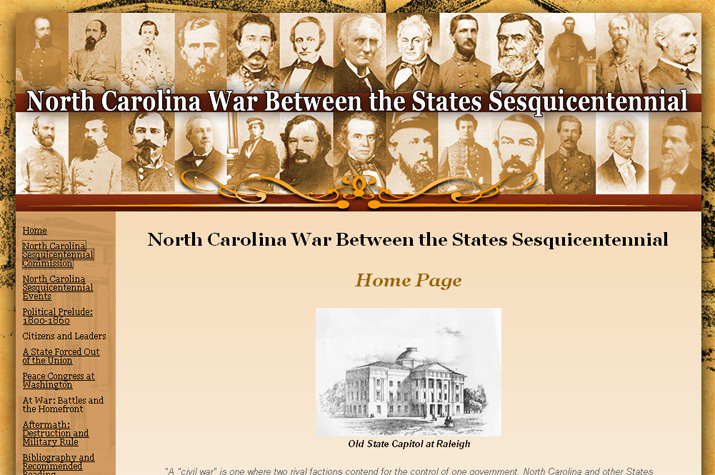
Fortunately for Levin and the rest of us, some of the folks associated with the Abbeville Institute have stepped bravely into the breach, and established an alternative website for the “North Carolina War Between the States Sesquicentennial.” (The website is managed by the Cape Fear Historical Institute, whose Board of Directors provides three of the four members of the Academic Board, and whose executive director, Bernhard Thuersam, serves as Commission Chariman.) They’re not looking forward; they’re explicitly looking backward, to the way the centennial was celebrated fifty years ago. The face of the project, featured on the introduction page, is Clyde N. Wilson, one of the prime movers at Abbeville. From Professor Wilson’s introduction (spelling and grammar as in the original):
America in 2011 is a very different country than America in 1961. The long march of cultural Marxism (political correctness) through American institutions, which began in the 1930’s, has achieved most of its objectives. Schools at every level, media, clergy, government agencies, and politicians are now captive to a false dogma of history as conflict between an evil past and the forces of revolution struggling toward a glorious future (This is exactly the way that Karl Marx, who knew nothing about America, described The War).
In regard to the War Between the States, the PC regime means that the demonisation of the South, chronic throughout American history, has re-emerged with a vengeance. The War is a morality play of good versus evil. Sspecifically of the freedom-loving forces of the North heroically and nobly vanquishing Southern traitors fighting with no other motive than to preserve the evil institution of slavery. . . .
It is now established with Soviet party-line rigour that The War was “caused by” and “about” slavery and nothing but slavery. This is not because the interpreters of history in 2011 are more knowledgable than those of 1961. Quite the reverse is true. The new orthodoxy does not result from new knowledge. It is a consequnece of a change in the national discourse because of the rise of PC and because of the obsession of many Americans with race and victimology as the centerpiece of American history. Being on the self-righteous side is also, of course, a disguise for hatred and a desire to dominate others.
It is near certain that the PC version of The War will dominate the public space in the observance to come. It is our opinion that history is far too important to be left to official “experts.” It is OUR history. History is about who we are. . . .
Our Confederate forefathers were not monsters, they were largely brave, honourable, and admirable people who endured greater suffering and sacrifice than any other large group of Americans ever have, and in pursuit of the American principle of self-government. To share their experience with the people of today, all that is needed is to present them in their own words, or in the words of scholars before the age of PC. The purpose of this Sesquicentennial Website is simply to present them as they were. That is all that is needed to destroy the PC version of history for any honest student.
I love it when a screed goes on, paragraph after paragraph, about their opponents’ political correctness (Wilson mentions it six times in 752 words), “cultural Marxism,” “Soviet party-line rigour [sic.],” and “hatred and a desire to dominate others,” and in the same breath argue that it’s those same opponents who are the ones feeding off a sense of victimhood.
On the other hand, Michael must be thrilled.
Snark aside, I don’t doubt that lots of folks who buy into this narrative are e-mailing links to this page to their kids’ teachers right now, encouraging them to look to it for the “truth” about the war. But I also doubt many of them will be fooled.
Update: Third paragraph updated March 17 to acknowledge the Cape Fear Historical Institute as sponsors of the website.
____________
Image: Screen capture of the new “North Carolina War Between the States Sesquicentennial website, showing the diversity of voices represented.





13 comments