Lincoln Documents Returned to National Archives

Here’s a rather notable video segment about a dealer in historical documents who, upon being notified that a document he’d sold had been missing from a file held by the National Archives, took active steps to see that it was returned.
I’ve been to too many collections, and asked to see too many documents listed in the catalog, only to find a note in the folder that reads, “Missing since [date].” The theft of materials from archives — with shrinking staff and often poor security — is a terrible problem. I’ve long believed that a not-insignificant proportion of the documents market is made up from material gone missing from archives, and especially so with autographs — whole letters can often be traced back to their source, but a signature excised from a larger document cannot.
As retired National Archives Civil War Subject Specialist Mike Musick notes in the video, there’s no way to know when the original theft in this case occurred; it may have happened while the documents were still under the stewardship of the War Department, decades ago. No matter; what’s important is that the material is back where it belongs.
_______________

Texas Drought Exposes African American Burial Site

Over at Interpreting Slave Life, Nicole Moore highlights a recent news item from north Texas, where a previously-unknown African American burial ground has been exposed by the drought in Navarro County, near Corsicana:
Forensics experts told Bailey the remains appear to belong to an African-American man, about 40 years old, who was likely a freed slave.
“We believe it was a person who worked on a plantation in that river bottom [sic.],” [Navarro County Sheriff’s Deputy Frank] Bailey said.
The reservoir is one of Tarrant County’s [i.e., Fort Worth’s] water sources.
Cemeteries were noted and moved before it was filled in the 1980s, but this small cemetery was not marked, and the graves did not have tombstones.
Boaters first found the remains in 2009 along the shoreline. But lake levels rose again within days, quickly reclaiming the site.
So, for three years, archaeologists and historians have waited for the reservoir to reveal them again.
The site was uncovered by the receding waters of the Richland Chambers Reservoir. It’s not actually a river bottom, but formed by the flow of Richland and Chambers Creeks. The Navarro County Times is also covering the story, as is the Corsicana Daily Sun.
There weren’t a lot of what what’s commonly thought of as plantations in that area in the mid-19th century. Navarro County had a total of 251 slaveholders in 1860, owning in aggregate 1,890 slaves. Seventeen slaveholders owned twenty or more slaves — one of the common standards for what designated a planter as opposed to a mere farmer — and only one of who owned more than a hundred.[1]
The largest slaveholder in Navarro County was Anderson Ingram (c. 1799 – c. 1875), who with three brothers purchased thousands of acres of land along the Trinity River, which forms the county’s eastern boundary.[2] In 1859, Ingram was actively farming 900 acres, on which his slaves cultivated 6,500 bushels of corn and 382 bales of cotton.[3]
Far more common were relatively small farming operations like that of Aaron Perry in neighboring Limestone County, who raised hogs and corn, much of the latter likely used for fattening the former before killing time in the fall.
I haven’t been able to locate Anderson Ingram’s property on plot maps from the General Land Office dated to 1858 and 1872, but if it was in the eastern part of the county, it was in the same general part of the county as the reservoir. In any event, the exact location of the site is held in confidence by local authorities to prevent its disturbance by both looters and the curious. There are likely more burials nearby, which may help present a more complete picture of north central Texas on the eve of secession.
[1] University of Virginia, Geospatial and Statistical Data Center. “Historical Census Browser.” Retrieved September 06, 2011, from the: http://fisher.lib.virginia.edu/collections/stats/histcensus/index.html.
[2] Christopher Long, “Ingram, Anderson,” Handbook of Texas Online (http://www.tshaonline.org/handbook/online/articles/fin07), accessed September 06, 2011. Published by the Texas State Historical Association.
[3] Ralph A. Wooster, “Notes on Texas’ Largest Slaveholders, 1860,” Southwestern Historical Quarterly 65 (July 1961).
Image: The Richland Chambers Reservoir, Navarro County, as imaged in ArcGIS Explorer. In this view, which incorporates bathymetry data, the original courses of Richland and Chambers Creeks can be seen faintly. The city of Corsicana appears at upper left. Full-size image here.

The Third Assistant Engineer

In response to my recent post on Monitor‘s turret, one of my readers writes:
One photo of all but one officers in chairs, shows at viewer’s left, seated before the turret, my Woollen kinsman, USS Monitor 3rd Asst. Engr. Robinson Woollen Hands, sitting atop a jury-rigged stool of two Monitor armored deck-light covers. He perished at his engine-room duty station when the Monitor foundered. His memorial stone is at Baltimore. The enlisted of the Monitor survivors group, the Starboard Watch Society, voted Robinson the most beloved of all the officers by the enlisted.. The first item recovered from the deep that identified the wreck as thee USS Monitor, and not just a monitor class vessel, was not the earlier lantern, but the armored deck-light cover. Possibly Robinson is sitting on the one first one recovered from the deep?

My correspondent goes on to say that Hands’ brother, George Washington Hands, Jr., was a captain in the Virginia infantry and “considered Robinson a traitor and never bespoke Robinson’s name again.” Their father, George Sr., was the civilian master of the steamer River Queen that was the scene of the famous meeting between Lincoln, Sherman, Grant and Porter in the closing days of the war.
It’s quite amazing how many stories there are like this; there’s the story of Edward Lea and his father Albert, the former a U.S. naval officer on the Harriet Lane and the latter an engineer officer on Confederate General Magruder’s staff at the Battle of Galveston. And of course Farragut’s Flag Captain, Percival Drayton, son of a prominent South Carolinian family who, early in the war, participated in a naval bombardment of forts commanded by his brother Thomas.
“Brother against brother” was too often literally true.


Robinson W. Hands’ memorial stone in Baltimore, via Find-a-Grave; a deck porthole cover like one of those Hands is sitting on, recovered from the wreck site, via National Geographic.
______________
Image: Officers of U.S.S. Monitor, July 9, 1862. Front, l. to r.: Robinson W. Hands, Edwin V. Gager. Seated, l. to r.: Louis N. Stodder, George Frederickson, William Flye and Daniel C. Logue and Samuel Dana Greene. Standing, l. to r.: Albert B. Campbell, Mark T. Sunstrom, William F. Keeler, and L. Howard Newman of U.S.S. Galena. Library of Congress photo; identifications from The Monitor Chronicles.

The Uneasy Remembrance of Private Albert Cashier

Many of you will have heard the story of Pvt. Albert D. J. Cashier, Co. G, 95th Illinois Infantry. Private Cashier was born a woman, Jennie Hodgers (1843-1915). My colleague Damian Shiels, who blogs at Irish in the American Civil War, recently told Cashier’s story here.
Apart from the wartime masquerade, there are a couple of other remarkable things about Cashier’s life. (I use that name and the masculine pronoun, because that’s how Cashier chose to present himself for more than 50 years.) The first is that, whatever his reasons for adopting a male identity and entering the Union army, Cashier continued to present and live as a man, settling in the village of Saunemin, Illinois, about 90 miles southwest of Chicago. Cashier lived in Saunemin for more than 40 years, supporting himself with small jobs and living alone. As independent radio producer Linda Paul discovered two years ago, Albert Cashier was a strange, eccentric person:
For me though, probably the most fascinating part of this project was trying to unpeel the onion to find a more nuanced portrait of Jennie Hodgers. I found a person who could be kind to children, offering them a treat whenever they came to her home. But there was also a hot-headed, disingenuous, petty and unquestionably eccentric Jennie Hodgers. She had her foibles, just like the rest of us. . . .
A few years before the rest of the world found out about Cashier’s true gender, Cathy Lannon’s great grandmother made the discovery. She had heard that Albert was sick one day and so she asked a nurse to go over to help him out. In short order the nurse came running back and spluttered,“ Mrs. Lannon, he’s a full fledged woman!“ The nurse was so upset that she packed up and left town and Lannon’s great-grandmother in a great act of empathy, didn’t tell anyone about it, including her husband.
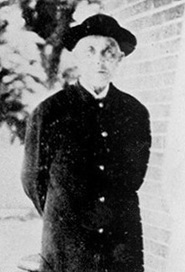 In Cashier’s final years (right, c. 1913), it seems, a series of injuries resulted in a handful of people discovering his secret, but they kept quiet, and it was not until a year or so before Cashier’s death that the story became public and Cashier was revealed publicly as being female. Cashier was eventually confined to a state asylum where he was forced to wear a dress, very much against his will. By that time, Cashier was somewhat famous, and in August 1915 the Rockford, Illinois Republic noted that he was “failing rapidly. . . mental state is rapidly deteriorating.” When Cashier died in October, he was buried with full military honors, in the uniform of the Grand Army of the Republic, with a standard veteran’s headstone. (Six decades later, in the 1970s, a larger stone was dedicated, with both Cashier’s names on it.)
Now one of my readers has passed along a news story from public radio WBEZ 91.5 in Chicago, telling the story of the restoration of the old soldier’s tiny house — and the unease that some locals still feel about discussing Cashier’s legacy. Returning in 2011 to Saunemin, Linda Paul resumes the story:
I’ve only just met the very affable Mayor Bob Bradford, but in no time flat, I’ve managed to get on his nerves.
See, the last time I was in town, a few years back, a couple of folks – a small number, really – weren’t so sure they wanted their town to celebrate the life of someone they considered a “cross-dresser.” So I may have gotten off on the wrong foot by asking Mayor Bradford if that’s still the case today.
“Well, I get a little perturbed when you use the word cross-dresser,” said Bradford.
Bradford said that anyone who uses that term just really doesn’t understand the story.
“And the story was, is, that Jennie Hodgers – Albert Cashier – was trying to make a living,” he notes. “And back in those days, a woman could not make a good dollar by being a housekeeper or doing laundry and so forth. But a woman could get three squares a day, and could make a good salary by serving in the army. So I think that was the reason. I don’t think it had to do with cross-dressers.”
I suppose if Mayor Bradford gets all squirmy at the mention of cross-dressing, maybe we shouldn’t even bring up the notion of transgender. 😉
In any event, it’s great that Saunemin’s residents have finally gone to the trouble and expense of restoring this small reminder of a very unusual Civil War story. I suspect that, in the coming years, they will wonder why they didn’t do it sooner, and why they were so uncomfortable with Albert Cashier’s legacy for so long.
___________
Image: Albert D. J. Cashier’s tiny house in Saunemin , Illinois, under restoration in 2010, via Pantagraph.com. Cashier photo via Abraham Lincoln Presidential Library and Museum.

“Prepared for It this Time”
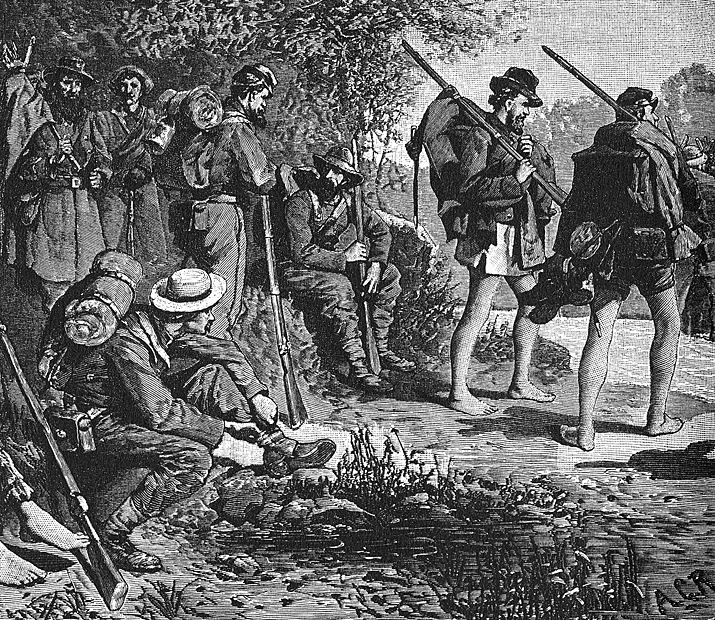
While posted near Suffolk, a six-foot Georgian from the up country of his State, and a member of the Fourth Georgia, attempted one morning to cross a little stream when the tide was in. Encumbered with his clothes, the poor fellow had to swim for his life, and narrowly escaped being drowned.
The regiment in the afternoon saw him sit down on the opposite bank of the creek, deliberately take off his shoes and socks, next his clothes, and tie them up carefully in a bundle for his back. All these preparations being made, he hesitated before proceeding any further; but at length having made up his mind like a gallant soldier, as he was, he plunged boldly into the water, which was nowhere more than two feet deep, the tide having gone out. The cheers with which he was received by his regiment, when his perilous feat was safely accomplished, were prolonged, enthusiastic, and somewhat vociferous.
________
From “A Confederate,” The Grayjackets: How They Lived, Fought and Died, with Incidents & Sketches of Life in the the Confederacy (Richmond: Jones Brothers & Co., 1867). Image: “Confederates at a Ford” by Alan C. Redwood (1844-1922).

Be Safe

For all of you in the path of Hurricane Irene, or dealing with its aftermath, those of us on the Gulf Coast are keeping you in our thoughts and prayers. Hang in there.
___________
Image: “A lone Tomb Sentinel, 3d U.S. Infantry Regiment (The Old Guard), walks his tour in humble reverence during Hurricane Irene in Arlington National Cemetery, Va., Aug 27. Members of The Old Guard have guarded the Tomb every second, of every day regardless of weather or holidays since April 6, 1948.” From here.

“I made some wicked and foolish remarks”
Charles C. Cone was the son of a wealthy attorney in Wellsboro, Pennsylvania. He was sixteen years old when the war began in 1861, reading law with another attorney in town. He enlisted in the 5th Pennsylvania Reserves, eventually rising to the rank of sergeant. In late 1863, he was appointed first lieutenant, Company I, in the 8th U.S. Colored Troops. He was wounded in action with the 8th USCT at the Battle of Olustee in Florida, in February 1864. After a long convalescence, he rejoined his regiment, now with Ben Butler’s Army of the James, advancing on Richmond.
In the Field, September 20, 1864
I am happy to know that the wicked prosper not, and that the traitorous schemes of our political antagonists, the enemies of our country and our cause, are in a fair way to come to naught.
How sublimely ridiculous has been the performance of the whole farce — the terrific splutter and fizzle at Chicago — the high horse which they rode after “little Mac” was announced as the nominee of the party, and their subsequent great trepidation and disgust upon the receipt of the letter of acceptance of the little saint! I have always thought that the true and loyal men of the North would prove sufficient in the contests between parties, where the questions at issue are of so great and vital importance, involving, as they do, the principles upon which our government is based, and we exist as a free people, independent and united; besides the consideration of the great problem of humanity and morality which is now being solved, and which is to affect the whole human race, and influence the destiny of coming generations.
When I read the proceedings of the Chicago Convention, during its organization and continuance, crouching as I was behind a friendly heap of dirt, which only protected me from the balls of the sharp-shooters — amid the roar of cannon, the bursting of bombs, the screeching of shell, and hurtling balls and hissing of bullets — tons of iron and lead being pitched about in a most promiscuous and careless manner — my heart almost failed me. I was fain to give up in despair and disgust. Then, in a day or two we got more particular accounts — the speeches, platform, and nominations — and my blood boiled in my fierce wrath and impotent rage!
I have no doubt but I made some wicked and foolish remarks and resolves, but I finally cooled off a little, and took a more extensive and reasonable view of the matter. I thought of the character of the men engaged, compared them with many others enlisted in the good cause and true party; compared platforms & c., and came to the conclusion that the thing wouldn’t work. The people wouldn’t swallow it, and although the party might cause us much trouble and sorrow, yet the mass of the people would, all in good time, show the true mettle and come to time.
“Eternal vigilance is the price of liberty.” We must use every means of an honorable character to controvert and overthrow the designs of our enemies. Grant and Sherman are great generals; Farragut is king of his craft or art — yet, would they make good presidents? It demands different qualities to constitute a soldier and a statesman and ruler of a nation; much besides scientific knowledge, or the great qualities even of patriotism, determination, and strong will.
Please excuse this hastily written letter; it is after tattoo, and I am sleepy.
I remain your affectionate cousin,
C. C. Cone
Lieutenant Cone would not live to see the election in November. Nine days after writing this letter, he was hit and severely wounded at the Battle of Chaffin’s Farm, where his regiment, along with other USCT units, successfully stormed and held Confederate lines on the approach to Richmond. Evacuated to the military hospital at Fortress Monroe, Lieutenant Cone died on October 23, 1864 of “exhaustion from Amputation of left Thigh.” Among Cone’s personal effects inventoried after his death were one box of buttons, two novels, two tooth brushes, three New Testaments, five photographs, twenty-two 3-cent stamps, a broken watch and $20.90 in cash.
___________
Letter from Soldier’s Letters from Camp, Battlefield and Prison, ed. by Lydia Minturn Post (New York: Bunce & Huntington, 1865). This post originally appeared at The Atlantic on August 11, 2010.

Is That An 11-inch Dahlgren in Your Pocket. . ?
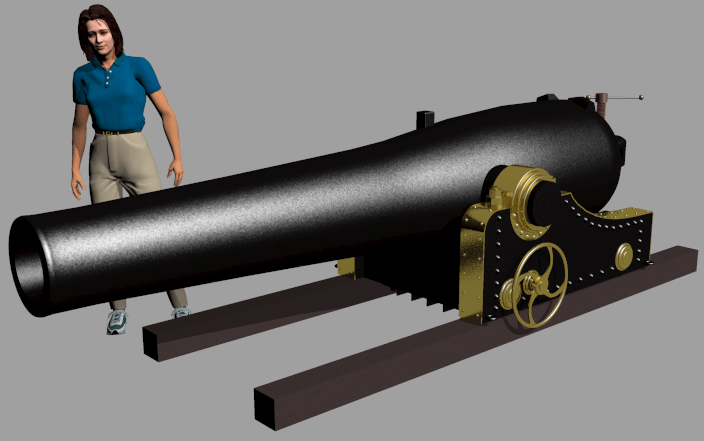
I’ll write up more about these later, but my recent post on Monitor‘s turret sent me off on an effort to sort out more of the structural detail of that unique feature. That, in turn, got me interested in the 11-inch (or XI-inch, as they were designated at the time) Dahlgren guns that served as Monitor‘s main armament. (Craig Swain has a great article on Dahlgrens here.) For now, eye aye candy:
Who Remembers Private Barron?
Not all war casualties are the result of enemy action. From the New York Times, March 20, 1864:
GALVESTON, Wednesday, Feb. 17.
A terrible accident occurred yesterday morning, near Fort Point. A torpedo, about to be deposited in the bay, exploded in the hands of JOHN T. BARRON, from Falls County, belonging to Co. A., COOK’s regiment. Mr. BARRON’s left leg was shot off below the knee; his right hand shattered, requiring amputation; his clothes took fire and severely burnt his face and legs. The unfortunate man was sent to the hospital. He was still alive when last heard from.
Private J. W. Barron of Company I, of the 1st Texas Heavy Artillery (Cook’s Regiment), was a 42-year-old conscript from Falls County in central Texas, near present-day Waco. His brief compiled service record suggests he was enlisted on January 28, 1864, less than three weeks before the accident; perhaps his inexperience in handling mines contributed to the incident. We’ll never know.
Barron died in the General Hospital at Galveston on either February 23, as noted in his CSR, or February 25, according to the city’s interment record. He was buried on that latter date in potter’s field, which was standard practice for soldiers who died here during the war. Although the interment record lists Barron’s cause of death as “leg blown off,” the week or more between the date of the incident and his death suggests that he died not from circulatory shock, but from the complications of infection that typically accompanied traumatic amputation and burns in the 19th century.

Oleander Cemetery, Galveston, 2011. This cemetery, located on Broadway between 41st and 42nd Streets, was established in the early 1900s, and all the markers here date from that time to the present. In the 1860s, however, this was the site of Galveston’s potters field, where transients and the poor were buried. During the Civil War, it was also the burial place of Confederate garrison troops who died in service here, including Private Barron.
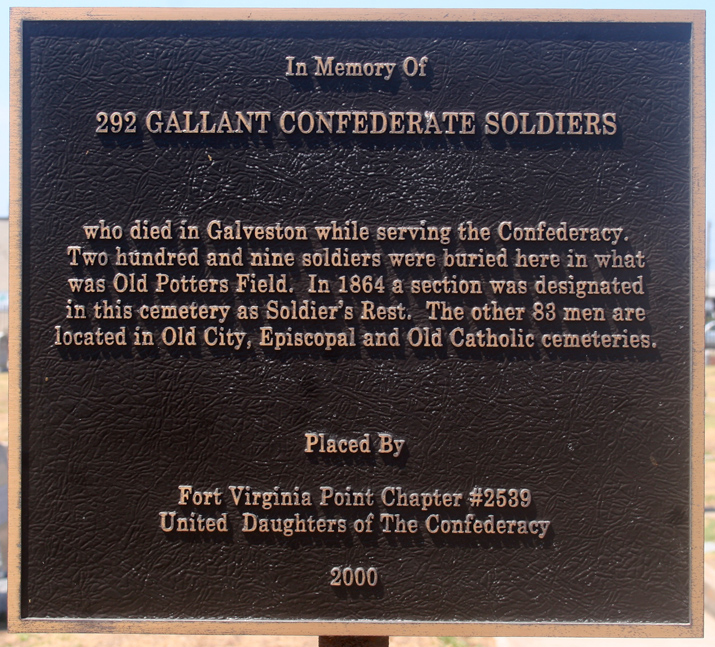
Marker placed by the local UDC chapter at Oleander Cemetery, noting the unmarked graves of soldiers buried at what was then a potters field.
I haven’t found a record of this event in the local newspapers, although the New York Times story was picked up by several other Northern papers. I also haven’t found out much definitive about him outside of his military service, alth0ugh at the time of the 1860 U.S. Census there was a John Barron in Falls County, whose listed age of 60 would make him significantly older than Private Barron. Perhaps he was a relative, or the census rolls gave his age incorrectly. In that census there was also a younger man, one J. W. Barron living near Tyler in east Texas, a 28-year-old farmer with a wife, Elizabeth (32), and three young daughters — Mary (8), Ann (6) and Theodosia (2). (See Vicki Betts’ update in the comments.)
Private Barron came to the ranks as a conscript, late in the war; it seems safe to say that one reason or another kept him from volunteering up to that date. In his early 40s, it seems likely that he had — or had had — a family, and perhaps those commitments kept him home. It’s entirely possible he has living descendants today; I wonder if they remember.
______________
Thanks to the staff at the Galveston and Texas History Center, Rosenberg Library, for assisting with this research.

U.S.S. Monitor Turret Revealed

Via Michael Lynch at Past in the Present, there are about three weeks left to see the 120-ton turret of the Union ironclad Monitor, currently undergoing restoration at the Mariner’s Museum in Newport News.The turret, recovered from the sea floor off Cape Hatteras in 2002, has been kept in a flooded tank of fresh water almost the entire time since then, allowing the salts that have penetrated the iron to gradually leach out. After a thorough cleaning, the turret will be flooded again, to to continue desalinization, a lengthy process that may take up to 15 more years. Even with the tank drained, it’s slow, painstaking work:
[Gary] Paden is an objects handler working in the USS Monitor Center at The Mariners’ Museum. He was gently nudging, hour after painstaking hour, a wrought-iron stanchion from the 9-foot-tall revolving gun turret that once sat atop the Civil War ironclad.
The stanchions rimmed the roof of the Monitor and held up a canvas awning to shelter the crew from the broiling sun. The stanchions needed to be removed so they could be separately treated for conservation.
Last week Paden strived to remove one of those stanchions from its bracket using a hydraulic jack. “I spent seven hours on it yesterday,” Paden said. “So far it’s been the most difficult one.”
Several other workers came in closer to watch, including Dave Krop, manager of the Monitor conservation project.
Paden said most of the tools used in restoring the various components of the Monitor brought up from the ocean’s floor were improvised. The hydraulic jack is an auto body tool used to fix dents.
He pressed the jack into the point where the stanchion met the bracket. A moment later, the stanchion fell from its 149-year-old position.
“Wow,” Krop said. “You got it off. Pretty awesome! That’s pretty awesome!”
Several handlers nearby paused from their snail’s-pace labors to savor the moment, beaming in Paden’s direction.
A few years ago I visited Mariners while doing research on another vessel and, after talking to one of the conservators there about my own project, was offered the chance to take a brief tour of the lab where they were working on Monitor artifacts. (That says less about me than it does about how much they wanted to show off the work they were doing there, and rightly so.) I wasn’t allowed to take pictures, but they showed me a first a life-sized color photograph of an encrusted dial from the engine room — a steam gauge, I think — and then, with a well-practiced flourish, pulled back a cloth covering the same artifact, now almost pristine, looking as new as the day the ship sailed over 140 years before. Folks like Gary Paden and Dave Krop don’t get a lot of attention, because their work is all behind-the-scenes, but it’s important to recognize what they do, that benefits every history buff and museum-goer.
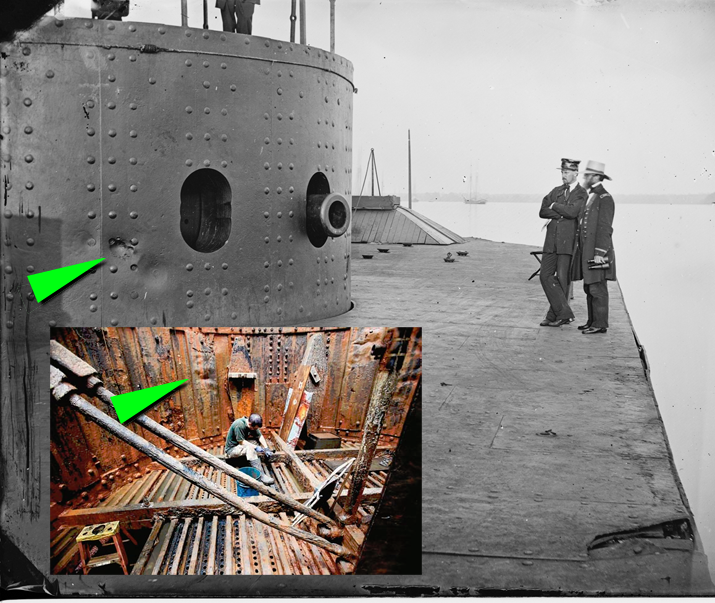
Moment of nerd: the dents made to the exterior of Monitor‘s turret by the guns of C.S.S. Virginia are still visible, 149 years later, on the interior of the upside-down turret. Additional damage to the deck edge is visible at lower right.
More video via the New York Times here. The tank containing Monitor‘s turret will be drained during the week during the rest of August. I hope some of y’all can make the trip. I’m certain you won’t be disappointed. For the rest of us, there’s always the webcam.


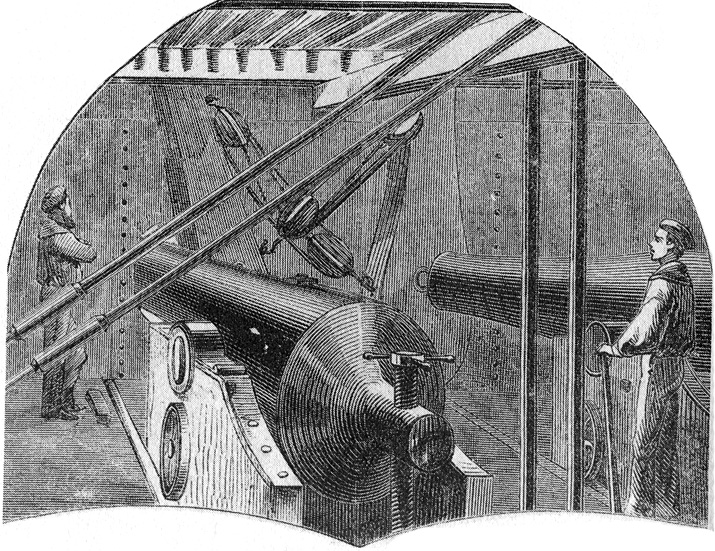
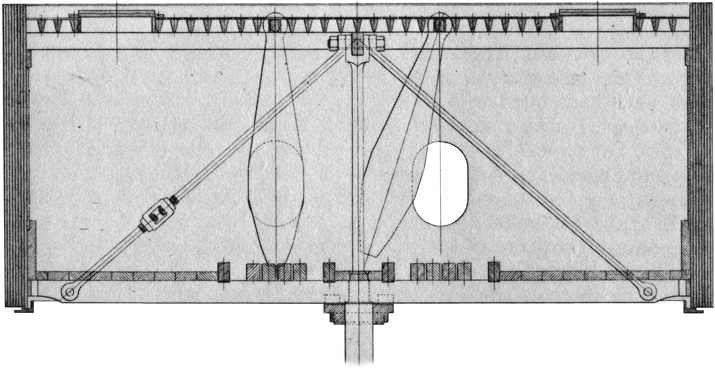
Added: Three additional images showing the interior of the turret, all from Miller’s book (top to bottom): Contemporary illustration from Harper’s Weekly; original drawing from Ericsson’s plan; and a modern cutaway illustration by the great Alan B. Chesley.

_________
Top color photo: “Dave Krop, who manages the Monitor conservation project, works inside the inverted turret at the Mariner’s Museum. Visitors can watch the work from viewing platforms or online.” Credit: Steve Earley, the Virginian-Pilot. Archival photo: Library of Congress. Bottom photo: Diorama of interior of Monitor‘s turret in action by Sheperd Paine, from U.S.S. Monitor: The Ship that Launched a Modern Navy by Lt. Edward M. Miller, USN.





1 comment