Maybe I Am Enabling Some Odious Folks, After All. . . .
Simpson unloads on the self-appointed defenders of Southern heritage — and the bloggers like me who’ve inadvertently given them more credibility than they warrant:
Those findings [that expose shoddy research on black Confederates] displease a small but sometimes visible minority of people who claim that they are defenders of southern [sic.] heritage, although their defense of southern heritage amounts to a defense of the Confederacy, whitewashing the story of slavery, and the usual array of “you, too” attacks upon their critics. Over time these attacks have grown more juvenile and pathetic.
It’s natural at first to want to highlight these responses, because, like cockroaches, these folks can’t stand the light of day as they scurry off to feed on more garbage. Nor do I see anything wrong in challenging specific claims of research, and calling it research is being very kind. But I question the wisdom of going beyond that, because I don’t see what good is to be achieved by exchanging potshots with these people. Not everyone agrees with me: they may have their own reasons for responding, and it’s understandable given some of the abuse they have withstood. But I wonder about giving these fringe elements too much attention, and, after having reviewed some of their blogs and a Facebook page over the past few weeks (and I’ve been astonished at what I’ve come across), I have come to the conclusion that to feature these groups and blogs is in fact to grant them a sort of recognition and legitimacy that they do not deserve. They simply aren’t responsible participants: indeed, they are rather childish. . . .
As someone who lived for some ten years in the South and who counts southerners, white and black, as good friends, I think that to give these fringe ranters undue attention is a disservice to the South and all southerners. Other bloggers may continue to draw attention to these folks, but, aside from highlighting specific examples of research claims, I will let them languish and stew in their own scalding juices of hate and resentment.
I need to cogitate on this a while. Food for thought, as it were.
__________

The Self-Appointed Defenders of Southern Heritage
On Wednesday, Kevin Levin put up a post about the Southern Heritage Preservation Group (SHPG) on Facebook. I would encourage you to read it, because it makes excellent, well-considered points. I appended a long comment at the end, saying that “there’s lots of name-calling, taunting and insults — and that can get pretty ugly, make no mistake — but when you strip all that away, and look past the epithets, it’s just sort of free-floating vitriol wrapped up verbiage about ‘heritage’ and ‘values’ and black Confederate ‘deniers.’ ”
Sometimes the name-calling is so over-the-top it’s funny, but in others cases there’s nothing funny about it at all. In case anyone doubted the ugliness and vitriol with which some of these folks go after those who challenge their preferred historical narrative, consider this posting — unedited and in its entirety, and reposted here with Kevin’s permission — made on July 3 by Carl W. Roden, one of the designated officers of the SHPG. It begins with an historical newspaper citation, but Roden gets to the point in the third full graf:
From The New Orleans Daily Crescent, Dec. 6, 1861:
“It would be impossible to give an account of all the acts of personal valor which took place in the fight; but I cannot omit to mention that Levin Graham, a free colored man, who was employed as a fifer, and attended to Capt. [J. Welby] Armstrong [Co. G., 2nd Tennessee], refused to stay in camp them the regiment moved, and obtaining a musket and cartridges, went across the river with us.
“He fought manfully, and it is known that he killed four of the Yankees, from one of which he took a Colt’s revolver. He fought through the whole battle, and not a single man in our whole army fought better.”
I showed this story to a pair of Deniers (not Levin or Hall but a pair of their supporters who often frequent their sites–I won’t give names, though I would love to) both of whom were not impressed.
One insisted that the story was pure revisionist propaganda, that the Confederates would never have allowed a black man to fight and was not really a soldier just for picking up a gun and killing “loyal Americans.” When I pointed out his inconsistencies–that first he denied the truth then tried to justify what was written–he really turned nasty and in typical PC fashion attacked me with personal insults and stereotypes.
The other started out nasty, when told of this story he flat out told me (his words not mine!): “There’s no way they let a n***er fight with them! Keep that lying bulls**t out of this! You f***ing SCV grannies just want to kiss those n***ers asses while you meet, eat and retreat! F*** You and your black Confederate s***! 88!” (For the record, the man in question has posted much of Andy Hall’s research on at least one white supremacist site for American Neo-Nazis–the part at the end “88” is a code used by Neo Fascists to identify one another also as a signature, the letter H being the 8th letter of the English alphabet and two being HH = Heil Hitler…of course on Kevin’s page when he shows up, he is a bit more cordial needless to say.)
Its funny how the Deniers (in all shapes and sizes) choose to deny what is obvious and what is clearly written.
One more fact: back then in the South the idea of arming slaves or any other black man was not a good one at the time (no denying that) so why would a Southern newspaper post an account of a black freedman taking up arms and fighting…even for propaganda purposes?
Food for thought.
Ten group members “liked” this post, including two SHPG officers (Roden “liked” his own post) and group president Gary Adams. The SHPG leadership not only condoned this ugly allegation, they endorsed it.
Roden has done this before. On May 20, he posted:
Once again the Deniers continue their intellectual and academic lynching of Black Confederates and their service….the Ku Klux Klan would be proud of them (and are from what I understand!).
—————
I feel a need to clarify the statement that I made upon posting the latest tirade of Southern hatred disguised as “academia” on the part of Andy “Dead Confederates” Hall and posted at Kevin Levin’s “Civil War Amnesia” blog.
I do not say that either Mr. Levin or Mr. Hall are collectively active supporters of the Neo-Fascist Movement or the Ku Klux Klan with my statements, but I know for a fact that their actions serve the obscene causes of those groups respectively.
It is a well know fact–one reported to me by several sympathizers of our struggle to preserve and honor our Southern heritage who keep tabs on Klan and Neo-Nazi sites (forgive the use of the N-word again)–that at least seven known individuals to date (and who knows how many others) who follow the actions of Mr. Levin, Mr Hall and our old pal, Corey Meyer frequently are individuals who likewise actively participate in white supremacist blogs and websites.
Those individuals spout the most obscene things regarding Black and Jewish Southerners…things that I will not dignify by either listing said sites, or in repeating those disgusting words.
The “research” of Mr Hall at his site: deadconfederates.com [sic.] concerning Black Confederates is currently in use by members of those groups mentioned to further the current onslaught against our heritage and its true meaning with the ultimate goal of discrediting all preservation efforts so that the practitioners of white supremacist false doctrines may lay full uncontested claim to our symbols and our ancestors good names….a goal with does not include respect for Black Confederates or Jewish Confederates (or any other minority who supported the South’s struggle for independence at all).
Now then from what I have observed of and know of both Mr. Hall and Mr. Levin, I do not believe that either are either white supremacists themselves or in sympathy with the goals of such groups….both are merely PC ideology who follow the Leftist views of our heritage with an almost fanatical obsession. They, like the leadership of the NAACP and other such groups currently attacking out heritage, merely fall into the category of “useful idiots” as far as the white supremacists go, but are no less dangerous than the latter enemies.
Ultimately the success of men like Mr Hall and Mr Levin and other such Deniers known and unknown benefit the cause of white supremacist racism more than it ever will whatever political or social goal that they themselves seek….a fact well known to us, but would never be acknowledged by such men.
No such men are dangerous, but not because of their actions so much as their ignorance. Such is always the danger of those who hide their hatred behind a cloak or “reicheousness”….or in their case: education.
Roden demurely declines to identify the “seven known individuals to date (and who knows how many others) who follow the actions of Mr. Levin, [and] Mr Hall,” and “likewise actively participate in white supremacist blogs and websites.” He conceals the identity of one person who, he says, has “posted much of Andy Hall’s research on at least one white supremacist site for American Neo-Nazis.” He also declines to identify the purported websites to which material has been posted, or what research of mine, specifically, is supposedly of such great interest to neo-Nazis and white supremacists. Roden has made a similar accusation on at least one other occasion, never identifying any of the supposed “real” white supremacists, but claiming that Kevin and I are serving as “useful idiots” who unwittingly enable their vile ideology.
So I really gotta ask — why is Roden protecting the identities of these alleged neo-Nazi, white supremacist “supporters” of Kevin’s and my blogs? The ones he “knows for a fact” are using our work to “serve the obscene causes of those groups”?
Or does he not identify them because they don’t actually exist, and he made up the whole, rancid thing?
Food for thought, indeed.

So, an open and public challenge to Carl Roden: I don’t believe you.
By declining to provide the evidence to support your allegation, you are protecting the identity of the “at least seven known individuals” who you “know for a fact” are frequenting white supremacist and neo-Nazi websites, and reposting information from my blog there. People like that should be called out and exposed, publicly. Post their names and online handles in comments section below. Identify the two “supporters” of mine you “showed” your news article to. Identify the website(s) or forums that are reposting this material, and provide links that show that.
Expose these people right here, today.
Prove that what you say is true. Stop protecting those who need to be exposed for who and what they are.
You have a choice, Mr. Roden: either provide the full and complete evidence of your allegations, in full, or leave it to others to reach their own conclusions on why you don’t. Or can’t.

Update, August 5: Mr. Roden has replied with a long, self-congratulatory post about patriotism and his commitment to “calling out anyone who directly or indirectly deals with, or helps to advance the continued disgrace against the Southern and American people with their so-called ‘research’.”
Calling out the actual white supremacists or neo-Nazis and their websites still appears to be something he’s not committed to, because again he refuses to provide the evidence to support any of his allegations.
________________

More on the “Negro Regiment” at Manassas
Update, December 2021: Reader Andersonh1 notes (see comments below) that “Quartermaster Pryor” appears to have been Col. John P. Pryor.
_________
We recently looked at what may be the origin of Frederick Douglass’ famous reference to black Confederate soldiers at Manassas, a report credited to a captured Confederate officer, one “Brigadier Quartermaster Pryor,” supposedly of the 19th Mississippi, who is alleged to have ridden into Union lines by mistake, and happily provided all sorts of dubious information to his captors, including a description of “a regiment of negro [sic.] troops in the rebel forces, but [Pryor] says it is difficult to get them in proper discipline in battle array.” This account, with slight variation in the wording, was reprinted in newspapers across the North, and even incorporated — with substantial embellishment — into accounts of the battle in British papers such as the Guardian and the Illustrated London News.
In fact, the Confederate “Negro regiment” at Manassas seems to been the subject of much curiosity and speculation, and so turns up in multiple accounts of the battle, mostly in Northern papers. These accounts seem to go unmentioned by the advocates of BCS, which is curious given that these items make clear reference to such a unit. Or perhaps it’s not so curious, given that the descriptions of that unit and its activities are not always laudatory — not to the actions of the unit on the field, not to the trust placed in them by Confederate officers, nor to the loyalty of the men themselves. From the New York Times, August 17, 1861:
To-day a negro [sic.] arrived in our lines, and was brought to Gen. MANSFIELD’s office. He is one of the celebrated negro regiment. He fought at Bull Run, and made his escape with a servant of BEAUREGARD, after the battle, and succeeded in reaching Point of Rocks after great privation. He states that a regiment of one thousand slaves were brought from the Cotton States, and the perfection of their drill led to the organization of two regiments of negroes from Southeastern Virginia. Before the battle they were compelled to drill three hours a day, and for several hours beside were put to work in the entrenchments. At night they were penned up in the rear, and a strict guard placed over them. The Virginia negroes were nearly all anxious to escape, and would do so when the opportunity occurred. Those from the Cotton States, however, were fearful of doing so, having been made to believe that their lives would be in danger among our troops.
And this, from the Hartford, Connecticut Daily Courant, July 27, 1862:
Mr. James Plaskett has received a very interesting letter from his son, who was in the fight of Sunday, as a member of the 14th regiment New York militia. We make a few extracts. He says. . . :
One of the most inhuman occurrences which we were compelled to witness that day, was the destruction of a building erected by us for a temporary hospital. The building was about a mile from the batteries, and was filled with the wounded and dying, and they were also lying all around outside of the building. The rebels pointed their guns, and threw bomb-shells into the building, which blew it up and killed all who were in or around the building. A negro regiment came on the field after the fight was over, and killed those who showed signs of life.
The sight upon the battlefield, in view of the carnage, was a sad one to me; legs, arms and heads off.
And this, from the Madison, Wisconsin Daily Patriot, August 1, 1861:
A Minnesota boy, at Manassas, was rushed upon by four colored soldiers — full-blooded Africans; three were shot by Zouaves, the fourth attempted to pin him to the ground with his bayonet, which he parried, which gave a slight wound upon his thigh, and run into the ground its whole length, and, before he could extricate it, the boy shot him through the body, which was so ear that the blaze of the gun set his clothes on fire.
On the other hand, the New Orleans Commercial Bulletin eventually decided that all the talk of a “Negro regiment” at Manassas was a big misunderstanding (September 24, 1861, p. 2, col. 3):
The famous Black Horse Cavalry of the Potomac have been formed into a regiment, with Chas. W. Field for Colonel. Hencetofore the organization consisted of but one company. The “Black Horse” have become a terror to the Kangaroos, and their fame has even reached the other side of the water. One of the London papers speaks of them as a negro regiment armed by the Confederate States.
There’s a lot to digest in those passages, both spoken and unspoken. Thoughts?
______________ 
Frederick Douglass and the “Negro Regiment” at First Manassas
From the Douglass Monthly, September 1861:
It is now pretty well established, that there are at the present moment many colored men in the Confederate army doing duty not only as cooks, servants and laborers, but as real soldiers, having muskets on their shoulders, and bullets in their pockets, ready to shoot down loyal troops, and do all that soldiers may to destroy the Federal Government and build up that of the traitors and rebels. There were such soldiers at Manassas, and they are probably there still. There is a Negro in the army as well as in the fence, and our Government is likely to find it out before the war comes to an end. That the Negroes are numerous in the rebel army, and do for that army its heaviest work, is beyond question. They have been the chief laborers upon those temporary defences in which the rebels have been able to mow down our men. Negroes helped to build the batteries at Charleston. They relieve their gentlemanly and military masters from the stiffening drudgery of the camp, and devote them to the nimble and dexterous use of arms. Rising above vulgar prejudice, the slaveholding rebel accepts the aid of the black man as readily as that of any other. If a bad cause can do this, why should a good cause be less wisely conducted? We insist upon it, that one black regiment in such a war as this is, without being any more brave and orderly, would be worth to the Government more than two of any other; and that, while the Government continues to refuse the aid of colored men, thus alienating them from the national cause, and giving the rebels the advantage of them, it will not deserve better fortunes than it has thus far experienced.–Men in earnest don’t fight with one hand, when they might fight with two, and a man drowning would not refuse to be saved even by a colored hand.
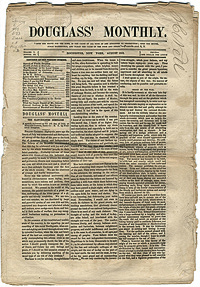
This quote, and most specifically the first part of it in bold above, is often waved triumphantly as an incontrovertible bit of evidence that the Confederacy did enlist African Americans as bona fide soldiers, “having muskets on their shoulders, and bullets in their pockets.” Those who advocate for the existence of large numbers of BCS seem to view Douglass’ quote as a sort of rhetorical trump card, as though the assertion of someone so genuinely revered could not possibly be questioned. If Frederick Douglass said so, the thinking seems to be, then even the most biased, politically-correct historian has to accept that.
The truth, of course, is that Frederick Douglass’ claims are subject to same scrutiny as anyone else’s. It’s worth remembering that Douglass was neither a reporter nor an historian; he was, by his own happy admission, an agitator, and is his September 1861 essay excerpted above he was again making the case for the enlistment of African American soldiers in the Union army. If there were reports that the Confederate army had used black troops at First Manassas — a battle that by September was well understood as an embarrassing setback for Union forces — then that made all the more compelling case for the Lincoln administration to respond in kind.
But why did Douglass believe that there were, or at least plausibly might be, such units in the Confederate army? He lived in upstate New York, in Rochester; he was nowhere near the battle and saw nothing of it at first hand. He might have spoken to someone who claimed first-hand knowledge of the event, but there’s no evidence that that’s the source of the claim. Indeed, the opening clause of the passage — “it is now pretty well established” — acknowledges that Douglass was not writing about something he knew to a certainty, but rather a conclusion based on what were likely numerous reports, rumors and press items.
Earlier this week Donald R. Shaffer looked at the evidence of black Confederate soldiers taking part in First Manassas, and argued that Douglass may have been basing his claim on an exchange in the Congressional Globe that took place soon after the battle, in which the involvement of African Americans in the Confederate army in a variety of capacities is discussed. Shaffer concludes, “it is apparent from the debate above that some servants and other African Americans attached to both armies were armed. This did not make them soldiers officially, but it does make murkier the line dividing soldiers and civilians attached to the armies in the Civil War.”
Dr. Shaffer, author of After the Glory: The Struggles of Black Civil War Veterans and Voices of Emancipation: Understanding Slavery, the Civil War, and Reconstruction through the U.S. Pension Bureau Files, makes a solid argument. Douglass closely followed the political debates of the day, and may well have followed the discussion in the Congressional Globe. But I would respectfully submit that it’s even more likely that he believed there were black Confederate troops at Manassas because he read it in the newspaper. From the New York Tribune, July 22, 1861, p. 5 col. 4:
A Mississippi soldier was taken prisoner by Hasbrouck of the Wisconsin Regiment. He turned out to be Brigadier Quartermaster Pryor, cousin to Roger A. Pryor. He was captured on his horse, as he by accident rode into our lines. He discovered himself by remarking to Hasbrouck, “we are getting badly cut to pieces.” What regiment do you belong to?” asked Hasbrouck. “The 19th Mississippi,” was the answer. “Then you are my prisoner,” said Hasbrouck.
From the statement of this prisoner it appears that our artillery had created great havoc among the rebels, of whom there are 30,000 to 40,000 in the field under command of Gen. Beauregard, while they have a reserve of 75,000 at the Junction.
He describes an officer most prominent in the fight, and distinguished from the rest by his white horse, as Jeff. Davis. He confirms previous reports of a regiment of negro [sic.] troops in the rebel forces, but says it is difficult to get them in proper discipline in battle array.
This account, with minor changes to the wording, appeared in newspapers all across the North, and even in Canada, in the days immediately following the battle. It was published in Batltimore, New York, Massachusetts, Albany and — yes — Rochester. A quick search of digitized newspapers suggests how far, and how often, the report of a back Confederate regiment in the field, seemingly confirmed by a captured Confederate officer, made it into print:
- St. John, New Brunswick Morning Freeman, July 25, 1861, p. 4, col. 3 (Google News)
- Baltimore American and Commercial Advertiser, July 22, 1861, p. 1 (Google News)
- Baltimore Sun, July 22, 1861, p. 2 (Google News)
- Lewiston, Maine Daily Evening Journal, p. 2, col. 2 (Google News)
- Springfield, Massachusetts Daily Republican, July 22, 1861, p. 4, col. 3 (GenealogyBank)
- Lowell Massachusetts Daily Citizen and News, July 22, 1861, p. 2 (GenealogyBank)
- Albany Evening Journal, July 22, 1861, p. 1. col. 6 (GenealogyBank)
- Jamestown, New York Journal, July 26, 1861, p. 2, col. 4 (GenealogyBank)
- Mineral Point, Wisconsin Tribune, July 26, 1861, p. 1, col 4 (NewspaperArchive)
- New York Daily Tribune, July 22, 1861, p. 5, col. 4 (Library of Congress)
- Moore’s Rural New Yorker, July 27, 1861, p. 6, col. 3 (Rochester Area Historic Newspapers)
As noted, these eleven citations are not an exhaustive list of papers that published this account in 1861; these are only examples that, 150 years later, survive in digitized, searchable form. The actual number of papers, large and small, across the country that repeated these short paragraphs may have counted in the dozens. Summaries based on Pryor’s account went even farther, with the British papers picking up and embellishing the claim. The Guardian was almost certainly rehashing Pryor’s account when it reported on August 7 that “Jefferson Davis was conspicuous on the field, on a white horse, in command of the centre of the army. A negro regiment fought on the same side.” The Illustrated London News went farther, claiming not only that such a unit went into action, but that “Northern troops found themselves opposed to a regiment of coloured men who fought with no want of zeal against them.”

I have no idea who “Brigadier Quartermaster Pryor” was; the 19th Mississippi had two Pryors, neither of which appear to be the man mentioned in the story. But who he was is less important here than assessing the reliability of his claims. I asked Harry Smeltzer of Bull Runnings for a quick assessment of Pryor’s report, as printed in the papers. Harry agreed, so long as I would indemnify him against getting dragged into the black Confederate discussion. (Done.) The Confederate numbers quoted are way off, he said, but then “numbers were wildly overstated by both sides, each being convinced they were outnumbered.” He continued:
OK – lots of [redacted barnyard term] in there, of course. The Federals did not move again on Manassas.
No 19th Mississippi at the battle: 2nd, 11th 13th, 17th, 18th. Last two were with Jones at McLean’s Ford. 2nd & 11th were with Bee and 13th with Early, so those three could have been where the 2nd Wisc was at some point. Pryor would have to have been very lost to wander from Jones to 2nd Wisc. Best bet to me is the 2nd or 11th. . . .
[Jeff Davis] arrived shortly after the fighting had stopped, during the retreat. . . .
Whoever “Brigadier Quartermaster Pryor” may have been, his claims about the battle and the Confederate army are a mess. Even allowing for the fog of war and the reality that no one, even the generals themselves, has a full and accurate picture of the fight in real time, Pryor’s claims are dubious and unreliable. It’s impossible to know, at this remove, what Pryor said on the battlefield, but what he’s quoted as saying in the newspaper is pretty worthless.
We’ll likely never know what caused Douglass to make his claim that the Confederacy had put African American soldiers on the field at Manassas. He may have heard about the battle from someone present, though Douglass’ passage doesn’t suggest that. He may well have followed the debate in the Congressional Globe, but at the same time he almost certainly was aware of the claims of “Brigadier Quartermaster Pryor,” printed in at least two papers likely to have crossed his cluttered desk in Rochester, Horace Greeley’s New York Daily Tribune and one of the local sheets, Moore’s Rural New Yorker. The presence of black men in Confederate uniform was an oft-repeated rumor that the time, and Douglass very likely saw “Brigadier Quartermaster Pryor’s” dubious account as further confirmation. Even an esteemed author like Frederick Douglass can only be a reliable as the material he has to work with.
_________________
Image: Issue of Douglass’ Monthly newspaper, via Division of Rare & Manuscript Collections, Carl A. Kroch Library, Cornell University.

37th Texas Cavalry Capitulates to Yankee Revisionism
I kid, I kid.
But I noticed recently a rather stark change that’s come over 37thTexas.org, which is (or perhaps was) the website of the reenactors of the 37th Texas (Terrell’s) Cavalry. It wasn’t exactly a favorite website of mine, but I found it extremely useful, collecting as it did in one place all sorts of cliched tropes and bad history. You can view the old website through the Internet Wayback Machine, but it has imbedded music so you may want to turn your speakers down. It was full of all sorts of useful stuff for a cynical blogger like me, with multiple sections on black Confederates, the Chandler Boys, Nathan Bedford Forrest at Fort Pillow, and that wicked old racist, Abraham Lincoln. That website was like an old friend — a drunk, belligerent, slightly-insane old friend.
So it came as a bit of a shock to see that the old website was gone, replaced by one (below) that’s infinitely tidier, easier to navigate, easier to read — and deadly dull. There’s hardly a controversial statement in the whole thing.


I don’t know what to make of this development. The new website is completely disorienting. Instead of a screed about Lincoln’s racism called, sarcastically, “The Great Emancipator,” there’s now a page of the same name describing the end of slavery without a trace of snark. Where there were once multiple pages about the supposed service of African Americans as soldiers in the Confederate Army, there’s now a page called “Blacks in the Civil War,” that describes the contribution of African Americans to the Union Army and Navy. And where there was once a long, tortured exoneration of Forrest’s actions at Fort Pillow, now there’s this:
General Forrest is largely known as a self-educated individual and a creative cavalry leader during the war and as a leading southern advocate after the war. He is foremost known as the Grand Wizard of the Ku Klux Klan, an organization with a secret character that launched a reign of terrorism against carpetbaggers, scalawags, Republicans and Afro-Americans.
Oh, my.
To be sure, there are a lot of small problems with the new content. The Emancipation Proclamation went into effect at the beginning of 1863, not 1963. Henry “Box” Brown, who famously escaped slavery in 1849 by having himself shipped north in a large crate, had no connection to the NAACP. And while I both (1) find figs to be “very delicious,” and (2) see the study of the war as a wide-ranging interdisciplinary effort, I have no idea what they have to do with the 37th Texas Cavalry.
I think I liked the old website better.
__________________

The Things I Do for You People. . . .
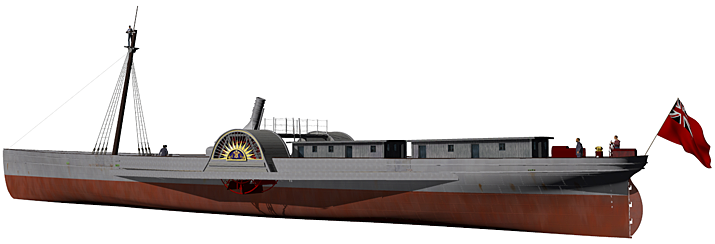
Couple days ago I posted some updated, work-in-progress images of my new digital model of Denbigh, one of the most successful blockade runners of the war, that completed eleven round voyages through the Union blockade between Havana, Mobile and Galveston. One of my regular readers asked, “no pintle on a rudder that large?” What cheek!
Except that my commenter was right — the model had a simple, stand-in rudder that just generally indicated its shape and position. I never got around to building a proper rudder for the old model, and hadn’t given it much thought on the new one. Well, now that’s fixed, with a new sternpost and rudder, based on the example in Captain Henry Paasch’s Illustrated Marine Dictionary.

Let’s Don’t Tell Rob Hodge About This, Okay?
Tim Smith is live-blogging (kinda-sorta) the Manassas reenactment over at A House Divided. It”s pretty good for a funny, not-at-all-serious take on the whole thing. This morning, “When Civil War reenactors go to Burger King:”
Derek Lanham, a Confederate cavalryman at Camp Manassas, has his horse saddled and he’s ready to ride for breakfast.
He’s getting a bite at Burger King.
“Where are you going to hitch up your horse there?”
“The drive thru,” he says.
With picture, FTW.
__________________

Texas Blue & Gray
 My colleague Ed Cotham, author of Battle on the Bay: The Civil War Struggle for Galveston, recently sent me a copy of Texas Blue & Gray, telling the story of the arrival of the Federal fleet off Galveston in July 1861 (1.0MB PDF). Ed sent it in plenty of time, but I got busy with other stuff and didn’t post it. Totally, completely mea culpa. So my sincere apologies to Ed for my letting this slip my attention.
_____________

Aye Candy
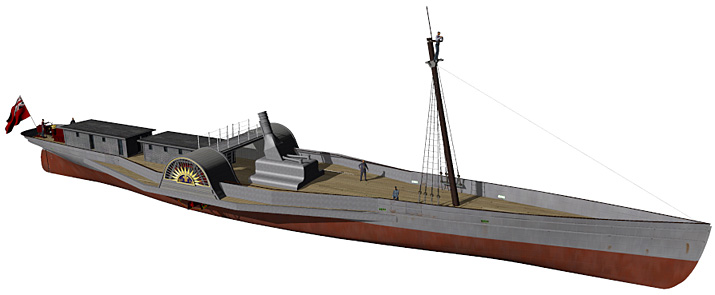
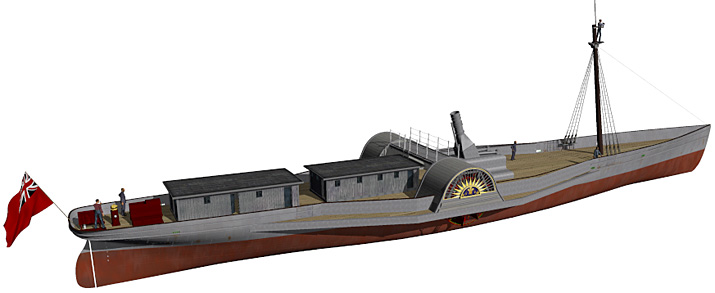
More work on the Denbigh model. The major changes from last time are the addition of the wheelbox, aft companion and deck houses. The latter are entirely new elements. And a new Red Duster, as well.
I tweaked the paddleboxes to get the emblem correct, and I’m happy with the result. (That was the biggest weak spot on the old model.) We’re fortunate to have an original 1864 portrait of the ship in her blockade-running guise (published in color here and here), that seems to show a fair amount of gilt on the paddleboxes, including the Prince of Wales feathers at the center. All that brightwork seems like an unlikely feature on a vessel intended to operate by stealth, and I don’t really know if the painting is (1) accurate, (2) depicting as gilt what was actually yellow paint, or (3) entirely fanciful on the part of the artist, Thomas Cantwell Healy (1820-89).
Fortunately, strict adherence to the primary source material coincides with good aesthetics — the paddleboxes add a much-needed splash of color to the vessel — so I’ve carried them over to the model, in all their ultramarine blue-and-gilt glory.


_______________




21 comments