Stonewall Jackson’s “Regiment of Free Negroes”
 Within the smoke-and-mirrors, ignore-that-man-behind-the-curtain game that constitutes advocacy for black Confederate soldiers, one often comes across the claim that Stonewall Jackson commanded two battalions of African American troops. It pops up all over the place, including (briefly) in grade school textbooks in the Old Dominion. Remarkably, with 27 bazillion books published to date on the Civil War, and a fair number of those specifically about Ol’ Blue Light himself, no one’s ever bothered to name those two battalions by their official designation, identify their officers, or point them out on the order of battle for a specific engagement.
I’m not sure where the claim about these battalions originated, but it may be at least in part based on this news item from the front page of the Philadelphia Inquirer of November 27, 1861:

FROM THE UPPER POTOMAC POSITION OF THE REBELS — A FREE NEGRO REGIMENT A letter from Darnestown, Md., dated to-day, says. . . . Gen. JACKSON, who, as Colonel, formerly commanded at Harper’s Ferry, is engaged at Winchester in organizing, arming, and equipping a regiment of free negroes [sic.], said to number fully a thousand. The negroes are reported to be very enthusiastic in their new position.

Rumors and second-hand accounts of African American troops in Confederate service appeared frequently in Northern newspapers, especially during the early part of the war. We’ve seen how a single mention of black troops — from a source that seems dubious to start with — got rewritten and embellished and recycled, over and over, for weeks after the Battle of First Manassas. That one took in a lot of people, including (it seems likely) Frederick Douglass.
So now we’ve got a date (November 1861) and a location (Winchester, Virginia), for at least one (anonymous, second-hand) account of Jackson’s black troops. Anyone who has further details on this regiment — its commanding officer, its official designation, the actions in which it fought, or citations to it in Confederate sources, please drop it in the comments.
I have Fold3 open and waiting.
___________

Juneteenth, History and Tradition
[This post originally appeared here on June 19, 2010.]
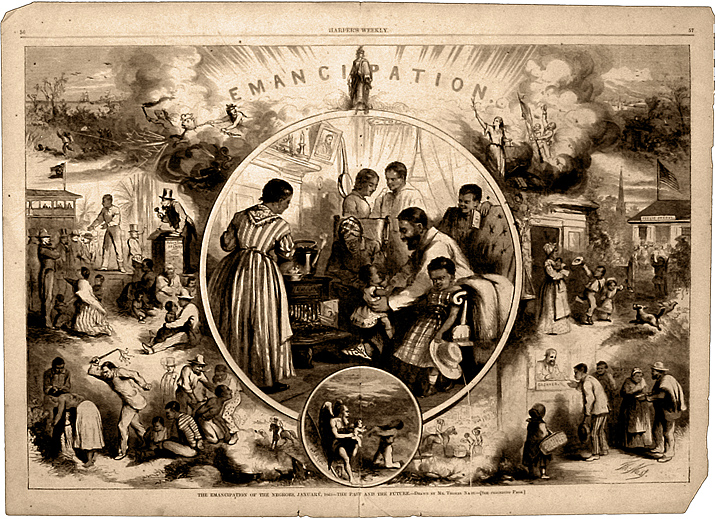
“Emancipation” by Thomas Nast. Ohio State University.

Juneteenth has come again, and (quite rightly) the Galveston County Daily News, the paper that first published General Granger’s order that forms the basis for the holiday, has again called for the day to be recognized as a national holiday:
Those who are lobbying for a national holiday are not asking for a paid day off. They are asking for a commemorative day, like Flag Day on June 14 or Patriot Day on Sept. 11. All that would take is a presidential proclamation. Both the U.S. House and Senate have endorsed the idea. Why is a national celebration for an event that occurred in Galveston and originally affected only those in a single state such a good idea? Because Juneteenth has become a symbol of the end of slavery. No matter how much we may regret the tragedy of slavery and wish it weren’t a part of this nation’s story, it is. Denying the truth about the past is always unwise. For those who don’t know, Juneteenth started in Galveston. On Jan. 1, 1863, the Emancipation Proclamation was issued. But the order was meaningless until it could be enforced. It wasn’t until June 19, 1865 — after the Confederacy had been defeated and Union troops landed in Galveston — that the slaves in Texas were told they were free. People all across the country get this story. That’s why Juneteenth celebrations have been growing all across the country. The celebration started in Galveston. But its significance has come to be understood far, far beyond the island, and far beyond Texas.
This is exactly right. Juneteenth is not just of relevance to African Americans or Texans, but for all who ascribe to the values of liberty and civic participation in this country. A victory for civil rights for any group is a victory for us all, and there is none bigger in this nation’s history than that transformation represented by Juneteenth.
But as widespread as Juneteenth celebrations have become — I was pleased and surprised, some years ago, to see Juneteenth celebration flyers pasted up in Minnesota — there’s an awful lot of confusion and misinformation about the specific events here, in Galveston, in June 1865 that gave birth to the holiday. The best published account of the period appears in Edward T. Cotham’s Battle on the Bay: The Civil War Struggle for Galveston, from which much of what follows is abstracted.
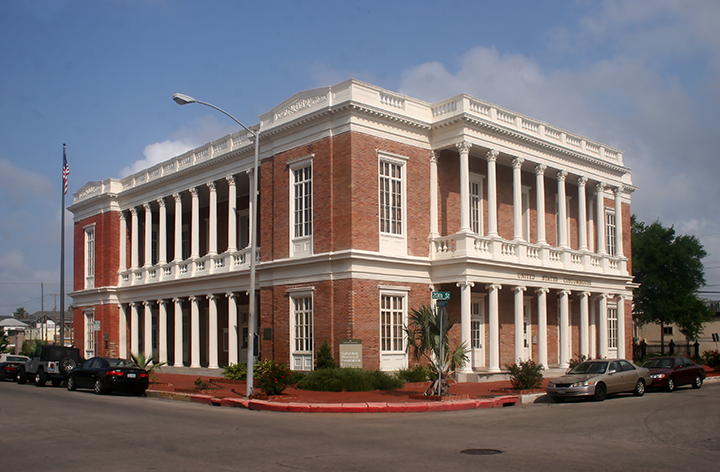
The United States Customs House, Galveston.
On June 5, Captain B. F. Sands entered Galveston harbor with the Union naval vessels Cornubia and Preston. Sands went ashore with a detachment and raised the United States flag over the federal customs house for about half an hour. Sands made a few comments to the largely silent crowd, saying that he saw this event as the closing chapter of the rebellion, and assuring the local citizens that he had only worn a sidearm that day as a gesture of respect for the mayor of the city.
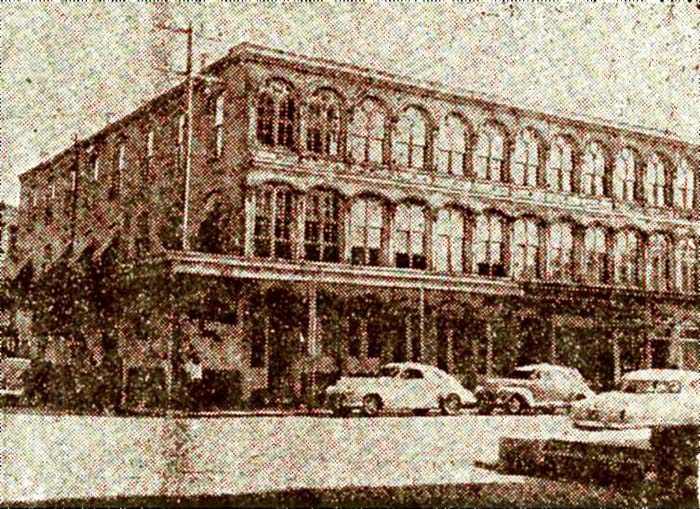
The 1857 Ostermann Building, site of General Granger’s headquarters, at the southwest corner of 22nd Street and Strand. Image via Galveston Historical Foundation.
A large number of Federal troops came ashore over the next two weeks, including detachments of the 76th Illinois Infantry. Union General Gordon Granger, newly-appointed as military governor for Texas, arrived on June 18, and established his headquarters in Ostermann Building (now gone) on the southwest corner of 22nd and Strand. The provost marshal, which acted largely as a military police force, set up in the Customs House. The next day, June 19, a Monday, Granger issued five general orders, establishing his authority over the rest of Texas and laying out the initial priorities of his administration. General Orders Nos. 1 and 2 asserted Granger’s authority over all Federal forces in Texas, and named the key department heads in his administration of the state for various responsibilities. General Order No. 4 voided all actions of the Texas government during the rebellion, and asserted Federal control over all public assets within the state. General Order No. 5 established the Army’s Quartermaster Department as sole authorized buyer for cotton, until such time as Treasury agents could arrive and take over those responsibilities.
It is General Order No. 3, however, that is remembered today. It was short and direct:
Headquarters, District of Texas
Galveston, Texas, June 19, 1865 General Orders, No. 3 The people are informed that, in accordance with a proclamation from the Executive of the United States, all slaves are free. This involves an absolute equality of personal rights and rights of property, between former masters and slaves, and the connection heretofore existing between them, becomes that between employer and hired labor. The Freedmen are advised to remain at their present homes, and work for wages. They are informed that they will not be allowed to collect at military posts; and that they will not be supported in idleness either there or elsewhere. By order of
Major-General Granger
F. W. Emery, Maj. & A.A.G.
What’s less clear is how this order was disseminated. It’s likely that printed copies were put up in public places. It was published on June 21 in the Galveston Daily News, but otherwise it is not known if it was ever given a formal, public and ceremonial reading. Although the symbolic significance of General Order No. 3 cannot be overstated, its main legal purpose was to reaffirm what was well-established and widely known throughout the South, that with the occupation of Federal forces came the emancipation of all slaves within the region now coming under Union control.
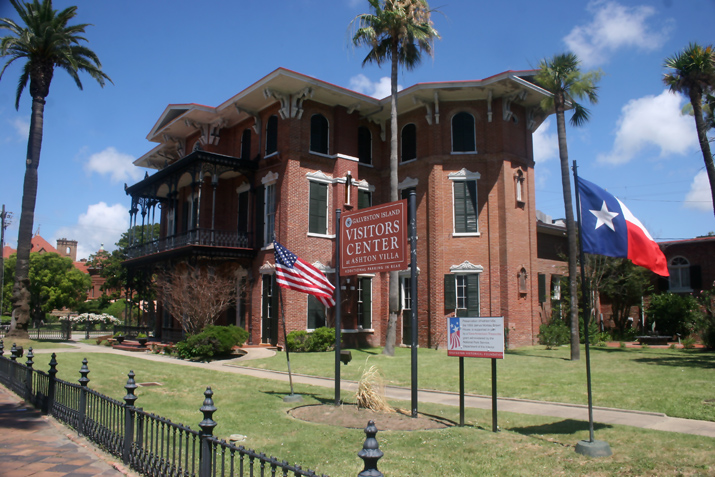
The James Moreau Brown residence, now known as Ashton Villa, at 24th & Broadway in Galveston. This site is well-established in recent local tradition as the site of the original Juneteenth proclamation, although direct evidence is lacking.
Local tradition has long held that General Granger took over James Moreau Brown’s home on Broadway, Ashton Villa, as a residence for himself and his staff. To my knowledge, there is no direct evidence for this. Along with this comes the tradition that the Ashton Villa was also the site where the Emancipation Proclamation was formally read out to the citizenry of Galveston. This belief has prevailed for many years, and is annually reinforced with events commemorating Juneteenth both at the site, and also citing the site. In years past, community groups have even staged “reenactments” of the reading of the Emancipation Proclamation from the second-floor balcony, something which must surely strain the limits of reasonable historical conjecture. As far as I know, the property’s operators, the Galveston Historical Foundation, have never taken an official stand on the interpretation that Juneteenth had its actual origins on the site. Although I myself have serious doubts about Ashton Villa having having any direct role in the original Juneteenth, I also appreciate that, as with the band playing “Nearer, My God, to Thee” as Titanic sank beneath the waves, arguing against this particular cherished belief is undoubtedly a losing battle.
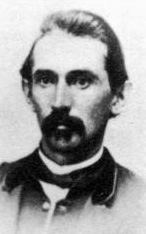 Assuming that either the Emancipation Proclamation (or alternately, Granger’s brief General Order No. 3) was formally, ceremonially read out to the populace, where did it happen? Charles Waldo Hayes, writing several years after the war, says General Order No. 3 was “issued from [Granger’s] headquarters,” but that sounds like a figurative description rather than a literal one. My bet would not be Ashton Villa, but one of two other sites downtown already mentioned: the Ostermann Building, where Granger’s headquarters was located and where the official business of the Federal occupation was done initially, or at the United States Customs House, which was the symbol of Federal property both in Galveston and the state as a whole, and (more important still) was the headquarters of Granger’s provost marshal, Lieutenant Colonel Rankin G. Laughlin (right, 1827-78) of the 94th Illinois Infantry. It’s easy to imagine Lt. Col. Laughlin dragging a crate out onto the sidewalk in front of the Customs House and barking out a brief, and somewhat perfunctory, read-through of all five of the general’s orders in quick succession. No flags, no bands, and probably not much of a crowd to witness the event. My personal suspicion is that, were we to travel back to June 1865 and witness the origin of this most remarkable and uniquely-American holiday, we’d find ourselves very disappointed in how the actual events played out at the time.
Maybe the Ashton Villa tradition is preferable, after all.

Update, June 19: Over at Our Special Artist, Michele Walfred takes a closer look at Nast’s illustration of emancipation.
Update 2, June 19: Via Keith Harris, it looks like retiring U.S. Senator Kay Bailey Hutchison supports a national Juneteenth holiday, too. Good for her.
______________

Federal Judge Tosses Lexington Flag Lawsuit
Via Kevin, the U.S District Court has granted the City of Lexington’s motion to dismiss the SCV’s lawsuit against the city. Rob Baker points to Judge Samuel Wilson’s ruling:
The Constitution does not compel a municipality to provide its citizens a bully pulpit, but rather requires it to refrain from using its own position of authority to infringe free speech. Second, there are highly compelling practical reasons for a city to close its flag poles to private expression. The city that cracks the door to private expression on flag poles practically invites litigation from other groups whose messages it would rather not hoist above the city. Related to that point, private expression might eventually so dominate city flag poles as to swallow whole the flag poles’ actual, official purposes. Third, and finally, the ordinance in this case leaves ample opportunity for SCV and every other group to display the flags of their choice. That is true by the ordinance’s own terms: “Nothing set forth herein is intended in any way to prohibit or curtail individuals from carrying flags in public and/or displaying them on private property.” § 420-205(C)(2). SCV and other groups may therefore carry their flags in parades, fly them from the flag poles at their local offices, or wave them while walking to the grocery store. As such, the ordinance is perfectly reasonable. Because reasonable, nondiscriminatory, content-neutral rules regulating speech in nonpublic fora pass First Amendment constitutional muster regardless of motive, the court will grant the City’s motion to dismiss.
Grafs are added for clarity. And then there’s this:
No court has found that the Constitution compels the government to allow private-party access to government flag poles.
I seem to recall someone saying at the time that the Lexington “ordinance is air tight.” That person was right.
The local SCV, led by Brandon Dorsey, isn’t happy:
As far as I am concerned, this is little different that some states shutting down all their public schools to avoid desegregation and then claiming their motivation for closing them is of no concern because they screwed over everyone.
Of all the possible analogies, Mr. Dorsey, you had to go with that one, didn’t you? It must be hard, getting H. K. Edgerton and Ruby Bridges mixed up like that. Because they’re so much alike, or something. But do try harder next time, please.

Update, June 16: Dorsey’s analogy, comparing the Virginia SCV’s situation to that of African Americans in the Jim Crow South, doesn’t appear to be an off-the-cuff comment; it’s a conscious public relations strategy. Yesterday they vowed to appeal Judge Wilson’s dismissal, and made the same analogy:
In its written statement, Sons of Confederate Veterans maintained that Wilson’s ruling would allow governments to deny everyone access to public places in its effort to silence the groups with whom it disagrees.
“That logic would legitimize many of the wrongs committed by state and local governments during the Civil Rights era,” the statement read.
“In its written statement. . . .”
Many of us have made the point that, in its public actions and rhetoric, the Southron Heritage™ movement is preaching to the choir; they’re doing and saying things calculated to appeal to fellow true believers, going out of their way to prove they’re more unreconstructed than the next guy. As for winning new supporters to their cause, or shaping broader public opinion, it’s a terrible strategy that only distances them farther from mainstream views and attitudes.
This analogy by Dorsey and his fellows doesn’t help their cause; it actively harms it. Anyone who actually remembers the Civil Rights Movement, or who’s studied it since, will be repulsed by such a comparison, and rightly so. It’s an odious analogy, one that should cost them any benefit of the doubt that the public might be willing to entertain about their motivations and supposed good faith. Kevin is right again: “they deserve everything they get.”
_____________

How — and Why — Real Confederates Endorsed Slave Pensions
In another forum recently, there was a lively discussion going on about the historical basis for present-day claims about black Confederates. One of the topics, naturally, was the pensions that some states awarded to African American men who had served as body servants, cooks, and in other roles as personal attendants to white soldiers. One person asked why it was that the former states of the Confederacy were so late in authorizing pensions for these men, or (in some cases) did not authorize them at all. It’s a good question, that I’m sure defies a single, simple answer.
But in the process of looking for something else, I came across this editorial in the October 1913 issue of the Confederate Veteran, calling on the states to provide pensions for a “a particular class of old slaves.” I’m putting it after the jump, because it’s peppered with racial slurs and stereotypes that are hurtful to modern ears, but were wholly unremarkable for that time, place and publication. So let me apologize in advance for the language, and hope that my readers will appreciate the necessity of repeating it here, in full and in proper context, in order to be crystal clear about the author’s meaning and intent. There are times when polite paraphrasing just doesn’t do the job.
As you read this editorial, keep in mind that the Confederate Veteran, by its own masthead, officially represented (1) the United Confederate Veterans, (2) the United Daughters of the Confederacy, (3) the Sons of Veterans (i.e., the SCV), and other groups. The magazine was mostly written by Confederate veterans and their families, to be read by Confederate veterans and their families. While the editorial may not reflect formal UCV/UDC/SCV policy, its appearance in the magazine does indicate that its perspective is one that would be shared by the magazine’s readership, and its call for action would reach a willing and receptive audience.
In short, if you want to know how real Confederate veterans viewed the purpose and necessity of pensions for former slaves, start here:

Focus on U.S.S. Fort Jackson


 My friend Ed Cotham e-mailed me recently with this photo of U.S.S. Fort Jackson, one of the ships making up a part of the blockade fleet off Galveston in the final months of the war. Fort Jackson had a long and active service history, capturing several blockade runners off the East Coast and taking part in the bombardment of Fort Fisher at the end of 1864. When she took up station off Galveston in the early part of 1865, she served as the flotilla’s flagship, under Captain Benjamin F. Sands (1811-1883, right). It was Sands who formally took the surrender of Galveston in June 1865.
When I first saw the image, I thought I’d not seen it before, and told Ed so. Soon after I realized that we’d used a much smaller version of this image on the Denbigh Project website, as it was a lookout aboard Fort Jackson that first sighted the stranded blockade runner at dawn on May 23, 1865, and Sands who ordered the gunboats Cornubia and Princess Royal to open fire. Simultaneously, Sands ordered boats from the blockaders Seminole and Kennebec to board and destroy Denbigh.
A very large proportion of both the U.S. and Confederate navies were vessels that were never built for military service, merchant ships that were either bought while still on the stocks, or pressed into service to meet the rapidly-expanding need for warships. Fort Jackson was one of these. She was built for Cornelius Vanderbilt’s service between New York and Panama, but was purchased by the Navy upon completion in the summer of 1863.
Fort Jackson was a big ship, 250 feet long and 1,850 tons burthen. She normally drew 18 feet of water, which would have made operations close inshore in the Gulf of Mexico difficult. (In fact, when Sands went into the harbor at Galveston to formally take possession of the city, he had to transfer to U.S.S. Cornubia, a smaller ship with a 9-foot draft.) Her two sidewheels were powered by a vertical beam engine, consisting of a single cylinder 80 inches in diameter, with a 12-foot stroke. Fort Jackson was armed with a 100-pounder rifle, two 30-pounder rifles, and eight 9-inch smoothbores.
Anyway, looking at the image there seemed to be a lot of good detail, so I downloaded the full-resolution version from the Library of Congress, and thought it would be fun to see what’s visible. Here we go. . . .
Dr. Leale’s Report
 This is pretty interesting — a researcher working at NARA, Helena Iles Papaioannou, discovered the original report of Dr. Charles A. Leale (right, 1842-1932), the first physician to reach Abraham Lincoln after he was shot at Ford’s Theater on the evening of April 14, 1865. Leale, who had just turned 23 a couple of weeks before, had seen Booth leap to the stage brandishing a dagger, and assumed that the president had been stabbed:
I commenced to to examine his head (as no wound near the shoulder was found) and soon passed my fingers over a large, firm clot of blood situated about one inch below the superior curved line of the occipital bone. The coagula I easily removed and passed the little finger of my left hand through the perfectly smooth opening made by the ball, and found that it had entered the encephalon.
Leale organized the transfer of the president to the Peterson house across the street, and remained to assist after more senior physicians arrived to take over Lincoln’s care. Indeed, Dr. Leale may have been the only witness who was with Lincoln continuously from the first moments after the shooting until he died several hours later. Leale’s report had apparently been filed away for storage, and overlooked until it was discovered last month by a researcher with the Papers of Abraham Lincoln Project.
The manuscript report is a fair copy, probably written out by a clerk in the Surgeon General’s office. You can download a 3.12MB PDF of the original, or read a full transcript after the jump:

Roll, Alabama, Roll

We’ve done this song before, but the animation here is remarkable. Worth it to watch in HD on Vimeo. H/t Kevin.
________________

When Make-Believe Confederates Diss Real Confederates


There’s been some discussion about the Virginia Flaggers’ recent appearance at an event in Fredericksburg, a commemoration of a procession on Decoration Day in 1871 when local residents and visitors from as far away as Washington, D.C. and Richmond to honor the Union dead buried in the national cemetery there. The Flaggers weren’t invited, they just showed up and trailed along at the end of the procession, to bring “a Confederate presence” to an event that, historically, didn’t commemorate or involve real Confederates at all. The group’s leader, Susan Hathaway, has said that the Flaggers “were greeted warmly by all the participants,” and John Hennessy notes that the Flaggers “were respectful and genial every step, as was, I think, the audience toward them.” But despite the civil tone, at least one participant disputes the notion that the Flaggers’ presence was appreciated by the procession’s participants, stating bluntly, “within the column itself they weren’t welcome.” That’s one of the tricky things about the South; just because people are polite doesn’t mean they actually like you.
Other bloggers have mentioned this event, but in concentrating on the Flaggers’ participation in the recreated Decoration Day procession, a number of folks have “buried the lede,” as the saying goes, which is that the Flaggers did not participate in the ceremony at the nearby Confederate cemetery (above). Michael Aubrecht and Ryan Quint have both noted this, but to me it’s a tremendous “tell” that the Flaggers opted to participate in the Decoration Day march, rather than honor their own Confederate forebears. The rationale seems pretty transparent; people carrying Confederate flags at a Confederate ceremony in a Confederate cemetery is not news. Marching in a procession to commemorate an event held years after the war to honor Union dead, that’s gonna make the papers.
Mission accomplished, y’all!
The Virginia Flaggers have shown consistently that their priorities lie less with spending time and effort doing the quiet, dogged work of preservation and education, than with self-promotion and generally stirring up resentments about “traitors and scalawags” and so on. They have a bad habit of picking unnecessary fights, setting up confrontations for the cameras, and claiming that a civil disagreement with them constitutes an “attack.”
The Flaggers like to call themselves Confederates. But last Monday they had the opportunity to honor real Confederates, and they took a pass, opting instead to “advance the colours” at an event that had no historical involvement of real Confederates, where they were neither invited nor especially welcome, but that they knew would attract attention and publicity. That pretty much epitomizes the Flaggers’ approach to “restoring the honour”; it’s all about them.
______________
Image: Confederate cemetery at Fredericksburg on May 28, 2012, via Fredericksburg Remembered.


You Can Only Pick One. . . .
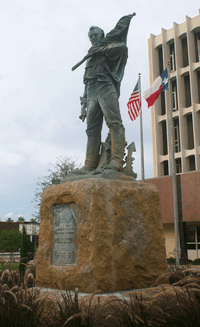 There are two CW events in Galveston coming up this Sunday afternoon that are worth noting. Unfortunately, they’re both happening at 2 p.m. that day.
The first is the re-dedication of Galveston’s Confederate memorial statue, “Dignified Resignation” (right, in 2010) on the grounds of the former county courthouse. The original dedication was held on June 3 1912, exactly 100 years before. The monument was recently cleaned and restored to its original bronze finish, and it looks great. I’ve long liked this particular monument, partly because it has a strong maritime component to it, and partly because it’s an original piece, not the more typical (even clichéd) styles so common to courthouse squares across the country. The primary speaker will be Dr. Judy Bernard, Chairman of District V of the Texas Division of the UDC.
The other event is Don Willett’s talk, “Overview: The Battle of Galveston,” at Menard Hall, 33rd Street and Avenue O. I’ve heard Prof. Willett speak before, but not on this particular subject, and I’m curious to hear what he has to say. Additionally, since I’m going to be doing a talk in that same series in a few weeks, it will probably be a wise move for me to attend the Battle of Galveston talk to see in advance how those are structured.
Kinda wish I didn’t have to pick one or the other, though.
______________





24 comments