Confederate Heritage™ Defenders, Ignorant of Confederate Heritage
Billy Bearden, Flagger extraordinaire, continues his unhinged rant against the United Daughters of the Confederacy, when they don’t live up his own personal standard of butternut patriotism:

MOVE OVER Gail Crosby, Aileen Ezell, Suzanne Townsend, Martha Van Schaick, Betty Giragosian! The Texas UDC is not about to be left out of the race to shed itself of the Anti BATTLEFLAG gang!

 Leaving aside the fact that that last sentence seems to say the opposite of what’s actually meant, the offense here is that a Dallas chapter of the UDC bought a bunch of “First National” flags to use on graves at a local cemetery, instead of the Confederate Battle Flag. Billy seems unaware that the First National has been the official flag of the UDC for more than a century, a part of its logo (right) in the same way that the CBF is part of the SCV emblem. Then again, the Flaggers’ allies at SHPG seem to believe that the UDC is a “support group to the SCV,” when in fact they are parallel organizations, with the UDC having been founded first, and thus is actually the senior of the two.
It’s amazing how little the Confederate Heritage™ folks seem to know about actual Confederate heritage.
______________

A Haka for Fallen Comrades

Some of you may have seen this video, currently going viral, of soldiers of the 2nd Battalion, 1st Royal New Zealand Infantry Regiment saluting two of their comrades, Lance Corporals Pralli Drurrer and Rory Malone, who died in Afghanistan. From the accompanying text:

Haka is used throughout New Zealand by many, not only Māori, to demonstrate their collective thoughts. There is a haka for each of the Services, as well as the Defence Force. Units with the NZ Army have their own haka. This video shows the soldiers of 2/1 RNZIR Battalion performing their Unit haka, powerfully acknowledging the lives and feats of their fallen comrades as they come onto the Unit’s parade ground. It is also an emotive farewell for they will leave via the waharoa (the carved entrance way) for the very last time.Haka –sometimes termed a posture dance could also be described as a chant with actions. There are various forms of haka; some with weapons some without, some have set actions others may be ‘free style.’ Haka is used by Māori (indigenous people of New Zealand) for a myriad of reasons; to challenge or express defiance or contempt, to demonstrate approval or appreciation, to encourage or to discourage, to acknowledge feats and achievements, to welcome, to farewell, as an expression of pride, happiness or sorrow. There is almost no inappropriate occasion for haka; it is an outward display of inner thoughts and emotions. Within the context of an occasion it is abundantly clear which emotion is being expressed.
It’s a remarkable example of how cultural practices cross traditional ethnic boundaries and strengthen shared national bonds. Different customs, but no less meaningful.
_____________

Monday Concert: Joe Hill’s “Casey Jones”

The ballad of Casey Jones has been recorded many, many times, but my favorite is this cover by the indomitable Pete Seeger, with the lyrics written by labor activist Joe Hill for the Industrial Workers of the World. Hill’s version took advantage of the popularity of the traditional version, which related the story of the real John Luther “Casey” Jones, an engineer on the Illinois Central Railroad, and made it into an allegory on the fate of union scabs. The real Jones was the sole fatality in a train wreck in rural Mississippi in 1900 — one in which his actions, staying on the brakes of his locomotive to the end, were credited with saving many lives among the passengers on his train — but Hill’s lyrics move his demise to a different railroad, in very different circumstances:
The workers on the S.P. line to strike sent out a call; But Casey Jones, the engineer, he wouldn’t strike at all; His boiler it was leaking, and its driver’s on the bum, And his engine and its bearings they were all out of plumb. Chorus:
Casey Jones kept his junk pile running; Casey Jones was working double time; Casey Jones got a wooden medal, For being good and faithful on the S.P. line. The workers said to Casey: “Won’t you help us win this strike?” But Casey said: “Let me alone, you’d better take a hike.” Then Casey’s wheezy engine ran right off the wheezy track, And Casey hit the river with an awful smack. Chorus: Casey Jones hit the river bottom; Casey Jones broke his blooming spine; Casey Jones turned into an angel, He took a trip to heaven on the S.P. line. When Casey Jones got up to heaven to the Pearly Gate, He said: “I’m Casey Jones, the guy that pulled the S.P. freight.” “You’re just the man,” said Peter, “our musicians went on strike: You can get a job a-scabbing any time you like.” Chorus: Casey Jones got a job in heaven; Casey Jones was doing mighty fine; Casey Jones went scabbing on the angels, Just like he did to workers on the S.P. line. The angels got together and they said it wasn’t fair For Casey Jones to go around a-scabbing everywhere. The Angels’ Union No. 23, they sure were there, And they promptly fired Casey down the Golden Stair. Chorus: Casey Jones went to Hell a-flying; “Casey Jones,” the Devil said, “Oh fine; Casey Jones, get busy shoveling sulfur That’s what you get for scabbing on the S.P. line.”
Hill’s lyrics have nothing at all to do with the real Casey Jones, but Seeger’s version is so vibrant, so compelling — so unerringly cynical, funny and explicitly political — that it overrides those concerns for me, at least temporarily. Unfortunately, whoever put this video together with Seeger’s recording used images of the real Casey Jones to illustrate Hill’s song. I suggest ignoring the visuals altogether.
Seeger sings the original here:
______________

My Obligatory General Lee Post
OK, the good news is that Warner Brothers has apparently backed down and will not be removing the Confederate flag from the roof of the famous Dukes of Hazzard car. However, there will be other modifications to the vehicle:

_________________
H/t to user Copperhead-mi at Civil War Talk for locating the image.

“This was the grandest thing I saw during the war.”
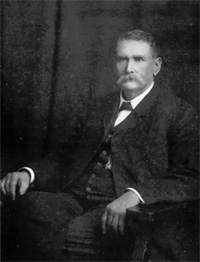 Today is the sesquicentennial of the Second Battle of Manassas. Yesterday we had an account of that action recorded by Val Giles, of Company B of the 4th Texas Infantry, describing the action against a Union Zouave regiment and the actions of the James Reilly’s battery, attached to the Texas Brigade. Today, we have a parallel account of the same action, by Lawrence Daffan (right), then a seventeen-year-old private in Company G of the 4th Texas. Years later, Daffan dictated his account to his daughter Katie, who was herself secretary of the Brigade Association, active in UDC affairs and, the following year, would be named superintendent of the Texas Confederate Woman’s Home. The story was subsequently published in a commemorative book, Unveiling and Dedication of Monument to Hood’s Texas Brigade on the Capitol Grounds at Austin, Texas. It contains a wealth of information about the famous brigade, collected from wartime records and surviving veterans.
On that August afternoon in 1862, Daffan and his comrades witnessed what later came to be known as “the very vortex of Hell.” At the center of that conflagration stood the famous Fifth New York Volunteers, Duryée’s Zouaves. They took the full brunt of the attack by Daffan’s counterparts in the Fifth Texas, and Hampton’s Legion of South Carolinians, and the Eighteenth Georgia. The Zouaves held on as long as they could, and were effectively wiped out as a fighting unit. Of 525 “redlegs” who marched into the fight that day, 332 were killed or wounded, a casualty rate of 63%.
Note: the original work as published, linked in the first paragraph above, has numerous small errors in dates, spelling of names, and so on. It’s impossible at this point to know if these were errors made by Lawrence Daffan, Katie Daffan, or the typesetter. I’ve corrected (or tried to) all those in the text below, without noting individual instances. Those wishing to see the uncorrected text can click the first link above to read the original, beginning on p. 187 of the original book, or n218 in the electronic version.

On Thursday evening, August 28, 1862, marching through the foothills of the Blue Ridge Mountains, we heard the sound and echo of artillery, which was familiar to us, and we knew that we were approaching the enemy.
Just before sundown we entered Thoroughfare Gap. We could hear musketry and artillery at the opposite side of the gap. Anderson’s Brigade had engaged the enemy, who was holding the gap, to keep us from forming a junction with Jackson at Manassas.
Hood’s Brigade filed out of the road and started right over the top of the mountain, which was very steep climbing. By the time we were at the top we received word that Anderson had routed the enemy. We returned to the road and continued that night and marched through the gap and camped right on the ground where Anderson had driven them away. We were ordered to be ready to move at a moment’s warning. We started at 6 o’clock Friday morning, August 29.
I speak of Hood’s division in this, which consisted of Benning’s Brigade and Anderson’s Georgia Brigade, Law’s Alabama Brigade and Hood’s Texas Brigade. Hood was, at this time, Brigadier General, but acting in the capacity of Major General for this division.
We marched along in ordinary time to Manassas, until 9 or 10 o’clock. At this time we began to hear very heavy cannonade. In an hour we were in the hearing of very heavy artillery and musketry, fierce and violent. Jackson had engaged Pope and his corps. The sound of the firing continued to grow more violent. We received orders to quickstep and shortly afterward received orders to double quickstep. We were all young and stout, and it seemed to me this kept up about two hours. Pope was pressing Jackson very hard at this point. We joined Jackson and formed at his right and double-quicked into line of battle and threw out skirmishers.
At this time, as we arrived there, the firing all along Jackson’s line ceased at once. We took position Friday evening, and Friday night we had a night attack. This and the attack at Raccoon Mountain, Tennessee, were the only night attacks that I know of made by the Confederates. This attack caused great confusion, and I could never understand what benefit it was. We slept that night very close to the enemy, in fact could not speak aloud or above a whisper. I had a very bad cold at this time, contracted on the retreat from Yorktown, and an officer was sent from headquarters “to tell than man who was constantly coughing to go from the front to the rear, where he could not be heard.” I went back, near half a mile, with my blanket and accouterments. I slept alone, under a large oak tree, coughing all night. I didn’t know the maneuvers of our regiment between this [time] and day[light], but I joined them early Saturday morning [August 30]. We formed in perfect order early in the day. Jackson brought on the attack on our left about noon and pressed the enemy until they began to give way in front of him. This drew a number of troops from in front of us to support those Jackson, was driving back on our left.
General Lee’s headquarters were in sight of where I was. About 4 o’clock in the afternoon I saw a considerable commotion in General Lee’s headquarters; he, his staff officers and couriers. The couriers darted off with their instructions to different commanders of divisions, in a few minutes a courier dashed up to General [Jerome B.] Robertson, commanding the Texas Brigade. These couriers and orderlies notified the respective Colonels. The order “attention” was given, then the order “to load,” then “forward,” “guide center.” We went through the heavy timber and emerged into an open field. We had a famous battery with us, [Captain James] Reilly’s Battery [Rowan Artillery], with six guns, four Napoleon and two six-p0und rifles.
Captain Reilly had always promised us that if the location of the company permitted, he would charge with us. We opened and made room between the Fourth and Fifth Texas for Reilly’s Battery to come in. As we started, the battery started.
Young’s Branch was between us and a hill on the other side, which was occupied by a Federal Battery [Curran’s Battery], which was playing on us. This turned into a charge as soon as we emerged from the timber. We had gone a short distance when Reilly unlimbered two of his guns and opened on the Federals. We moved past these guns while they were firing. As we passed on the other two guns came in some distance ahead of those that were firing, swung into position and unlimbered. It seemed to me by the time the first two had stopped, the second two opened fire. This was done remarkably quick. They charged with us in this charge until we arrived at Young’s Branch ; two sections, two Napoleon guns each, two firing while the other two would limber up and run past them, swing into position and open fire.
This was the grandest thing I saw during the war — the charge of Reilly’s Battery with the Texas Brigade. I don’t know whether they shot accurately or not, it was done so fast. But I do know that it attracted the attention of the Yankee battery on the hill, diverting their attention from us.
Reilly’s Battery were North Carolinians and were with us all during the war and they never lost a gun.
In this charge at Manassas we saw a Zouave regiment [5th New York Volunteers, Duryée’s Zouaves]. It stood immediately in front of the Fifth Texas to our right. It was a very fine regiment. As the Fifth Texas approached, it checked the speed of the Fifth in its quick charge. The Fifth Texas, Hampton Legion and the Fourth Texas had a tendency to swing around them. As the Fifth Texas approached them, I saw the blaze of their rifles reached nearly from one to the other.
The First Texas, Hampton’s Legion and Fourth Texas from their position gave the Zouaves an enfilading fire, which virtually wiped them off the face of the earth. I never could understand why this fine Zouave regiment would make the stand they did in front of the brigade until nearly every one was killed.
We rallied at Young’s Branch. I looked up the hill which we had descended and the hill was red with uniforms of the Zouaves. They were from New York.
We ascended the hill out of Young’s branch, charged a battery of six guns [Curran’s], supported by a line of Pennsylvania infantry. This battery was near enough to use on us grapeshot and canister. As we came near to it one of the guns was pointed directly at my company and lanyard strung. Our Captain commanded Company G to right and left oblique from it. I was on the right and with a few others went into Company H. At this time one of the artillerymen threw the main beam, and this threw the cannon directly on Company H. Company H received a load of canister which killed four or five men.
I was immediately with Lieutenant [C. E.] Jones and [Private R. W.] Ransom of that company, who were both killed right at my feet. I stepped over both of them. Captain [James T.] Hunter, now living, was also shot down at that time. Most of the company were my schoolmates.
This last shot threw smoke and dust all over me, and the shot whizzed on both sides of me. Lieutenant Jones was shot in the head and feet, but I was not touched, When the smoke cleared away we had these guns, and they were so hot I couldn’t bear my hands on them. I then fired one shot at this retreating infantry which the rest of the brigade had been engaged with. This wound up that day’s engagement for us, except the Fifth Texas. A part of their regiment and their colors were carried about five miles after the retreating enemy.
We returned to Young’s branch and my attention was attracted to our support coming down the same hill that we had come down.
There were four lines of battle of Longstreet’s Corps in perfect order, which passed us and took up the fight with the retreating enemy where we left it off. This battle was fought on the 30th and 31st of August, 1862.
I can’t understand why the Federals have always attached so little importance to this battle, as they lost many gallant men there. They were terribly defeated, and may have been ashamed of their commanding general.

Image: 5th New York Zouaves, by Don Troiani

“The domned skillipins skeddaddle extinsively — extinsively, sir!”
 One of the great firsthand accounts of Texas troops in the Civil War is Val C. Giles’ Rags and Hope: Four Years with Hood’s Brigade, Fourth Texas Infantry, 1861-1865 (Mary Lasswell, ed.). The book was originally published in 1961, at the time of the Civil War Centennial, and (to my knowledge) has never been reprinted. Copies are hard to find, and correspondingly expensive. That’s a shame, because Giles’ narrative is poignant, vivid, and often very funny.
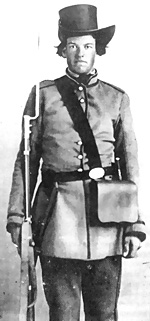
Giles’ account of Second Manassas shares much with that of his postwar friend and fellow 4th Texas veteran, Lawrence Daffan of Company G. It’s a harrowing description, and Giles (Company B) was much shaken by the carnage he saw around him within the regiment. That’s for a later time, though; for now, I want to follow-up Daffan’s dramatic description of Captain James Reilly’s Battery D of the 1st North Carolina Artillery with Giles’ description of the same event. As always, Giles (right, in a studio portrait taken in Austin at the time of his enlistment in 1861) has a keen ear for vivid characters and humorous spectacle:*
When I say the greatest battles of the world have been fought by the infantry, I don’t mean to reflect on the artillery or cavalry, or intimate that they have ever failed to do their duty. Stuart’s Cavalry was always vigilant. They were the eyes and ears of the army, and while the infantry slept, these gallant fellows were far away on the flanks, watching the enemy, guarding the fords, bridges and crossroads, escorting supply trains, and, for weeks at a time, fighting every day. During the war I used to think that the artillerymen were the bravest men on earth. They could pull through deeper mud, ford. deeper streams, shoot faster, swear louder, and stand more hard pounding than any other class of men in the service. . . .
Attached to the Texas Brigade was a fine battery of six Napoleon guns, commanded by Captain Reilly. Reilly had been an artillery sergeant in the old Army, and when the trouble began in 1861, he cast his lot with the Confederacy. He was an Irishman, rough, gruff, grizzly, and brave. He loved his profession and knew his business.
In this battle of Second Manassas, we witnessed a fine display of his skill and courage. General Hood instructed his colonels to halt their regiments when they reached Young Branch, which ran parallel with our line of battle, but when the Brigade reached the branch, the enemy was falling back, all along the line, and many of our field officers were killed or wounded. Colonel J. B. Robertson, Lieutenant Colonel J. C. Upton, Major Bryant, Captain J. D. Roberdeau, and Adjutant Campbell Woods of the Fifth Texas Regiment had all fallen before they reached the branch. The regiment was left without field officers, so the men pressed over the Zouaves, across the stream, and up the hill beyond.
Lieutenant Colonel [S. Z.] Ruff, Majors [John C.] Griffis, [John B.] O’Neill, [D. L.] Jarrett, and [Joel C.] Roper of the Eighteenth Georgia had gone down. Majors [William P.] Townsend, [D. U.] Barziza, and [James T.] Hunter of the Fourth had also fallen. Colonel [William T.] Wofford of the Eighteenth Georgia, Colonel [Benjamin F.] Carter of the Fourth Texas, Lieutenant Colonel P. A. Work of the First Texas, and Colonel [W. M.] Gary of Hampton’s South Carolina Legion finally succeeded in checking our men and bringing them back under the crest of the hill.
It was then that “Old Tarantula,” Captain Reilly, made his appearance on the field. He turned a point of timber to our left and came toward us in a sweeping run. Every horse in the battery carried a rider and the caissons and gun carriages were covered with red caps holding on like monkeys as they thundered over gullies, rocks, even over dead and wounded soldiers.
“Old Tarantula” rode fifty yards in front of his battery. He hurriedly selected an elevation, and at the wave of his hand, the guns were whirled into position and every artilleryman appeared to hit the ground at once. He threw his field glass to his eye, swept the horizon at one glance, then sang out: “Six hundred yards — shrapnel!”’
The guns bellowed and roared, the shells passing ten feet over our heads. Many of .the men sprang to the top of the hill to see the effect of Reilly’s shells. He was accurate in distance, for every shell exploded right in the midst of the confused and retreating enemy. He sat on his horse, calmly giving his commands, increasing the distance as the broken columns retired.
Major [William] Harvey Sellers, General Hood’s Assistant Adjutant General, rode up to the battery on his wounded gray horse to deliver some order. Old Reilly greeted him with a grand flourish and gleefully said, pointing in the direction of the bursting shells, “See, Major, see! The domned skillipins skeddaddle extinsively — extinsively, sir!”

I have no idea what “skillipins” is a phonetic spelling of, but they skeddaddled — extinsively!
___________________________
* I’ve corrected spellings of proper names without further note. Image: Reilly’s Battery in action at Gettysburg, by Dale Gallon.

A Public Service Annoucement
Here in Texas we’re having a bad year for West Nile Virus. It’s a concern every summer, but 2012 has seen an usually high number of cases and fatalities. Folks who are outdoors a lot should take reasonable precautions against mosquitoes, and watch for the symptoms of illness.
That said, please don’t call 9-1-1- every time you get bit by a ‘skeeter:

____________________

Presenting Private Pollard, 7th Confederate Cavalry

You’ve likely seen his image before, labeled as “unidentified Confederate soldier.” But via user Glorybound at Civil War Talk, he’s unidentified no more:

Last month, through a chance meeting at a Civil War memorabilia show, the old photograph was identified as that of Confederate soldier Stephen Pollard of Carroll County, Ga., who fought in and survived the war. And it turned out that the identity had been known in Georgia but apparently not far beyond. The photograph depicts a man clean-shaven except for a slight moustache. He is wearing a striking, light-colored outer shirt with dark trim on the cuffs and collar, a light inner shirt and a tie. He has on an unusual belt with twin buckles and two fat revolvers wedged in the waistband. He is holding a long-barrel, muzzle-loading 1855 pistol with a musketlike stock. His image is a Civil War classic and is well known among collectors and historians. “He was even in Episode One of Ken Burns’s series on the Civil War,” said Tom Liljenquist, the McLean collector who bought the photograph about two years ago and donated it, along with hundreds of others, to the Library of Congress in 2010. “They actually used him for about 10 seconds on-air.” “He’s been around a long time, probably published four or five times,” he said. “Very famous photograph. . . . A lot of people kind of liked his look. He’s just an interesting looking character.” But “no identity was ever associated with him — none,” he said. At least in the broader historical community. “When I bought it, it was unidentified.”
Over at Civil War Talk, user Republican Blues, a friend of one of Pollard’s direct descendants, fills in the rest of the story:
Stephen was born in Fayette, Carroll County, GA on August 19, 1829 and married Mary A. Vines on July 27, 1850. He enlisted in June 1862 in Carroll County with the 7th Confederate Cavalry, Company B, also known as “Claiborne’s Regimental Partisan Rangers/7th Regimental Confederate Partisan Rangers). In March 1863, he transfered to Company L. Sometime between September and October of 1863, he was promoted to corporal. He was a member of this cavalry unit until April 29, 1864 when he was given leave to go home for another horse after losing his the day before. In July, he also received a letter from his wife stating their house had burned down. On bounty rolls from April to October of 1864, he is marked as “not entitled to bounty” due to his absence. This may be in part due to him not being able to rejoin his regiment which was disbanded in July with remnants being integrated into the 10th Confederate Cavalry. Family legend states he was not able to rejoin his cavalry command and therefore enlisted in Company G, 40th Georgia Infantry and that he served with this unit until surrendering in April 1865 at Raleigh-Durham, NC. However, though no record has been found of this enlistment, he was with a unit somewhere because he was issued clothing in the 3rd quarter of 1864 by the Confederate army. He died at the age of 70 in Temple, Haralson County, GA on October 24, 1899. His widow lived until 1904.
Makes you wonder how many “unidentified” portraits were have are actually of known people — but known to just a few.
_______________

For the Ferroequinologists

Remains of the bridge of the Washington County/Houston & Texas Central/Southern Pacific crossing the Brazos River, by Patrick Feller. Used under Creative Commons license.

It’s been a busy week, and a busier weekend, with a flying trip to Austin for an Historical Commission meeting and dinner with an old friend and colleague. A couple of rail-related items, though:
The first is the addition of the Confederate Railroads site to the resources section at right. Confederate Railroads is a reference to railway lines operating in the South during the war, and indexes lots of detailed information — some of it seemingly arcane minutiae (like the different track gauges used by different lines), but potentially very important in understanding how these lines operated and interacted (or not) with each other. The site includes rosters of rolling stock, mileages, lists of of other railroad infrastructure, maps and indices of relevant citations in contemporary sources, including the OR. There’s a lot of good, granular data there.
The second thing is that I’ve figured out the long-defunct route of the CW-period Washington County Railroad, a 21-mile between Hempstead and Brenham, Texas, completed in April 1861, which connected to the Houston & Texas Central at the former place. The H&TC took it over after the war, and later extended the line west to Austin; the route roughly parallels Highway 290 between Houston and Austin today. That particular stretch of road between Hempstead and Brenham is of interest to me for reasons I’ll get to at another time. Still later, in the 1880s, the H&TC was absorbed into the Southern Pacific, through the H&TC continued to operate under its own name for many years.
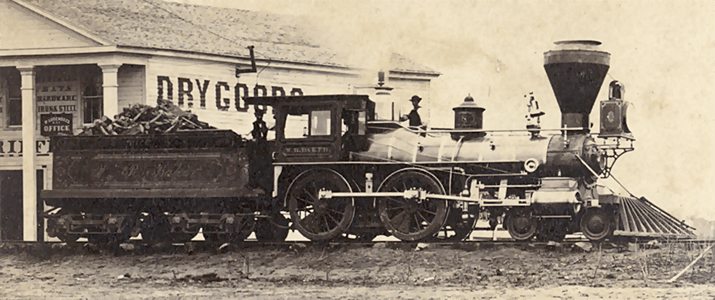
Postwar Houston & Texas Central Locomotive W. R. Baker, c. 1868. Southern Methodist University Libraries.
I’ve traced what I think is the correct route in Google Earth, which can be downloaded here. One of the great things about a tool like Google Earth (or more formal GIS tools like ArcGIS) is that while the original feature may be long since gone, the changes it makes to the terrain are often visible for generations later, particularly in an aerial view. The route is almost perfectly straight from Hempstead to the Brazos River, where the land is flat; it takes a more meandering path west of the Brazos, where there are gently-rolling hills to deal with.
__________

Public Talk: “Yellow Fever in Galveston During the Civil War”
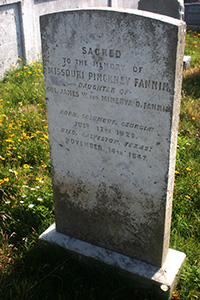 My colleague, Jim Schmidt, will give the final 2012 Menard Lecture tomorrow, Sunday, at 2 p.m. at Menard Hall, 33rd Street and Avenue O in Galveston. Tickets are $10 for GHF members and $12 for non-members. It’s going to be a great talk. Having read some of Jim’s work on the subject, I know it will cover a lot of new ground, and folks who are able to attend are in for a treat.
Jim is a chemist by training and profession. After receiving his B.S. in Chemistry from the University of Central Oklahoma, he has worked in a number of private, government, and industrial laboratories, and is currently employed as a scientist with a biotech firm in The Woodlands, Texas. He has had a life-long interest in history, with a special regard for the Civil War. His historical writing credits include more than fifty articles for The Civil War News, North & South, Learning Through History, World War II, and Chemical Heritage magazines, and other publications. Jim is also a popular speaker and has given lectures on the Civil War to groups around the country.
Jim’s books, Lincoln’s Labels: America’s Best Known Brands and the Civil War, Years of Change and Suffering: Modern Perspectives on Civil War Medicine co-edited with Guy Hasegawa, and Notre Dame and the Civil War: Marching Onward to Victory, have received praise from both popular and academic historians alike. His new book, Galveston and the Civil War: An Island City in the Maelstrom, is published by the History Press and is now available for pre-order.
__________________





35 comments