Engaging Confederate Guerrillas on the Tennessee River
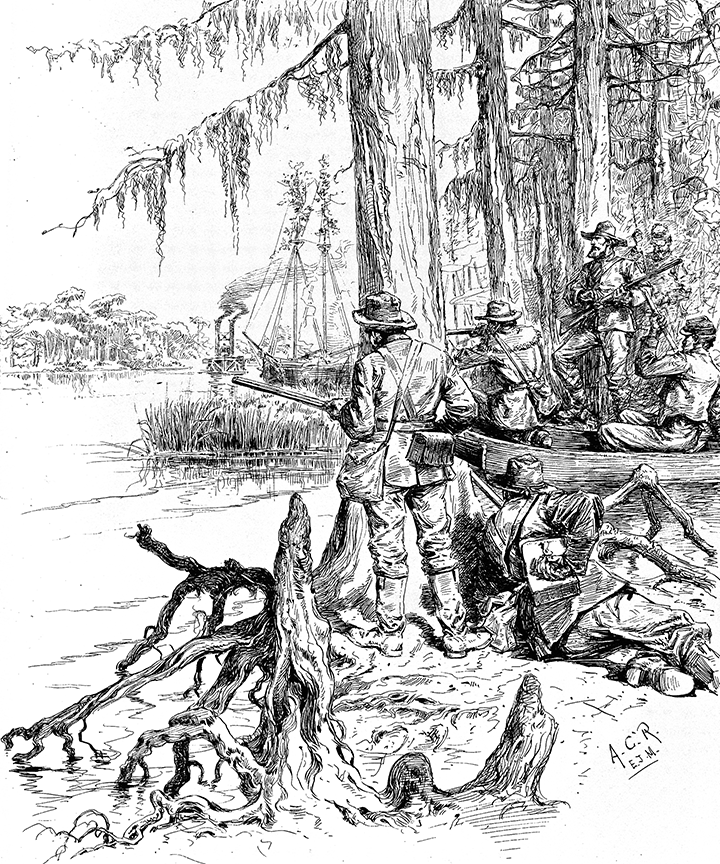
One thing I like about Robert S. Critchell’s memoir, Recollections of a Fire Insurance Man, is how it details some aspects of naval life aboard aboard one of the U.S. Navy’s “tinclad” gunboats on the Western Rivers. There’s scads of material written about Hampton Roads, or the cruise of the Confederate raider Alabama, and lots on the blockade, as well. There seems to be relatively little, though, about less-glamorous, and generally less dramatic, operations of the small, lightly-armored and lightly-armed gunboats like Critchell’s boat, U.S.S. Silver Cloud. Even though the U.S. Navy claimed control of the entire length of the Mississippi from mid-1863 on, as a practical matter was never able to completely cut off communication between the two halves of the Confederacy. Part of their attempt to do that was to commission a large fleet of lightweight gunboats that could engage light forces and maintain at least some semblance of local control over a stretch of river. In many respects, the activities Acting Master’s Mate Critchell and his crew mates were engaged in was very similar to the Navy’s famous riverine operations in Vietnam, a century later.
Here, Critchell describes a typical, and ultimately unresolved, encounter with Confederate guerrillas on the Tennessee River.
It was the duty of the officer of the deck to be in uniform, wearing his sword, to communicate to the other officers, or the crew, all orders given by the captain or executive officer, which were written on a slate (or had been by the watch officer receiving them, and by him, turned over to the succeeding deck officer), to keep the “log,” a book which stated where we were, what boats passed up or down the river and any events of interest, noting drills, “quarters,” and other things showing the details of our daily occupation. Our captain was an “acting master,” afterwards promoted to “acting volunteer lieutenant,” on account of bravery and good conduct in an action in which the boat he was on was engaged in Arkansas. While slowly ascending the crooked waters of the Tennessee river, one morning, the quartermaster on “lookout,” who was stationed on the hurricane deck, over my head, I being officer on deck at that time, came down and reported “guerrillas ahead, on the shore.” He handed me the glass, and indicating the spot where he saw them, I looked through the glass and saw ahead a number of men who were evidently trying to conceal themselves behind logs, tree branches and brush. As several boats had been fired upon in this vicinity, we were keeping a sharp lookout. I at once reported to the captain and was ordered to give them a shell with the ten-pounder rifled gun, which was loaded with a percussion shell. This was my first opportunity to use powder on the enemy, so I had the gun’s crew up at once and fired the gun, the shell hit a tree and exploded, which caused the “Johnnies” to get out of their hiding place in quick time and retreat back into the woods. We followed up this shell with another one; but, although we ran close to the shore, when we got to the place from which we had driven them, we could see no more signs of life. This little affair illustrates what the “tinclad” gunboats were for. With few guns and light iron protection for boilers, machinery and crew, they were terrors to the hands of Rebels who with muskets or small field pieces, could kill and wound pilots and crews of unarmed steamboats engaged in carrying troops or supplies in the rivers or engaged in peaceful occupations. The Mississippi and its tributaries had been opened up to navigation, but it was necessary to keep them open. Heavy and slow ironclads could not navigate the shallow river channels in which steamers had to go, and the light craft “tin-clads,” with no heavier armament than twenty-four pound howitzers, were a terror to these sharp-shooters. The twenty-four pound howitzer usually fired a shrapnel shell containing about eighty one-ounce musket balls, and the shell was filled with powder and sulphur, which would cause the shell to explode in from one to five seconds, according’ as its fuse was cut, the range of the gun being about one mile. These exploding shells were a source of fear to the enemy and set on fire any inflammable object they struck.
___________
Excerpt from Robert S. Critchell, Recollections of a Fire Insurance Man (Chicago: McClurg & Co., 1909). Image: “An Incident in the Defense of New Orleans,” by Allen C. Redwood (1844-1922).

Black Confederates, A Subsidiary of Dixie Outfitters
Update, August 10: Near the end of this post, I wrote that “as far as I can tell, neither Barber nor Edgerton have ever explicitly claimed Heritage 411 to be a non-profit organization.”
I was wrong. They claim both non-profit status and that donations to Southern Heritage 411 are tax-deductable for donors:
To those of you who would like to make a tax deductible contribution to a non- profit organization and support H.K. Edgerton now, please make your checks payable to: Southern Heritage 411 and send it to:’ Southern Heritage 411, Inc.
P O Box 220
Odum GA 31555-0220 Dewey Barber
Owner, Dixie Outfitters

Judging from the Internet Way-back machine, this claim has been posted on the Heritage 411 website since (at least) July 2008, more than four years ago.

 Kevin has made a couple of posts recently poking fun at H. K. Edgerton, and his frequent display (when not in Confederate uniform) of different shirts sold by Dixie Outfitters, frequently one with his own image emblazoned upon it. But there’s a method to this, and Edgerton’s sartorial choices need to be understood in the context of his business relationship with Dixie Outfitters. Southern Heritage 411 is a for-profit corporation, registered as such with Georgia Secretary of State from 2006 to 2010, when its license was dissolved because the company repeatedly failed to file its required annual re-registration. Although it is sometimes described as a non-for-profit organization (e.g., on Clint Lacy’s blog), and Edgerton solicits donations constantly, Heritage 411 has never been registered as such with the IRS or any state agency that I can find.

Did you ever wonder why Southern Heritage 411 is located in Georgia, when Edgerton lives 300+ miles away in North Carolina? Turns out, that’s easy — because Southern Heritage 411 is run by Dewey Barber, not H. K. Edgerton.
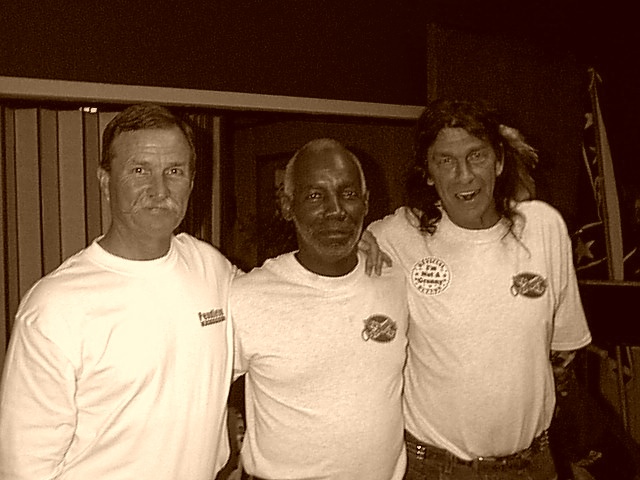
Dewey Barber, H. K. Edgerton and musician Terry Warren, via TerryWarren.net.
The Heritage 411 website is scattered with praise for Dixie Outfitters owner Dewey Barber, and an acknowledgment of Barber’s support for Edgerton (e.g., “HK’s main benefactor is Dewey Barber, who uses HK to sell merchandise from his business Dixie Outfitters“). But in fact, Edgerton is (or at least was, until 2010) effectively Barber’s employee, a junior officer in the company reporting to Barber, who has always been the primary contact for Heritage 411, and from 2007 t0 2010, was the CEO as well. The core truth, as outlined in official filings made by Heritage 411 in Georgia (accessible at the link above) is that Southern Heritage 411 is a for-profit business, run by Dewey Barber, with H. K. Edgerton as the public face of that business. It’s a deeply cynical arrangement, one that takes commercial advantage of Edgerton’s popularity among Confederate Heritage™ groups who embrace Edgerton and his theatrics as a sort of vaccination against being accused of some of the uglier attitudes and beliefs commonly associated with the Confederate flag. Barber’s Heritage 411 operation is, at its most benign interpretation, a sort of under-the-radar marketing enterprise, firing up the True Southrons and encouraging them to (not coincidentally) purchase Dixie Outfitters’ merchandise. It probably brings a good return on investment, too, given the effectiveness of a popular and high-profile representative like Edgerton.

Edgerton with (r.) Clint Lacy, whose blog, “Across Our Confederation,” falsely describes Southern Heritage 411 as a “non for profit resource.” Image via the John T. Coffee SCV Camp No. 1934.
As far as I can tell, neither Barber nor Edgerton have ever explicitly claimed Heritage 411 to be a non-profit organization, but they do seem perfectly content to let people believe they are, and to let others make that claim on their behalf. And Heritage 411 sure makes itself sound like a charitable organization. There’s nothing illegal about soliciting “donations” to a for-profit business like Heritage 411, but I’ll leave it for others to decide how ethical it is, given Edgerton’s continual solicitation of donations — he routinely appends an address for PayPal payments to his e-mails — and presenting himself as a lone voice, a committed and uncomplicated individual fighting the good fight for Southern Heritage™, without mentioning his formal business and legally-binding links to one of the best-known vendors of Confederate-themed merchandise in the country. I suspect there are a lot of folks, taken in by Edgerton’s apparent sincerity, who’ve donated money to Heritage 411 — money they may have been hard-pressed to give — thinking that they’re donating to a non-profit enterprise, when in fact Southern Heritage 411 is just another branch of the Dixie Outfitters’ marketing outreach.
______________

Duck Hunting with the Navy


The other day we had an account of the aftermath of the Fort Pillow massacre written by Acting Master’s Mate Robert S. Critchell (right) of the “tinclad” gunboat U.S.S. Silver Cloud (above). Today’s story is much more fun. Here, Critchell describes a trip on the Mississippi with a distinguished passenger, and an unusual method for replenishing the boat’s commissary.
The first day of January, 1864, was the coldest day that I ever knew in the southern country. At Memphis, where the “Silver Cloud” was then lying, the river was full of floating ice of great thickness and the pieces of ice were so heavy, hard and sharp that the steamboats were laid up, waiting for the ice to become soft and of less quantity in the stream, as it was feared the grinding of the ice would cut through the planking of the hulls and sink the boats. It was very unusual for ice to be so thick and so hard and in such quantities as far south as Memphis. At this particular time General Sherman and his staff came to Memphis. He was very anxious to proceed immediately down the Mississippi river to Vicksburg, so one of his staff officers visited the various gunboats at Memphis and made inquiries as to the possibility of carrying the general and his staff down the river, without delay. Our captain and senior officers decided that it was worth while for us to try it, to accommodate General Sherman, so we at short notice got on board a lot of two-inch pine plank, sawed up into two-foot lengths, a lot of long spikes, some hammers, stages and lanterns. The object of these preparations being that, in case the ice should grind our hull seriously, we would by means of the stages dropped over the gunwales, spike on some of these pieces of plank so that they would stand the grind, rather than the hull. Without waiting to get on board fresh provisions, which we needed to supply our distinguished company, we got on our way and, of course, went very slowly, but successfully got down to Vicksburg, where we remained for two days, giving us all an opportunity to see the wonderful place which had been surrendered by General Pemberton, C. S. A., to the Union army under General Grant on the 4th day of July, six months before this time. We then started back up the river, but still without any better provisions than we left Memphis with, as Vicksburg was a simple military post and its garrison and inhabitants had been obliged to subsist considerably on mule meat during the latter part of the siege. While I was on deck, after leaving Vicksburg, our boat, having proceeded about twenty miles up the river, I saw a small sand island, called in the pilot’s vernacular, a “towhead,” literally covered with geese, ducks and sandhill cranes, the large number being no doubt congregated there by reason of the excessive cold weather. It occurred to me that here was a chance to lay in some fresh provisions, and, asking the captain’s permission to fire one of my twenty-four pound bow howitzers at this flock of birds, I brought the boat slowly up to the island, as near as I could, without frightening the birds away. I then stopped the boat and fired my gun and, by some extraordinary piece of good luck, happened to explode the shell just on the edge of the island. The birds of course rose with the sound of the explosion. As near as I could estimate the distance, I had fired the gun at a range of a mile. Our boat being brought to anchor, I went to the island in the cutter and found a large number of dead birds and some fluttering and badly wounded, which the boat’s crew and myself finished, either by striking them with the oars, or shooting them with revolvers. On returning, the number of dead birds we brought, turned out to be forty-three, of which the large majority were geese and ducks. I had the satisfaction of being patted on the shoulder by our distinguished passenger, General Sherman, and told by him that “we could now have some change of diet,” owing to my good shot. This proved to be the case. We gave the sandhill cranes to the crew, they having a rank flavor and requiring to be boiled, or parboiled, to get this flavor out somewhat, so that they could be afterwards roasted and eaten. I have often told this story at dinners of naval veterans, etc., but always prefaced it with the statement that “I once killed forty-three geese and ducks with one shot,” which, from the above statement, will be seen was a fact. Some years ago, I was called on by a little old man at my office in Chicago, who inquired for me with a peculiar high pitched and squeaky voice. I at once recognized him as a man who had been one of the crew of the “Silver Cloud.” He said he wanted my signature to some pension papers he was sending to Washington. I at first pretended not to be able to recognize him, when he pulled from his vest pocket a small black object, which he told me was the skin of one of the sandhill cranes’ feet that I shot just above Vicksburg and that he had brought that with him to prove to me that he was the man that he claimed to be. I signed his paper with alacrity, on the production of this proof of his identity. At a dinner of a naval veteran society in Chicago, subsequently, at the Union League Club, where there were several guests invited by the members of the society, I was called on to tell my “duck story,” which, like many sailor’s yarns, was considered by those who had heard it before, as a little bit exaggerated. I was so pressed to tell the story that I did so and, when several sarcastic remarks to the effect of “couldn’t I reduce the number of ducks one or two,” were made, to my utter astonishment, one of the guests, a tall, gray-bearded old man arose in his place and said that “he saw that shot and counted the birds and there were forty-three.” I immediately said to this gentleman that I was unable to locate him and asked him for some details of his welcome corroboration of my story. He said that he was General Bingham, at this particular time stationed at the headquarters in Chicago of the Department of the Lakes of the United States army as chief quartermaster. He said that in 1864 he was captain and quartermaster on General Sherman’s staff, and was one of the party that we took on our boat from Memphis to Vicksburg, and he had always remembered the great success of that howitzer shell, particularly as it produced a lot of fresh provisions in the shape of geese and ducks, instead of the “salt horse” of which they had had so much and were so tired.
_____________
Excerpt from Robert S. Critchell, Recollections of a Fire Insurance Man (Chicago: McClurg & Co., 1909).

Oregon “Redneck” Flag Case Moves Forward

Ken Webber, the rural Oregon school bus driver who was fired after refusing to remove a large Confederate flag from his truck, blazoned “REDNECK,” when it was parked in his employer’s lot, has gotten permission to proceed with his case against the local school district. I had understood that the district had been excused from the case because Webber worked for a private contractor, but perhaps they were reinstated as defendants.
U.S. Magistrate Judge Mark D. Clarke ruled against a motion to dismiss the First Amendment case and said the suit should go to trial, according to court records filed in U.S. District Court in Medford. School bus company First Student Inc. and Jackson County School District 4 had argued the case should be dismissed because driver Ken Webber flew the flag as an expression of what he called his “redneck lifestyle,” not protected political speech. Clarke wrote there is enough evidence to allow a jury to find that Webber flew the flag to express his feelings for history and heritage, which other courts have included in freedom of speech protections guaranteed by the First Amendment to the Constitution. The magistrate’s recommendation goes to a judge for final action. No trial date has been set. Webber’s attorney Thomas Boardman called it “a thrilling victory for the First Amendment.”
Well, no — not yet, anyway. This ruling means Webber’s still in the game. It remains to be seen whether the federal judge in the case will accept the magistrate’s ruling and schedule an actual trial. And this:
Clarke also found that Webber’s flag amounted to an expression of his personal beliefs, and could not be considered an expression of policies of the bus company or school district.
I have no idea what those beliefs actually are, which would at least help one understand Webber’s position. As I’ve said before, the interesting thing about this case to me is that Webber, as far as I can see, hasn’t made any claim that his flag is an expression of Southern culture or Confederate heritage or any particular historic connection; he seemingly equates the Confederate Battle Flag with redneckism/redneckitude/redneckery. That’s entirely his prerogative, of course, but advocates for public display of the Confederate Battle Flag ought to be uneasy about that.
______________
Image: Associated Press.

To My Closeted Readership: Be Out and Proud, Say it Loud

One of my readers called a local historical group recently and asked about the source of this image (above) of Will o’ the Wisp, which I’ve used several times here. The person there didn’t know where I got the image, and suggested the caller contact me directly through the blog. That, apparently, was out of the question for the caller, who got a little upset and went off on a ranty tangent about the name of the blog, Dead Confederates, proving that it was anti-Southern, that it showed disrespect for Confederate soldiers and the Southern cause, and so on. For those reasons, this person refused to “log on” to this blog in order to post a query in the comments about the image.
Which is really another way of saying, I read that blog, I just don’t want anyone to know I do.
Now, I’m nothing if not sympathetic. It’s hard to maintain one’s “Confed cred” with one’s butternut buds while admitting that you actually follow the content here. After all, John Stones has warned the make-believe Confederates about visiting blogs like this one, and you sure don’t want to get in trouble with him, right?
I know Stones claims to be tight with Jesus, but lookit: the Lord never said anything in the Gospels about not reading blogs; historiphobia is a modern invention. Y’all need the courage of your convictions. If you read supposedly “anti-Southern” blogs, you need to say so. Set your feet in a wide stance, and stand foursquare against historiographic bigotry. There’s nothing inherently wrong with being curious about the other team, so to speak, and many people have experimented with other historical orientations. Be out and be proud. Tell them you’re here, you’re sincere, and the rest should just get over it.
Above all, remember: Stonewall would want you to.
_______________

What They Saw at Fort Pillow
While doing research on something else, I came across a couple of accounts of the aftermath of the Confederate assault on Fort Pillow, written by naval officers of U.S.S Silver Cloud (above), the Union “tinclad” gunboat that was the first on the scene. I don’t recall encountering these descriptions before, and they really do strike a nerve with their raw descriptions of what these men witnessed, at first hand.
These accounts are particularly important because historians are always looking for “proximity” in historical accounts of major events. The description of an event by someone who was physically present is to be more valued than one by someone who simply heard about it from another person. The narrative committed to paper immediately is, generally, more to be valued than one written months or years after the events described, when memories have started to fade or become shaded by others’ differing recollections. Hopefully, too, the historian can find those things in a description of the event by someone who doesn’t have any particular axe to grind, who’s writing for his own purposes without the intention that his account will be widely and publicly known. These are all factors — somewhat subjective, to be sure — that the historian considers when deciding what historical accounts to rely on when trying to reconstruct historical events, and to understand how one or another document fits within the context of all the rest.
Which brings us back to the eyewitness accounts of Acting Master William Ferguson, commanding officer of U.S.S. Silver Cloud, and Acting Master’s Mate Robert S. Critchell of that same vessel.
Ferguson’s report was written April 14, 1864, the day after he was at the site. It was addressed to Major General Stephen A. Hurlbut, commanding officer of the Union’s XVI Corps of the Army of the Tennessee, then headquartered at Memphis. It appears in the Army OR, vol. 57, and the Navy OR, vol. 26.
U.S. STEAMER SILVER CLOUD,
Off Memphis, Tenn., April 14, 1864. SIR: In compliance with your request that I would forward to you a written statement of what I witnessed and learned concerning the treatment of our troops by the rebels at the capture of Fort Pillow by their forces under General Forrest, I have the honor to submit the following report: Our garrison at Fort Pillow, consisting of some 350 colored troops and 200 of the Thirteenth Tennessee Cavalry, refusing to surrender, the place was carried by assault about 3 p.m. of 12th instant. I arrived off the fort at 6 a.m. on the morning of the 13th instant. Parties of rebel cavalry were picketing on the hills around the fort, and shelling those away I made a landing and took on-board some 20 of our troops (some of them badly wounded), who had concealed themselves along the bank and came out when they saw my vessel. While doing so I was fired upon by rebel sharpshooters posted on the hills, and 1 wounded man limping down to the vessel was shot. About 8 a.m. the enemy sent in a flag of truce with a proposal from General Forrest that he would put me in possession of the fort and the country around until 5 p.m. for the purpose of burying our dead and removing our wounded, whom he had no means of attending to. I agreed to the terms proposed, and hailing the steamer Platte Valley, which vessel I had convoyed up from Memphis, I brought her alongside and had the wounded brought down from the fort and battle-field and placed on board of her. Details of rebel soldiers assisted us in this duty, and some soldiers and citizens on board the Platte Valley volunteered for the same purpose. We found about 70 wounded men in the fort and around it, and buried, I should think, 150 bodies. All the buildings around the fort and the tents and huts in the fort had been burned by the rebels, and among the embers the charred remains of numbers of our soldiers who had suffered a terrible death in the flames could be seen. All the wounded who had strength enough to speak agreed that after the fort was taken an indiscriminate slaughter of our troops was carried on by the enemy with a furious and vindictive savageness which was never equaled by the most merciless of the Indian tribes. Around on every side horrible testimony to the truth of this statement could be seen. Bodies with gaping wounds, some bayoneted through the eyes, some with skulls beaten through, others with hideous wounds as if their bowels had been ripped open with bowie-knives, plainly told that but little quarter was shown to our troops. Strewn from the fort to the river bank, in the ravines and hollows, behind logs and under the brush where they had crept for protection from the assassins who pursued them, we found bodies bayoneted, beaten, and shot to death, showing how cold-blooded and persistent was the slaughter of our unfortunate troops. Of course, when a work is carried by assault there will always be more or less bloodshed, even when all resistance has ceased; but here there were unmistakable evidences of a massacre carried on long after any resistance could have been offered, with a cold-blooded barbarity and perseverance which nothing can palliate. As near as I can learn, there were about 500 men in the fort when it was stormed. I received about 100 men, including the wounded and those I took on board before the flag of truce was sent in. The rebels, I learned, had few prisoners; so that at least 300 of our troops must have been killed in this affair. I have the honor to forward a list(*) of the wounded officers and men received from the enemy under flag of truce. I am, general, your obedient servant, W. FERGUSON,
Acting Master, U.S. Navy, Comdg. U.S. Steamer Silver Cloud.
Ferguson’s report is valuable because it is detailed, proximate in time to the event, and was written specifically for reference within the military chain of command. It seems likely that Ferguson’s description is the first written description of the aftermath of the engagement within the Federal’s command structure. Certainly it was written before news of Fort Pillow became widely known across the country, and the event became a rallying cry for retribution and revenge. Ferguson’s account was, I believe, ultimately included in the evidence published by the subsequent congressional investigation of the incident, but he had no way of anticipating that when he sat down to write out his report just 24 hours after witnessing such horrors.
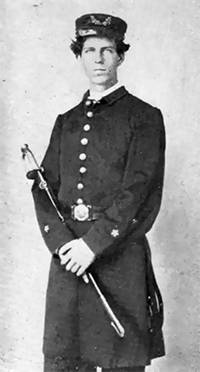 The second account is that of Acting Master’s Mate Robert S. Critchell (right), a 20-year-old junior officer aboard the gunboat. Critchell’s letter, addressed to U.S. Rep. Henry T. Blow of Missouri, was written a week after Ferguson’s report, after the enormity of events at the fort had begun to take hold. If Ferguson’s report reflected the shock of what he’d seen, Critchell’s gives voice to a growing anger about it. Critchell’s revulsion comes through in this letter, along with his disdain for the explanations of the brutality offered by the Confederate officers he’d met, that they’d simply lost control of their men, which the Union naval officer calls “a flimsy excuse.” Crittchell admits to being “personally interested in the retaliation which our government may deal out to the rebels,” but also stands by the accuracy of his description, offering to swear out an affidavit attesting to it.
UNITED STATES STEAMER “SILVER CLOUD.” Mississippi River, April 22nd, 1864. SIR :-Since you did me the favor of recommending my appointment last year, I have been on duty aboard this boat. I now write you with reference to the Fort Pillow massacre, because some of our crew are colored and I feel personally interested in the retaliation which our government may deal out to the rebels, when the fact of the merciless butchery is fully established. Our boat arrived at the fort about 7½ A. M. on Wednesday, the 13th, the day after the rebels captured the fort. After shelling them, whenever we could see them, for two hours, a flag of truce from the rebel General Chalmers, was received by us, and Captain Ferguson of this boat, made an arrangement with General Chalmers for the paroling of our wounded and the burial of our dead; the arrangement to last until 5 P. M. We then landed at the fort, and I was sent out with a burial party to bury our dead. I found many of the dead lying close along by the water’s edge, where they had evidently sought safety; they could not offer any resistance from the places where they were, in holes and cavities along the banks; most of them had two wounds. I saw several colored soldiers of the Sixth United States Artillery, with their eyes punched out with bayonets; many of them were shot twice and bayonetted also. All those along the bank of the river were colored. The number of the colored near the river was about seventy. Going up into the fort, I saw there bodies partially consumed by fire. Whether burned before or after death I cannot say, anyway, there were several companies of rebels in the fort while these bodies were burning, and they could have pulled them out of the fire had they chosen to do so. One of the wounded negroes told me that “he hadn’t done a thing,” and when the rebels drove our men out of the fort, they (our men) threw away their guns and cried out that they surrendered, but they kept on shooting them down until they had shot all but a few. This is what they all say. I had some conversation with rebel officers and they claim that our men would not surrender and in some few cases they “could not control their men,” who seemed determined to shoot down every negro soldier, whether he surrendered or not. This is a flimsy excuse, for after our colored troops had been driven from the fort, and they were surrounded by the rebels on all sides, it is apparent that they would do what all say they did,throw down their arms and beg for mercy. I buried very few white men, the whole number buried by my party and the party from the gunboat “New Era” was about one hundred. I can make affidavit to the above if necessary. Hoping that the above may be of some service and that a desire to be of service will be considered sufficient excuse for writing to you, I remain very respectfully your obedient servant, ROBERT S. CRITCHELL, Acting Master’s Mate, U. S. N.
Critchell’s note about the explanation offered by Confederate officers, who argued that the black soldiers “would not surrender and in some few cases [the Confederate officers] ‘could not control their men,’ who seemed determined to shoot down every negro soldier, whether he surrendered or not,” is worth noting. That was the excuse offered at the time, and it remains so almost 150 years later, for those Fort Pillow apologists who acknowledge that unnecessary bloodshed took place at all. Critchell observed at the time that “this is a flimsy excuse,” and so it remains today.
Critchell’s letter also seems to endorse retaliation-in-kind, “because some of our crew are colored and I feel personally interested in the retaliation which our government may deal out to the rebels, when the fact of the merciless butchery is fully established.” This urge is, unfortunately, entirely understandable, and we’ve seen that within weeks the atrocity at Fort Pillow was being used as a rallying cry to spur Union soldiers on to commit their own acts of wanton violence. Vengrance begets retaliation begets vengeance begets retaliation. It never ends, and it’s always rationalized by pointing to the other side having done it before.
It never ends, but it often does have identifiable beginnings. Bill Ferguson and Bob Critchell saw one of those beginnings first-hand.
_____________
Critchell letter and images from Robert S. Critchell, Recollections of a Fire Insurance Man (Chicago: McClurg & Co., 1909).
You Take Your Victories Where You Can Find Them. . . .
 The white nationalist League of the South is taking a bold stand against anti-racism (?), one men’s room graffito at a time.
Readers will recall that the LoS recently removed from its website a long-standing statement formally denouncing racism. LoS President J. Michael Hill sees this latest public potty protest as a harbinger of grander glories: “things are turning in our favor.” No word yet if “things are turning” over the top of the roll, or around the back side of it.
Honestly, I can’t think of a better venue for the League of the South’s “message.”
At this rate, can it be long before they start bravely flagging empty office buildings at night? Oh, wait. . . .
_______________

The National Dime Museum
As our wars in Iraq and Afghanistan wind down, more and more people are beginning to think about the long-term costs of those conflicts, particularly for the tens of thousands of men and women who’ve suffered serious injuries with permanent effects. The costs will be staggering.
But this is not a new concern. In January 1898 — coincidentally, a month before an American battleship went BOOM! in Havana harbor, plunging the United States into another war — the satirical magazine Puck offered its readers this analogy, with pensioned Union veterans and Uncle Sam as carnival sideshow attractions in the “National Dime Museum” — with the veterans as the Fat Man, getting ever fatter, and a destitute Uncle Sam as the “Living Skeleton.” How long before we start mocking the veterans of Iraq and Afghanistan like this caricature, living off the largesse of the taxpayer?

___________
Image: Library of Congress

Fantasizing Robert E. Lee as a Civil Rights Pioneer
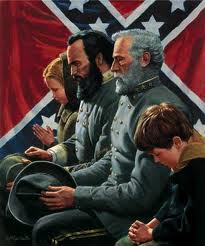 Have you heard the story about how, shortly after the end of the war, Robert E. Lee took communion with an African American man at St. Paul’s Episcopal Church in Richmond, embracing racial harmony and setting an example of Christian brotherhood between former slaves and former slaveholders?
Today’s make-believe Confederates may buy that feel-good story, but real Confederates saw Lee’s actions for what they actually were — a solemn, dignified, FFV-style “fnck you.”
_____________

MoC Appomattox is Doing Just Fine, Thankyouverymuch.
For all the kerfuffle surrounding the opening of the Museum of the Confederacy’s annex at Appomattox a few months back, attendance seems solid:
“We wanted to open last year,” said Museum of the Confederacy/Appomattox site manager Linda Lipscomb, “but that didn’t happen. Still, I think things are going well for us. We’ve had more than 17,000 visitors so far since the end of March, and we’re very happy about that number. We didn’t really set a goal.” Nevertheless, the Museum of the Confederacy in Richmond knew it was taking a chance by establishing a satellite branch. Appomattox’s status as the place where the war ended made it a logical choice. On the other hand, the county really isn’t on the way to anywhere tourists are likely to visit. “We’re a destination,” Lipscomb said. “That’s how we have to look at it.”
It’s benefiting the local business community, too:
Sheila Palamar of the Babcock House Bed & Breakfast in downtown Appomattox would have to agree. Palamar said she has seen a significant spike in both overnight stays and lunch and dinner reservations since the museum opened. “We rented more rooms in June than we ever have in a month,” she said, “and a lot of those people stayed two nights.” This week, she was preparing to happily confront a mini-invasion of her own — 54 Civil War buffs from Salem wanting lunch.
MoC memberships are up, too.
“We’ve added 800 members since we started,” said Lipscomb. “On the day we opened, we offered a special deal for membership, and a lot of people passed on it when they went in. But when they came out, they said, ‘We have to sign up for that membership. We didn’t get a chance to see it all.”
Museums are usually not huge drivers in a local economy; they don’t generally rake in huge piles of cash, and they tend to be very precarious enterprises, from a purely financial point of view. It is a success story when a museum — any museum — can hold its own in terms of attendance and memberships. Seventeen thousand visitors in a period of less than four months, in a (relatively) out-of-the-way place like Appomattox is nothing to sneeze at. If that works out to around 50,000+ visitors annually, that’s a sizable chunk of the 216K people who visit Appomattox Court House NHP each year. I expect, though, that attendance at the MoC annex at Appomattox will increase substantially over the next few years, as we move through the sesquicentennial into 2015. It sounds like the MoC Appomattox is off to a solid start.
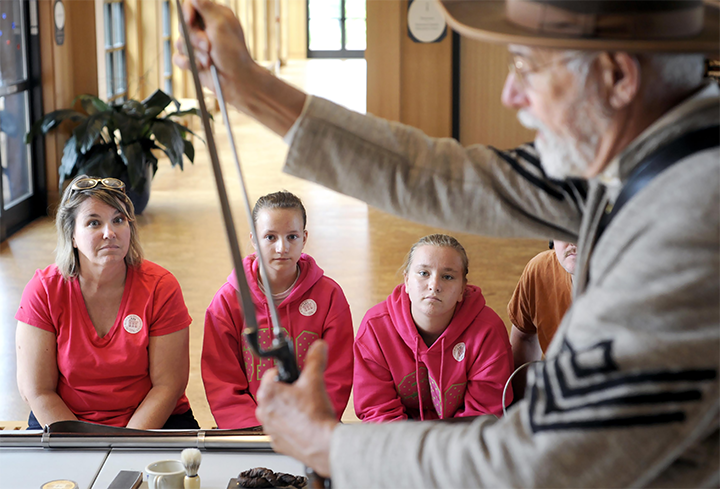
______________Image: Jimmy Lipscomb (right) demonstrates loading a musket for visitors (from left) Tammy Smith, Ashton Fowlkes and Hannah Smith at the Museum of the Confederacy in Appomattox, Va., July 18, 2012. Several days a week, Lipscomb greets visitors with a hands-on introduction to life as a soldier in the Civil War. (Photo by Parker Michels-Boyce/The News & Advance)






18 comments