Stonewall Jackson Killed by His Own Troops (Again)


It’s been a little over a year since the Lexington, Virginia City Council voted to bar all but the U.S., Virginia and municipal flags from city-owned light poles in the town. The decision was met with protests then, but there have been relatively few developments since. There was a lawsuit, of course, that was tossed out by the judge in June, and if there have been any other major developments on the legal side of the dispute, I’m not aware of them.
So to keep stirring the pot, now local SCV Camp Commander Brandon Dorsey points to the closure and layoffs as a local tourist attraction the Theater at Lime Kiln. This, Dorsey, claims, is “thanks to Lexington City Council,” and somehow vaguely the result of political correctness. Dorsey doesn’t actually explain the connection, though, which is not really surprising, given that the attached news item about the closure makes no such inference. Indeed, the article makes it clear that the theater has been in dire straits financially for the better part of a decade:
When the theater launched the fund drive earlier this year, Russell said Lime Kiln “has been on life support for the past several seasons.” He said the theater has managed with a staff of three doing the work of 10, but that there were no more expenses that could be cut, while the theater’s facility continued to deteriorate and consume what little cash reserves exist. The theater has asked Lexington and Rockbridge County to make $200,000 in multiyear pledges by Dec. 31, in order to make needed repairs and build a new permanent rain structure. It also is seeking a $93,000 rural development loan from the U.S. Department of Agriculture. When it asked for that help earlier this year, Lime Kiln said it needed a total of $300,000 by the end of the year to do all the work it needed to do in order to present a 10-performance season in 2013. It hopes to grow to 15 performances in 2014 and to become self-supporting. The theater closed for a while in 2005, and now says its signature production, “Stonewall Country,” seriously overstretched its ability to operate, because of its high cost.
My emphasis. For the record, 2005 is SIX YEARS before the Lexington City Council took action on the flag ordinance.
What we have here is, pretty obviously, a case where a long-standing business that’s been teetering on the precipice for years eventually succumbs to hard economic times and competition for visitors’ entertainment dollars. Although the theater’s signature production, “Stonewall Country” (above), focuses on the life of Stonewall Jackson, there’s nothing in the news story that suggests that show, in particular, was struggling due to lack of attendance or a general antipathy toward Confederate subjects.
Dorsey offers no evidence supporting his suggestion that Lexington Mayor Mimi Elrod and her PC minions are the root cause of this event, or why, exactly, they would want the closure of a cultural venue that brings visitors and their dollars to town. And of course the ordinance passed had no bearing on the theater or any other business in Lexington. Dorsey’s claim doesn’t even make sense, frankly. But while we’re busy making unsubstantiated accusations, I’ll toss in one of my own, that at least has some logic to it.
Gary Adams claims that the SCV/Virginia Flagger boycott of Lexington has cost local merchants $633,271 in lost revenue already. Where that number comes from, I have no idea — citing the source of material he posts is not a big priority for him — and I’m dubious that it’s even a real number than can be attributed to the boycott.
But just for the moment, let’s assume this is a real number, and the boycott has cost local visitor-oriented businesses well over half a million dollars. It’s not hard to see that under those circumstances the boycott, cheered on by folks like Dorsey, Billy Bearden and Susan Hathaway, may have played a very direct role the demise of the Theater at Lime Kiln. I remain dubious that the boycott has had much real effect at all, but if it has, as its backers claim, then their fingerprints are all over the pink slips handed out to theater employees last week.
Once again, Stonewall Jackson has been killed by his own troops. Well done, asshats.
______________

The Passing of Marc Ferguson
 As other bloggers have noted, Marc Ferguson passed away recently. Marc was a regular commenter on this blog, and always willing to share his own experience or a new perspective on the topic at hand. As Kevin suggests, Marc was one of the good guys, who used the Internet to engage in serious and challenging discussion, who was committed to learning and extending knowledge to others. He’ll be missed by many of us.
_____________

Memo to the Union Pacific: You Didn’t Build That

Tuesday’s Houston Chronicle has a story about Navasota, a small town northwest of Houston, being listed in Union Pacific’s Train Town USA Registry. From the railroad:
Navasota will receive an official Train Town USA resolution signed by Union Pacific Chairman Jim Young, and Navasota’s historical connection with Union Pacific will be featured at www.up150.com. “We are proud to recognize Navasota as we commemorate our railroad’s sesquicentennial celebration and growing up together,” said Joe Adams, Union Pacific vice president – Public Affairs. “The bond between our railroad and early settlements continues to strengthen and grow. Today, Union Pacific serves nearly 7,300 communities where we live, our children grow up together and in which we recruit employees. “Our shared heritage with Navasota is a source of pride as we remember our past while serving and connecting our nation for years to come.” The railroad was essential to the birth of Navasota, which brought in major trade and market centers for cotton and livestock. Union Pacific laid 44 miles of track in 1902 to connect Navasota and Madisonville, Texas, and the town declared it a holiday when the first train departed to Madisonville. The line runs through historic downtown on Railroad Street and was added to the National Register of Historic Places in 1982. Today, Union Pacific works with the City of Navasota to create and maintain a landscaped area along Railroad Street, which brings heavy tourism, economic development and future infrastructure projects to the area.
Navasota absolutely is a railroad town, and I’m happy they were awarded this distinction. I hope Navasota Mayor Bert Miller, the city administration and the local chamber of commerce play this for all it’s worth, and can bring in a few extra tourist dollars as a result. That’s all to the good.
But contrary to the narrative suggested by the UP press release, that railroad had precious little to do with either Navasota’s creation or its establishment as a railroad town. Navasota was founded as a settlement in 1854, and in September 1859 was reached by the Houston & Texas Central, which extended just a few miles farther to Millican by the outbreak of the Civil War. The H&TC expanded rapidly after the war, north to the edge of Indian Territory and west to Austin. In 1876-77 the Morgan Line bought controlling interest in the H&TC, only to be itself absorbed into the Southern Pacific in the 1880s. The H&TC continued to operate under its own name until 1927, though — almost seventy years after it first put down rails in Navasota, and a full quarter-century after the UP completed its spur line to Navasota from Madisonville. The UP didn’t take over the Southern Pacific until 1998, fourteen years ago — less than one-tenth the time that Navasota has been a railroad town.
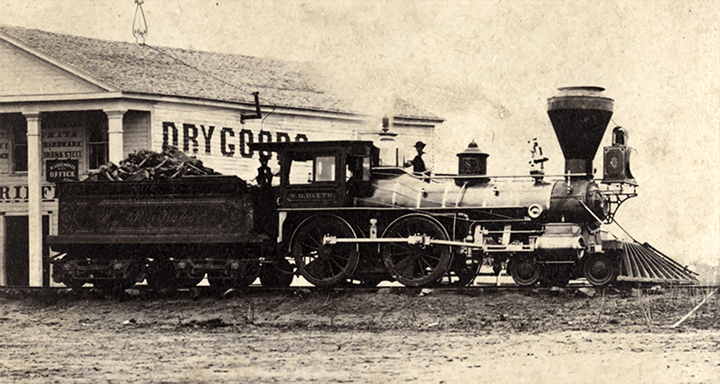
Houston & Texas Central locomotive W. R. Baker, c. 1868. Lawrence T. Jones III Collection of Texas Photographs, Southern Methodist University.

To be sure, I’m not a disinterested observer in this. My grandparents lived in Navasota for 40 years, and my father grew up there. When I was little, we lived nearby, and I spent a lot of time in Navasota. Even though I’ve never lived there myself, it’s a town I feel like I know, and feel a certain ownership in it. And on the other side of my family, I have a relative — a Confederate veteran, in fact — whose home was at Navasota during the war, and who took a job in 1865 as a brakeman on the H&TC. He eventually rose to be Superintendent of one of the railroad’s divisions, and finally, was General Agent for Transportation for the H&TC.
So it’s not for no reason that I find this award, ostensibly celebrating the rail history of Navasota, that doesn’t actually acknowledge the rail history of Navasota, just a little irksome.


Navasota mayor Bert Miller holds a sign announcing the city’s recent membership into Union Pacific’s Train Town USA Registry. Photo By Michael Paulsen/Houston Chronicle.
___________

“They lay as thick as autumn leaves”
Friday, September 19, 1862, near Sharpsburg, Maryland:

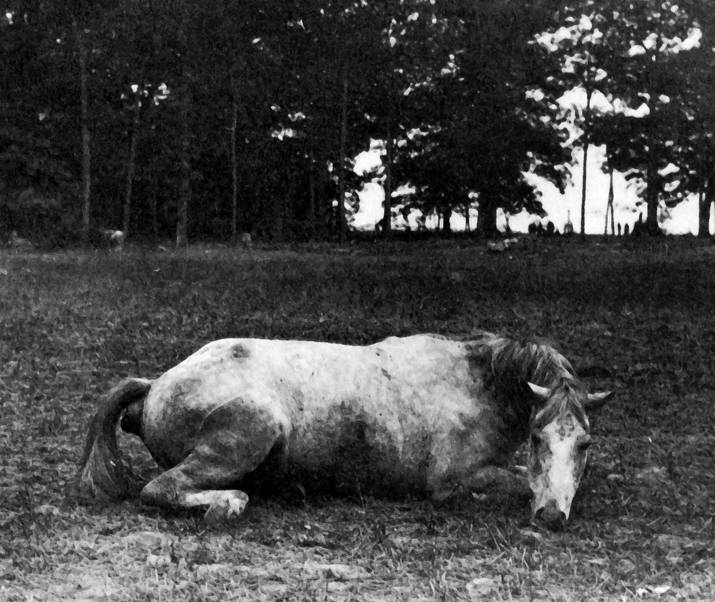
I took the delay to ride over the field of battle. The Rebel dead, even in the woods last occupied by them, was very great. In one place, in front of the position of my corps, apparently a whole regiment had been cut down in line. They lay in two ranks, as straightly aligned as on a dress parade. There must have been a brigade, as part of the line on the left had been buried. I counted what appeared to be a single regiment and found 149 dead in the line and about 70 in front and rear, making over 200 dead in one Rebel regiment. In riding over the field I think I must have seen at least 3,000. In one place for nearly a mile they lay as thick as autumn leaves along a narrow lane cut below the natural surface, into which they seem to have tumbled. Eighty had been buried in one pit, and yet no impression had apparently been made on the unburied host. The cornfield beyond was dotted all over with those killed in retreat. The wounded Rebels had been carried away in great numbers and yet every farmyard and haystack seemed a large hospital. The number of dead horses was high. They lay, like the men, in all attitudes. One beautiful milk-white animal had died in so graceful a position that I wished for its photograph. Its legs were doubled under and its arched neck gracefully turned to one side, as if looking back to the ball-hole in its side. Until you got to it, it was hard to believe the horse was dead. Brigadier General Alpheus S. Williams,
Division Commander, Army of the Potomac

________________________
Alpheus S. Williams, Milo Milton Quaife (eds.), From the Cannon’s Mouth: The Civil War Letters of General Alpheus S. Williams (Detroit: Wayne State, 1959). Image: Library of Congress.
Why the South Lost, Explained in One Photo
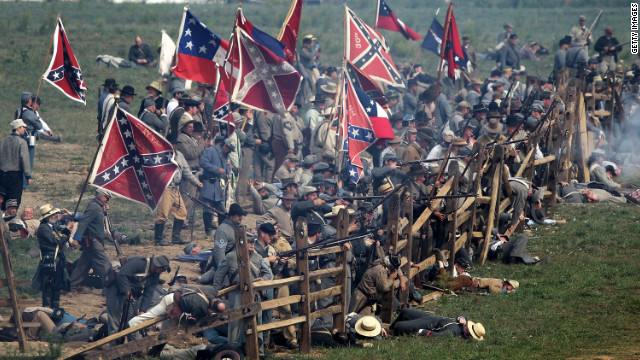
More dudes carrying flags than guns is no way to fight a war.
___________
Image: Confederate infantry re-enactors re-create the Battle of Bloody Lane on Saturday in Sharpsburg, Maryland. Via CNN.

Additional Hatteras Project Photos
New Hatteras News Items

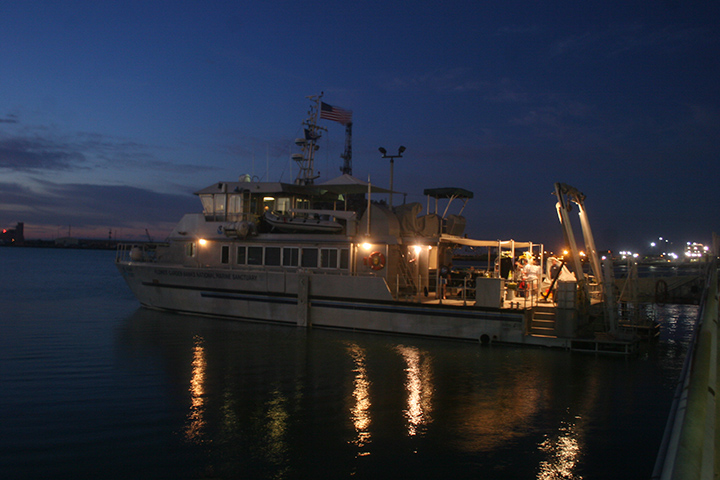
Nautical archaeologist Amanda Evans of Tesla Offshore examines Hatteras‘ starboard paddlewheel. Photo by Jesse Cancelmo.

Two new news items today on this week’s fieldwork on the Hatteras site:
Galveston County Daily News
Researchers Map Hatteras as Anniversary Approaches
Houston Chronicle
Sunken Ship Yields Secrets to Technology
____________

“The Fight of the Hatteras and Alabama”
 A popular song of the Civil War period was “The Fight of the Hatteras and Alabama,” reportedly composed by Ordinary Seaman Frank Townsend (or Townshend) of the Confederate raider. The lyrics were probably first published in 1889 in Frank Moore’s The Civil War in Song and Story, 1860-1865. Townsend may have been a veteran of Alabama‘s entire cruise; he was rescued by the British yacht Deerhound after the battle with Kersarge in June 1864. This song is the first track on the recent Smithsonian Folkways release, Civil War Naval Songs: Period Ballads from the Union and Confederate Navies, and the Home Front.

Preparing for a heavy fight they were to have next day;
Down came the Alabama, like an eagle o’er the wave,
And soon their gunboat Hatteras had found a watery grave. Twas in the month of January; the day was bright and clear;
The Alabama she bore down; no Yankee did we fear:
Their Commodore he spied us; to take us long he burned;
S0 he sent the smartest boat he had, but she never back returned. The sun had sunk far in the West when down to us she came;
Our Captain quickly hailed her, and asked them for her name;
Then spoke our First Lieutenant, — for her name had roused his ire,
“This is the Alabama — now, Alabamas, fire.” Then flew a rattling broadside, that made her timbers shake;
And through the holes made in her side the angry waves did break;
We then blew up her engine, that she could steam no more —
They fired a gun to leeward, and so the fight was o’er. So thirteen minutes passed away before they gave in beat;
A boat had left the Yankee’s side, and pulled in for their fleet;
The rest we took on board of us, as prisoners to stay;
Then stopped and saw their ship go down, and then we bore away. And now, to give our foes their due, they fought with all their might;
But yet they could not conquer us, for God defends the right;
One at a time their ships they have to fight us they may come,
And rest assured that our good ship from them will never run.
____________

Memorial for U.S.S. Hatteras Crew Members
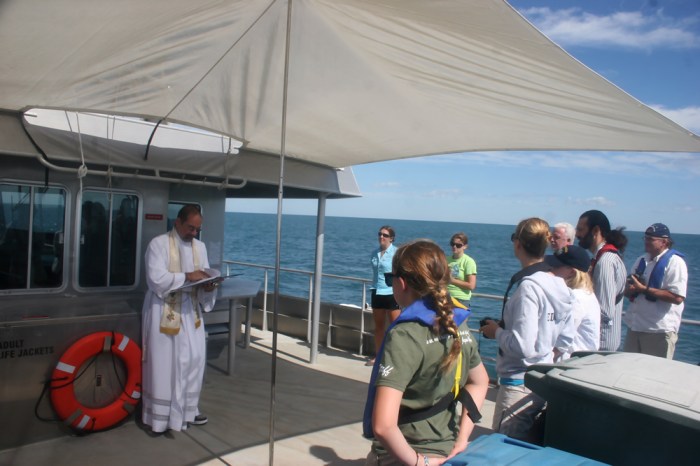
September 10, 2012. Fr. Stephen Duncan of Galveston, Texas conducts a memorial service for U.S.S. Hatteras Fireman John G. Cleary and Coal Heaver William Healy, who died in the battle with C.S.S. Alabama, January 11, 1863. This service, conducted over the wreck of Hatteras, is believed to be the first to honor these men, both of whom were Irish immigrants. The service marked the beginning of an intensive survey of the wreck conducted by a team of archaeologists and technicians assembled by NOAA, that will create a three-dimensional sonar map to document the storm-exposed remains of the USS Hatteras. The wreck itself will not be disturbed, and no artifacts will be recovered. The wreck is a protected site, and because the remains of the two crewmen were never recovered, the site is considered to be a war grave.
________

A memorial wreath and red and white rose petals scattered on the Gulf of Mexico at the site. I’ll have more to write about this project soon. In the meantime, here’s a NOAA press release providing the basic details. More Fr. Duncan here.
__________

Steamboat Veterans for Truth and the 1864 Presidential Campaign

Several bloggers have noted these videos individually, but Corey flags a whole set of them at FlackCheck.org. Who says you can’t critique the excesses of modern campaigning and be funny at the same time?
Here’s one exposing the Homestead Act of 1862 as “wealth redistribution”:

________________






14 comments