Decoration Day at Arlington, 1871
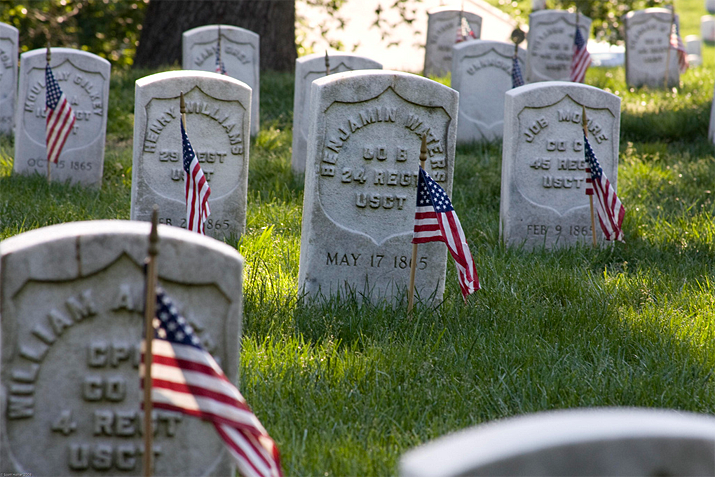

As many readers will know, the practice of setting aside a specific day to honor fallen soldiers sprung up spontaneously across the country, North and South, in the years following the Civil War. Over the years, “Decoration Day” events gradually coalesced around late May, particularly after 1868, when General John A. Logan, commander-in-chief of the Grand Army of the Republic, called for a day of remembrance on May 30 of that year. It was a date chosen specifically not to coincide with the anniversary of any major action of the war, to be an occasion in its own right. While Memorial Day is now observed nationwide, parallel observances throughout the South honor the Confederate dead, and still hold official or semi-official recognition by the former states of the Confederacy.
Recently while researching the life of a particular Union soldier, I came across a story from a black newspaper, the New Orleans Semi-Weekly Louisianan dated June 15, 1871. It describes an event that occurred at the then-newly-established Arlington National Cemetery. Like the U.S. Colored Troops who’d been denied a place in the grand victory parade in Washington in May 1865, the black veterans discovered that segregation and exclusion within the military continued even after death:
 The black soldiers’ graves were never moved; rather, the boundaries of Arlington were gradually expanded to encompass them, in what is now known as Section 27. Most of the graves, originally marked with simple wooden boards, were subsequently marked with proper headstones, though many are listed as “unknown.” In addition to the black Union soldiers interred there, roughly 3,800 civilians, mostly freedmen, lie there as well, many under stones with the simple, but profoundly important, designation of “citizen.” The remains of Confederate prisoners buried there were removed in the early 1900s to a new plot on the western edge of the cemetery complex, where the Confederate Monument would be dedicated in 1914.
Unfortunately, the more things change, the more. . . well, you know. In part because that segment of the cemetery began as a burial ground for blacks, prisoners and others of lesser status, the records for Section 27 are fragmentary. Further, Section 27 has — whether by design or happenstance — suffered an alarming amount of negligence and lack of attention over the years. The Army has promised, and continues to promise, that these problems will be corrected.
As Americans, North and South, we should all expect nothing less.
____________________________________
Images of Section 27, Arlington National Cemetery, © Scott Holter, all rights reserved. Used with permission. Thanks to Coatesian commenter KewHall (no relation) for the research tip. This post originally appeared here in December 2010.

Friday Night Concert: “The Brooklyn, Sloop-of-War”
One of the reasons I enjoy this album is because four of the thirteen songs on it are explicitly about events that happened in the Gulf of Mexico. The four songs are “The Fight of the Hatteras and Alabama,” “Farragut’s Ball,” “The Florida‘s Cruise,” and this one, “The Brooklyn, Sloop-of-War.” Four out of thirteen may not seem like a lot, but it’s more attention than the Gulf gets most of the time when talking about the naval side of the Civil War.
This particular song deals with Farragut’s passage of the forts below New Orleans in April 1862, but Brooklyn gave long service with the West Gulf Blockading Squadron during the war. She was the division flagship stationed off Galveston for a time, and in August 1864 led the Federal fleet when Farragut forced the entrance to Mobile Bay, ending Mobile’s time as a blockade-running port.
__________

2014 “Galveston Firsts” Menard Summer Lecture Series
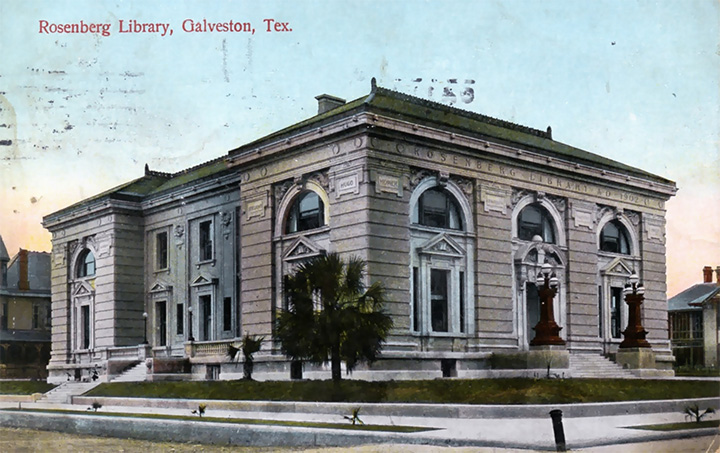
From my colleagues at the Galveston Historical Foundation:
___________
Juneteenth Marker to Be Unveiled
Next month, the Texas Historical Commission will unveil a state historical marker commemorating Juneteenth. It’s been a long time coming:
Thierry‘s point about placing the marker at the “most accurate, documented, historically significant venue” is well made. the location at 22nd Street and Strand is the former site of the Ostermann Building, which served as Granger’s headquarters. Backgrounder on the competing traditions on Juneteenth in Galveston here.
__________
Civil War Blockade Running on the Texas Coast
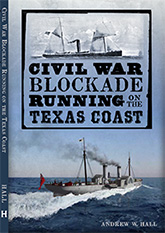
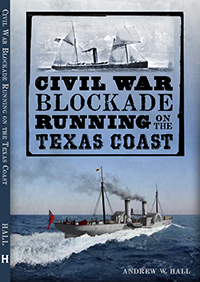 My new book, Civil War Blockade Running on the Texas Coast, will be released by the History Press on June 10. It’s available now for pre-order at the History Press, on Amazon and Barnes & Noble. An e-book version should follow this summer. This short volume discusses blockade-running in the western Gulf of Mexico, with particular emphasis on the last year of the war, when Galveston became the last remaining port in Confederate hands in the region. Running the blockade under sail, life aboard the Union ships of the blockade, and the lure of prize money are also discussed. The book includes an epilogue that discusses some of the archaeological work done on runners over the last 40 years.
Blockade-running in this area has been an active interest of mine for nearly 20 years, and I’ve been privileged to contribute to the documentation of four different ships involved — the famous runners Denbigh and Will o’ the Wisp, as well as Union vessels U.S.S. Arkansas and U.S.S. Hatteras. Lots of folks have helped me along the way, and I’m grateful to all of them.
____________

____________
U.S.S. Westfield Presentation, Houston, May 13

Folks in the Houston area will want to mark their calendars for next Tuesday, May 13 at 7 p.m., when Justin Parkoff and Jessica Stika speak about the USS Westfield preservation project. The Westfield wreckage lay in the murky waters of the Texas City ship channel until 2009, when the dis-articulated artifact debris field was recovered in Texas’ largest marine archaeology rescue project to date. Although the hull itself was not preserved, learn how the experts at Texas A & M University’s Conservation Research Laboratory have used modern technology to glean clues from this scant archaeological evidence. Admission is free and refreshments will be served.
__________
Is Cinco de Mayo an American Civil War Holiday?

I can’t let May 5 slip past entirely without flagging an article from CNN, asking whether Cinco de Mayo, the anniversary of the Battle of Puebla (above, in reenactment) in 1862, is fundamentally an American Civil War holiday. David Hayes-Bautista, Director of the Center for the Study of Latino Health and Culture at the UCLA School of Medicine, believes it is:
I’ll have to cogitate some on this idea that Puebla was viewed by Hispanics in the Far West as, in effect, a proxy Union victory. It’s certainly true that a good many Hispanics served the Confederacy, as well. We do sometimes forget, these days, how fluid borders and cultures were in the Southwest 150 years ago. The hero of the Battle of Puebla, Ignacio Zaragoza Seguín, for example, was born at Presidio la Bahía, near present-day Goliad, Texas in 1829.
In the meantime, I think I’ll fire up Netflix streaming and revisit that period with Cinco de Mayo, La Batalla (2013). Here’s Zaragoza’s address to his troops before the battle from that film:
__________
(h/t Civil War Talk user KansasFreestater)
Tom Liljenquist Continues to Amaze
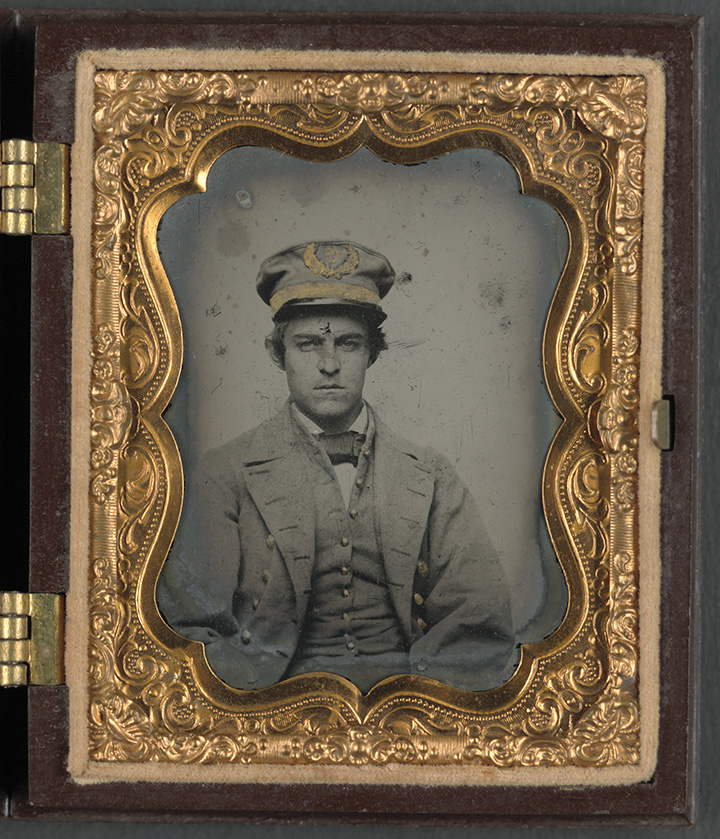
As many of you know, Tom Liljenquist is a longtime collector of Civil War-era images, particularly ambrotype portraits of soldiers, sailors and civilians. Starting with an initial gift of almost 700 images in 2010, Liljenquist has donated these images to the Library of Congress, where they’ve been indexed, scanned and put online in high-res format for the general public to use and download. Liljenquist’s perseverance in collecting these images is surpassed only by his commitment to sharing them with the rest of us.
One thing I didn’t realize until recently is that Liljenquist’s donation was not a one-time event, but continues as he acquires new material. I was initially surprised to find this image of an unidentified Confederate naval officer, sure I would have seen it before. But it turns out that Liljenquist only acquired the image last year, and it was cataloged and scanned by LoC as recently as last month, April 2014.
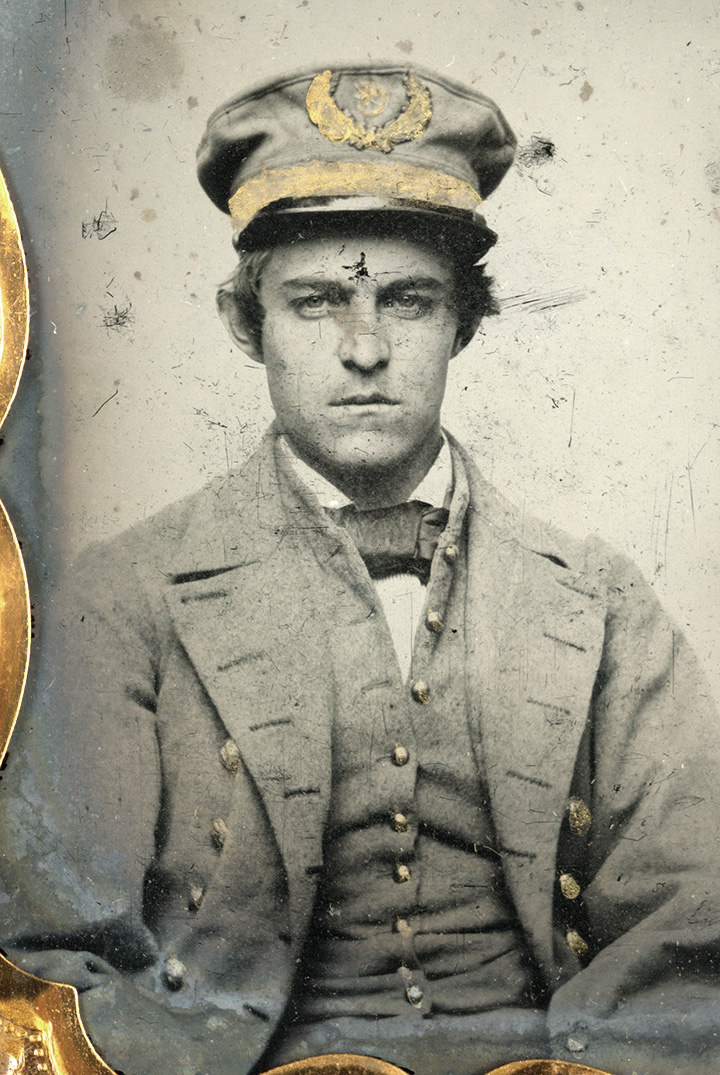
This particular image is interesting. Portraits of C.S. naval personnel are uncommon. This officer seems particularly well-accoutered, dressed in a standard naval uniform under the regulations adopted in 1861.
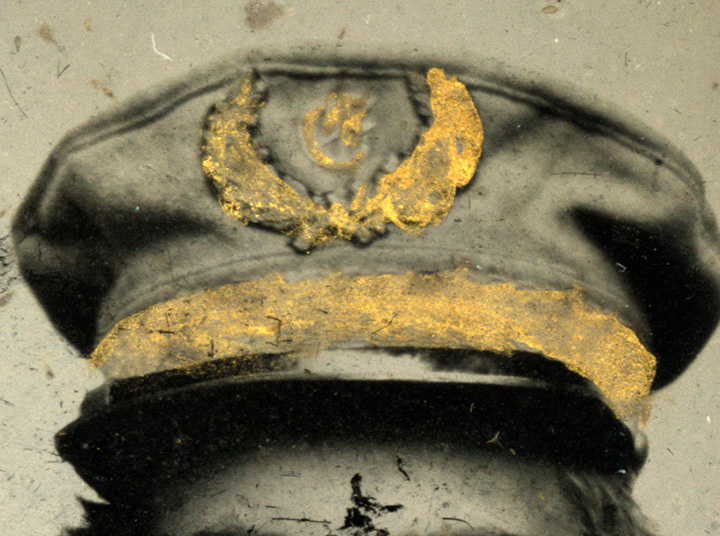
 If you reverse the image left-to-right, and look closely under the hand-applied gilt paint, his cap appears to carry an Old English letter E within the wreath, which would be the badge of a Second- or Third Assistant Engineer (right). I wonder who he is.
____________
Canister!
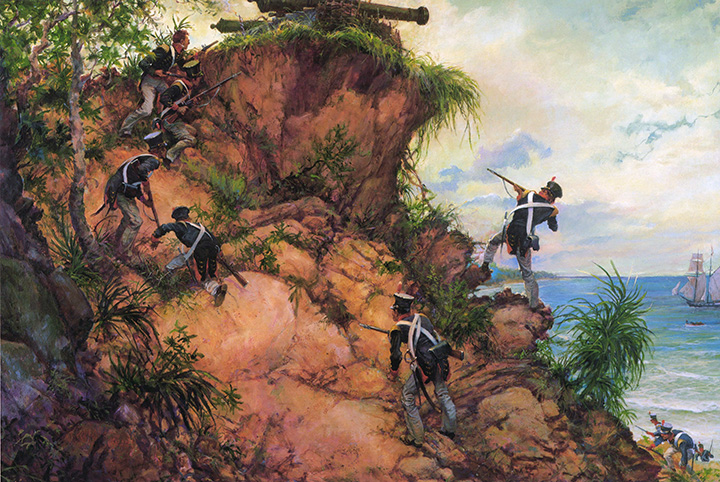
I’d like to extend my thanks to the Laffite Society of Galveston, that invited me to give a short talk last Saturday at their annual research seminar on David Porter’s campaign against pirates in the Caribbean. (Above, Marines storm a shore battery at Fajardo, Puerto Rico in 1824, in a painting by the late Col. Charles H. Waterhouse, USMCR, Ret.) They’re a great bunch of folks, who have done solid work in sorting out fact, maybe-fact and total BS when it comes to documenting the lives of Jean and Pierre Laffite. If you’re interested in a good biography of those two, I’d recommend Jack Davis’ book.
More assorted items:
- Conservators in Charleston are embarking on a new phase in the Hunley story, a three-month process to remove the concretion inside and outside the boat’s iron hull plating. This might provide provide more specific evidence of what caused the craft to sink.
- Researchers in San Fransisco have found the wreck of City of Chester, a passenger ship that sank in the Golden Gate after a collision with the much larger steamer Oceanic in 1888. Interesting to maybe no one but me, Oceanic was the first ship of the famous White Star Line and pioneered the idea that transoceanic steamers should focus on luxurious accommodations and good food (at least for those in first class), a tradition that runs right down through the cruise industry today. Oceanic also carried round-the-world racers Nellie Bly and Elizabeth Bisland across the Pacific in late 1889 and early 1890, respectively.
- Ever seen a “zonkey”? Me neither, but they’re cute.
- Slate has an interesting article on female CW reenactors, if you can get past the smug “subculture-within-a-subculture” business.
- Remember on Seinfeld when George Costanza went to work for Donald Sterling and the LA Clippers? Good times.
-
I’ve long thought that, as much as I disagreed with their historical narrative, the UDC at least didn’t embrace the open, explicit racial nastiness that runs as an undercurrent through other “heritage” or southern nationalist groups. After seeing that the Alabama Division of the UDC hosted a speaker for a prominent event who openly posts trash like this to Facebook, I’m not so sure, now:
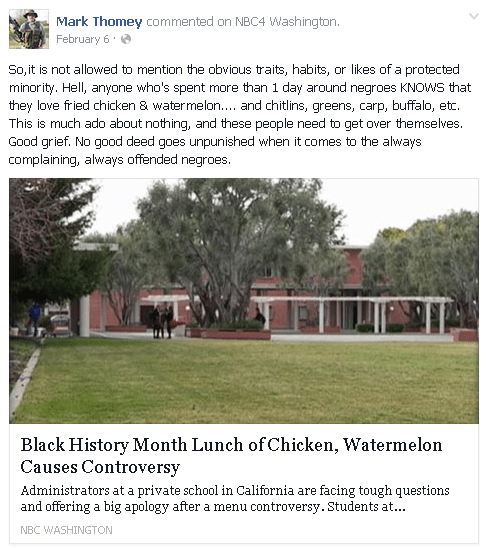
Ms. Clark, I’d love to hear a (plausible) explanation of why you and the Alabama UDC selected this person to headline your event. (H/t Brooks)
Finally, in honor of Willie Nelson’s 81st birthday this week, here are two of his songs. The first is Willie singing “Hello, Walls,” on the Porter Waggoner Show in about 1962, and the second is a favorite of mine, “Uncloudy Day.” Have a great weekend, y’all.
_________
“What will you do, Mr. & Mrs. White Southerner. . . ?”
Gary Adams is sorry.
It seems that on Tuesday someone posted a nasty little screed over at SHPG urging white southerners to band together against the “blacks, Hispanics, Jews, etc.” who are set on “‘get[ing] even’ with the White Devils.” It was up for a couple of hours before it was removed and the person who posted it got booted from group’s membership. Gary assumed responsibility for the post, and apologized for it. And I am certain that he is sincere about that.
Nonetheless, Gary left out one really important fact about that post. It wasn’t some random new member who posted those paragraphs, but arguably the most prominent southern nationalist today, League of the South President J. Michael Hill:

 I know Gary and other folks at SHPG are embarrassed by this, but they should also be embarrassed that some of their members obviously agree with Hill. If Gary and the rest of the leadership at SHPG were serious about calling out such vile people, they would do so by name. Hill’s post is only surprising for its location; his views, and the those of the League of the South, have been very clear for a while now. Whether they saw that particular posting or not, I’m sure nearly everyone on SHPG knows who Hill (right) and his group are; why protect them by giving them anonymity in their bad behavior? Is it because many prominent members at SHPG — John Stones, Robert Mestas, Valerie Protopapas, Carl Roden, Susan Frise Hathaway, David Tatum, Jimmy Shirley and Karen Cooper — are (as of this writing) social network friends of Hill’s?
While you’re at it, Gary, you might want to ask yourself why a smart, calculating man like Hill would think his message would have a receptive audience at SHPG — which, for at least some folks, it absolutely did.
I know that Gary and the other folks at SHPG won’t ask those questions. But one can hope.
If Confederate Heritage™ means covering up for reprehensible characters like Michael Hill, it damn well deserves to whither and die.
__________





 Dead Confederates, A Civil War Era Blog
1 comment