More Photo Mysteries Uncovered

The new issue of Civil War Times features a neat bit of detective work by Rick Eiserman, who discovered the likely photographer behind the famous images of the Texas Brigade in its winter quarters near Dumfries, Virginia, in the winter of 1861-62. Eiserman came upon the critical reference while doing more generalized research on the Texas Brigade, in the papers of two Galveston soldiers, William and Charles Schadt:
The Schadts wrote several letters from their Dumfries encampment at Camp Wigfall during 1861-62. I was halfway through an April 2, 1862, letter from William when the words seemed to jump off the page: “When we were in winter quarters Tom Blessing in our company had some dauguean [sic] fixings send [sic] to him and he went to work taking pictures in [sic] we have had a picture taken of the mess you can see it by calling on Mr. Waters or F. Hitchcock either of them will let you have one to take a copy of if you want it.”
My heart started racing as I read and reread that letter. After so many hours of searching specifically for the identity of the photographer, I’d found what I wanted when I wasn’t really anticipating it. The Dumfries photographer had actually been a soldier in the Texas Brigade. But who was this man who had obtained “dauguean fixings,” and how did he know what to do with them?
It turns out that Solomon Thomas “Tom” Blessing, who did indeed serve with William Schadt in Company L, was one of three brothers who worked as professional photographers before and after the war. Between the three of them, they owned or operated studios in New Orleans, Houston and Galveston. Clearly he had the knowledge and skills to take the photographs.

This is good stuff, made better for me by the local connection of the photographer, and the archival source being the incomparable Galveston and Texas History Center at Rosenberg Library here. The Blessings were prolific photographers in the years after the war.
Props as well to Craig Swain, who has his own photographic detective work highlighted in the same issue, along with a feature article on the Union’s 4.5-inch rifle, appropriately dubbed the “Yankee Super Gun.”
_____________
Images: At top, a photo believed to have been taken by Pvt. Tom Blessing of Galveston, Texas, of fellow members of Co. L of the 1st Texas Infantry. Left to right, as identified by Rick Eiserman: Pvt. Charles McCarty, Pvt. Joseph Nagle, Sgt. James Southwick, and Pvt. James Nagle. Photo via Austin History Center, Austin Public Library.

Is a Wirz Execution Photo Misidentified?
Henry Wirz (1823-1865) remains one of the most controversial figures of the American Civil War. Reviled in the North for his role as commandant of the notorious Confederate prison camp at Andersonville, Georgia, Wirz was tried in the summer of 1865 in Washington, D.C. and condemned to death. He was hanged on November 10, 1865, on a scaffold set up in the courtyard of the Old Capitol Prison (below), on what is now the site of the U.S. Supreme Court.
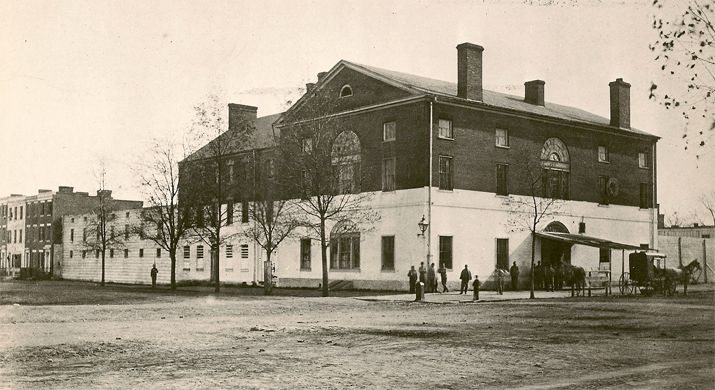
Wirz continues to have many supporters, who argue that he did the best he could to care for the Federal soldiers imprisoned at Andersonville, with the very limited resources he had at his disposal. The Confederacy, they argue, had not sufficient means to care for its own population, much less enemy prisoners, and point to hard conditions in Northern prisons, where lack of resources was far less a problem, in response. They also point out that one of the key witnesses in the prosecution’s case against Wirz was apparently an imposter, who could not have witnessed the things he testified to under oath. Nearly a century and a half after his death, efforts are still being made to exonerate Wirz and restore his reputation.
This post isn’t about any of that.
Wirz’ execution was the subject of a famous sequence of four photographs, now part of the collection of the Library of Congress, taken by Alexander Gardner. The sequence of the photos, as indicated by both their captions and catalog numbers, is usually given as follows:
- Reading the death warrant to Wirz on the scaffold, LC-B817- 7752
- Adjusting the rope for the execution of Wirz, LC-B8171-7753
- Soldier springing the trap; men in trees and Capitol dome beyond, LC-B8171-7754
- Hooded body of Captain Wirz hanging from the scaffold, LC-B8171-7755
The four images were taken from three different locations (below). The first two appear to have been taken from the roof of the prison kitchen (Point A), looking diagonally across the yard where the scaffold is set up. For the image of Wirz’ body hanging from the beam, Gardner moved the camera to the left, and to a higher position to get a clearer view of the body in the trap (Point B). Gardner may have also wanted to frame his shot to capture the dome of the U.S. Capitol in the background. For the shot labeled “springing the trap,” the camera is again at a lower position, similar to the height of Point A, but still further to Gardner’s left (Point C), again with the dome of the Capitol in the background. Gardner’s framing of these last shots is not subtle.

Plan of the Old Capitol Prison, showing the approximate positions of Gardner’s camera during the Wirz execution sequence. The plan is undated (from here), but shows the facility during its use as a prison during and immediately after the Civil War, 1861-67.
After looking closely at these images, though, I believe that these last two are transposed chronologically; the third image, labeled “springing the trap,” is properly the last image in sequence, and shows Wirz’ body being lowered from gallows into the space below the scaffold. The evidence – and somewhat graphic images of the hanging – after the jump:

History Channel Kicks Off the Sesquicentennial
Michael Lynch at Past in the Present is looking forward to this upcoming 2-hour production by Ridley and Tom Scott, Gettysburg. (Rea Andrew Redd also covered this story over at Civil War Librarian.) From the History website:
It’s the summer of 1863, more than two years into our nation’s devastating Civil War, and the stakes have never been higher. The Confederate Army of Northern Virginia, led by Robert E. Lee, crosses into Pennsylvania. Trailed by the Union’s Army of the Potomac, Lee’s 75,000-strong army heads toward Harrisburg, but the forces meet instead near Gettysburg, a quiet farm town that would become synonymous with the epic battle that all but decided the outcome of the American Civil War. For three long days, the two sides clashed in one of the war’s bloodiest engagements to decide the ultimate question: Would the United States of America survive?
Executive produced by Ridley and Tony Scott, GETTYSBURG strips away the romanticized veneer of the Civil War to present the pivotal Battle of Gettysburg in a new light–a visceral, terrifying and deeply personal experience, fought by men who put everything on the line in defense of their vision of the American future. Cinematic in scope, GETTYSBURG is an information-packed look at the turning points, strategic decisions, technology and little-known facts surrounding the battle. Developed in collaboration with highly esteemed Civil War historians, GETTYSBURG reflects hundreds of individual accounts of the battle–the unique voices of struggle, defeat and triumph that tell the larger story of a bitterly conflicted nation.
I’m not sure you can really tell the story of Gettysburg well in two hours, but it should be visually stunning. It will be nice to see what CGI can add to this story; as sweeping as the 1993 theatrical film was, there are just some things you can’t do realistically with live-action. At the same time, though, gee-whiz SFX aren’t enough to tell a real historical narrative well, and I can see this thing going either way — either a landmark documentary that sets a standard for others to follow, or a two-hour demo reel of eye candy, evocative music and little else.
Gettysburg premieres May 30 at 9:00 p.m.
________________

Frankly, my dear. . . .

The scene, driving into school Friday:
[Kid digs around for loose change in the console]
Me: What are you looking for?
Kid: I need 75 cents for popcorn.
Me: Popcorn?
Kid: Yeah, Ms. _____ lets us get popcorn, we’re watching a movie in her history class.
Me: What movie?
Kid: Gone with the Wind. It’s awful, and we all get popcorn ’cause it’s sooooo booooring.
Turns out they’d spent the entire week, since Monday, watching Gone with the Wind in class. The good news, I suppose, is that (according to the Kid) none of it registers with the the other middle school students. They’re not following the plot, they can’t keep the characters straight, and the dialogue is mostly incomprehensible. They’re distracted that one of the leading male characters “has a girl’s name.” The clothing looks ridiculous. They have only the vaguest sense of the course of the war, which is the mostly-off-screen event that drives the entire plot of the picture. Interaction between characters like the one pictured above just don’t register. Gone with the Wind, it seems, is a waste in the classroom when presented in this way; it might as well be a Bollywood musical, with all the dialogue and lyrics in Hindi, for all the effect it’s having. The only thing it’s teaching this class is to remember to bring their three quarters every day for popcorn. (Kevin, teaching at the high school level, has used segments from GwtW, but that’s an entirely different approach to classroom use of the film.)
There’s no question that Gone with the Wind is one of the classic films of all time. And it should be remembered in that context. But it’s portrayal of the Antebellum South and its depiction of slavery is atrocious, Hattie McDaniel’s Oscar notwithstanding. It’s not a history lesson.
I feel like I know Ms. _____ reasonably well, and I’m surprised, to say the least. No idea what’s going on here, or why GwtW would be the film of choice, even if one does choose to coast the rest of the year. (State-mandated standardized testing, which seems to be the tail that wags the dog, wrapped up last week.) There are much better, more historically accurate films out there, although they may not be do-able for the classroom. Glory, for example, is rated R; although the violence in it is probably not more gruesome than what’s seen on prime-time broadcast teevee, an R-rated film is a non-starter in the classroom. Gettysburg came out just four years later, and it’s only PG.
What’s done is done for this year, but I think I’ll drop a note to Ms. _____. I really hate to be one of those parents who’s always getting up in the teacher’s face, and the plain truth of the matter is that we’ve rarely had reason to complain. But there’s got to be something better than this.
__________________

“His name will be inscribed on the roll of true-hearted patriots”

In my recent post on the Lincoln assassination, and the common dismissal of John Wilkes Booth as a “madman” whose actions are both inscrutable and unconnected to the Confederate cause, commenter Corkingiron asked about how Booth’s actions were received at the time, in the South. It’s a great question; the American Experience documentary I cited in reply suggests that condemnation of Booth’s act was immediate and universal.
In fact, it was not.
TSHA’s Handbook of Civil War Texas
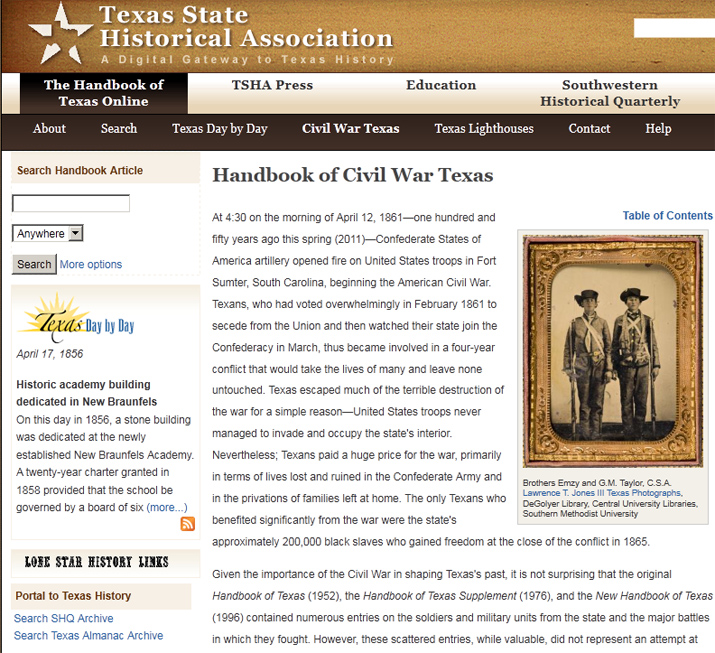
Regular commenter Dick Stanley, who blogs at the 13th Mississippi Infantry and Knoxville 1863, the Novel, points to a new resource available from the Texas State Historical Association, the online Handbook of Civil War Texas. It’s not a separate website, but rather an index to Civil War-related material already covered in the Handbook of Texas, which has for many years been a standard reference for anyone with a serious interest in Texas history. The Handbook began as an actual two-volume handbook, published in 1952; a supplementary volume was released in 1976. The New Handbook of Texas appeared in 1996 — six large volumes of around 1,200 pages each, and at several hundred dollars not a practical purchase for many — but the following year the TSHA began putting the Handbook online, opening up a valuable resource to all.
__________________

No Gettysburg Casino
From Linda Wheeler, writing at the NYT A House Divided Blog:
The controversial proposal to open a gambling casino near the Gettysburg battlefield was shot down this morning when the Pennsylvania Gaming Control Board chose a different applicant for the license. This is the second time developer and philanthropist David LeVan has failed to convince the board that a site near the Gettysburg battlefield is the best place for a gaming business.
Instead, the board voted 6-1 to award the license to a resort in the southwestern part of the state, one of four contenders for the license.
Good. From last summer, a video in opposition:
_________________

Ancestry Continues to Impress
I’ve been using Ancestry.com for a year or so now. While it’s been a tremendous help in tracing my own family lineage, it’s become invaluable in tracking some of the people I’ve discussed here on the blog. Even if I never looked up another family member again, I’d still consider it worthwhile. It’s not cheap, but for the blogging I do, access to online resources like Ancestry, Footnote and GenealogyBank are simply part of the price of admission.
But they continue to impress with new additions. Who would’ve though of this:
The Military Headstone Archive: a one-of-a-kind new collection
Ancestry.com has undertaken an ambitious project to chronicle military headstones, starting with 33 Civil War cemeteries. This interactive collection lets you search gravesites, attach headstone images to your tree and find GPS coordinates for your soldier ancestor’s final resting place. You’ll also get rich context about some of the Civil War’s most important battlefield cemeteries.
In practice, the system is a little dodgy. As a test, I looked up several headstone photos on Flickr, more-or-less- at random, and tried to find them in the new database. I couldn’t locate the first few, but did find that of David Mowery listed as below, at Shiloh:

. . . and this one for William E. Miller at Gettysburg:

One more tool in the collection, and a welcome one.
______________

Southern Heritage Preservation Group: Straight-Up Plagiarism
Corey Meyer has a new and lengthy post up at his place, taken from the Southern Heritage Preservation Group on Facebook. A member The president of that group, Gary Adams, posted a long-ish piece that argues that the prevalence of slaveholding was much more common in Southern households than the low single-digit percentages usually cited for Confederate soldiers. It sounded familiar, and it should — most of it is lifted verbatim from a comment I posted ten months ago (under a different user name) at Kevin’s blog. Indeed, it seems Mr. Adams was posting it on Facebook, without attribution, almost as soon as it went online at Kevin’s. I later expanded this material into a guest post at The Atlantic.
I appreciate that Mr. Adams found my writing on the subject valuable — valuable enough to appropriate and distribute as his own, in fact — but his actions cause one to question what else he’s putting out there under his own name. Adams notes that, when he presented similar arguments on other pro-Confederate Facebook groups, his hosts found his arguments offensive and removed his membership. I wonder whether this case of straight-up plagiarism will result in a similar action on the part of the Southern Heritage Preservation Group.
Update: I realize now that it’s unlikely that the Southern Heritage Preservation Group will take any censure or sanction against Mr. Adams, considering he’s that group’s president.
_________________

Looking Closely at Old Photos
 One of the (many) things to love about the online collections at the Library of Congress is that many of the images there are made available in high- or very-high resolution, in TIFF format. The glass plate negatives used at the time often captured far more detail that is apparent when the image is reproduced in a book, or at a size that fits conveniently on a computer monitor.
Not long ago I used a Library of Congress image of the ferry connecting Mason’s Island (now Theodore Roosevelt Island) to Georgetown. But looking more closely at that image, I keep coming back to one of the privates at the landing, standing guard while his colleagues check the passes of people coming off the ferry. There’s nothing particular about his pose; he’s standing in profile, facing to the left, seemingly oblivious to the photographer capturing his likeness. But even though I know next to nothing about period firearms, his weapon strikes me as unusual. Is that a patch box on the stock? What sort of bayonet is that? Do these details provide clues as to his unit?
And what’s up with the cut of those trousers?
_______________





 Dead Confederates, A Civil War Era Blog
4 comments