A Smart Take on Black Confederates
With all due respect to Kevin and Robert and so many others who’ve pulled apart the Black Confederate meme, spread the pieces out on the table and looked at them from different angles to see what makes it run, Adam Serwer today had one of the most insightful, cut-to-the-core, expose-the-man-behind-the-curtain analyses I’ve seen yet:
White guilt is generally characterized as a liberal phenomenon. The idea is that liberals seek to exonerate themselves from past racism rather than simply meet their obligations to their fellow citizens. To the extent that the former is an accurate description of someone’s motives, the criticism is warranted. But the attempt to minimize the suffering caused by slavery and segregation, to recast the Lost Cause as one motivated by “honor” and self-determination rather than racial supremacy and the preservation of chattel slavery, arises out of the same contemptible emotional impulse. The Lost Causer insisting that the Confederacy was not built on racism because of the presence of black soldiers isn’t any less mired in guilt than the liberal quietly mouthing the names of their black friends as they count them on their fingertips. In both cases, the individual trying to free themselves from history ends up drowning in a bottomless pit of self-pity and self-deception that, over time, can only ferment into rage over inability to find an absolution that will be forever beyond their reach.
_____________
h/t, David White of the Golden Horde.

A Hot Mess of Historiography
I haven’t written much here about the new book by Ann DeWitt and Kevin M. Weeks, Entangled in Freedom, a novel for young people. The book’s protagonist, Isaac Green, is a young black slave in Civil War Georgia who follows his master into the Confederate Army and, by virtue of having memorized the Bible, quickly finds himself voted by the white soldiers to be the regimental chaplain. I’ve tried to avoid the subject in part because Levin has been all over it since the book was announced, and partly because I had intended to publish here an e-mail interview with Ms. DeWitt, trying to get at some of her background and thinking in writing and publishing the work. I contacted her a couple of weeks ago asking if she’d be willing, and she promptly responded positively. But I got lazy and didn’t send her my questions and, in the meantime, the debate over the book has intensified considerably. Last month Mr. Weeks sent a copy of the book and an angry letter to Levin’s employer — very bad form, that — accusing Levin of “slander” and trying to have the book “silenced.” In the back-and-forth that’s followed, both on Levin’s site and Ms. DeWitt’s, both sides have laid out their cases (and likely will continue to do so), and I’m not sure that there’s any point now in doing the e-mail interview. I don’t think it will illuminate much, since neither “side” in the debate is even speaking the other’s language.
Here is what I mean about not speaking each other’s language: Levin’s (and others’) criticisms of the book — what’s known of it — revolved entirely around the historicity of it, how well the fictional story fits within the known historical framework of that time and place. In response, Ms. DeWitt counters with a response outlining her values and motivations in writing the book:
Imagine writing a novel for young adults which (1) espouses the sanctity of marriage, (2) does not contain profanity, (3) promotes earning ones way in America, (4) advocates true friendship, (5) demonstrates the positive progression of America over the last 150 years, and (6) highlights the strength of the family unit; yet, the novel is dubbed “nonsense” by a recognized Virginia Civil War journalist and historian.
The above six principles are the family narratives of Ann DeWitt. I have no 19th century written documentation of these six family values because they were passed down to me verbally by my ancestors. I do not secretly hide them but proudly share them with the world.
It’s clear that, far from defending the research and historical background presented in the novel, she doesn’t understand the criticism of it. None of those “principles” have anything to do with the historical accuracy of the setting or the plot. One could write such a work in any of a thousand settings, and and frame it in a way that is, if not historically documented, at least plausible. Laura Ingalls Wilder is the obvious example of doing this, although she had the advantage of having actually lived the life she described in her writing.
DeWitt asserts that “these six family values because they were passed down to me verbally by my ancestors.” Okay, fine, but no one’s asking for documentation of her family values. This statement reveals something much more essential here, specifically that, in Ms. DeWitt’s view, criticizing the historical accuracy of the book is criticizing her family, and her values. She sees it not as criticism of her work, but as a personal attack on her. It’s not the same thing at all. I don’t doubt that Ms. DeWitt is a very well-intentioned and sincere person, but having good intentions and a strong moral compass is not enough when it comes to presenting a believable and realistic picture of the past.
Ms. DeWitt and Mr. Weeks haven’t written an historical novel; they’ve written a moral allegory nominally set in the Civil War. But it’s not the South that existed in 1860s or, for that matter, the 1960s. Ms. DeWitt and Mr. Weeks have constructed a Confederacy where wise people “in the Deep South knew all the time that black people are cut from the same board of cloth as whites,” and “knew that slavery wasn’t going to last always.” Alexander Stephens and George Wallace never existed in this version of the American South. Ms. DeWitt and Mr. Weeks have the notion of historical fiction exactly backwards; the goal is to tell a story that fits within the larger, factual context of its setting, not to create a fictional history that supports the particular story one wants to tell for other reasons.
The passage Levin posted recently shows that the historical framework for the novel is based largely on Black Confederate factoids and memes culled from the web. Just that one short passage — 648 words — crams in multiple Black Confederate bullet points, strung together by stilted dialogue. Only a tiny percentage of Confederate soldiers owned slaves? Check. Harper’s Weekly reference to black soldiers at Manassas? Check. Loyal slaves will be delivered “a great prize?” Check. Slaves and owners who “get along fine?” Check.
In defending her book and its thesis, Ms. DeWitt has made some extremely odd arguments — so odd or tangential that one might guess that they were meant in jest, though I don’t think they were. She argues — in all sincerity, it seems — that the slaves who went to war with their masters as body servants were the historical equivalent of present-day, college-educated executive assistant, and then extends that analogy further to the entourage that a modern-day U.S. president travels with. She openly wonders why “mark-and-capture,” a technique used to estimate wildlife populations that involves trapping animals, tagging them and releasing them back into the wild to be recaptured and counted at a later date, hasn’t been used to calculate the numbers of Black Confederates. DeWitt does an online search of Confederate pension records from Alabama’s state archives under the surname “Slave” (!), but says cryptically that the archive “does not document if these African-Americans fought for the Union or the Confederate States Army.” DeWitt lists over two hundred men who received “colored” pensions from the State of Tennessee, helpfully adding that “Colored = Black = African-American,” but omits the fact that Tennessee differentiated these from “S” pensions, issued to soldiers. She hints — both on her website and in the novel — that enlistment or service records that do not explicitly identify the subject as white should be taken as de facto evidence of prospective Black Confederates: “CSA enlistment forms and pension applications did not include race, so . . . the world may never know the total number of African-Americans (Blacks) who served in any and all capacities of the American Civil War.” And then there are explanations that are just odd non-sequiturs:
African-Americans want to know their family history for personal as well as medical reasons. We have turned to scientific DNA testing in order to trace our family lineage. As a human being, it is offensive when historians overall imply that my ancestors in South Carolina were not smart enough to band together and run across a field of dying Confederate soldiers to join the Union Army.
As historiography, this is a hot mess. I don’t know Ms. DeWitt; she seems like a very nice, well-intentioned person who’s deeply devoted to her family and its traditions. That’s a good thing, but I fear that she assumes oral tradition, passed from generation to generation, to be sufficient in not only interpreting her own family’s history — I’ve addressed this before with regard to my own Confederate ancestors — but also in understanding the South, the Confederacy and the fundamental nature of the white supremacist slave society the Confederacy was established to protect and promote. The historical world she presents in Entangled in Freedom isn’t based on research or academic study; it’s the product of intuition and her own, deeply-held faith. But those things are not enough, and to frame what’s intended as an uplifting and inspiring personal story within such a farcical historical context does a real disservice to the public generally, and to students particularly.
It’s a missed opportunity.

“I know of no other way for us to end the war than to retaliate”
Running through the 1865 compilation, Soldiers’ Letters from Camp, Battlefield and Prison, I was struck by this letter’s clarity and direct, matter-of-fact language.
Vidalia, La.
May 17th, 1864There has been a party of guerrillas prowling about here, stealing horses and mules from the leased plantations. A scouting party was sent out from here, in which was a company of colored cavalry, commanded by the colonel of a colored regiment. After marching some distance, they came upon the party of whom they were in pursuit. There were seventeen prisoners captured and shot by the colored soldiers. When the guerrillas were first seen, the colonel told them in a loud tone of voice to “Remember Fort Pillow.” And they did: all honor to them for it.
If the Confederacy wish to fight us on these terms, we are glad to know it, and will try and do our part in the contest. I do not admire the mode of warfare, but know of no other way for us to end the war than to retaliate.
Lieut. Anson T. Hemingway
70th U.S. Col. Regiment
I’ve seen no better example of the way one atrocity is used to justify another in wartime, fueling an endless, violent spiral of reprisal and revenge. And yet, knowing what happened at Fort Pillow, I cannot be sure I’d have tried to stop those cavalrymen. The desire for retribution is very strong, and very human.
 Anson Tyler Hemingway was born in East Plymouth, Connecticut in 1844. He moved to Chicago with his family at age ten. Hemingway enlisted in Company D of the 72nd Illinois Infantry and served with that regiment at Vicksburg. Mustered out of the service, he later joined Company H, 70th USCT as 1st Lieutenant and also served as provost martial of the Freedman’s Bureau in Natchez. Hemingway was mustered out of the service in March 1866, after which he attended Wheaton College. Two of Hemingway’s brothers had died in the war. After two years at Wheaton, Hemingway took a position as general secretary of the Chicago YMCA. He later established a real estate business in Oak Park. He died in 1926 at the age of 82.
Anson Hemingway’s grandson Ernest also enjoyed some success as a writer.
__________
Image: Wheaton College Archives and Special Collections
Now We’re Finally Getting Somewhere.

Over the last few weeks there’s been a good bit of discussion about Ann DeWitt and her website on Black Confederates, particularly since the announcement of a new novel for young adults, written by her and Kevin M. Weeks, Entangled in Freedom. The discussion has been pretty volatile over at Levin’s place — who coulda’ seen that coming? — but I’ve tried to steer a little clear of criticizing Ms. DeWitt personally, because she seems a sincere, if ill-informed, advocate for the idea, and because at this point anything else will be perceived as “piling on.” But now, I think, she’s actually (and unwittingly) done us all a favor, by acknowledging explicitly what skeptics have been saying for a long time: that at the core of Black Confederate lies a definition of the word “soldier” that is so broad, so vague and nebulous that the word can be taken to mean virtually anything, and is applied to any person who had even the remotest connection to the Confederate army.
This morning, I noticed her project home page now opens with a definition:
Merriam Webster Dictionary defines a soldier as a militant leader, follower, or worker.
If we’re going to quote the dictionary, let’s be clear: she’s quoting the secondary, alternate definition. By citing it, Ms. DeWitt tacitly acknowledges that the primary definition of the word — “a: one engaged in military service and especially in the army b : an enlisted man or woman c : a skilled warrior” — does not generally apply, or is at least too narrow to describe, Black Confederates as she identifies them. It is not too much to say, I think, that in citing such a broad definition, Ms. DeWitt just knocked over the whole house of cards that comprises most of the “evidence” for Black Confederates.
There’s an old saying that a “gaffe” is what happens when a politician accidentally speaks the truth. This is a gaffe. This is the truth that forms the foundation of most Black Confederate advocacy. To qualify as a Black Confederate, one needs only to qualify as a follower or a worker. In short, the term “soldier” applies to anyone — enlisted man, musician, teamster, body servant, cook, hospital orderly, laundress, sutler, drover, laborer, anyone — involved with the army in any capacity.
A long time ago, I learned a rule that has stood me in good stead ever since: any time a writer or public speaker starts off his or her essay by quoting a definition from the dictionary, you can safely stop reading or listening, because nothing worthwhile or new is likely to follow. That’s still true, but it this case Ms. DeWitt’s use of the technique does do us all a genuine service, by admitting what Black Confederate skeptics have been saying all along — that the movement’s advocates are so loose with the their definitions, so willing to conflate service as a volunteer, enlisted soldier under arms with a slave’s compelled service as a cook and body servant to his owner and master, that the narratives they offer cannot stand close historiographical scrutiny at all. To borrow an analogy allegedly coined by Lincoln himself, Black Confederate advocacy is like shoveling fleas across the barnyard — you start with what seems to be a shovelful, but by the time you get to the other side, there’s very little actually there.
Update, August 22: I just noticed this on the website, as well:
Another challenge is the fact that 19th century CSA enlistment forms and pension applications did not include race, so unless all current SCV members come forward with more historical accounts, the world may never know the total number of African-Americans (Blacks) who served in any and all capacities of the American Civil War.
If I’m reading this correctly, Ms. DeWitt views any Confederate enlistment or pension document that doesn’t explicitly state otherwise to be potential evidence of a Black Confederate. Wowza!
Not sure what the call for “all current SCV members come forward with more historical accounts” means.
United States Colored Troops Support Amendment 62

Company E, 4th U.S. Colored Infantry. Library of Congress.
I don’t like to get too much into present-day politics on this blog, but when folks drag historical figures (real or imagined) into the fray, it becomes fair game for commentary. Personhood Colorado, an anti-abortion group looking to amend that state’s constitution to designate a fetus a “person” under law, has a new radio ad in which an actor portrays a runaway slave who joins the Union Army to fight in the Civil War:
I’m George Stevens and I’m a person. I was held as property as a child. Even before my birth I was called a slave in an America you wouldn’t recognize. But folks like you helped me escape North to freedom and in 1864, I joined the infantry to fight for my country. I fought so all slaves would be recognized as persons, not property. And we won. But today in Colorado, there are still people called property – children – just like I was. And that America you thought you wouldn’t recognize is all around you and these children are being killed. This November, vote “yes” on Amendment 62. Amendment 62 declares unborn children persons, not property. And that’s the America I fought for. . . .
I’m sure “George Stevens” was chosen as a sufficiently common name to allow the producers to avoid having to answer for pinning any specific individual, even a long-dead one, to this cause. According to the National Park Service’s Civil War Soldiers and Sailors System, there were at least ten “George Stevens” serving in black U.S. regiments during the war, and at least one more among state troops, in the 55th Massachusetts Infantry.
There seems to be a lot of this going on lately, latching on to specific historical figures for a sort of endorsement-from-beyond-the-grave. I’m not talking about your run-of-the-mill, homage to leaders of the past in a gauzy, feel-good sort of way, but taking actual (or in “George Stevens” case, fictional) historical figures and presenting them as explicitly endorsing a particular candidate or position. In many of these cases, it seems, the pairing of the candidate and known, established positions of the historical figure are dubious, or even amusing. Rand Paul, the GOP Senate candidate in Kentucky who has questioned the propriety of the Civil Rights Act and has defended the right of private businesses to discriminate based on race — though he’s also said “it’s bad for business” if they do — published an editorial in the Bowling Green Daily News in which he wrote that “when I read history I side with abolitionists such as William Lloyd Garrison and Frederick Douglas,” apparently forgetting the spelling of “Douglass.” Rick Barber, running in the GOP primary for a congressional seat in Alabama, famously ran an ad where he sits in a bar, surrounded by colonial revolutionaries like Sam Adams and Ben Franklin and asserts that the American Revolution began as a protest over taxes, seemingly unaware that it was about taxation without representation, a legitimate problem that Barber’s own candidacy would seem to disprove on its face. Not quite satisfied with that bit of whiplash-inducing logic, Barber followed up with an ad in which he asked Abraham Lincoln (“Hey, Abe!”) the Great Emancipator’s view on federal income taxes, to which the sixteenth president ominously intones, “slavery!” As with his previous ad, Barber’s history here is a little off, given that the Lincoln administration imposed the first income tax in U.S. history. Oops.
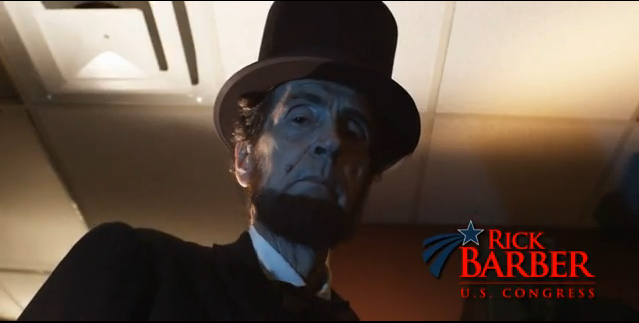
I don’t mind it so much when modern politicians make reference to historical figures, when the parallels actually, you know, make sense, when the current issue or policy position shows a clear and logical lineage. But these recent examples are just silly, made more so by the dissonance between the positions actually taken by the historical figures whose mantles they claim and the modern-day political positions they’ve been exhumed to endorse. Does anyone actually believe that, in their own day, Franklin and Adams would have been considered to stand on the “conservative” side of the political spectrum, or that Douglass favored the federal government keeping out of civil rights issues? Did George Washington really support the idea of violent overthrow of a republic’s elected government? (“Gather your armies!”) And remind me again — what does the historical record say about Private Stevens’ (Stevenses?) position on abortion? I hate to generalize, but I’ve never got the idea that the political forebears of the Tea Party movement — prime backers of both Rand Paul and Rick Barber — were big fans of either Lincoln or strident abolitionists like Douglass, neither of whom were shy about using the force of the U.S. government to pursue their objectives. Is it worth noting that at the same time Personhood Colorado is making a direct and explicit parallel between itself and the abolitionists of 150 years ago, its allies in Washington D.C. are lynching their opponents in effigy?
This is all pretty ridiculous, over-the-top political theater, and I suspect that the vast majority of people see it that way, including those who happen to agree with the candidate in question on the issues. But I’m skeptical that it wins elections. There’s some evidence of that; for all the cable-news airtime and YouTube play Barber’s ads got — over 380,000 views and counting for the “gather your armies!” spot — he got a thumpin‘ a couple of weeks ago in the primary runoff with Montgomery City Councilwoman Martha Roby. And Personhood Colorado may need an entire regiment of “George Stevenses” to pass their constitutional amendment — the last time it came up for a vote, in 2008, it got crushed almost three-to-one.
How to Make a Black Confederate from Nothing at All
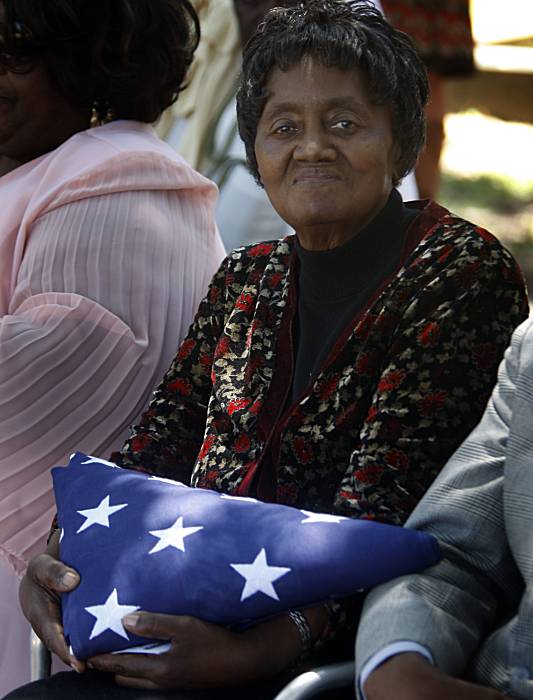
Mary Johnson, granddaughter of Pvt. Samuel Brown, holds an American flag presented to her at the event. Paul Chinn/SF Chronicle
Over the weekend, David Woodbury of Battlefields and Bibliophiles and Kevin Levin at Civil War Memory highlighted a story in the San Fransisco Chronicle, about Samuel Brown, an African American Civil War veteran whose grave in Vallejo, California, was recently marked with a stone commemorating his service with the 137th United States Colored Troops. The event came about because the original stone, which had been on Brown’s gravesite since shortly after his death, designated him as a Confederate veteran. Via the CBS teevee affiliate in San Fransisco, Brown’s grave had originally been marked with a stone that read, contradictorily,

So it was a fnckup at the engravers, simple as that. Someone assumed that a Civil War soldier from Georgia must’ve been a Confederate. Nothing nefarious or conspiratorial. Mistakes like this are unfortunate, but certainly not unheard of. Read the full article here.
What’s most remarkable about this story, though, is not the story itself, but the reaction to it. Corey Meyer, posting at Blood of My Kindred, asks, “is this how Black Confederates are created?”
Why yes, Corey. Yes it is.
As Corey points out, the comments section of the original story is already filling with posters who, based on nothing at all, are accusing the ceremony’s organizers with changing Pvt. Brown’s history to conform to modern-day political correctness, and to cover up the fact that Brown was really a Confederate soldier. Commenter levesque writes, “my uninformed guess is that Mr. Brown was a black Confederate soldier who surrendered to occupying Union Army forces in Georgia.” He continues, “As anyone who has seen Gone With the Wind knows. . . .”
An “uninformed guess,” based on watching Gone with the Wind. There’s some scholarship. Watch out, Blight, you effete liberal hack, levesque is gunnin’ for your endowed chair.
Someone calling him- or herself whiteheat uses Brown as a jumping-off point for a Beckian rant about Lincoln and how he started the long, slow destruction of Real America™:
What this article does not mention is that many African slaves did indeed fight for the Confederacy. Lincoln’s ‘Emancipation Proclamation’ was issued two years into the civil war, and was mostly for propaganda purposes, since Lincoln said repeatedly that he would be willing to retain slavery if it would preserve the Union. Lincoln was all about Federal power and Big government. He also believed that whites and “negros” could not live together as equals.
After presiding over America’s most destructive war (quite a feat) Lincoln’s additional legacy is that he got us lurching towards Empire. America’s decline can (in part) be attributed to this magnificent war-maker.
Yet another commenter, blogorama, brings the snark:
How is this a positive story? For almost 100 years this man was laid to rest under a head stone that identified him as an ignorant buffoon instead of a hero. And his family never noticed. Gee, that’s heart warming.
Enfield53 — get it? — also jumps to the defense of the idea of Black Confederates, saying
Thousands of slaves and free blacks did serve with honor in the Confederate Army. Indeed, twenty percent of the Confederate Navy was black as well. There are hundreds of photographs taken of black Confederates taken with their white mess-mates at reunions held decades after the war. . . .
Dead Confederates regulars are already familiar with the pitfalls of relying on Confederate reunion photographs.
It doesn’t look like Private Brown has been credited as a Black Confederate up to now, but I wouldn’t be surprised if that changes. The claims made for Black Confederates are often based on the flimsiest of evidence, and a headstone reading “CONFEDERATE STATES ARMY” is undoubtedly sufficient in this case, especially if one overlooks that the original stone correctly identified Brown’s regiment. That last part is a detail that, I suspect, will get overlooked in the clamor about “political correctness” and denial of Brown’s “true” Confederate heritage. After all, it is the Bay Area. I’m sure somehow this whole thing is Nancy Pelosi’s fault.
Update: The Sacramento Bee has nice coverage of the story with additional details, and the Long Beach Press-Telegram has a story from last March on Brown’s family in the Vallejo area. Below: One of Private Brown’s pension application index cards, dated January 6, 1894, via Footnote.

Simkins Hall Update
From the Houston Chronicle:
The University of Texas’ governing board voted unanimously this morning [Thursday, July 15] to rename a dormitory and park named after former leaders of the Ku Klux Klan. . . .
The new names will be Creekside Residence Hall and Creekside Park.
The dormitory, built in 1955 on the banks of Waller Creek, was named for William Stewart Simkins, who taught at the law school from 1899 to 1929 and previously had been a leader of the Ku Klux Klan in Florida.
The park had been named for Simkins’ brother, former UT regent Judge Eldred Simkins, who also was involved with the Klan.
Good move. Some have argued that changing the name of the dorm is an attempt to cover up or deny an ugly historical fact — “history is history,” they say. That’s wrong. This move is exactly the opposite, in that it exposes a more complete view of both the Simkins brothers and the University of Texas in the first half of the 20th century. Professor Simkins contributed a great deal to the early university. That is widely recognized, and will not change. But he brought with that a shameful and hateful advocacy for racial violence and intimidation. He never repudiated that; in fact, he reveled in it. That is not something that should be honored, and you cannot honor the man without honoring the whole man. And in the Simkins brothers’ case, theirs is a deeply disturbing legacy.
William Stewart Simkins, the Klan and the Law School
On Friday, University of Texas at Austin President William Powers Jr. issued a statement calling on the university’s Board of Regents to change the name of Simkins Hall, a dorm for graduate and law students. The dorm, built in the 1950s, is named for a famed UT law professor who was a Confederate officer and, as a recent publication points out, a senior leader of the Ku Klux Klan in Florida during Reconstruction and a lifelong, unabashed defender of the “Invisible Empire” throughout his later tenure at the university. The Board of Regents is likely to consider the president’s recommendation at a meeting this week.
 William Stewart Simkins (1842-1929) was a well-known member of the faculty at the University of Texas, teaching there from 1899 to 1929. Although he officially attained emeritus status in 1923, he continued to lecture weekly until his death. “Colonel Simkins,” as he was sometimes called, was a memorable teacher, and something of a character. He was grumpy and irritable. He drank whiskey and once got into a famous argument with the temperance leader Carrie Nation. “Many students were scared of him,” one old alum wrote, “but I always got on well with him and did well in his class.”
Simkins was a South Carolinian by birth, and enrolled at the Citadel in the years just before the outbreak of the Civil War. In January 1861, it was Cadet Simkins who sounded the alarm when lookouts sighted Star of the West, a civilian steamer sent by the Buchanan administration to bring supplies to the Federal garrison at Fort Sumter. (Some contemporary accounts credit Simkins with firing the initial gun, widely recognized as the first shot of the Civil War.) Simkins was subsequently commissioned as an artillery officer in a South Carolina battery, participated in the defense of Charleston Harbor in 1863, and ended the war in 1865 as a colonel.
After the war, Simkins settled in Florida, where he and his older brother, Eldred James Simkins (1838-1903), soon helped organize that state’s Ku Klux Klan. By his own admission, William Stewart Simkins played a central role in coordinating that organization’s violence and intimidation against both white “carpetbaggers” and African Americans who challenged the prewar social or political order. Simkins not only acknowledged his role in the Klan’s violent activities, he fairly bragged about his own deeds. In an infamous speech he gave fifteen years after joining the UT faculty — and a half-century after the war — Simkins told of how he ambushed an African American state senator who had spoken out publicly against Simkins’ and his friends’ publication of a anti-Reconstructionist newspaper:
Now in the same town there was a negro [sic.] by the name of Robert Meacham who was. . . brought up as a domestic servant in a refined Southern family and absorbed much of the courteous manner of the old regime. He had been highly honored by the Republican party; in fact, had been made temporary chairman of the so-called Constitutional Convention heretofore referred to. He was at the time of which I am now speaking State Senator and Postmaster in the town. I could hardly exaggerate his influence among the negroes; glib of tongue, he swayed them to his purpose whether for good or evil; in a word, he was their idol. On one occasion he was delivering a very radical speech in which he referred to the paper which we were editing as that “dirty little sheet.” He was correct as to the word “little,” for it was not much larger than a good size pocket handkerchief; but it was exceedingly warm, a fact which had excited his ire. The next day, being informed by a friend who was present of Meacham’s remark, I called upon him at the post-office and asked an interview. With his usual courtesy he bowed and said he would come over to my office as soon as he had distributed the mail. I cut a stick, carried it up to the office and hid it under my desk. Within an hour he appeared. I told him to take a seat, but I could see that he suspected something unusual as he began to back towards the door. I saw that I was going to lose the opportunity of an interview, so I grabbed the stick and made for him. Now, my office was the upper story of a merchandise building approached on the side by wooden stairs. I hardly think that he touched one of those steps going down; it was a case of aerial navigation to the ground. This gave him the start of me. He was pursued up to the postoffice door and through a street filled with negroes and yet not a hand was raised or word said in his defense, nor was the incident ever noticed by the authorities. The unseen power was behind me. Had I attempted anything of the kind a year before I would have been mobbed or suffered the penalties of the law.
In modern-day Texas, this would be considered aggravated assault — a first-degree felony when committed against a public servant.
Simkins’ active involvement with the Klan may have ended when he and his brother came to Texas and began practicing law in Corsicana in the early 1870s, but his open admiration and promotion of the Klan did not. He continued to be an outspoken champion of the “Invisible Empire” throughout his decades on the faculty in Austin. Simkins’ 1914 Thanksgiving Day speech, excerpted above, was so popular that he gave it again on Thanksgiving the following year, 1915, a date which is widely accepted as the rebirth of the Klan in the 20th century. The speech was subsquently published in the UT alumni magazine, The Alcade.
Professor Simkins’ role as a founder of the Ku Klux Klan in Florida had largely been forgotten until this past spring, when Tom Russell, a law professor at the University of Denver, published a paper (PDF download) on the Klan and its sympathizers as a force that had worked steadily behind the scenes at UT to exclude African American students. Russell had first encountered Simkins’ history when Russell himself had been a faculty member in Austin in the 1990s. Russell presented his paper in March at a conference on the UT campus on the history on integration of the school, and publicly called for Simkins Hall to be renamed. The story was quickly picked up in blogs and editorials, and coverage in the Wall Street Journal and on television news soon followed.
It’s important to remember the time at which the decision was made to name the new dormitory after Professor Simkins. An editorial in the campus newspaper, the Daily Texan, points out that the 1954 decision came just weeks after the Supreme Court issued its famous Brown v. Board of Education ruling. But it’s likely that the regents who considered and approved the move were thinking at least as much about an earlier decision, Sweatt v. Painter (1950), in which a unanimous Supreme Court had rejected Texas’ refusal to admit an African American man, Heman Marion Sweatt, to the University of Texas School of Law on the grounds that there was no other public law school in the state of similar caliber open to African Americans. The Sweatt case was another nail in the coffin of separate-but-equal as enshrined in Plessy, and the State of Texas fought hard against it, going so far as to secure a six-month delay in state court quickly to establish a blacks-only law school at Texas Southern University in Houston — now the Thurgood Marshall School of Law. Considering the rancor that surrounded the Sweatt case — a cross was burned in front of the law school during Sweatt’s first semester — it’s hard to believe that just four years later, when it came time to name the new law school dormitory building, old Professor Simkins’ infamous Thanksgiving lectures, attended by hundreds of enthusiastic and applauding students, had been forgotten.
Russell’s call to remove Simkins’ name from the dorm has generated a lot of interest, and much controversy. Russell has continued to be a strong and steadfast advocate for the change, reminding critics that the issue here is not Simkins’ service as a Confederate officer during the war, but his active involvement with the Klan in the years following, and his enthusiastic support of the violence and intimidation they employed. “Please note that I have no problem with Colonel Simkinsʼs service as a Confederate soldier,” Russell wrote in an opinion piece in The Horn, the UT online news site. “Confederate and Union soldiers alike fought with honor. No one should confuse Confederate soldiers with Klansman. Doing so dishonors the soldiers by equating them with criminals.” I’m not certain, based on his manuscript, that Professor Russell is entirely sincere in drawing a bright line between the conduct of klansmen and wartime Confederates more generally; it may be more of a calculation than a conviction.
Nonetheless, Simkins Hall has got to go.
The Board of Regents is widely expected to accept President Powers’ recommendation to rename Simkins Hall this week. The facility’s new name would be “Creekside Dormitory.”
Additional: At the end of the third-to-last paragraph above, I observed that Professor Russell’s distinction between the action of klansmen like Simkins and Confederate soldiers as a whole was “more of a calculation than a conviction.” After thinking about it a little more, I’m convinced of it, but my comment was somewhat flip and unduly harsh. It’s effective strategy. In adding that short paragraph to his op-ed, Professor Russell takes a necessary and practical step to narrow the focus of his campaign. I have no idea what Russell’s views on the Civil War or the Confederacy are generally, but he very wisely keeps the focus here on Simkins, both his actions as a klansman during Reconstruction and his advocacy for the Klan in the decades that followed. The removal of Simkins’ name from the dorm is an easy case to make, on its own merits; allowing others to redirect the debate into one about the Confederacy (or “political correctness,” or the late Senator Robert Byrd, etc.) is wrong. In three sentences, Russell keeps the focus exactly where it should be in this case, on whether or not a major university should retain the name on one of its dormitories of a man whose explicit and enthusiastically-held actions and attitudes are so entirely out of line with the values the institution stands for. By excluding the Confederacy and the war from his central argument, Russell pares his campaign to its central and essential element, reducing it to a core that is effectively impossible to argue against on its own merits. That’s good lawyering.
Additional, Pt. 2: Tom Russell has a column on this case at the Huffington Post.
Fight of the Century

Jack Johnson in training in Chicago, c. 1907. Library of Congress.
Today is the centennial of the “Fight of the Century” in Reno, Nevada, between Jack Johnson and Jim Jeffries. More than 20 years ago, one of my first “for reals” published pieces was on this famous bout, appearing in the July 1989 edition of Sports History magazine. It’s not very good, and suffers both from my own inexperience and the red pen of an editor who wanted to make it more appealing to a general readership. (I really, really hate the title he gave it.) It lacks both deep analysis and novel insight, but if there’s ever going to be an opportune moment to foist this article off on others, this is it.
(more…)
Old Pete, “Slave Raids” and the Gettysburg Campaign

One hundred forty-seven years ago today, Confederate Lieutenant General James Longstreet, writing through his adjutant, ordered General George Pickett to bring up his corps from the rear to reinforce the main body of the Army of Northern Virginia. The lead elements of the armies of Robert E. Lee and George Meade had come together outside a small Pennsylvania market town called Gettysburg. The clash there would become the most famous battle of the American Civil War, and would be popularly regarded as a critical turning point not just of that conflict, but in American history. More about Longstreet’s order shortly.
I was thinking about that when I recently read an essay by David G. Smith, “Race and Retaliation: The Capture of African Americans During the Gettysburg Campaign,” part of Virginia’s Civil War, edited by Peter Wallenstein and Bertram Wyatt-Brown. All but the last page and a few citations is available online through Google Books. It’s not a pleasant read.
During the Gettysburg Campaign, soldiers in the the Army of Northern Virginia systematically rounded up free Blacks and escaped slaves as they marched north into Maryland and Pennsylvania. Men, women and children were all swept up and brought along with the army as it moved north, and carried back into Virginia during the army’s retreat after the battle. While specific numbers cannot be known, Smith argues that the total may have been over a thousand African Americans. Once back in Confederate-held territory, they were returned to their former owners, sold at auction or imprisoned.
That part of the story is well-known. What makes Smith’s essay important is the way he provides additional, critical background to this horrible event, and reveals both its extent across the corps and divisions of Lee’s army, as well as the acquiescence to it, up and down the chain of command. The seizures were not, as is sometimes suggested, the result of individual soldiers or rouge troops acting on their own initiative, in defiance of their orders. The perpetrators were not, to use a more recent cliché, “a few bad apples.” The seizure of free Blacks and escaped slaves by the Army of Northern Virginia was widespread, systematic, and countenanced by officers up to the highest levels of command. This event, and others on a much smaller scale, were so much part of the army’s operation that Smith argues they can legitimately be considered a part of the army’s operational objective. Smith is blunt in his terminology for these activities; he calls them “slave raids.”
These ugly episodes did not spring up spontaneously; it was a violent and entirely predictable result of multiple factors that had been building for months or years. For a long time, there was growing resentment in Virginia over escaped slaves seeking refuge in Pennsylvania, where there was considerable sympathy for the abolitionist cause, and stops on the Underground Railroad. These tensions increased substantially after the outbreak of the war, as Virginia slaves learned that they could expect to be safe as soon as they reached Union territory, where they would be considered contraband. White Southerners’ resentment of this situation redoubled again in the fall of 1862, with the news that the Lincoln administration would issue the Emancipation Proclamation. This further encouraged slaves to flee to the North, and made it clear to slaveholders — had it not been clear before — that defeat would put an end to the “peculiar institution,” and upend the economy and culture that went with it.

A November 1862 Harper’s Weekly (New York) illustration showing Confederate officers driving slaves further south, to put them out of reach of the Federal armies in advance of the Emancipation Proclamation. The accompanying article told of two white men who escaped to Union lines and
upon being questioned closely, they admitted that they had just come from the James River; and finally owned up that they had been running off “niggers” having just taken a large gang, belonging to themselves and neighbors, southward in chains, to avoid losing them under the emancipation proclamation. I understand, from various sources, that the owners of this species of property, throughout this section of the State, are moving it off toward Richmond as fast as it can be spared from the plantation; and the slaveholders boast that there will not be a negro left in all this part of the State by the 1st of January next.
Against this backdrop, the organization of Federal units of Black soldiers, comprised of both escaped slaves and free men, was taken as an outrage. It struck a raw nerve, never far off in the Southern psyche: fear of a slave insurrection. The prospect of African American men in blue uniforms was taken as an extreme provocation, so much so that it was proposed in the Confederate congress — and endorsed by General Beauregard, the hero of Fort Sumter — that all Federals captured, black or white, should be summarily executed. This proposal was never adopted, but the Confederate congress did eventually pass, in May 1863, a proclamation instructing President Jefferson Davis to exercise “full and ample retaliation” against the North for arming black soldiers.
Finally, there was simple revenge. The Union army’s shelling of Fredericksburg several months before had been a particular sore point, that festered for months as the Confederate army went into winter quarters nearby. One officer, determined to fix the destruction there in his mind’s eye, made a special visit to that town one last time before setting out on the road north into Maryland and Pennsylvania.
So when Lee’s army finally marched north in June 1863, it was fully infused with the intent to exact “full and ample retaliation” on Union territory as it passed. Lee issued orders against the indiscriminate destruction of civilian property, but made no mention of seizing African Americans, whether free or former slaves. In his essay, Smith points out that diaries, letters and even official reports from every division in Lee’s army mention Confederates rounding up African Americans and holding them with the army. The practice was tolerated — if not actively encouraged — by officers at all levels of the army. Even Lieutenant General Longstreet, the most senior of Lee’s corps commanders and effectively the second-in-command of the Army of Northern Virginia, acknowledged the practice and accommodated it. In sending orders to General Pickett, whose corps was bringing up the rear of the army, Longstreet, writing through his adjutant, G. M. Sorrel, sent word on July 1 — the day the two armies first engaged each other — to move his troops toward Gettysburg. In closing he added, “the captured contrabands had better be brought along with you for further disposition.”
“Further disposition” here refers to imprisonment, auction, enslavement, and (often) severe punishment at the hands of a former-and-once-again master.
Those thirteen words closing words of Longstreet’s order are damning, in that they show full well that the seizure and abduction of African Americans was, if not official policy, widely tolerated and made allowance for, even at the highest levels of the Confederate command structure. Longstreet was second-in-command; while his order does not prove Lee knew and approved of this practice, it’s hard to imagine he was unaware of it, and there’s no evidence that he publicly objected to it, or made any effort to curtail it. My intent here is not to condemn Longstreet specifically — the de facto policy neither originated nor was actively encouraged by him — but to demonstrate that the forcible abduction of free African Americans and escaped slaves was known and tolerated, from the lowest private to the most senior generals.
There are many questions, many aspects, of the Civil War that are legitimate sources of controversy and dispute. There are questions that serious historians will argue about as long as anyone remembers this conflict, saying that this politician’s actions were justified by that event, or that general made the right decision because he didn’t know those troops were on the other side of the river. The abduction of free Blacks and escaped slaves from Maryland and Pennsylvania during the Gettysburg campaign is not one of those events. It cannot be justified, or rationalized, or denied. It can only be ignored.
But it shouldn’t be.




 Dead Confederates, A Civil War Era Blog
4 comments