Not Surprising, Part Deux
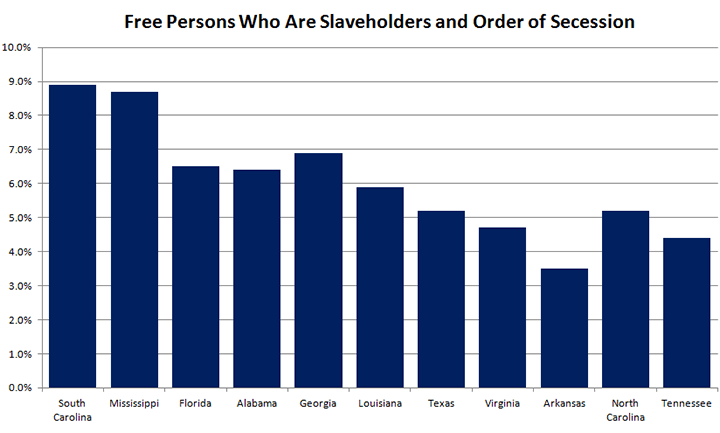
Recently Michael Rodgers reminded me of this post from 2011, in which I pointed out the very tight correlation (beyond -0.9, for y’all stats wonks) between the order in which the states that formed the Confederacy seceded, and both the proportion of slaves and the proportion of slaveholders in their total population. It’s based on a table compiled by David C. Hanson of Virginia Western Community College, and came to my attention via Donald R. Shaffer’s Civil War Emancipation blog. It makes a fundamental point but, in tabular format, the point may not be obvious to all. At the time, Shaffer wrote that “Hanson makes a definite connection between the concentration of slaves and slaveholders in a particular southern states and when it seceded from the Union in 1860-61, and whether it seceded at all. Certainly, there is plenty of anecdotal evidence connecting slavery and Civil War causation, but this table also makes a compelling statistical case.”
It’s more than a “definite connection.” Hanson’s simple data set reveals that for the eleven states that actually seceded, the proportion of free persons owning slaves was an excellent predictor of the order in which they seceded, beginning with South Carolina (highest proportion of slaves and slaveholders) and ending with Tennessee (low proportions of both). The percentage of slaves as part of the state’s overall population was equally reliable as a predictor. In short, each percentage is a nearly perfect predictor of where each state falls in the order of secession. The states with the largest proportions of slaves and slave-holders seceded earliest.
Anyway, back to data presentation: here’s Hanson’s data shown in two simple bar charts. There is absolutely a clear pattern in both cases; if slaves and slaveholding were not connected to the timing of each state’s secession, the tall and short columns would be randomly scattered. They’re not.

__________

A Little Knowledge. . . .
Over at Mid-South Flaggers, the admin there has been doing a little independent research on Confederate pensions from Washington County, Mississippi, and is disturbed by what he’s found — or rather, what he’s not found:


He’s right; the word “slave” does not appear on the documents he’s looking at. Instead, they’re referred to as “servants,” and there are thirteen of them listed on the page he posted to illustrate his findings:
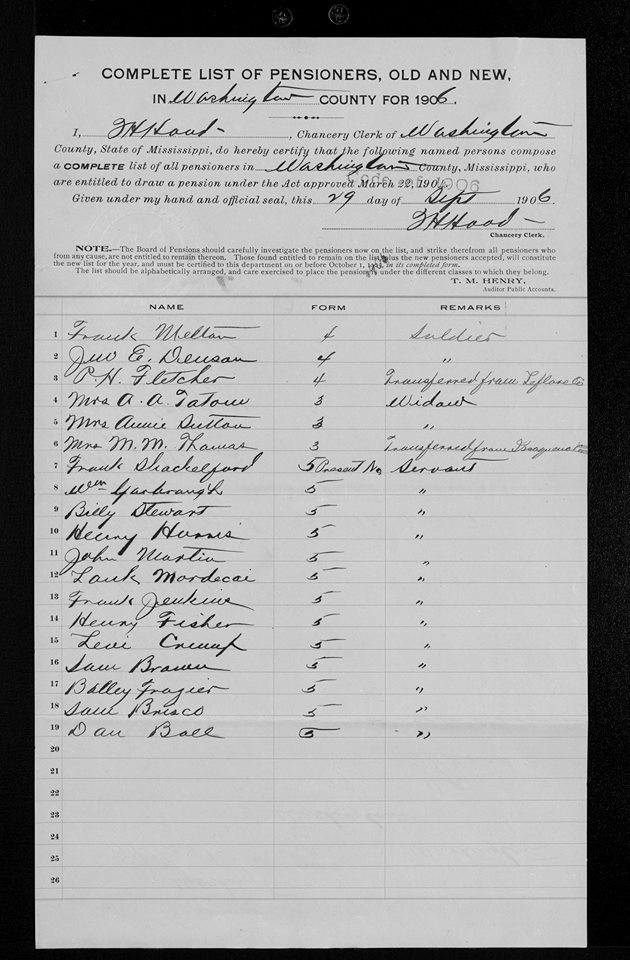
True, an example servant’s pension application he posted requires applicants to identify “the name of the party whom you served,” and the military unit “in which your owner served,” but it doesn’t use the word slave, and that’s what matters, right? 
Yes, Mid-South Flagger, you’ve been lied to. Just not by who you think.
______________
Friday Night Concert: Shovels & Rope, “The Fall of Charleston”

 Here’s a third track from the new album, Divided and United. This one is by Shovels & Rope, the Charleston husband and wife duo of Michael Trent and Cary Ann Hearst. You can read more about them and their recording of “The Fall of Charleston” here, or hop over to NPR for a mini-concert. A contemporary broadside of the lyrics is available here.
Charleston is taken, and the rebels put to rout;
And Beauregard the chivalrous, he ran to save his bacon—
When he saw General Sherman’s “Yanks,” and “Charleston is taken!” With a whack, rowdy-dow, A hunkey boy is General Sherman, Whack, rowdy-dow, Invincible is he! This South Carolina chivalry, they once did loudly boast,
That the footsteps of a Union man, should ne’er pollute their coast.
They’d fight the Yankees two to one, who only fought for booty, But when the “udsills” came along it was “Legs, do your duty!” With a whack, rowdy-dow, Babylon is fallen, Whack, rowdy-dow, The end is drawing near! And from the “Sacred City,” this valiant warlike throng;
Skedaddled in confusion, although thirty thousand strong—
Without a shot, without a blow, or least sign of resistance,
And leaving their poor friends behind, with the “Yankees” for assistance! With a whack, rowdy-dow, How are you, Southern chivalry? Whack, rowdy-dow, Your race is nearly run! And again o’er Sumter’s battered walls, the Stars and Stripes do fly,
While the chivalry of Sixty-one in the “Last ditch” died;—
With Sherman, Grant and Porter too, to lead our men to glory,
We’ll squash poor Jeff’s confederacy, and then get “Hunkydory!” With a whack, rowdy-dow, How are you, neutral Johnny Bull? Whack, rowdy-dow, We’ll settle next with you!
__________
Darien, Georgia as a Military Target
Over the last several months, Craig Swain has been doing steady, diligent work in blogging (often in sesqui-real-time) the military campaigns around Charleston. He’s told some familiar stories, but much of his output is wholly original research, put together through a variety of official records, memoranda, and contemporary photos. It’s small-scale, fine-grained history at its best.
Today, Craig has a new post up discussing the role that the little coastal town of Darien, Gerogia played in blockade-running. Darien is best known now as the town that was burned by Union Colonel (and former wild-eyed Kansas Jayhawker) James Montgomery in June 1863. This incident is widely regarded as a wanton and unnecessary act of spite on Montgomery’s part, and formed an important story element in the 1989 film Glory. (If your knowledge of Darien is based primarily on its depiction in that film, you’d never realize it was a small port in the first place.) Craig uses the story of the capture of the blockade runner Chatham in December 1863, though, to make the clear case that Darien was not only a point for bringing supplies in (and cotton out) of the Confederacy, but that it served as a distribution point for Confederate military forces on that part of the Georgia coast. As such, the docks and warehouses of Darien — though not the town itself — was a legitimate military target:
Kudos to Craig for telling these stories, and applying hard research to better understand a singularly inflammatory subject.
__________
Friday Night Concert: Richmond is a Hard Road to Travel

Another track from the new album, Divided and United , by bluegrass artists Chris Thile and Michael Daves. I love this song, and this is a great cover of it. It has a lot more verses than this, but you get the idea.
___________
Canister!
Small stories that don’t warrant full posts of their own:
- Stephanie McCurry, author of Confederate Reckoning: Power and Politics in the Civil War South, will be giving a 10-week online course beginning in January called “History of the Slave South” (above). Registration is free.
- The SCV has committed $25,000 to help keep the Jefferson Davis Memorial Historic Site in Irwinville, Georgia open to the public. Kudos to them for stepping up.
- The contentious dispute over the Confederate monument at Reidsville may be effectively over, with the installation of a replacement statue atop the restored monument at the UDC plot in Greenview Cemetery. The usual suspects are furious, but given (1) the city’s flat (and repeated) refusal to restore the monument in its original location (which they own), and (2) the fact that the core legal challenge to the UDC’s plans went nowhere, this is not a bad outcome. Glass half full, etc.
- Four Civil War battlefields may soon be rolled into the National Park System. Most of the property is currently held by the Civil War Trust, which should facilitate the process.
- Finally, everyone’s favorite Confederate heritage beard showed up in Florida to protest the possible renaming of Nathan Bedford Forrest High School.
___________
Tracking Confederate Deserters in East Texas
Both desertion and men running from conscription was a big problem in Texas, as it was in other parts of the South during the war. I recently came across this account of using “Negro dogs,” bred and trained to hunt runaway slaves, to track deserters in East Texas. The place mentioned, Winter’s Bayou, runs through the Sam Houston National Forest, southeast of Huntsville. From the Houston Tri-Weekly Telegraph, December 21, 1864, p. 1:
___________
Friday Night Concert: “Kindom Come” with Pokey LaFarge
 A cut from the new album, Divided and United: The Songs of the Civil War, produced by Randall Poster. Divided and United offers more than 30 (!) tracks of period songs, re-interpreted by modern artists, including well-known performers like Loretta Lynn, Ricky Skaggs, Taj Mahal, Lee Ann Womack and Dolly Parton. Some of the best, though, are from less-familiar artists like Shovels & Rope and Pokey LaFarge (right). There’s a neat NPR story on the new album here.
From the interview:
I’ve known this song for years, but I never heard this verse:
- The overseer he makes us trouble, and drive us ’round a spell, We locked him in the smokehouse cellar, with the key thrown down the well. The whip is lost, the handcuffs broken, but the massa’ll have his pay, He’s old enough, big enough, ought to known better than to try an’ run away!
Enjoy.
______________
Mandela and the Complexity of Righteousness

Amid the tributes and commentary on the passing of Nelson Mandela, I didn’t have anything particular to add. But then I read this, by my friend Emily L. Hauser, that cuts like a clarion bell through all the well-intentioned hagiography that’s filling the airwaves right now. I hope she will forgive me for repeating it here in toto:
_____________
Nelson Mandela in 2009 Photo by Media24/Gallo Images/Getty Images.“Too much d—d science on board”
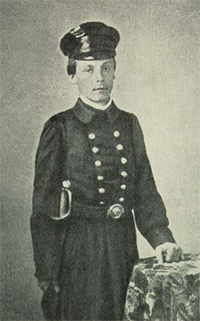 James Morris Morgan (right, 1845-1928) was a 17-year-old Acting Midshipman in the Confederate Navy, serving aboard the ironclad Chicora at Charleston, when he received orders sending him abroad, where he would later join the crew of the commerce raider C.S.S. Georgia. First, though, he had to get safely out of the Confederacy. One of his fellow passengers on the run to Bermuda was the celebrated naval officer and oceanographer, Matthew Fontaine Maury (1806-73). As Morgan would recall decades later in his memoir, Recollections of a Rebel Reefer, Maury’s presence aboard the runner would prove to be a fortuitous circumstance.




8 comments