First Sergeant Henry, Is that You?

You’ve seen this picture a hundred times.
It appears in almost every book and article about African Americans serving in the Union Army, and on blogs dedicated to the subject. I’ve even used it here, myself. It’s an image of Company E, 4th U.S. Colored Infantry. I’d always guessed that this image was taken early in the 4th’s history, perhaps during its training phase; the uniforms and equipment (including polished shoulder scales) seemed too pristine, too precisely-placed (below). These are, I decided, garrisoned soldiers, not men who’ve been spending their time recently on the march or living in the field.

My reasoning was right, but my conclusion about the date was wrong. The image was not made during the 4th USCT’s working-up period. On the upper edge of the full image, available from the Library of Congress, the notation is scratched on the glass plate negative reads, “Co E 4th US Col’d Troops Fort Lincoln 11-17-65. WMS [William Morris Smith, the photographer].”:

It’s a postwar image, taken seven months after Appomattox. So they are garrisoned troops, well rested, in fresh uniforms and accoutrements. But they’re probably also all combat veterans, of hard-fought actions at Petersburg, Chaffin’s Farm/New Market Heights, and Fort Fisher. These men are not green recruits; they’re veterans, men who’ve seen some of the hardest fighting in the east in the last year of the conflict.
I had always guessed this image was a detachment of Co. E; in fact, it may be all of the enlisted men in Company E as it was at the end of the war.
We were discussing this image the other day at Coates’ blog, and I wondered if it was possible to identify any of the men in the image. There are twenty-seven men visible in the image; at least six of them are non-commissioned officers. It may be impossible to identify the others, but there should have been only a single First Sergeant on the company roster in November 1865; can he be identified?

It’s actually a straightforward, two-step process. First, the NPS Soldiers & Sailors System database allows users to search by regiment, and pull up names of officers and enlisted men assigned to it. Helpfully, the database includes each soldier’s initial and final rank, so it’s a simple matter to identify a few likely candidates. Second, cross-check those men’s compiled service records via Footnote, to confirm each individual’s duty assignment and dates in rank. Using this method, it was quickly determined that in November 1865, the First Sergeant of Co. E, 4th USCT was First Sergeant Harry Henry. You can read his service record here, via Footnote (5.2MB PDF).
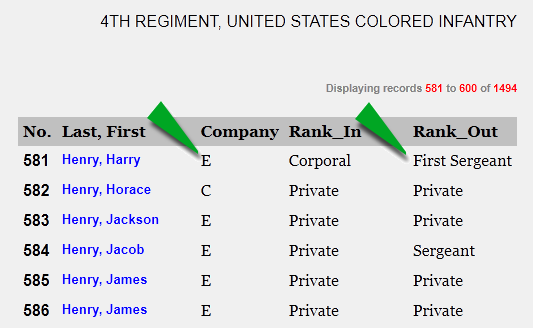
Locating a likely match in the NPS oldiers & Sailors System.
Harry Henry was born about 1842 on the Eastern Shore of Maryland. He was likely born free; he first appears in the 1850 U.S. Census, living with his father Jacob, a sawyer, and his wife, Mary, in or near Cambridge in Dorchester County. Harry was the third of at least six siblings; the others were Jane, born c. 1834; Jacob (Jr.), born c. 1838; William, born c. 1842; John, born c. 1845, and Ann, born c. 1848. At the time of the census, neither Jacob nor Mary could read or write, but Jacob held title to land valued at $100.
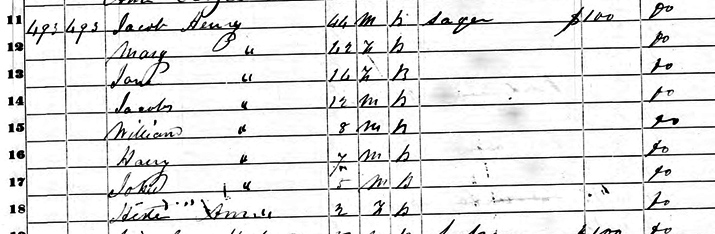
The Jacob and Mary Henry family in the 1850 U.S. Census.
By the time of the 1860 U.S. Census, most of the older children were no longer part of the household, but Harry, age 19, was still living with his parents and, like his father, earning his living as a sawyer. Ann, now aged 13, lived with them as well. As with the earlier census, none of the adults — now including Harry — were recorded as being able to read or write.
Harry Henry enlisted in Company E of the 4th U.S. Colored Infantry at Baltimore on July 28, 1863, a few weeks after recruitment for the USCTs began. He enlisted for a term of three years. At the time he gave his age as 21 years, his height as five-foot-seven, with a “black” complexion, black eyes and curly hair. His occupation was listed as “farmer.” It appears that on that same day Harry’s older brothers, Jacob and William, enlisted in the same company. Jacob would be wounded at New Market Heights on September 29, 1864, but eventually return to duty. Jacob was apparently a crack shot, as he spent much of his enlistment on detached service, away from the regiment, with a sharpshooters’ unit. Both Jacob and William would survive the war and, with Harry, muster out of the 4th USCT as a Sergeant and Corporal respectively, in May 1866.
Henry was appointed Corporal at the time of his enlistment, but his service record carries few notations that give additional details of his service for his first year in the army. There are no notices of pay stoppage for lost gear, for example (a common entry for enlisted troops), nor notation of illness or injury. Beginning in July 1864, his pay records carry the notation, “free on or before April 19, 1861,” reflecting the army’s agreement to pay black soldiers the same as white, and to award the difference in back pay to those men who had been free before the outbreak of the war.

Sgt. Maj. Christian Fleetwood saves the 4th USCT’s colors at New Market Heights, September 29, 1864. Harry Henry’s brother Jacob was wounded in that action, and Co. E’s First Sergeant, Isaac Harroll, was killed. Image: “Field of Honor “by Joseph Umble, © County of Henrico, Virginia. Via The Sable Arm blog.
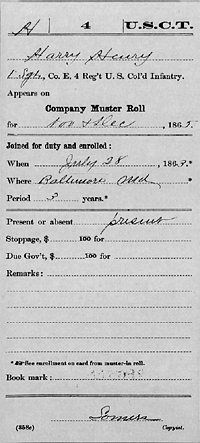 Company E’s original First Sergeant, Isaac Harroll, was killed at Chaffin’s Farm/New Market Heights on September 29, 1864, the same day Jacob Henry was wounded. Four other men of the 4th U.S. Colored Infantry, including Sergeant Major Christian Fleetwood, would earn Medals of Honor in that action.The 4th took terrific casualties that day — 97 dead, 137 wounded and 14 missing.
Corporal Harry Henry was promoted to take Harroll’s place as First Sergeant of the company two weeks after the action, on October 14. He would remain First Sergeant of Company E for the remainder of the regiment’s time in service, including in November 1865 (right) when the famous photo was taken. There are few further notations describing his service through the end of the war; he mustered out with the regiment on May 4, 1866 in Washington, D.C.
I’ve found few solid leads on Harry Henry’s life after the war. There was a Harry Henry of about the right age living in Snow Hill, Maryland — about 40 miles from where the sawyer’s son Harry Henry had grown up — at the time of the 1900 U.S. Census. That later Harry Henry was married to a Sally M. Henry, age 51, with the notation that they’d been married for 35 years. It’s not certain, though, that these two Harry Henrys were in fact the same man. After 1900, the trail grows cold, and I really don’t know with certainty what became of Harry Henry after his discharge in 1866.

So that’s the circumstantial case for the man in the photo being Harry Henry. Does the photo itself yield any clues? Yes, it does.
Looking at the overall image, the First Sergeant at first appears substantially taller than the other soldiers. But that could be a trick of perspective; he’s also closer to the camera than any of the others. Fortunately, he holds in his hands a tool we can use to estimate his height, what appears to be a U.S. M1840 Non-commissioned officer’s sword. The M1840 had a blade variously described as being between 31 and 31.5 inches long; because he’s holding it close to the vertical, we can use that blade as a rough scale to determine the First Sergeant’s height.

At left, a six-foot scale has been aligned and adjusted to match the blade on the sword. (The left side of the scale is marked in inches, the right in feet.) At right, that same scale has been moved to align with the approximate location of the bottom of the man’s heel. The scale suggests the man’s overall height at around five-foot-six, very close to Henry’s recorded height of five-foot-seven. While this estimate is only approximate — neither the bottom of the man’s foot not the top of his head are visible — it’s very consistent with the man in the image being Harry Henry.

Can we definitively prove that the First Sergeant in the famous photo is Harry Henry? No. But both the documentary record and careful analysis of the photo suggest strongly that it is.
If anyone out there has additional information on Harry Henry, either his service with the 4th USCT or his life afterwards, I’d love to know it.
______________

Frederick Douglass on Decoration Day, 1871
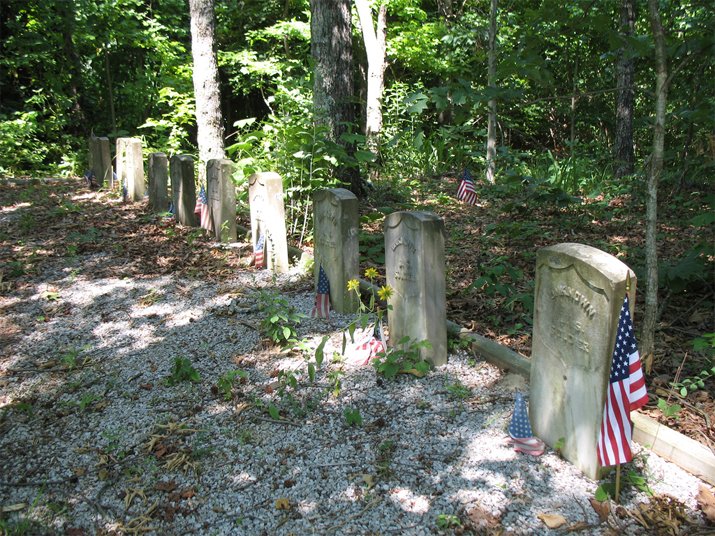
On Decoration Day, 1871, Frederick Douglass gave the following address at the monument to the Unknown Dead of the Civil War at Arlington National Cemetery. It is a short speech, but one of the best of its type I’ve ever encountered. I’ve posted it before, but it think it’s something worth re-reading and contemplating every Memorial Day.
The Unknown Loyal Dead
Arlington National Cemetery, Virginia, on Decoration Day, May 30, 1871Friends and Fellow Citizens:
Tarry here for a moment. My words shall be few and simple. The solemn rites of this hour and place call for no lengthened speech. There is, in the very air of this resting-ground of the unknown dead a silent, subtle and all-pervading eloquence, far more touching, impressive, and thrilling than living lips have ever uttered. Into the measureless depths of every loyal soul it is now whispering lessons of all that is precious, priceless, holiest, and most enduring in human existence.
Dark and sad will be the hour to this nation when it forgets to pay grateful homage to its greatest benefactors. The offering we bring to-day is due alike to the patriot soldiers dead and their noble comrades who still live; for, whether living or dead, whether in time or eternity, the loyal soldiers who imperiled all for country and freedom are one and inseparable.
Those unknown heroes whose whitened bones have been piously gathered here, and whose green graves we now strew with sweet and beautiful flowers, choice emblems alike of pure hearts and brave spirits, reached, in their glorious career that last highest point of nobleness beyond which human power cannot go. They died for their country.
No loftier tribute can be paid to the most illustrious of all the benefactors of mankind than we pay to these unrecognized soldiers when we write above their graves this shining epitaph.
When the dark and vengeful spirit of slavery, always ambitious, preferring to rule in hell than to serve in heaven, fired the Southern heart and stirred all the malign elements of discord, when our great Republic, the hope of freedom and self-government throughout the world, had reached the point of supreme peril, when the Union of these states was torn and rent asunder at the center, and the armies of a gigantic rebellion came forth with broad blades and bloody hands to destroy the very foundations of American society, the unknown braves who flung themselves into the yawning chasm, where cannon roared and bullets whistled, fought and fell. They died for their country.
We are sometimes asked, in the name of patriotism, to forget the merits of this fearful struggle, and to remember with equal admiration those who struck at the nation’s life and those who struck to save it, those who fought for slavery and those who fought for liberty and justice.
I am no minister of malice. I would not strike the fallen. I would not repel the repentant; but may my “right hand forget her cunning and my tongue cleave to the roof of my mouth,” if I forget the difference between the parties to hat terrible, protracted, and bloody conflict.
If we ought to forget a war which has filled our land with widows and orphans; which has made stumps of men of the very flower of our youth; which has sent them on the journey of life armless, legless, maimed and mutilated; which has piled up a debt heavier than a mountain of gold, swept uncounted thousands of men into bloody graves and planted agony at a million hearthstones — I say, if this war is to be forgotten, I ask, in the name of all things sacred, what shall men remember?
The essence and significance of our devotions here to-day are not to be found in the fact that the men whose remains fill these graves were brave in battle. If we met simply to show our sense of bravery, we should find enough on both sides to kindle admiration. In the raging storm of fire and blood, in the fierce torrent of shot and shell, of sword and bayonet, whether on foot or on horse, unflinching courage marked the rebel not less than the loyal soldier.
But we are not here to applaud manly courage, save as it has been displayed in a noble cause. We must never forget that victory to the rebellion meant death to the republic. We must never forget that the loyal soldiers who rest beneath this sod flung themselves between the nation and the nation’s destroyers. If today we have a country not boiling in an agony of blood, like France, if now we have a united country, no longer cursed by the hell-black system of human bondage, if the American name is no longer a by-word and a hissing to a mocking earth, if the star-spangled banner floats only over free American citizens in every quarter of the land, and our country has before it a long and glorious career of justice, liberty, and civilization, we are indebted to the unselfish devotion of the noble army who rest in these honored graves all around us.
______________
Image: Graves of nine unknown Federal soldiers in Pontotoc County, Mississippi. Photo by Flickr user NatalieMaynor, used under Creative Commons license. Text of Douglass speech from Philip S. Foner and Yuval Taylor, Frederick Douglass: Selected Speeches and Writings.

NYC Project IDs More than 4,000 Civil War Graves
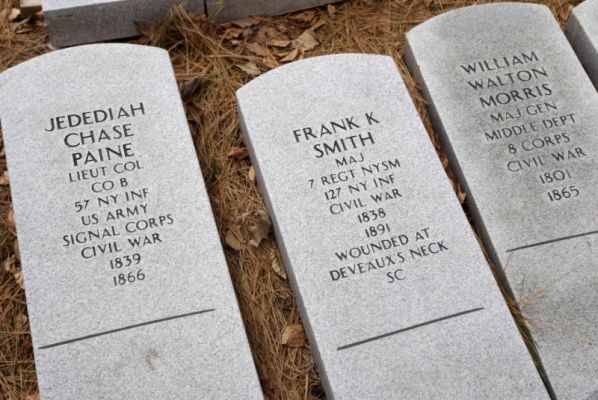
This seems like a big thing, and a good one. From the Associated Press:
Clarence McKenzie, a local boy fatally wounded in an accidental shooting in Maryland, was buried June 14, 1861, two months after the Union garrison at Fort Sumter surrendered to Confederate forces. He was followed to the grave 12 days later by Adolph Vincens, a 23-year-old London-born jeweler who was the first Civil War battle casualty buried at Green-Wood.
By the time the war ended four years later, about 200 other soldiers and sailors who died in the Civil War were buried at Green-Wood, established in 1838 in what was then a rural section of Brooklyn. In the decades after the war, thousands of others would join their comrades – and even some of their one-time enemies – at the historic cemetery.
Today, the 478-acre expanse of greenery and statuary covering the cemetery’s rolling hills is believed to be the final resting place of about 8,000 Civil War veterans.
A team of volunteers and Green-Wood staff has spent nearly a decade trying to identify all those graves. When the project began in September 2002, cemetery officials figured they had, at most, 500 veterans of the nation’s bloodiest war buried here.
Using the cemetery’s own burial records, plus government, military and privately owned documents available online, Green-Wood’s project has identified the graves of about 4,600 Civil War veterans. Green-Wood historian Jeffrey Richman estimates 3,000 to 4,000 more are scattered among the cemetery’s more than 560,000 total interments.
The Civil War dead buried at Green-Wood include unknown privates and famous officers, buglers and Medal of Honor recipients, Yankees from Maine to Iowa, fathers, sons and brothers, and even 75 Confederates, including two generals. None of the original gravestones for the Confederates gave any indication they had fought for the South, an intentional omission being rectified by the installation of new granite markers provided by Veterans Affairs.
___________
Image: In this March 2, 2011 photo, headstones from the Veterans Administration are ready to be installed on the graves of Civil War veterans who had no markers at Green-Wood Cemetery in the Brooklyn borough of New York. A project at the cemetery hopes to identify the nearly 8,000 Civil War soldiers buried beneath the green expanse in the New York City outer borough. (AP Photo/Seth Wenig)

Headstones and the Stories Left Untold
Many of us will spend part of this Memorial Day weekend at a cemetery, visiting the graves of relatives, placing wreaths or flags, or just remembering the generations of sacrifice represented by the rows of marble and granite stones. It is, as others have suggested, altogether fitting and proper that we should do this.
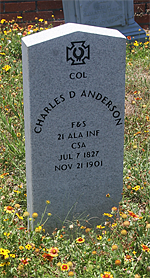 In a cemetery near my home there’s the grave of Colonel Charles DeWitt Anderson (1827-1901). His grave is marked solely by a modern, VA-issued headstone (right), listing his name, rank, regiment and birth and death dates. Those notations mean little to the casual passerby, and I doubt many people who pass Anderson’s plot will bother to look further into his story. Anderson’s best-known Civil War service is his defense, and subsequent controversial surrender, of Fort Gaines at the entrance to Mobile Bay in August 1864. The capitulation of Fort Gaines enabled the West Gulf Blockading Squadron, under the command of David Farragut, to then focus its attention on Fort Morgan on the opposite side of the channel, which Farragut successfully passed soon thereafter. Anderson’s wartime record is a significant and active one, if not especially glorious.
None of that story, of course, is reflected on his headstone. Here are some other facts about Charles DeWitt Anderson that don’t fit on a slab of grey marble:
- When he was a boy, in 1839, his family emigrated by sea to the newly-established Republic of Texas. Anderson’s parents died at sea, and he and his brother were left orphans in a new land where they knew no one. They were adopted and raised by the rector of the Episcopal church here.
- Anderson was the first Texan appointed to West Point; his application was endorsed by Senator Sam Houston
- He left West Point after his freshman year, having struggled academically, but eventually received a direct commission into the artillery in 1856.
- After the war, he used his engineering training in the construction harbor and river improvements for the government. After settling in Texas he served two terms as the city engineer for Austin.
- After moving to Galveston, he served as engineer on a new U.S. customs, house (now demolished).
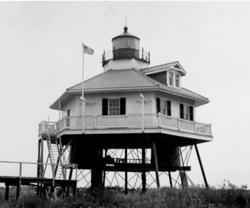
- Anderson spent the last six years of his life again on the federal payroll, as keeper of the Fort Point Lighthouse.
From his obituary in the Galveston Daily News, November 22, 1901:
Colonel C. A. [sic.] Anderson, the venerable keeper of the Fort Point light house [right] , died yesterday morning at 10 o’clock at the light house, aged 74 years. The body was brought to the city on the tug Cynthia and is now at Levy Bros. undertaking parlors. The funeral arrangements had not been made last night pending the arrival of relatives from the interior.
In the steel structural light house where the aged keeper and his devoted wife were imprisoned during the awful storm of September 8, 1900, he passed away after a lingering illness. He had suffered an attack of the grip shortly before the storm and never fully recovered his health. For six years he has cared for the Fort Point light and faithful to the last he insisted on remaining near where he could direct the mariners in guiding their ships into the harbor. The deceased was an honored soldier in the Confederate army and won distinction in the long struggle between the States. He lived a noble life and was honored and esteemed by all who knew him.
And this:
At the surrender [of Fort Gaines] he was given his choice to surrender to the army or the navy, and he decided to give his sword to Admiral Farragut. The sword was a gift of a number of friends and a few years later it was returned to Colonel Anderson with the following inscription engraved on the blade: “Returned to Colonel C. D. Anderson by Admiral Farragut for his Gallant Defence of Fort Gaines, April 8, 1864”
So this Memorial Day, let us all remember that headstones simply don’t tell the full story.
______________

“Slavery is the element of all value.”
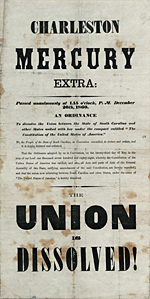 A while ago I took former SCV Virginia Division Commander Brag Bowling to task for his A House Divided essay, which repeated the hoary old trope that the Confederacy had been “forced” to open fire on Fort Sumter. Not surprisingly, he’s still pounding that particular drum. In response to a question about whether the South’s secession came about because of a small number of fire-eaters or was actually a movement with wide popularity, Bowling instead prefers to answer a different question that hadn’t been asked:
On December 20, 1860, South Carolina formally withdrew from the Union and was closely followed by Georgia, Florida, Mississippi, Alabama, Louisiana, and Texas. Certainly an argument could be made that the fire eaters in those states did much to stir up secession sentiment. The “cotton states” seceded primarily for economic reasons and a fear that their economies would be disrupted by the ascension of Lincoln and the Republican Party to national governance.
This is arguably true, if by “economic reasons” Bowling means the perpetuation of the institution of slavery, and its expansion into the territories, the latter proposition which the Republican Party (i.e., the “Black Republicans”) had vowed to block.
But that’s not what Bowling is suggesting, of course. Is he correct, that those first several states secede because of generalized worries about tariffs and their economies? No, they didn’t; Southern political leaders were torqued about the possible loss of their property. More specifically, their property in slaves. How can we know this? Because they effing told us.
For the umpteenth time, South Carolina:
The right of property in slaves was recognized by giving to free persons distinct political rights, by giving them the right to represent, and burthening them with direct taxes for three-fifths of their slaves; by authorizing the importation of slaves for twenty years; and by stipulating for the rendition of fugitives from labor.
We affirm that these ends for which this Government was instituted have been defeated, and the Government itself has been made destructive of them by the action of the non-slaveholding States. Those States have assume the right of deciding upon the propriety of our domestic institutions; and have denied the rights of property established in fifteen of the States and recognized by the Constitution; they have denounced as sinful the institution of slavery; they have permitted open establishment among them of societies, whose avowed object is to disturb the peace and to eloign the property of the citizens of other States. They have encouraged and assisted thousands of our slaves to leave their homes; and those who remain, have been incited by emissaries, books and pictures to servile insurrection.
For twenty-five years this agitation has been steadily increasing, until it has now secured to its aid the power of the common Government. Observing the *forms* [emphasis in the original] of the Constitution, a sectional party has found within that Article establishing the Executive Department, the means of subverting the Constitution itself. A geographical line has been drawn across the Union, and all the States north of that line have united in the election of a man to the high office of President of the United States, whose opinions and purposes are hostile to slavery. He is to be entrusted with the administration of the common Government, because he has declared that that “Government cannot endure permanently half slave, half free,” and that the public mind must rest in the belief that slavery is in the course of ultimate extinction.
Our position is thoroughly identified with the institution of slavery– the greatest material interest of the world. Its labor supplies the product which constitutes by far the largest and most important portions of commerce of the earth. These products are peculiar to the climate verging on the tropical regions, and by an imperious law of nature, none but the black race can bear exposure to the tropical sun. These products have become necessities of the world, and a blow at slavery is a blow at commerce and civilization. That blow has been long aimed at the institution, and was at the point of reaching its consummation. There was no choice left us but submission to the mandates of abolition, or a dissolution of the Union, whose principles had been subverted to work out our ruin.
John C. McGehee, President of the Florida Secession Convention:
In the formation of the government of our fathers, the Constitution of 1787, the institution of domestic slavery is recognized and the right of property in slaves is expressly guaranteed. The people of a portion of the States who were parties in the government were early opposed to the institution. The feeling of opposition to it has been cherished and fostered and inflamed until it has taken possession of the public mind at the North to such an extent that it overwhelms every other influence. It has seized the political power, and now threatens annihilation to slavery throughout the Union. At the South and with our people, of course, slavery is the element of all value, and a destruction of that destroys all that is property. This party, now soon to take possession of the powers of government, is sectional, irresponsible to us, and, driven on by an infuriated, fanatical madness that defies all opposition, must inevitably destroy every vestige of right growing out of property in slaves.
The North demanded the application of the principle of prohibition of slavery to all of the territory acquired from Mexico and all other parts of the public domain then and in all future time. It was the announcement of her purpose to appropriate to herself all the public domain then owned and thereafter to be acquired by the United States. The claim itself was less arrogant and insulting than the reason with which she supported it. That reason was her fixed purpose to limit, restrain, and finally abolish slavery in the States where it exists. The South with great unanimity declared her purpose to resist the principle of prohibition to the last extremity. This particular question, in connection with a series of questions affecting the same subject, was finally disposed of by the defeat of prohibitory legislation.
The Presidential election of 1852 resulted in the total overthrow of the advocates of restriction and their party friends. Immediately after this result the anti-slavery portion of the defeated party resolved to unite all the elements in the North opposed to slavery an to stake their future political fortunes upon their hostility to slavery everywhere. This is the party two whom the people of the North have committed the Government. They raised their standard in 1856 and were barely defeated. They entered the Presidential contest again in 1860 and succeeded.
The prohibition of slavery in the Territories, hostility to it everywhere, the equality of the black and white races, disregard of all constitutional guarantees in its favor, were boldly proclaimed by its leaders and applauded by its followers.
With these principles on their banners and these utterances on their lips the majority of the people of the North demand that we shall receive them as our rulers.
The prohibition of slavery in the Territories is the cardinal principle of this organization.
Georgia goes on to argue that “because by [the Republicans’] declared principles and policy they have outlawed $3,000,000,000 of our property in the common territories of the Union.” The phrase, “$3,000,000,000 of our property” refers to slaves.
E.S. Dargan, addressing the Alabama Secession Convention:
If pecuniary loss alone were involved in the abolition of slavery, I should hesitate long before I would give the vote I now intend to give. If the destruction of slavery entailed on us poverty alone, I could bear it, for I have seen poverty and felt its sting. But poverty, Mr. President, would be one of the least of the evils that would befall us from the abolition of African slavery. There are now in the slaveholding States over four millions of slaves; dissolve the relation of master and slave, and what, I ask, would become of that race? To remove them from amongst us is impossible. History gives us no account of the exodus of such a number of persons. We neither have a place to which to remove them, nor the means of such removal. They therefore must remain with us; and if the relation of master and slave be dissolved, and our slaves turned loose amongst us without restraint, they would either be destroyed by our own hands– the hands to which they look, and look with confidence, for protection– or we ourselves would become demoralized and degraded. The former result would take place, and we ourselves would become the executioners of our own slaves.
And my own state, Texas:
Texas abandoned her separate national existence and consented [in 1845] to become one of the Confederated Union to promote her welfare, insure domestic tranquility and secure more substantially the blessings of peace and liberty to her people. She was received into the confederacy with her own constitution, under the guarantee of the federal constitution and the compact of annexation, that she should enjoy these blessings. She was received as a commonwealth holding, maintaining and protecting the institution known as negro slavery– the servitude of the African to the white race within her limits– a relation that had existed from the first settlement of her wilderness by the white race, and which her people intended should exist in all future time. Her institutions and geographical position established the strongest ties between her and other slave-holding States of the confederacy. Those ties have been strengthened by association. But what has been the course of the government of the United States, and of the people and authorities of the non-slave-holding States, since our connection with them?
The controlling majority of the Federal Government, under various pretences and disguises, has so administered the same as to exclude the citizens of the Southern States, unless under odious and unconstitutional restrictions, from all the immense territory owned in common by all the States on the Pacific Ocean, for the avowed purpose of acquiring sufficient power in the common government to use it as a means of destroying the institutions of Texas and her sister slaveholding States.
These passages are not the writings of some politically-correct textbook author, or a liberal academic, or a South-hating blogger caught in the trap of “present-ism”; they’re not some modern historian’s opinion, or analysis, or interpretation. They’re the words written and spoken at the time, by the men who voted to take their respective states out of the Union. These are the words they themselves chose to explain and justify their actions, to their peers and to posterity. These words are explicitly how they wanted succeeding generations to understand their actions.
We should take them at their word.
Bowling, of course, continues to play his one-note tin whistle, again (and always) placing full and utter responsibility for the war on the sixteenth president, while admitting no missteps or bad faith on anyone in gray:
Lincoln had made his choice to fight. There had been no casualties at Ft. Sumter. Things might still have been worked out peacefully. One must wonder if Lincoln had met with the peace negotiators and tried to negotiate the contentious issues dividing the country such as slavery and tariffs rather than by using coercion and military force, that the ensuing fratricidal war might have been avoided. It must be noted that Lincoln was still willing to legally permit slavery to exist even several years into the war. The war rightfully should be laid at Lincoln’s feet. Lincoln’s premeditated bad choice set in motion a series of events which would lead to the death of 600,000 American citizens and the total devastation of the South for over 100 years.
An online friend of mine, JimmyD, summed up the secessionists’ situation nicely, saying “first they lost the election, then they lost their minds.” By April 1861 nothing other than complete capitulation on on the part of the Lincoln administration would have avoided a shooting war, and given the indignant lather the fire-eaters had worked the South into, it’s an open question whether even that would have sufficed. “Negotiation,” in those Confederates’ (and Bowling’s) view, meant “give us everything we want.”
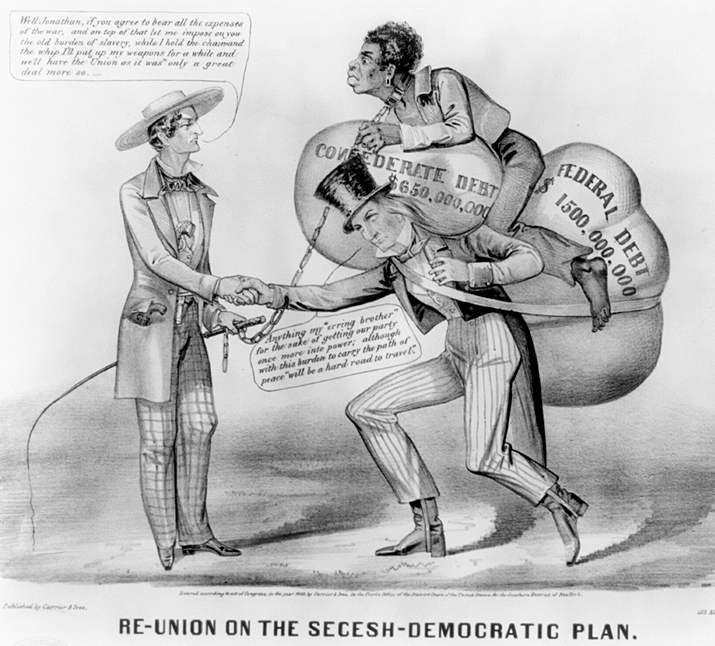
A Northern cartoon c. 1862, mocking the terms on which the Confederate states might be persuaded to rejoin the Union. Jeff Davis (left), his coat pockets stuffed with pistols, chides Brother Jonathan, an early representation of the United States: “Well Jonathan, if you agree to bear all the expenses of the war, and on top of that let me impose on you the old burden of slavery, while I hold the chain and the whip, I’ll put up my weapons for a while and we’ll have the ‘Union as it was’ only a great deal more so.” Library of Congress.
Folks committed to the Southron Heritage™ movement are fond of pointing to things like Lincoln’s reluctant support of the Corwin Amendment to demonstrate the the new president was not, at that point, willing to commit to ending the institution of slavery; true enough. But they ignore that his support for that legislation is Exhibit A in his willingness even to go against his own, personal opposition to slavery to ensure what he saw at the time as a more important goal, to preserve the Union intact. That was the one line he would not cross, and the South knew it. As Lincoln himself would later recall, “both parties deprecated war, but one of them would make war rather than let the nation survive, and the other would accept war rather than let it perish.”
And the war came.
It’s slightly embarrassing to have to continually remind folks of these inconvenient truths; it’s far more embarrassing for the Washington Post, historically one of this country’s great newspapers, to give over electronic real estate to such revisionist foolishness.
__________

On the Road

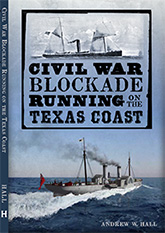
There are lots of good things about living where I do, but one you won’t find in the Chamber of Commerce brochures is that there are four wrecks of Civil War steam blockade runners right along this stretch of the Upper Texas Coast. Two of them, Acadia and Denbigh, have been positively identified; a third, Will o’ the Wisp (above), has been tentatively identified, and a fourth, Caroline (or Carolina) may have been located. Good, good stuff.
I’ve had the opportunity to dive on a couple of these sites, and from 1997-2003 was one of the lead investigators on Denbigh, the only one of the four to be formally excavated as an archaeology project. Denbigh was a remarkable ship, built in the same Birkenhead yard as the Confederate raider Alabama — which has its own connection to Galveston, thankyouverymuch — the second-most-successful runner of the war, having completed a total of eleven round voyages between Havana and Mobile, and Havana and Galveston, before being lost on the inbound passage of her twelfth trip into the Confederacy in May 1865.
But I digress. I’ve accepted an invitation to speak on Civil War blockade runners on the Texas coast on Thursday, October 20 at the Brazoria County Historical Museum in Angleton as part of Texas Archaeology Month. It’s been a long time since I talked about blockade runners, so it will be nice to return to that subject. More details closer to the date.
More blockade runner aye candy here.
_____________

Peter Phelps Was Not a “Negro in Grey”
Update, May 19.
After I posted this essay George Purvis, the author of the Negroes in Gray website, contacted the TSL again, asking for clarification on Peter Phelps. This was their reply, which he has also posted to the website:
In consulting with colleagues, it was discovered that the list of soldiers and widows believed to be African-American used to answer your previous question had been revised with the deletion of the name Peter Phelps and the addition of two other names.
We agree with your research that Peter Phelps is White. The additional names on the revised list are:
William A. Green Rejected of Burleson County
Turner Armstrong 38653 of Franklin CountyWe apologize for the incorrect information.
So we can call the case of Peter Phelps closed, I guess. For my part, I don’t think the TSL staff has anything to apologize for in this case; what they’d sent originally was an informal list, compiled by their staff over a period of time. It is what it is. It’s up to the rest of us to be careful and diligent consumers of historical information.

Recently one of the more outspoken online advocates for black Confederate soldiers (BCS) posted a link to a site that purports to list African Americans who, in one way or another, were part of the Confederate military effort during the Civil War. This person, who dismisses ideas like historical context, analysis and interpretation as “opinion” and “biased agenda,” insists that he’s only interested in “facts,” and has compiled this website in that vein. No interpretation, no discussion, no larger context. Just “facts.”
So I went to the Negroes in Grey website and, clicking on the menu at upper left, selected “The States, The People.” A fly-out menu lists several states, including Texas, so I clicked there. Immediately I was presented a transcript of a letter (presumably to the site’s owner) from the staff of the Texas State Library, explaining that they have no comprehensive means of searching for African Americans in their files. They did, however, explain that the staff there had, over a period of years, compiled a list of sixteen applications in which either the applicant or his widow was believed by the staff to be African American, and included in the letter their names, counties and pension numbers. One that jumped out at me right away was Peter Phelps of Galveston County (No. 07720). Being a native of Galveston County myself, I determined to find out more about this guy. Who was Peter Phelps, and was he really a “Negro in Grey?”
Well, no. It turns out that Peter Phelps was a white man who married a mixed-race woman after the war, and it takes about two minutes with readily-available, online records to determine that. So what’s up with this “Negro in Grey” business?
History Channel Kicks Off the Sesquicentennial
Michael Lynch at Past in the Present is looking forward to this upcoming 2-hour production by Ridley and Tom Scott, Gettysburg. (Rea Andrew Redd also covered this story over at Civil War Librarian.) From the History website:
It’s the summer of 1863, more than two years into our nation’s devastating Civil War, and the stakes have never been higher. The Confederate Army of Northern Virginia, led by Robert E. Lee, crosses into Pennsylvania. Trailed by the Union’s Army of the Potomac, Lee’s 75,000-strong army heads toward Harrisburg, but the forces meet instead near Gettysburg, a quiet farm town that would become synonymous with the epic battle that all but decided the outcome of the American Civil War. For three long days, the two sides clashed in one of the war’s bloodiest engagements to decide the ultimate question: Would the United States of America survive?
Executive produced by Ridley and Tony Scott, GETTYSBURG strips away the romanticized veneer of the Civil War to present the pivotal Battle of Gettysburg in a new light–a visceral, terrifying and deeply personal experience, fought by men who put everything on the line in defense of their vision of the American future. Cinematic in scope, GETTYSBURG is an information-packed look at the turning points, strategic decisions, technology and little-known facts surrounding the battle. Developed in collaboration with highly esteemed Civil War historians, GETTYSBURG reflects hundreds of individual accounts of the battle–the unique voices of struggle, defeat and triumph that tell the larger story of a bitterly conflicted nation.
I’m not sure you can really tell the story of Gettysburg well in two hours, but it should be visually stunning. It will be nice to see what CGI can add to this story; as sweeping as the 1993 theatrical film was, there are just some things you can’t do realistically with live-action. At the same time, though, gee-whiz SFX aren’t enough to tell a real historical narrative well, and I can see this thing going either way — either a landmark documentary that sets a standard for others to follow, or a two-hour demo reel of eye candy, evocative music and little else.
Gettysburg premieres May 30 at 9:00 p.m.
________________

“It’s the Civil War dead, not ‘living historians,’ who deserve our attention”

Civil War historian Glenn W. Lafantasie has a provocative new article over at Salon, “The Foolishness of Civil War Reenactors.” It’s not really so much about reenactors — though they get a thumpin’, as a recent U.S. president would say — but actually about how we, as a country, will observe the Civil War Sesquicentennial.
It should not be necessary to point out that the Civil War was tragic, not romantic, but the romanticism is what dominates public conceptions of the war. Allen Nevins, a brilliant historian whose work is now mostly ignored by younger scholars, once attempted to emphasize the war’s enormous tragedy by making this profoundly powerful point: “We can say that the multitude of Civil War dead represent hundreds of thousands of homes, and hundreds of thousands of families, that might have been, and never were. They represent millions of people who might have been part of our population today and are not. We have lost the books they might have written, the scientific discoveries they might have made, the inventions they might have perfected. Such a loss defies measurement.” Nevins wrote those words in 1961, and it seems unlikely that his admonition, or anything I could add to it, will impress Civil War enthusiasts to abandon the romantic myths of the war in favor of a stark realism that lays out, without any varnish, how Americans suffered and sacrificed as they killed one another in droves.
Even some academic historians shrink from accepting the hellishness of the Civil War. One scholar, Mark E. Neely Jr., complains that vital aspects of the war have become hidden by what he believes has been an overemphasis on the conflict’s destructiveness, what he condemns among his fellow experts as “a cult of violence.” He argues, in fact, that the Civil War was, comparatively speaking, no more violent or destructive than other wars, which may or may not be so, but his contention that the war was somehow less violent than historians have claimed flies in the face of the fact that 620,000 Americans died in the four years between 1861 and 1865. Historians haven’t exaggerated the war’s human toll; if anything, they still have not dealt effectively with the sensationalized romance — promulgated in part by the Civil War generation itself — that smothers our comprehension of the contest between North and South as an excessive expression of an American tradition of violence. . . .
It’s worth reading the whole thing.
__________
Image: “2010 – Reenactment; Pellicer Creek Raid (Civil War),” by Flickr user iambrianna. Used under Creative Commons license. H/t: Kevin Levin

“The color of the white man is now, in the South, a title of nobility.”
A few days ago we posted on the writings of James D. B. DeBow, a publisher and essayist who brought his considerable talents to the denunciation of abolitionism, and the defense of slavery, in the years leading up to the war. In his December 1860 booklet The Interest in Slavery of the Southern Non-Slaveholder, DeBow argued that slavery was not only an economic necessity, but absolutely essential to maintaining an aristocracy of white men that must — always — be above those of African descent, regardless of their economic standing:
The non-slaveholder of the South preserves the status of the white man, and is not regarded as an inferior or a dependant. He is not told that the Declaration of Independence, when it says that all men are born free and equal, refers to the negro equally with himself. It is not proposed to him that the free negro’s vote shall weigh equally with bis own at the ballot-box, and that the little children of both colors shall be mixed in the classes and benches of the school-house, and embrace each other filially in its outside sports. . . . No white man at the South serves another as a body servant, to clean his boots, wait on his table, and perform the menial services of his household. His blood revolts against this, and his necessities never drive him to it. He is a companion and an equal. When in the employ of the slaveholder, or in intercourse with him, he enters his hall, and has a seat at his table. If a distinction exists, it is only that which education and refinement may give, and this is so courteously exhibited as scarcely to strike attention. The poor white laborer at the North is at the bottom of the social ladder, whilst his brother here has ascended several steps and can look down upon those who are beneath him, at an infinite remove.
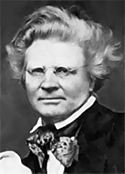 DeBow was not the only Southern writer to make this argument. At the end of October 1860, South Carolina State Senator John Townsend (1799-1881, right) published a pamphlet, The Doom of Slavery in the Union – Its Safety Out of It. Along with DeBow’s booklet, The Doom of Slavery was one of the most popular secessionist tracts of the day. A few weeks after his pamphlet appeared, Townsend went on to sign of the South Carolina’s Ordinance of Secession. Here, Townsend makes explicit that slavery is not just central to the perpetuation of social order in the South, but the maintenance of a uniquely Southern system of caste:
The Effects to the Non-Slaveh0lder.
We forbear to notice the effect of the abolition of slavery upon the Banks, Insurance Companies, Railroads, and all other corporations, depending upon a rich a and flourishing country for their own prosperity. But in noticing its effects upon the different classes and: interests in the South, we should not omit to notice its effects upon the non-slaveholding portion of our citizens.
Accompanied as that measure is to be, by reducing the two races to an equality—or, in other words, in elevating the negro slave to an equality with the white man—it will be to the non-slaveholder, equally with the largest slaveholder, the obliteration of caste and the deprivation of important privileges. The color of the white man is now, in the South, a title of nobility in his relations as to the negro; and although Cuffy or Sambo may be immensely his superior in wealth, may have his thousands deposited in bank, as some of them have, and may be the owner of many slaves, as some of them are, yet the poorest non-slaveholder, being a white man, is his superior in the eye of the law; may serve and command in the militia; may sit upon juries, to decide upon the rights of the wealthiest in the land ; may give his testimony in Court, and may cast his vote, equally with the largest slaveholder, in the choice of his rulers. In no country in the world does—the poor white man, whether slaveholder or non-slaveholder, occupy so enviable a position as in the slaveholding States of the South. His color here admits him to social and civil privileges, which the white man enjoys nowhere else. In countries where negro slavery does not exist, (as in the Northern States of this Union and in Europe,) the most menial and degrading employments in society are filled by the white poor, who are hourly seen drudging in them. Poverty, then, in those countries, becomes the badge of inferiority, and wealth, ordistinction. Hence the arrogant airs which wealth there puts on, in its intercourse with the poor man. But in the Southern slaveholding States, where these menial and degrading offices are turned over to be per formed exclusively by the negro slave, the status and color of the black race becomes the badge of inferiority, and the poorest non-slaveholder may rejoice with the richest of his brethren of the white race, in the distinction of his color. The poorest non-slaveholder, too, except as I have before said, he be debased by his vices or his crimes, thinks and feels and acts as if he was, and always intended to be, superior to the negro. He may be poor, it is true; but there is no point upon which he is so justly proud and sensitive as his privilege of caste; and there is nothing which he would resent with more fierce indignation than the attempt of the Abolitionist to emancipate the slaves and elevate the negros to an equality with himself and his family. The abolitionists have sent their emissaries among that class of our citizens, trying to debauch their minds by persuading them that they have no interest in preventing the abolition of slavery, But they cannot deceive any, except the most ignorant and worthless, the intelligent among them are too well aware of the degrading consequences of abolition upon themselves and their families (such as I have described them), to be entrapped by their arts. They know that, at the North and in Europe, where no slavery exists, where poverty is the mark of inferiority; where the negros have been put upon equality with the whites, and “money makes the man,” although, —that man may be a negro;—they know, I say, that there the white man is seen waiting upon the negro;—there he is seen obeying the negro as his ostler, his coachman, his servant and his bootblack. Knowing, then, these things, and that the abolition of slavery, and the reign of negro equality here, may degrade the white man in the same way as it has done in those countries, there is no non-slaveholder with the spirit of the white race in his bosom, who would not spurn with contempt this scheme of Yankee cunning and malice.
It’s always hard to know whether, and to what extent, essays like DeBow’s and Townsend’s shaped the beliefs and motivations of bot the general public in the South and Confederate soldiers, specifically. They are, in may respects, like highly-politically-partisan cable channels and websites today, in that they (or the ideas they express) form part of the larger rhetorical environment that influences individuals’ views. We can get a better, if imperfect, handle on this today through polling (“Where do you mostly get your news?”), but the exact dynamics of the phenomenon 150 years ago are harder to discern.
Another aspect that bears on this, as well, is that essays like these, or excerpts from them, were picked up and carried in other publications across the South, so they got far more circulation than the actual print run of the original pamphlet would suggest. I came across the Townsend quote, for example, in the Trinity Advocate, published in Palestine in East Texas. Arguments like DeBow’s and Townsend’s went far and wide.
I haven’t worked with large assemblies of contemporary sources, but McPherson addresses the differences in stated motivations between slaveholders and non-slaveholders in Cause & Comrades, and gives a number of examples of non-slaveholders who expressed very much the same ideas Townsend and DeBow both argue, that they saw themselves as defending not an economic institution, but a social order, explicitly based on white supremacy, of which the institution of African slavery was central. “Herrenvolk democracy,” he summarizes (p. 109), “– the equality of all who belonged to the master race — was a powerful motivator for many Confederate soldiers.”
McPherson also touches on something that Chandra Manning is much more explicit about, which is the concept of “liberty,” which was an idea shared widely between slaveholders and non-slaveholders alike. When they spoke of principles like liberty and property rights, there is an implicit belief that those are things that apply to white men (and to a much lesser extent, white women), and to no one else (pp. 29-30):
When Confederate soldiers spoke of liberty, they referred not to a universally applicable ideal, but to a carefully circumscribed possession available to white Southerners. No mere abstraction, liberty had to do with the unobstructed pursuit of material prosperity for white men and their families. As one Virginian put it, liberty consisted of the “good many comforts and privileges” that his family could enjoy without outside interference. While exclusive in terms of race, liberty was inclusive in terms of class. In other words, while liberty applied strictly to whites, it applied to all whites, regardless of present social class or economic condition, because all whites, by virtue of being white, enjoyed the right to individual ambition and aspirations of material betterment through means of their own choosing.
The institution of slavery was so central to daily life across much of the South that it is part of the “home and hearth” that so many Confederate soldiers saw themselves as defending.
So while it’s usually impossible to demonstrate that this Debow essay influenced that Confederate soldier, it seems clear that the ideas they expressed were very much a part of political discourse, and found a receptive audience in the Confederate ranks, both among slaveholders and non-slaveholders. Certainly this line of thinking wasn’t the only one out there — individuals’ motivations to do anything are rarely so simple as that — but scholarship like McPherson’s and Manning’s shows that these arguments were absolutely part of the mix, and the common rationalization that non-slaveholders must, Q.E.D., not have seen any interest in defending the institution is just that — a self-serving rationalization that papers over the cognitive dissonance that inevitably goes with Confederate hagiography.
_______________
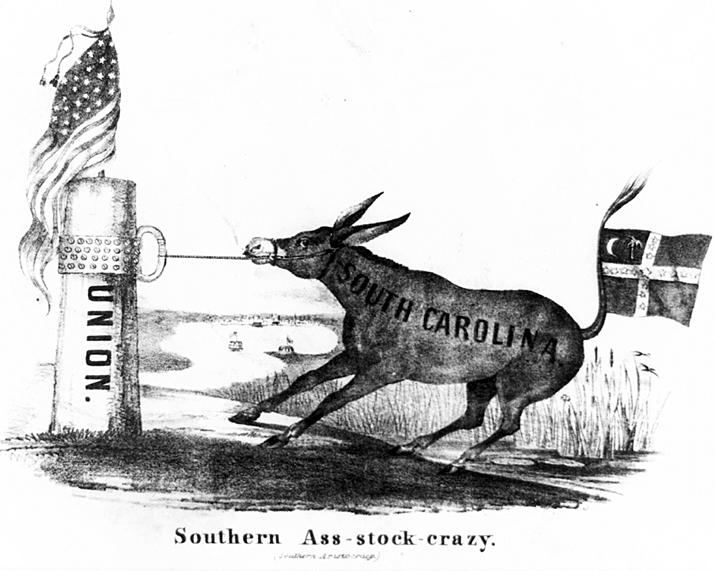
The latter part of this post, beginning, “it’s always hard to know. . ,” was originally a comment in response to Marc Ferguson. In retrospect, it seems more appropriate as part of the text. Image: “Southern Ass-Stock-Crazy (Southern Aristocracy),” 1861, Library of Congress.





 Dead Confederates, A Civil War Era Blog
39 comments