“This was the grandest thing I saw during the war.”
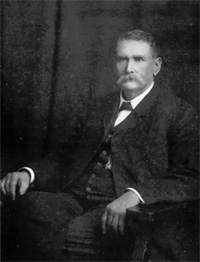 Today is the sesquicentennial of the Second Battle of Manassas. Yesterday we had an account of that action recorded by Val Giles, of Company B of the 4th Texas Infantry, describing the action against a Union Zouave regiment and the actions of the James Reilly’s battery, attached to the Texas Brigade. Today, we have a parallel account of the same action, by Lawrence Daffan (right), then a seventeen-year-old private in Company G of the 4th Texas. Years later, Daffan dictated his account to his daughter Katie, who was herself secretary of the Brigade Association, active in UDC affairs and, the following year, would be named superintendent of the Texas Confederate Woman’s Home. The story was subsequently published in a commemorative book, Unveiling and Dedication of Monument to Hood’s Texas Brigade on the Capitol Grounds at Austin, Texas. It contains a wealth of information about the famous brigade, collected from wartime records and surviving veterans.
On that August afternoon in 1862, Daffan and his comrades witnessed what later came to be known as “the very vortex of Hell.” At the center of that conflagration stood the famous Fifth New York Volunteers, Duryée’s Zouaves. They took the full brunt of the attack by Daffan’s counterparts in the Fifth Texas, and Hampton’s Legion of South Carolinians, and the Eighteenth Georgia. The Zouaves held on as long as they could, and were effectively wiped out as a fighting unit. Of 525 “redlegs” who marched into the fight that day, 332 were killed or wounded, a casualty rate of 63%.
Note: the original work as published, linked in the first paragraph above, has numerous small errors in dates, spelling of names, and so on. It’s impossible at this point to know if these were errors made by Lawrence Daffan, Katie Daffan, or the typesetter. I’ve corrected (or tried to) all those in the text below, without noting individual instances. Those wishing to see the uncorrected text can click the first link above to read the original, beginning on p. 187 of the original book, or n218 in the electronic version.

On Thursday evening, August 28, 1862, marching through the foothills of the Blue Ridge Mountains, we heard the sound and echo of artillery, which was familiar to us, and we knew that we were approaching the enemy.
Just before sundown we entered Thoroughfare Gap. We could hear musketry and artillery at the opposite side of the gap. Anderson’s Brigade had engaged the enemy, who was holding the gap, to keep us from forming a junction with Jackson at Manassas.
Hood’s Brigade filed out of the road and started right over the top of the mountain, which was very steep climbing. By the time we were at the top we received word that Anderson had routed the enemy. We returned to the road and continued that night and marched through the gap and camped right on the ground where Anderson had driven them away. We were ordered to be ready to move at a moment’s warning. We started at 6 o’clock Friday morning, August 29.
I speak of Hood’s division in this, which consisted of Benning’s Brigade and Anderson’s Georgia Brigade, Law’s Alabama Brigade and Hood’s Texas Brigade. Hood was, at this time, Brigadier General, but acting in the capacity of Major General for this division.
We marched along in ordinary time to Manassas, until 9 or 10 o’clock. At this time we began to hear very heavy cannonade. In an hour we were in the hearing of very heavy artillery and musketry, fierce and violent. Jackson had engaged Pope and his corps. The sound of the firing continued to grow more violent. We received orders to quickstep and shortly afterward received orders to double quickstep. We were all young and stout, and it seemed to me this kept up about two hours. Pope was pressing Jackson very hard at this point. We joined Jackson and formed at his right and double-quicked into line of battle and threw out skirmishers.
At this time, as we arrived there, the firing all along Jackson’s line ceased at once. We took position Friday evening, and Friday night we had a night attack. This and the attack at Raccoon Mountain, Tennessee, were the only night attacks that I know of made by the Confederates. This attack caused great confusion, and I could never understand what benefit it was. We slept that night very close to the enemy, in fact could not speak aloud or above a whisper. I had a very bad cold at this time, contracted on the retreat from Yorktown, and an officer was sent from headquarters “to tell than man who was constantly coughing to go from the front to the rear, where he could not be heard.” I went back, near half a mile, with my blanket and accouterments. I slept alone, under a large oak tree, coughing all night. I didn’t know the maneuvers of our regiment between this [time] and day[light], but I joined them early Saturday morning [August 30]. We formed in perfect order early in the day. Jackson brought on the attack on our left about noon and pressed the enemy until they began to give way in front of him. This drew a number of troops from in front of us to support those Jackson, was driving back on our left.
General Lee’s headquarters were in sight of where I was. About 4 o’clock in the afternoon I saw a considerable commotion in General Lee’s headquarters; he, his staff officers and couriers. The couriers darted off with their instructions to different commanders of divisions, in a few minutes a courier dashed up to General [Jerome B.] Robertson, commanding the Texas Brigade. These couriers and orderlies notified the respective Colonels. The order “attention” was given, then the order “to load,” then “forward,” “guide center.” We went through the heavy timber and emerged into an open field. We had a famous battery with us, [Captain James] Reilly’s Battery [Rowan Artillery], with six guns, four Napoleon and two six-p0und rifles.
Captain Reilly had always promised us that if the location of the company permitted, he would charge with us. We opened and made room between the Fourth and Fifth Texas for Reilly’s Battery to come in. As we started, the battery started.
Young’s Branch was between us and a hill on the other side, which was occupied by a Federal Battery [Curran’s Battery], which was playing on us. This turned into a charge as soon as we emerged from the timber. We had gone a short distance when Reilly unlimbered two of his guns and opened on the Federals. We moved past these guns while they were firing. As we passed on the other two guns came in some distance ahead of those that were firing, swung into position and unlimbered. It seemed to me by the time the first two had stopped, the second two opened fire. This was done remarkably quick. They charged with us in this charge until we arrived at Young’s Branch ; two sections, two Napoleon guns each, two firing while the other two would limber up and run past them, swing into position and open fire.
This was the grandest thing I saw during the war — the charge of Reilly’s Battery with the Texas Brigade. I don’t know whether they shot accurately or not, it was done so fast. But I do know that it attracted the attention of the Yankee battery on the hill, diverting their attention from us.
Reilly’s Battery were North Carolinians and were with us all during the war and they never lost a gun.
In this charge at Manassas we saw a Zouave regiment [5th New York Volunteers, Duryée’s Zouaves]. It stood immediately in front of the Fifth Texas to our right. It was a very fine regiment. As the Fifth Texas approached, it checked the speed of the Fifth in its quick charge. The Fifth Texas, Hampton Legion and the Fourth Texas had a tendency to swing around them. As the Fifth Texas approached them, I saw the blaze of their rifles reached nearly from one to the other.
The First Texas, Hampton’s Legion and Fourth Texas from their position gave the Zouaves an enfilading fire, which virtually wiped them off the face of the earth. I never could understand why this fine Zouave regiment would make the stand they did in front of the brigade until nearly every one was killed.
We rallied at Young’s Branch. I looked up the hill which we had descended and the hill was red with uniforms of the Zouaves. They were from New York.
We ascended the hill out of Young’s branch, charged a battery of six guns [Curran’s], supported by a line of Pennsylvania infantry. This battery was near enough to use on us grapeshot and canister. As we came near to it one of the guns was pointed directly at my company and lanyard strung. Our Captain commanded Company G to right and left oblique from it. I was on the right and with a few others went into Company H. At this time one of the artillerymen threw the main beam, and this threw the cannon directly on Company H. Company H received a load of canister which killed four or five men.
I was immediately with Lieutenant [C. E.] Jones and [Private R. W.] Ransom of that company, who were both killed right at my feet. I stepped over both of them. Captain [James T.] Hunter, now living, was also shot down at that time. Most of the company were my schoolmates.
This last shot threw smoke and dust all over me, and the shot whizzed on both sides of me. Lieutenant Jones was shot in the head and feet, but I was not touched, When the smoke cleared away we had these guns, and they were so hot I couldn’t bear my hands on them. I then fired one shot at this retreating infantry which the rest of the brigade had been engaged with. This wound up that day’s engagement for us, except the Fifth Texas. A part of their regiment and their colors were carried about five miles after the retreating enemy.
We returned to Young’s branch and my attention was attracted to our support coming down the same hill that we had come down.
There were four lines of battle of Longstreet’s Corps in perfect order, which passed us and took up the fight with the retreating enemy where we left it off. This battle was fought on the 30th and 31st of August, 1862.
I can’t understand why the Federals have always attached so little importance to this battle, as they lost many gallant men there. They were terribly defeated, and may have been ashamed of their commanding general.

Image: 5th New York Zouaves, by Don Troiani

“The domned skillipins skeddaddle extinsively — extinsively, sir!”
 One of the great firsthand accounts of Texas troops in the Civil War is Val C. Giles’ Rags and Hope: Four Years with Hood’s Brigade, Fourth Texas Infantry, 1861-1865 (Mary Lasswell, ed.). The book was originally published in 1961, at the time of the Civil War Centennial, and (to my knowledge) has never been reprinted. Copies are hard to find, and correspondingly expensive. That’s a shame, because Giles’ narrative is poignant, vivid, and often very funny.
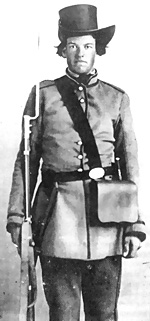
Giles’ account of Second Manassas shares much with that of his postwar friend and fellow 4th Texas veteran, Lawrence Daffan of Company G. It’s a harrowing description, and Giles (Company B) was much shaken by the carnage he saw around him within the regiment. That’s for a later time, though; for now, I want to follow-up Daffan’s dramatic description of Captain James Reilly’s Battery D of the 1st North Carolina Artillery with Giles’ description of the same event. As always, Giles (right, in a studio portrait taken in Austin at the time of his enlistment in 1861) has a keen ear for vivid characters and humorous spectacle:*
When I say the greatest battles of the world have been fought by the infantry, I don’t mean to reflect on the artillery or cavalry, or intimate that they have ever failed to do their duty. Stuart’s Cavalry was always vigilant. They were the eyes and ears of the army, and while the infantry slept, these gallant fellows were far away on the flanks, watching the enemy, guarding the fords, bridges and crossroads, escorting supply trains, and, for weeks at a time, fighting every day. During the war I used to think that the artillerymen were the bravest men on earth. They could pull through deeper mud, ford. deeper streams, shoot faster, swear louder, and stand more hard pounding than any other class of men in the service. . . .
Attached to the Texas Brigade was a fine battery of six Napoleon guns, commanded by Captain Reilly. Reilly had been an artillery sergeant in the old Army, and when the trouble began in 1861, he cast his lot with the Confederacy. He was an Irishman, rough, gruff, grizzly, and brave. He loved his profession and knew his business.
In this battle of Second Manassas, we witnessed a fine display of his skill and courage. General Hood instructed his colonels to halt their regiments when they reached Young Branch, which ran parallel with our line of battle, but when the Brigade reached the branch, the enemy was falling back, all along the line, and many of our field officers were killed or wounded. Colonel J. B. Robertson, Lieutenant Colonel J. C. Upton, Major Bryant, Captain J. D. Roberdeau, and Adjutant Campbell Woods of the Fifth Texas Regiment had all fallen before they reached the branch. The regiment was left without field officers, so the men pressed over the Zouaves, across the stream, and up the hill beyond.
Lieutenant Colonel [S. Z.] Ruff, Majors [John C.] Griffis, [John B.] O’Neill, [D. L.] Jarrett, and [Joel C.] Roper of the Eighteenth Georgia had gone down. Majors [William P.] Townsend, [D. U.] Barziza, and [James T.] Hunter of the Fourth had also fallen. Colonel [William T.] Wofford of the Eighteenth Georgia, Colonel [Benjamin F.] Carter of the Fourth Texas, Lieutenant Colonel P. A. Work of the First Texas, and Colonel [W. M.] Gary of Hampton’s South Carolina Legion finally succeeded in checking our men and bringing them back under the crest of the hill.
It was then that “Old Tarantula,” Captain Reilly, made his appearance on the field. He turned a point of timber to our left and came toward us in a sweeping run. Every horse in the battery carried a rider and the caissons and gun carriages were covered with red caps holding on like monkeys as they thundered over gullies, rocks, even over dead and wounded soldiers.
“Old Tarantula” rode fifty yards in front of his battery. He hurriedly selected an elevation, and at the wave of his hand, the guns were whirled into position and every artilleryman appeared to hit the ground at once. He threw his field glass to his eye, swept the horizon at one glance, then sang out: “Six hundred yards — shrapnel!”’
The guns bellowed and roared, the shells passing ten feet over our heads. Many of .the men sprang to the top of the hill to see the effect of Reilly’s shells. He was accurate in distance, for every shell exploded right in the midst of the confused and retreating enemy. He sat on his horse, calmly giving his commands, increasing the distance as the broken columns retired.
Major [William] Harvey Sellers, General Hood’s Assistant Adjutant General, rode up to the battery on his wounded gray horse to deliver some order. Old Reilly greeted him with a grand flourish and gleefully said, pointing in the direction of the bursting shells, “See, Major, see! The domned skillipins skeddaddle extinsively — extinsively, sir!”

I have no idea what “skillipins” is a phonetic spelling of, but they skeddaddled — extinsively!
___________________________
* I’ve corrected spellings of proper names without further note. Image: Reilly’s Battery in action at Gettysburg, by Dale Gallon.

A Public Service Annoucement
Here in Texas we’re having a bad year for West Nile Virus. It’s a concern every summer, but 2012 has seen an usually high number of cases and fatalities. Folks who are outdoors a lot should take reasonable precautions against mosquitoes, and watch for the symptoms of illness.
That said, please don’t call 9-1-1- every time you get bit by a ‘skeeter:

____________________

Presenting Private Pollard, 7th Confederate Cavalry

You’ve likely seen his image before, labeled as “unidentified Confederate soldier.” But via user Glorybound at Civil War Talk, he’s unidentified no more:

Last month, through a chance meeting at a Civil War memorabilia show, the old photograph was identified as that of Confederate soldier Stephen Pollard of Carroll County, Ga., who fought in and survived the war. And it turned out that the identity had been known in Georgia but apparently not far beyond. The photograph depicts a man clean-shaven except for a slight moustache. He is wearing a striking, light-colored outer shirt with dark trim on the cuffs and collar, a light inner shirt and a tie. He has on an unusual belt with twin buckles and two fat revolvers wedged in the waistband. He is holding a long-barrel, muzzle-loading 1855 pistol with a musketlike stock. His image is a Civil War classic and is well known among collectors and historians. “He was even in Episode One of Ken Burns’s series on the Civil War,” said Tom Liljenquist, the McLean collector who bought the photograph about two years ago and donated it, along with hundreds of others, to the Library of Congress in 2010. “They actually used him for about 10 seconds on-air.” “He’s been around a long time, probably published four or five times,” he said. “Very famous photograph. . . . A lot of people kind of liked his look. He’s just an interesting looking character.” But “no identity was ever associated with him — none,” he said. At least in the broader historical community. “When I bought it, it was unidentified.”
Over at Civil War Talk, user Republican Blues, a friend of one of Pollard’s direct descendants, fills in the rest of the story:
Stephen was born in Fayette, Carroll County, GA on August 19, 1829 and married Mary A. Vines on July 27, 1850. He enlisted in June 1862 in Carroll County with the 7th Confederate Cavalry, Company B, also known as “Claiborne’s Regimental Partisan Rangers/7th Regimental Confederate Partisan Rangers). In March 1863, he transfered to Company L. Sometime between September and October of 1863, he was promoted to corporal. He was a member of this cavalry unit until April 29, 1864 when he was given leave to go home for another horse after losing his the day before. In July, he also received a letter from his wife stating their house had burned down. On bounty rolls from April to October of 1864, he is marked as “not entitled to bounty” due to his absence. This may be in part due to him not being able to rejoin his regiment which was disbanded in July with remnants being integrated into the 10th Confederate Cavalry. Family legend states he was not able to rejoin his cavalry command and therefore enlisted in Company G, 40th Georgia Infantry and that he served with this unit until surrendering in April 1865 at Raleigh-Durham, NC. However, though no record has been found of this enlistment, he was with a unit somewhere because he was issued clothing in the 3rd quarter of 1864 by the Confederate army. He died at the age of 70 in Temple, Haralson County, GA on October 24, 1899. His widow lived until 1904.
Makes you wonder how many “unidentified” portraits were have are actually of known people — but known to just a few.
_______________

For the Ferroequinologists

Remains of the bridge of the Washington County/Houston & Texas Central/Southern Pacific crossing the Brazos River, by Patrick Feller. Used under Creative Commons license.

It’s been a busy week, and a busier weekend, with a flying trip to Austin for an Historical Commission meeting and dinner with an old friend and colleague. A couple of rail-related items, though:
The first is the addition of the Confederate Railroads site to the resources section at right. Confederate Railroads is a reference to railway lines operating in the South during the war, and indexes lots of detailed information — some of it seemingly arcane minutiae (like the different track gauges used by different lines), but potentially very important in understanding how these lines operated and interacted (or not) with each other. The site includes rosters of rolling stock, mileages, lists of of other railroad infrastructure, maps and indices of relevant citations in contemporary sources, including the OR. There’s a lot of good, granular data there.
The second thing is that I’ve figured out the long-defunct route of the CW-period Washington County Railroad, a 21-mile between Hempstead and Brenham, Texas, completed in April 1861, which connected to the Houston & Texas Central at the former place. The H&TC took it over after the war, and later extended the line west to Austin; the route roughly parallels Highway 290 between Houston and Austin today. That particular stretch of road between Hempstead and Brenham is of interest to me for reasons I’ll get to at another time. Still later, in the 1880s, the H&TC was absorbed into the Southern Pacific, through the H&TC continued to operate under its own name for many years.
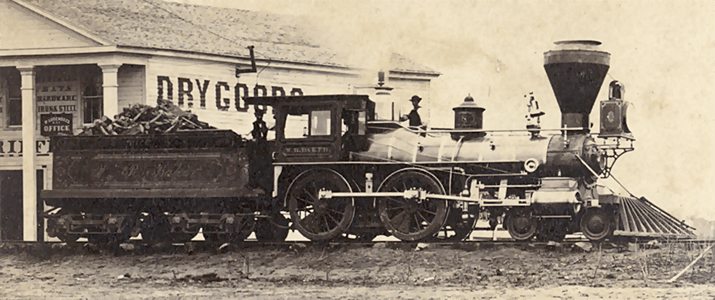
Postwar Houston & Texas Central Locomotive W. R. Baker, c. 1868. Southern Methodist University Libraries.
I’ve traced what I think is the correct route in Google Earth, which can be downloaded here. One of the great things about a tool like Google Earth (or more formal GIS tools like ArcGIS) is that while the original feature may be long since gone, the changes it makes to the terrain are often visible for generations later, particularly in an aerial view. The route is almost perfectly straight from Hempstead to the Brazos River, where the land is flat; it takes a more meandering path west of the Brazos, where there are gently-rolling hills to deal with.
__________

Public Talk: “Yellow Fever in Galveston During the Civil War”
 My colleague, Jim Schmidt, will give the final 2012 Menard Lecture tomorrow, Sunday, at 2 p.m. at Menard Hall, 33rd Street and Avenue O in Galveston. Tickets are $10 for GHF members and $12 for non-members. It’s going to be a great talk. Having read some of Jim’s work on the subject, I know it will cover a lot of new ground, and folks who are able to attend are in for a treat.
Jim is a chemist by training and profession. After receiving his B.S. in Chemistry from the University of Central Oklahoma, he has worked in a number of private, government, and industrial laboratories, and is currently employed as a scientist with a biotech firm in The Woodlands, Texas. He has had a life-long interest in history, with a special regard for the Civil War. His historical writing credits include more than fifty articles for The Civil War News, North & South, Learning Through History, World War II, and Chemical Heritage magazines, and other publications. Jim is also a popular speaker and has given lectures on the Civil War to groups around the country.
Jim’s books, Lincoln’s Labels: America’s Best Known Brands and the Civil War, Years of Change and Suffering: Modern Perspectives on Civil War Medicine co-edited with Guy Hasegawa, and Notre Dame and the Civil War: Marching Onward to Victory, have received praise from both popular and academic historians alike. His new book, Galveston and the Civil War: An Island City in the Maelstrom, is published by the History Press and is now available for pre-order.
__________________

Engaging Confederate Guerrillas on the Tennessee River
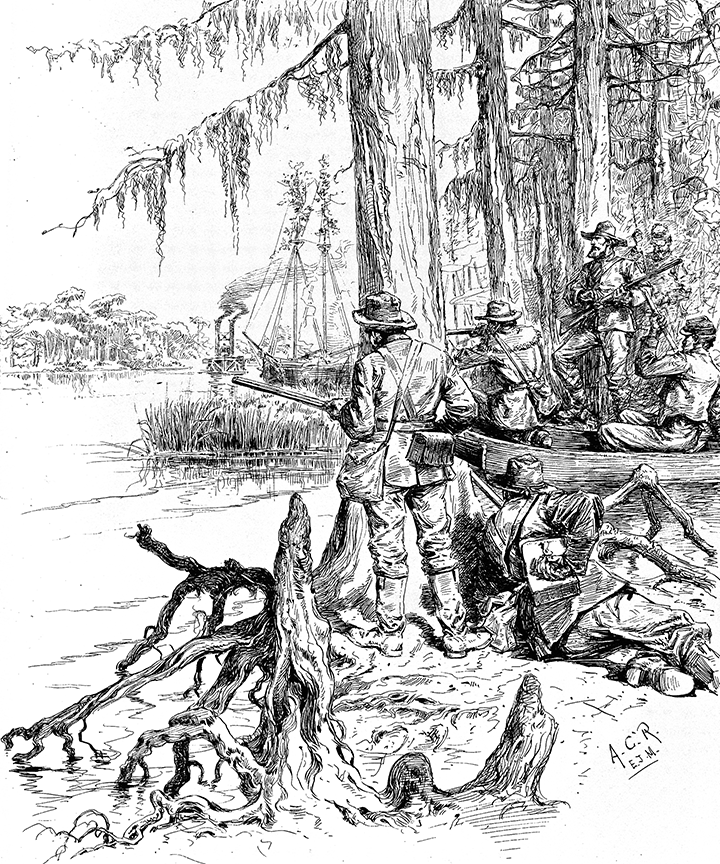
One thing I like about Robert S. Critchell’s memoir, Recollections of a Fire Insurance Man, is how it details some aspects of naval life aboard aboard one of the U.S. Navy’s “tinclad” gunboats on the Western Rivers. There’s scads of material written about Hampton Roads, or the cruise of the Confederate raider Alabama, and lots on the blockade, as well. There seems to be relatively little, though, about less-glamorous, and generally less dramatic, operations of the small, lightly-armored and lightly-armed gunboats like Critchell’s boat, U.S.S. Silver Cloud. Even though the U.S. Navy claimed control of the entire length of the Mississippi from mid-1863 on, as a practical matter was never able to completely cut off communication between the two halves of the Confederacy. Part of their attempt to do that was to commission a large fleet of lightweight gunboats that could engage light forces and maintain at least some semblance of local control over a stretch of river. In many respects, the activities Acting Master’s Mate Critchell and his crew mates were engaged in was very similar to the Navy’s famous riverine operations in Vietnam, a century later.
Here, Critchell describes a typical, and ultimately unresolved, encounter with Confederate guerrillas on the Tennessee River.
It was the duty of the officer of the deck to be in uniform, wearing his sword, to communicate to the other officers, or the crew, all orders given by the captain or executive officer, which were written on a slate (or had been by the watch officer receiving them, and by him, turned over to the succeeding deck officer), to keep the “log,” a book which stated where we were, what boats passed up or down the river and any events of interest, noting drills, “quarters,” and other things showing the details of our daily occupation. Our captain was an “acting master,” afterwards promoted to “acting volunteer lieutenant,” on account of bravery and good conduct in an action in which the boat he was on was engaged in Arkansas. While slowly ascending the crooked waters of the Tennessee river, one morning, the quartermaster on “lookout,” who was stationed on the hurricane deck, over my head, I being officer on deck at that time, came down and reported “guerrillas ahead, on the shore.” He handed me the glass, and indicating the spot where he saw them, I looked through the glass and saw ahead a number of men who were evidently trying to conceal themselves behind logs, tree branches and brush. As several boats had been fired upon in this vicinity, we were keeping a sharp lookout. I at once reported to the captain and was ordered to give them a shell with the ten-pounder rifled gun, which was loaded with a percussion shell. This was my first opportunity to use powder on the enemy, so I had the gun’s crew up at once and fired the gun, the shell hit a tree and exploded, which caused the “Johnnies” to get out of their hiding place in quick time and retreat back into the woods. We followed up this shell with another one; but, although we ran close to the shore, when we got to the place from which we had driven them, we could see no more signs of life. This little affair illustrates what the “tinclad” gunboats were for. With few guns and light iron protection for boilers, machinery and crew, they were terrors to the hands of Rebels who with muskets or small field pieces, could kill and wound pilots and crews of unarmed steamboats engaged in carrying troops or supplies in the rivers or engaged in peaceful occupations. The Mississippi and its tributaries had been opened up to navigation, but it was necessary to keep them open. Heavy and slow ironclads could not navigate the shallow river channels in which steamers had to go, and the light craft “tin-clads,” with no heavier armament than twenty-four pound howitzers, were a terror to these sharp-shooters. The twenty-four pound howitzer usually fired a shrapnel shell containing about eighty one-ounce musket balls, and the shell was filled with powder and sulphur, which would cause the shell to explode in from one to five seconds, according’ as its fuse was cut, the range of the gun being about one mile. These exploding shells were a source of fear to the enemy and set on fire any inflammable object they struck.
___________
Excerpt from Robert S. Critchell, Recollections of a Fire Insurance Man (Chicago: McClurg & Co., 1909). Image: “An Incident in the Defense of New Orleans,” by Allen C. Redwood (1844-1922).

Black Confederates, A Subsidiary of Dixie Outfitters
Update, August 10: Near the end of this post, I wrote that “as far as I can tell, neither Barber nor Edgerton have ever explicitly claimed Heritage 411 to be a non-profit organization.”
I was wrong. They claim both non-profit status and that donations to Southern Heritage 411 are tax-deductable for donors:
To those of you who would like to make a tax deductible contribution to a non- profit organization and support H.K. Edgerton now, please make your checks payable to: Southern Heritage 411 and send it to:’ Southern Heritage 411, Inc.
P O Box 220
Odum GA 31555-0220 Dewey Barber
Owner, Dixie Outfitters

Judging from the Internet Way-back machine, this claim has been posted on the Heritage 411 website since (at least) July 2008, more than four years ago.

 Kevin has made a couple of posts recently poking fun at H. K. Edgerton, and his frequent display (when not in Confederate uniform) of different shirts sold by Dixie Outfitters, frequently one with his own image emblazoned upon it. But there’s a method to this, and Edgerton’s sartorial choices need to be understood in the context of his business relationship with Dixie Outfitters. Southern Heritage 411 is a for-profit corporation, registered as such with Georgia Secretary of State from 2006 to 2010, when its license was dissolved because the company repeatedly failed to file its required annual re-registration. Although it is sometimes described as a non-for-profit organization (e.g., on Clint Lacy’s blog), and Edgerton solicits donations constantly, Heritage 411 has never been registered as such with the IRS or any state agency that I can find.

Did you ever wonder why Southern Heritage 411 is located in Georgia, when Edgerton lives 300+ miles away in North Carolina? Turns out, that’s easy — because Southern Heritage 411 is run by Dewey Barber, not H. K. Edgerton.
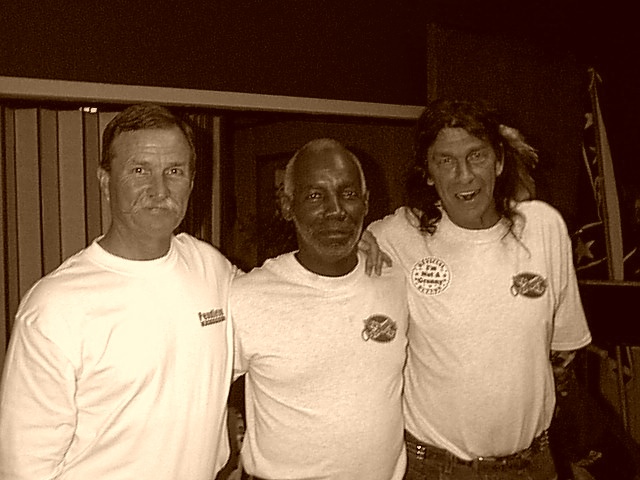
Dewey Barber, H. K. Edgerton and musician Terry Warren, via TerryWarren.net.
The Heritage 411 website is scattered with praise for Dixie Outfitters owner Dewey Barber, and an acknowledgment of Barber’s support for Edgerton (e.g., “HK’s main benefactor is Dewey Barber, who uses HK to sell merchandise from his business Dixie Outfitters“). But in fact, Edgerton is (or at least was, until 2010) effectively Barber’s employee, a junior officer in the company reporting to Barber, who has always been the primary contact for Heritage 411, and from 2007 t0 2010, was the CEO as well. The core truth, as outlined in official filings made by Heritage 411 in Georgia (accessible at the link above) is that Southern Heritage 411 is a for-profit business, run by Dewey Barber, with H. K. Edgerton as the public face of that business. It’s a deeply cynical arrangement, one that takes commercial advantage of Edgerton’s popularity among Confederate Heritage™ groups who embrace Edgerton and his theatrics as a sort of vaccination against being accused of some of the uglier attitudes and beliefs commonly associated with the Confederate flag. Barber’s Heritage 411 operation is, at its most benign interpretation, a sort of under-the-radar marketing enterprise, firing up the True Southrons and encouraging them to (not coincidentally) purchase Dixie Outfitters’ merchandise. It probably brings a good return on investment, too, given the effectiveness of a popular and high-profile representative like Edgerton.

Edgerton with (r.) Clint Lacy, whose blog, “Across Our Confederation,” falsely describes Southern Heritage 411 as a “non for profit resource.” Image via the John T. Coffee SCV Camp No. 1934.
As far as I can tell, neither Barber nor Edgerton have ever explicitly claimed Heritage 411 to be a non-profit organization, but they do seem perfectly content to let people believe they are, and to let others make that claim on their behalf. And Heritage 411 sure makes itself sound like a charitable organization. There’s nothing illegal about soliciting “donations” to a for-profit business like Heritage 411, but I’ll leave it for others to decide how ethical it is, given Edgerton’s continual solicitation of donations — he routinely appends an address for PayPal payments to his e-mails — and presenting himself as a lone voice, a committed and uncomplicated individual fighting the good fight for Southern Heritage™, without mentioning his formal business and legally-binding links to one of the best-known vendors of Confederate-themed merchandise in the country. I suspect there are a lot of folks, taken in by Edgerton’s apparent sincerity, who’ve donated money to Heritage 411 — money they may have been hard-pressed to give — thinking that they’re donating to a non-profit enterprise, when in fact Southern Heritage 411 is just another branch of the Dixie Outfitters’ marketing outreach.
______________

Duck Hunting with the Navy


The other day we had an account of the aftermath of the Fort Pillow massacre written by Acting Master’s Mate Robert S. Critchell (right) of the “tinclad” gunboat U.S.S. Silver Cloud (above). Today’s story is much more fun. Here, Critchell describes a trip on the Mississippi with a distinguished passenger, and an unusual method for replenishing the boat’s commissary.
The first day of January, 1864, was the coldest day that I ever knew in the southern country. At Memphis, where the “Silver Cloud” was then lying, the river was full of floating ice of great thickness and the pieces of ice were so heavy, hard and sharp that the steamboats were laid up, waiting for the ice to become soft and of less quantity in the stream, as it was feared the grinding of the ice would cut through the planking of the hulls and sink the boats. It was very unusual for ice to be so thick and so hard and in such quantities as far south as Memphis. At this particular time General Sherman and his staff came to Memphis. He was very anxious to proceed immediately down the Mississippi river to Vicksburg, so one of his staff officers visited the various gunboats at Memphis and made inquiries as to the possibility of carrying the general and his staff down the river, without delay. Our captain and senior officers decided that it was worth while for us to try it, to accommodate General Sherman, so we at short notice got on board a lot of two-inch pine plank, sawed up into two-foot lengths, a lot of long spikes, some hammers, stages and lanterns. The object of these preparations being that, in case the ice should grind our hull seriously, we would by means of the stages dropped over the gunwales, spike on some of these pieces of plank so that they would stand the grind, rather than the hull. Without waiting to get on board fresh provisions, which we needed to supply our distinguished company, we got on our way and, of course, went very slowly, but successfully got down to Vicksburg, where we remained for two days, giving us all an opportunity to see the wonderful place which had been surrendered by General Pemberton, C. S. A., to the Union army under General Grant on the 4th day of July, six months before this time. We then started back up the river, but still without any better provisions than we left Memphis with, as Vicksburg was a simple military post and its garrison and inhabitants had been obliged to subsist considerably on mule meat during the latter part of the siege. While I was on deck, after leaving Vicksburg, our boat, having proceeded about twenty miles up the river, I saw a small sand island, called in the pilot’s vernacular, a “towhead,” literally covered with geese, ducks and sandhill cranes, the large number being no doubt congregated there by reason of the excessive cold weather. It occurred to me that here was a chance to lay in some fresh provisions, and, asking the captain’s permission to fire one of my twenty-four pound bow howitzers at this flock of birds, I brought the boat slowly up to the island, as near as I could, without frightening the birds away. I then stopped the boat and fired my gun and, by some extraordinary piece of good luck, happened to explode the shell just on the edge of the island. The birds of course rose with the sound of the explosion. As near as I could estimate the distance, I had fired the gun at a range of a mile. Our boat being brought to anchor, I went to the island in the cutter and found a large number of dead birds and some fluttering and badly wounded, which the boat’s crew and myself finished, either by striking them with the oars, or shooting them with revolvers. On returning, the number of dead birds we brought, turned out to be forty-three, of which the large majority were geese and ducks. I had the satisfaction of being patted on the shoulder by our distinguished passenger, General Sherman, and told by him that “we could now have some change of diet,” owing to my good shot. This proved to be the case. We gave the sandhill cranes to the crew, they having a rank flavor and requiring to be boiled, or parboiled, to get this flavor out somewhat, so that they could be afterwards roasted and eaten. I have often told this story at dinners of naval veterans, etc., but always prefaced it with the statement that “I once killed forty-three geese and ducks with one shot,” which, from the above statement, will be seen was a fact. Some years ago, I was called on by a little old man at my office in Chicago, who inquired for me with a peculiar high pitched and squeaky voice. I at once recognized him as a man who had been one of the crew of the “Silver Cloud.” He said he wanted my signature to some pension papers he was sending to Washington. I at first pretended not to be able to recognize him, when he pulled from his vest pocket a small black object, which he told me was the skin of one of the sandhill cranes’ feet that I shot just above Vicksburg and that he had brought that with him to prove to me that he was the man that he claimed to be. I signed his paper with alacrity, on the production of this proof of his identity. At a dinner of a naval veteran society in Chicago, subsequently, at the Union League Club, where there were several guests invited by the members of the society, I was called on to tell my “duck story,” which, like many sailor’s yarns, was considered by those who had heard it before, as a little bit exaggerated. I was so pressed to tell the story that I did so and, when several sarcastic remarks to the effect of “couldn’t I reduce the number of ducks one or two,” were made, to my utter astonishment, one of the guests, a tall, gray-bearded old man arose in his place and said that “he saw that shot and counted the birds and there were forty-three.” I immediately said to this gentleman that I was unable to locate him and asked him for some details of his welcome corroboration of my story. He said that he was General Bingham, at this particular time stationed at the headquarters in Chicago of the Department of the Lakes of the United States army as chief quartermaster. He said that in 1864 he was captain and quartermaster on General Sherman’s staff, and was one of the party that we took on our boat from Memphis to Vicksburg, and he had always remembered the great success of that howitzer shell, particularly as it produced a lot of fresh provisions in the shape of geese and ducks, instead of the “salt horse” of which they had had so much and were so tired.
_____________
Excerpt from Robert S. Critchell, Recollections of a Fire Insurance Man (Chicago: McClurg & Co., 1909).

Oregon “Redneck” Flag Case Moves Forward

Ken Webber, the rural Oregon school bus driver who was fired after refusing to remove a large Confederate flag from his truck, blazoned “REDNECK,” when it was parked in his employer’s lot, has gotten permission to proceed with his case against the local school district. I had understood that the district had been excused from the case because Webber worked for a private contractor, but perhaps they were reinstated as defendants.
U.S. Magistrate Judge Mark D. Clarke ruled against a motion to dismiss the First Amendment case and said the suit should go to trial, according to court records filed in U.S. District Court in Medford. School bus company First Student Inc. and Jackson County School District 4 had argued the case should be dismissed because driver Ken Webber flew the flag as an expression of what he called his “redneck lifestyle,” not protected political speech. Clarke wrote there is enough evidence to allow a jury to find that Webber flew the flag to express his feelings for history and heritage, which other courts have included in freedom of speech protections guaranteed by the First Amendment to the Constitution. The magistrate’s recommendation goes to a judge for final action. No trial date has been set. Webber’s attorney Thomas Boardman called it “a thrilling victory for the First Amendment.”
Well, no — not yet, anyway. This ruling means Webber’s still in the game. It remains to be seen whether the federal judge in the case will accept the magistrate’s ruling and schedule an actual trial. And this:
Clarke also found that Webber’s flag amounted to an expression of his personal beliefs, and could not be considered an expression of policies of the bus company or school district.
I have no idea what those beliefs actually are, which would at least help one understand Webber’s position. As I’ve said before, the interesting thing about this case to me is that Webber, as far as I can see, hasn’t made any claim that his flag is an expression of Southern culture or Confederate heritage or any particular historic connection; he seemingly equates the Confederate Battle Flag with redneckism/redneckitude/redneckery. That’s entirely his prerogative, of course, but advocates for public display of the Confederate Battle Flag ought to be uneasy about that.
______________
Image: Associated Press.





 Dead Confederates, A Civil War Era Blog

2 comments