“One of them was a better soldier than I was.”
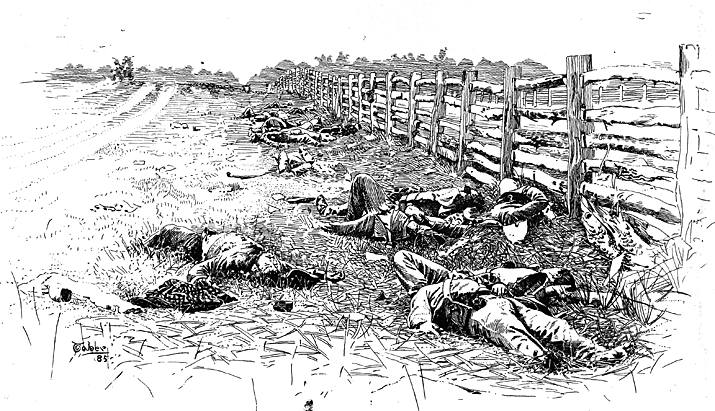
Private Lawrence Daffan, Co. G, Fourth Texas Infantry, at Sharpsburg, September 17, 1862:

On the evening of the 16th we crossed the Antietam Creek, falling back from Boonsboro Gap. This occasioned some skirmishing and artillery duels across the creek, as we had taken a stand near Sharpsburg. We had orders the evening of the 16th to cook up three days’ rations, and to be ready to move at a moment’s warning. We were located nearly a half mile south of an old Dunkard church. There was heavy timber between us and the church; north and west of us there was a large stubblefield where wheat was cut. North of this stubble was a large cornfield of considerable dimensions. Corn there in September is as high as it is here in July; fodder was about ready to be gathered. By daylight the pickets commenced firing. By sunrise wer were ordered forward in line of battle. We stopped near the church in the heavy timber, the branches were falling on us, and many spent balls played around us. A short time after this we were ordered “forward.” We emerged from the timber into the stubblefield; some of it I think had recently been plowed. As we emerged from the timber, a panorama, fearful and wonderful, broke upon us. It was a line of battle in front of us. Immediately in front of us was Lawton’s Georgia Brigade. After we left the timber we were under fire, but not in a position to return the fire. As we neared Lawton’s Brigade, the order came for the Texas Brigade to charge. Whenever a halt was made by a command under fire, every man lay flat on the ground, and this was done very quick. Lawton’s Brigade had been on this line fighting some time before we reached them. Lawton’s Brigade attempted to charge, and did charge; their charge was a failure, because their numbers had been decimated; they had no strength. Then the Texas Brigade as ordered to charge; the enemy was on the opposite side of this stubblefield in the cornfield. As we passed where Lawton’s Brigade had stood, there was a complete line of dead Georgians as far as I could see. Just before reaching the cornfield General Hood rode up to Colonel [Benjamin F.] Carter, commanding the fourth Texas Regiment (my regiment), and told him to front his regiment to the left and protect the flank. This he did and made a charge directly to the west. We were stopped by a pike fenced on both sides. It would have been certain death to have climbed the fence. Hays’ Louisiana Brigade had been in on our left, and had been driven out. Some of their men were with us at this fence. One of them was a better soldier than I was. I was lying on the ground shooting through the fence about the second rail; he stood up and shot right over the fence. He was shot through his left hand, and through the heart as he fell on me, dead. I pushed him off and saw that “Seventh Louisiana” was on his cap. The Fifth [Texas], First [Texas] and Eighteenth Georgia, which was the balance of my brigade, went straight down into the cornfield, and when they struck this cornfield, the corn blades rose like a whirlwind, and the air was full.

_____________
Lawrence Daffan was seventeen years old at the time. He survived this fight, the assault on Little Round Top at Gettysburg the following year, and the Battle of Chickamauga, only to be captured in late 1863 and spend the remainder of the war as a prisoner at Rock Island, Illinois. Passage from My Father as I Remember Him, by Katie Daffan. Image: “The Hagerstown Pike,” by Walton Taber.
Additional Hatteras Project Photos
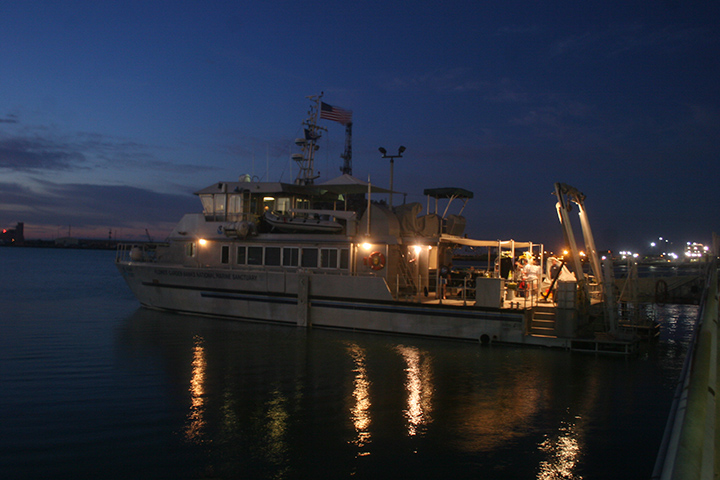
New Hatteras News Items

Nautical archaeologist Amanda Evans of Tesla Offshore examines Hatteras‘ starboard paddlewheel. Photo by Jesse Cancelmo.

Two new news items today on this week’s fieldwork on the Hatteras site:
Galveston County Daily News
Researchers Map Hatteras as Anniversary Approaches
Houston Chronicle
Sunken Ship Yields Secrets to Technology
____________

“The Fight of the Hatteras and Alabama”
 A popular song of the Civil War period was “The Fight of the Hatteras and Alabama,” reportedly composed by Ordinary Seaman Frank Townsend (or Townshend) of the Confederate raider. The lyrics were probably first published in 1889 in Frank Moore’s The Civil War in Song and Story, 1860-1865. Townsend may have been a veteran of Alabama‘s entire cruise; he was rescued by the British yacht Deerhound after the battle with Kersarge in June 1864. This song is the first track on the recent Smithsonian Folkways release, Civil War Naval Songs: Period Ballads from the Union and Confederate Navies, and the Home Front.

Preparing for a heavy fight they were to have next day;
Down came the Alabama, like an eagle o’er the wave,
And soon their gunboat Hatteras had found a watery grave. Twas in the month of January; the day was bright and clear;
The Alabama she bore down; no Yankee did we fear:
Their Commodore he spied us; to take us long he burned;
S0 he sent the smartest boat he had, but she never back returned. The sun had sunk far in the West when down to us she came;
Our Captain quickly hailed her, and asked them for her name;
Then spoke our First Lieutenant, — for her name had roused his ire,
“This is the Alabama — now, Alabamas, fire.” Then flew a rattling broadside, that made her timbers shake;
And through the holes made in her side the angry waves did break;
We then blew up her engine, that she could steam no more —
They fired a gun to leeward, and so the fight was o’er. So thirteen minutes passed away before they gave in beat;
A boat had left the Yankee’s side, and pulled in for their fleet;
The rest we took on board of us, as prisoners to stay;
Then stopped and saw their ship go down, and then we bore away. And now, to give our foes their due, they fought with all their might;
But yet they could not conquer us, for God defends the right;
One at a time their ships they have to fight us they may come,
And rest assured that our good ship from them will never run.
____________

Memorial for U.S.S. Hatteras Crew Members
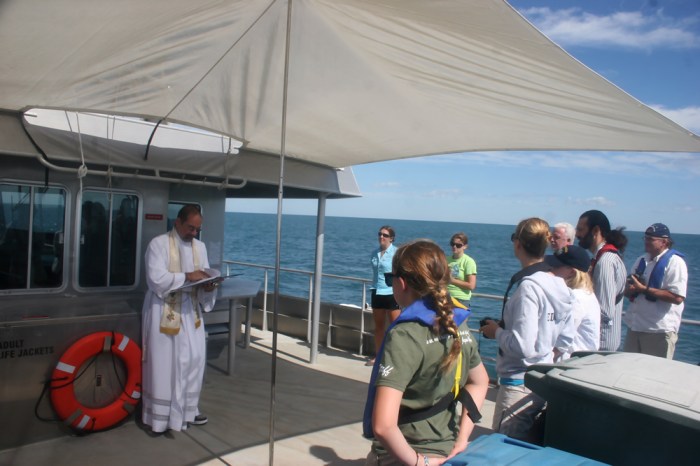
September 10, 2012. Fr. Stephen Duncan of Galveston, Texas conducts a memorial service for U.S.S. Hatteras Fireman John G. Cleary and Coal Heaver William Healy, who died in the battle with C.S.S. Alabama, January 11, 1863. This service, conducted over the wreck of Hatteras, is believed to be the first to honor these men, both of whom were Irish immigrants. The service marked the beginning of an intensive survey of the wreck conducted by a team of archaeologists and technicians assembled by NOAA, that will create a three-dimensional sonar map to document the storm-exposed remains of the USS Hatteras. The wreck itself will not be disturbed, and no artifacts will be recovered. The wreck is a protected site, and because the remains of the two crewmen were never recovered, the site is considered to be a war grave.
________

A memorial wreath and red and white rose petals scattered on the Gulf of Mexico at the site. I’ll have more to write about this project soon. In the meantime, here’s a NOAA press release providing the basic details. More Fr. Duncan here.
__________

Steamboat Veterans for Truth and the 1864 Presidential Campaign

Several bloggers have noted these videos individually, but Corey flags a whole set of them at FlackCheck.org. Who says you can’t critique the excesses of modern campaigning and be funny at the same time?
Here’s one exposing the Homestead Act of 1862 as “wealth redistribution”:

________________

Confederate Heritage™ Defenders, Ignorant of Confederate Heritage
Billy Bearden, Flagger extraordinaire, continues his unhinged rant against the United Daughters of the Confederacy, when they don’t live up his own personal standard of butternut patriotism:

MOVE OVER Gail Crosby, Aileen Ezell, Suzanne Townsend, Martha Van Schaick, Betty Giragosian! The Texas UDC is not about to be left out of the race to shed itself of the Anti BATTLEFLAG gang!

 Leaving aside the fact that that last sentence seems to say the opposite of what’s actually meant, the offense here is that a Dallas chapter of the UDC bought a bunch of “First National” flags to use on graves at a local cemetery, instead of the Confederate Battle Flag. Billy seems unaware that the First National has been the official flag of the UDC for more than a century, a part of its logo (right) in the same way that the CBF is part of the SCV emblem. Then again, the Flaggers’ allies at SHPG seem to believe that the UDC is a “support group to the SCV,” when in fact they are parallel organizations, with the UDC having been founded first, and thus is actually the senior of the two.
It’s amazing how little the Confederate Heritage™ folks seem to know about actual Confederate heritage.
______________

A Haka for Fallen Comrades

Some of you may have seen this video, currently going viral, of soldiers of the 2nd Battalion, 1st Royal New Zealand Infantry Regiment saluting two of their comrades, Lance Corporals Pralli Drurrer and Rory Malone, who died in Afghanistan. From the accompanying text:

Haka is used throughout New Zealand by many, not only Māori, to demonstrate their collective thoughts. There is a haka for each of the Services, as well as the Defence Force. Units with the NZ Army have their own haka. This video shows the soldiers of 2/1 RNZIR Battalion performing their Unit haka, powerfully acknowledging the lives and feats of their fallen comrades as they come onto the Unit’s parade ground. It is also an emotive farewell for they will leave via the waharoa (the carved entrance way) for the very last time.Haka –sometimes termed a posture dance could also be described as a chant with actions. There are various forms of haka; some with weapons some without, some have set actions others may be ‘free style.’ Haka is used by Māori (indigenous people of New Zealand) for a myriad of reasons; to challenge or express defiance or contempt, to demonstrate approval or appreciation, to encourage or to discourage, to acknowledge feats and achievements, to welcome, to farewell, as an expression of pride, happiness or sorrow. There is almost no inappropriate occasion for haka; it is an outward display of inner thoughts and emotions. Within the context of an occasion it is abundantly clear which emotion is being expressed.
It’s a remarkable example of how cultural practices cross traditional ethnic boundaries and strengthen shared national bonds. Different customs, but no less meaningful.
_____________

Monday Concert: Joe Hill’s “Casey Jones”

The ballad of Casey Jones has been recorded many, many times, but my favorite is this cover by the indomitable Pete Seeger, with the lyrics written by labor activist Joe Hill for the Industrial Workers of the World. Hill’s version took advantage of the popularity of the traditional version, which related the story of the real John Luther “Casey” Jones, an engineer on the Illinois Central Railroad, and made it into an allegory on the fate of union scabs. The real Jones was the sole fatality in a train wreck in rural Mississippi in 1900 — one in which his actions, staying on the brakes of his locomotive to the end, were credited with saving many lives among the passengers on his train — but Hill’s lyrics move his demise to a different railroad, in very different circumstances:
The workers on the S.P. line to strike sent out a call; But Casey Jones, the engineer, he wouldn’t strike at all; His boiler it was leaking, and its driver’s on the bum, And his engine and its bearings they were all out of plumb. Chorus:
Casey Jones kept his junk pile running; Casey Jones was working double time; Casey Jones got a wooden medal, For being good and faithful on the S.P. line. The workers said to Casey: “Won’t you help us win this strike?” But Casey said: “Let me alone, you’d better take a hike.” Then Casey’s wheezy engine ran right off the wheezy track, And Casey hit the river with an awful smack. Chorus: Casey Jones hit the river bottom; Casey Jones broke his blooming spine; Casey Jones turned into an angel, He took a trip to heaven on the S.P. line. When Casey Jones got up to heaven to the Pearly Gate, He said: “I’m Casey Jones, the guy that pulled the S.P. freight.” “You’re just the man,” said Peter, “our musicians went on strike: You can get a job a-scabbing any time you like.” Chorus: Casey Jones got a job in heaven; Casey Jones was doing mighty fine; Casey Jones went scabbing on the angels, Just like he did to workers on the S.P. line. The angels got together and they said it wasn’t fair For Casey Jones to go around a-scabbing everywhere. The Angels’ Union No. 23, they sure were there, And they promptly fired Casey down the Golden Stair. Chorus: Casey Jones went to Hell a-flying; “Casey Jones,” the Devil said, “Oh fine; Casey Jones, get busy shoveling sulfur That’s what you get for scabbing on the S.P. line.”
Hill’s lyrics have nothing at all to do with the real Casey Jones, but Seeger’s version is so vibrant, so compelling — so unerringly cynical, funny and explicitly political — that it overrides those concerns for me, at least temporarily. Unfortunately, whoever put this video together with Seeger’s recording used images of the real Casey Jones to illustrate Hill’s song. I suggest ignoring the visuals altogether.
Seeger sings the original here:
______________

My Obligatory General Lee Post
OK, the good news is that Warner Brothers has apparently backed down and will not be removing the Confederate flag from the roof of the famous Dukes of Hazzard car. However, there will be other modifications to the vehicle:

_________________
H/t to user Copperhead-mi at Civil War Talk for locating the image.





 Dead Confederates, A Civil War Era Blog
3 comments