The Veteran, the Historian, and the Things Not Seen
Over the Christmas holiday in 1905 Lawrence Daffan (1845-1907), a former private in the Fourth Texas Infantry, dictated to his daughter Katie a biographical sketch of his life, along with more detailed accounts of two major actions he served in. After his death, Katie published these in a memorial book, My Father as I Remember Him.
In the memoir, Daffan recalled that after the Army of Northern Virginia was turned back at Gettysburg and withdrew across the Potomac,
we then marched to Culpepper, where we camped a while, then on to Fredericksburg, thence to Port Royal, where we camped some weeks.
While at Culpepper we had something of a riot in our regiment, caused by one of the regiment being ordered to wear a ball and chain, which we thought was a disgrace to our regiment and to the State of Texas. A number of us boys, who did not know any better, attempted to take him from the guard. Charges of mutiny were made against twenty-five of us, and we were put under arrest. Our captains were responsible for our appearance at court. This relieved us from drill and every other duty for six weeks of the summer.
Our trial was ordered to take place at General Longstreet’s headquarters, at Fredericksburg, in the first days of September, 1863. We were then camped at Port Royal, twenty miles east of Fredericksburg. We were all ordered to report to General Longstreet’s headquarters, near Fredericksburg, to be tried. On the way there I stopped at my uncle’s home, Champ Jones, twelve or fifteen miles from Fredericksburg, and did not arrive at Fredericksburg until after my “crowd” had arrived there. In going, I was alone. There was no guard with any of us. In looking for the headquarters where I might be tried, I went to the camp of the battalion of artillery, and the major commanding met me. I asked him to tell me where the General’s headquarters were, and he said “At the Reynold’s place, a large, white house about a mile away.” He said, “What are you going for?” I said, “I am going to be court-martialed for mutiny.” He said, with astonishment, “What, looking for a court to be court-martialed? That beats everything I ever heard of.” I said, “yes,” and he replied to go ahead, that he didn’t think I would be shot. I was then eighteen years old. We were all cleared through the influence of General Lee.
This anecdote was first widely published forty years ago in Harold B. Simpson’s Hood’s Texas Brigade: Lee’s Grenadier Guard, and has been mentioned in other secondary accounts since. To my knowledge, it’s not corroborated by other firsthand accounts. (Giles’ Rags and Hope mostly skips over this period of relative inactivity.) Ten years ago, Texas A&M historian Charles E. Brooks included this anecdote in his journal article, “The Social and Cultural Dynamics of Soldiering in Hood’s Texas Brigade,” published in the Journal of Southern History. Brooks briefly summarizes Daffan’s account, and then assesses it in terms of its time and place — not 1863, but 1905:
Written years later after the cult of the Lost Cause had romanticized the war and magnified the heroic deeds of Confederate soldiers, Daffan’s account only noted parenthetically that neither he nor the others “knew any better” at the time. But his amplifying comment was characteristic of many wartime reminiscences, which often glossed over the continuous conflicts that had taken place between officers and men concerning matters of discipline and subordination. Young Private Daffan and the others knew exactly what they were doing when they tried to rescue their fellow soldier. Although enlisting as a soldier of the Confederate Army required soldiers to occupy a new social status somewhere between freedom and slavery, the ball-and-chain punishment had blurred the distinction beyond what they were willing to accept.
Shorter: Daffan’s account is a reminiscence that has to be understood in the context of the time it was recorded.
Comparing these two passages makes for a good illustration of what a professional historian does. Daffan’s account, like so many written about that same time, stresses the humor and devil-may-care attitude of soldiering during the war. Daffan was indeed eighteen at the of this incident, but he was also a veteran (by his own count) of at least six different engagements, including Second Manassas, Sharpsburg and Little Round Top. The soldiers understood what they were doing when they tried to overpower the prisoner’s guard. Daffan and his compatriots also understood at least the potential penalty upon conviction of mutiny by a court martial; it cannot have seemed to Daffan at the time to have been such a summertime lark as he suggests when he describes his arrest as relieving “us from drill and every other duty for six weeks of the summer.”
Brooks’ reference to the pervasiveness of the Lost Cause is not supposition; it’s true both generally, and in Lawrence Daffan’s case specifically. Daffan was an active member of UCV and the Hood’s Texas Brigade Association; his daughter Katie was secretary and sole female member of the latter organization. When the local UDC chapter bestowed the honorary title of “colonel” on Lawrence Daffan, he adopted it immediately, and used it in both his personal and professional life so much that, upon his death, newspapers around the state referred to him as “Col. Daffan,” even though he’d never risen above the rank of private during the war.
Daffan was captured late in 1863 an spent the remainder of the war in the prison camp at Rock Island. Although he spent almost as much time as prisoner as he did as a soldier in the field, in his memoir he generally declines to discuss the hardships of this period in his life, commenting instead on the sheer boredom of the experience, where one day was exactly like the one before, and exactly like the one following, so that there was little concept of the passage of time. In fact, Daffan apparently left much unsaid in his dictation, and found his recollections, as they appeared on the page, difficult emotionally. As a preface to his autobiographical sketch, Katie wrote that
he would frequently related some anecdote or little incident, which he did not deem worthy of being included in the sketch, but which was invariably interesting.
Once or twice, while reviewing the battles [i.e., Second Manassas and Sharpsburg], he gave way to weeping and expressions of the deepest feeling, very unusual for him.
He told me that it carried him back to the days when he was a boy, that it was all so vivid, and so much had occurred since to change him, and so many of his friends and comrades had died, that it made him very sad.
What were the “invariably interesting” anecdotes that Daffan thought too inconsequential to commit to paper? More important, what ugly and terrible experiences remained, insufficiently blurred by the passage of time and memory, that he declined to recall for Katie’s note-taking? My guess is that the latter includes Gettysburg, notably missing from Daffan’s story, where the Fourth Texas remained pinned on the slopes of Little Round Top after the failed assault on the Federal left on July 2, or the habit of the “hundred dazers” walking post on the wall at Rock Island occasionally to relieve their own boredom by squeezing off rounds into the prisoners’ barracks.
None of this diminishes the value of the memoirs of old veterans like Daffan, but it does remind us that, even as important as they are as the record of the men who were there, they nonetheless have real limitations. Their tales of battle, hardship, humor and adventure are only as complete as they themselves recalled them.
Or were willing to.
___________
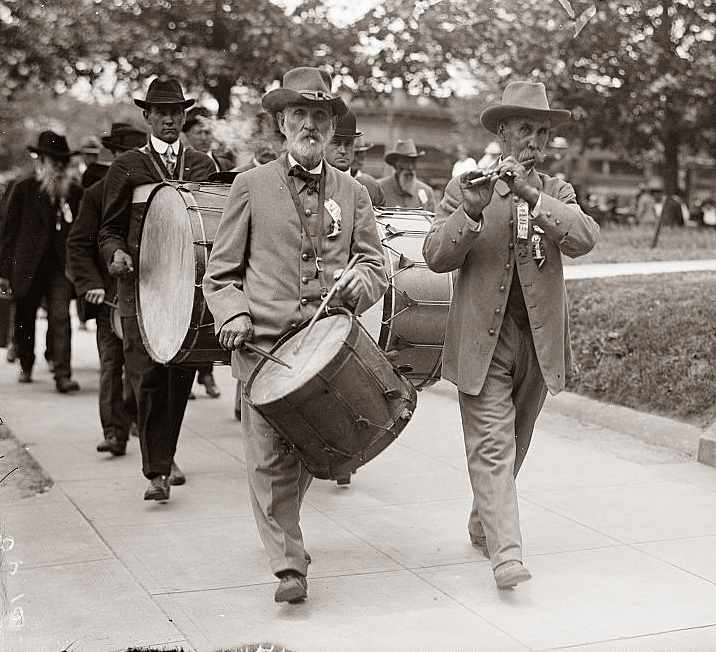
Image: Fife and drums at the United Confederate Veterans’ reunion, Washington, D.C., 1917. Library of Congress.

Sanding Smooth the Rough Edges of History
Several folks have noted online that one of the Confederate reenactors at last Saturday’s Jeff Davis inaugural in Montgomery was an African American woman. Her name is Barbara Marthal, and she’s been active in Confederate heritage activities for years. She is a member of the Tennessee Order of the Black Rose, does public presentations on “black Confederates,” and last spring was married in a Confederacy-themed ceremony (PDF) hosted by the local SCV camp and ladies’ auxiliary. Her commitment to a particular, SCV-endorsed narrative about the war is unquestioned.
I mention Ms. Marthal because, in response to a story on the event at NPR, she posted a comment in which she cited the case of a Civil War relative of hers, Handy Davis Crudup, “who fought for and received a pension from the Confederacy. One hundred fifty years ago he would have cheered Mr. Davis.” The characterization of Mr. Crudup here is interesting, because Crudup’s Tennessee pension explicitly identifies him as a slave, accompanying Pvt. Richard T. Davis of the 7th Tennessee Infantry. This is a salient fact — indeed the most fundamental fact of his wartime experience — but rather than being clear about that, Ms. Marthal instead offers the somewhat ill-defined assertions that Crudup “fought for” the Confederacy, and “would have cheered Mr. Davis.” In place of specific fact, the reader is offered vague assertion and speculation. As with Jefferson Davis in 1861 and his doppelganger in 2011, the mention of slavery is avoided in preference to grander language. I really don’t know how she figures to know Crudup’s likely response to Davis” original speech.
It may seem unfair to examine too closely a comment posted to a news story, but in this case it’s not a quickly dashed-off response. They’re Ms. Marthal’s own words, unfiltered by a reporter or editor. Ms. Marthal’s comment is carefully-worded and clear. It is written in defense of the ceremony in Montgomery, addressed to other NPR readers whose own comments are clearly not sympathetic to her view. And it does as good a job of that as it can. But at the same time it badly misleads the casual reader about Mr. Crudup’s actual wartime status, leaving the clear impression that the man was recognized as a soldier. (Another news story gets closer, saying that Crudup “fought as a slave.”)
Ms. Marthal is clearly committed to her Southern heritage, as she views it. She seems conscientious and sincere, but it’s unfortunate that someone who commits so much time and effort to getting history right, falls into the trap of offering vague-but-grand-sounding language rather than clear and specific wording. We don’t do our ancestors honor by being vague or misleading about who they were. It’s hard enough to try to know them at all; it does no honor to their memory to avoid the unpleasant realities of their lives. They lived those hard, ugly realities; is it too much for us even to acknowledge them directly?

The Plywood Steps
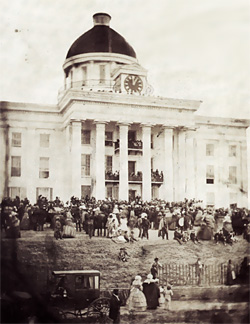 Today the SCV will be sponsoring a sesquicentennial parade and reenactment of the inauguration of Jefferson Davis as president of the Confederacy at the State Capitol in Montgomery, Alabama. It will be interesting to see how many folks turn out for this event, and what sort of media coverage it gets.
I’ve never visited the Alabama State Capitol, but it nonetheless resonates with me because of a story told me many times by an old friend. In the summer of 1965 he was in high school, and lived with his family in Houston. The family’s social life revolved around church, where my friend’s father was music director and a deacon, and their vacations usually consisted of going to family reunions. This was not a lot fun for a teenager.
My friend prevailed upon his parents that summer to fore-go the usual family reunion, and instead take a long driving trip across the South, with particular attention to visiting Civil War sites. This was in the last year of the Civil War Centennial, and my friend already had a pretty big fascination with the subject.
Their visit to Montgomery came a few months after the famous Third Selma-to-Montgomery March, which had ended with a rally at the State Capitol, yards from the spot where Jefferson Davis had been sworn in a century before. My friend remembered that event vividly, and was as interested to see the Capitol as much for that recent history as for its association with the Civil War. One thing he remembered clearly from watching coverage of the anticipated rally was that the capitol steps, at least some of them, had been covered with sheets of plywood. These formed a steep slope, and my friend hadn’t quite figured it out. Maybe, he thought, they’d been put out to allow people in wheelchairs to participate in the rally, but they seemed at too great an incline for that.
So when he actually visited the Alabama State Capitol a few months later, my friend made it a point to ask about the plywood. What was it for, he asked a state trooper on duty nearby. What was the purpose of the plywood covering the capitol steps?
“So the coloreds couldn’t desecrate them,” was the trooper’s answer.

Is it fair that I think of that story every time I see a mention of the Alabama State Capitol or Jeff Davis’ inauguration? Probably not, but the paths our minds take when we think about things, and how we feel about them, often isn’t fair. It just is.
My friend, a son of the South, continued his fascination with the war, and the Confederacy. By his own admission, he bought into the Lost Cause without hesitation, even tacking up an enormous Confederate Battle Flag in his college dorm room at a school that had only desegregated a few years previously. But looking back on his youth now, all these decades later, he sees that offhand comment by the Alabama state trooper at Montgomery, juxtaposed against Jeff Davis’ inauguration and the Selma-to-Montgomery March, to have been the first, crucial step in his questioning of the Lost Cause and developing a more mature, complex understanding of both the history of the war and the historical heritage of his own family. It was the beginning of a hard process of realization, and it took him a long time to understand the realities of those events, and ugly legacies of them that have come down to us, right to the present day.
Added: Scott MacKenzie, via Kevin Levin, attended today’s event (with a little cardboard “UNIONIST” sign) and has the pictures.
_____________
Image: Inauguration of Jefferson Davis, Montgomery, Alabama, 1861. Library of Congress.

Hey, Mississippi SCV: This is How It’s Done
There didn’t seem to be much else to be said about the Mississippi SCV’s Nathan Bedford Forrest commemorative license plate proposal, but Robert Moore suggested Wednesday that a better choice would be to put a generic Confederate soldier on it. This seems appropriate for several reasons, among others that there are a helluva lot more SCV members (and well as Mississippians generally) related to rank-and-file soldiers than there are descendants of cavalry generals. Such a plate might also serve as a point to generate constructive conversations with the public, including:
“Who was that man in the uniform?”
“What made-up the Confederate soldier, who, in turn, became the Confederate veteran?”
“How was the individual man part of the Confederate story?”
“Was he willing, unwilling?”
“Was he enthusiastic for ‘the cause’… for ‘a cause’?”
And so on. One of Robert’s commenters suggested the plates feature some of Don Troiani’s uniform studies. It’s a capital idea.
The SCV could issue five plates, one for each year of the war, each celebrating a “common man” (or woman) from the conflict. An early-war infantryman for 2011 (below). A civilian woman from Vicksburg in 2013. A former slave in the USCT for 2015. (Well, maybe that last one wouldn’t go over so well with the SCV. But it would sure work for a state-sponsored plate.) There are lots of other possibilities.
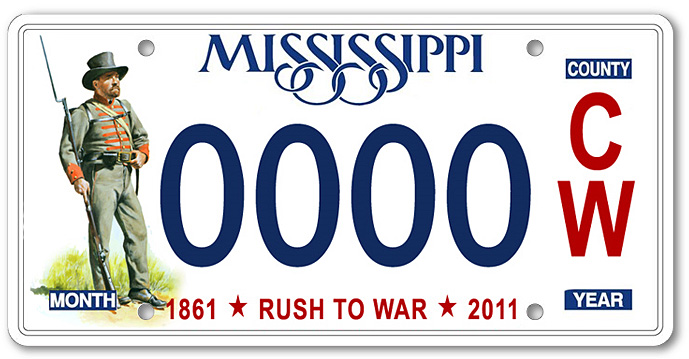
It’s colorful, it carries a bit of history, and it certainly comes closer to reflecting the Civil War experience of typical Mississippians better than one bearing the picture of a millionaire slave trader from Memphis. Granted, it doesn’t have quite the in-your-face impact of a big-ass flag out on the interstate, but sometimes less is more, ya know?
_________________________
Image: Soldier of the 17th Mississippi Infantry, Company I, Pettus Rifles by Don Troiani.

Did “that Devil Forrest” Go to Heaven? Does it Matter?
Nathan Bedford Forrest may not be “more popular than Jesus” (you know, like the Beatles), but he’s a damn sight more popular these days than James Longstreet, John Bell Hood or Joe Johnston, officers who all commanded larger units in the field and who, by most standards, played a more important role in the Confederacy’s conduct of the war. There’s no question that, in the eyes of today’s True Southrons™, Nathan Bedford Forrest is a favorite. He’s frequently featured in the secular trinity of Confederate heroes, alongside Lee and Jackson. And like those two, in the ultimate present-day apotheosis of Confederate fame, Forrest now rates his own page of t-shirts at Dixie Outfitters.
It’s a good time to be Nathan Bedford Forrest.
 I was thinking about this surge of interest in the old cavalryman recently while reading the recent Pelican Press volume, Nathan Bedford Forrest’s Redemption, by Shane E. Kastler. The concept of this book intrigued me immediately for a couple of reasons. First, I’m a fan of anyone who, with solid research and compelling narrative, can overturn the conventional interpretation of the subject, to counter what “everyone knows” about that person or event. There are few characters in the Civil War whose reputations could better use a reexamination than Nathan Bedford Forrest’s. His prewar activities as a slave trader, his military reputation scarred by the massacre of black troops at Fort Pillow, his postwar involvement in the Klan, all combine to present a picture of a man who, despite his acknowledged brilliance as a cavalry officer, sums up to be a pretty
 odious excuse for a complicated human being. Civil War blogger Harry Smeltzer had a thumbnail review in of the book in a recent issue of America’s Civil War, and his summary of the book is concise:
Kastler is dealing with matters of faith here — consequently, there are more “must have beens” and “probablys” than students of history are used to. For instance, the author states that “so many near death experiences had to have had a spiritual effect upon him.” Such a claim is difficult to substantiate with a standard documentary citation, but I suppose it takes a little faith on the reader’s part. How well the author argues the case for Forrest’s forgiveness in the final chapter will no doubt depend on one’s interpretation.
Harry’s correct, but he’s being too nice by half. The documentation in Kastler’s work is sparse. In the last four historical chapters — the last chapter is Kastler’s own rumination on Forrest and the nature of redemption — the author provides a total of 28 citations over 48 pages. Almost all of these are to well-known secondary works on Forrest, not primary sources, and most of them are only offered when Kastler includes a direct quote.
The other appeal to me of this book is the very personal reason that, as a lapsed Baptist myself, I like the concept of redemption. There’s no sin, and no sinner, who is beyond redemption and salvation, if his repentance is sincere. Although I no longer think of myself as an especially religious person, it’s a little piece I still carry with me from that little country church I was baptized in almost forty years ago.
I suspect that similar notions were part of Kastler’s decision to tackle this particular subject. Kastler clearly writes to specific audience, and recognizes that his thesis will not be universally accepted. In the final chapter of the book, a musing on Forrest’s later years in the context of the Baptist doctrine of redemption, Kastler (an ordained Baptist preacher himself) takes a preemptive swipe at his critics, asserting that “the only thing more disturbing than an unrepentant sinner is the pompous rejection of one who does repent.” But Kastler does not, can not, make a definitive case for Forrest’s true repentance and redemption. No one can; the only mortal who truly knew died in 1877. Kastler’s theology is spot-on, as it should be, but no one can know another’s heart.
More broadly, this focus on Forrest’s (and other Confederates’) religiosity strikes me as unseemly, something akin to a spiritual voyeurism. Religious belief is a hugely personal thing, and should be. After all, the core tenet of Protestantism holds that the individual makes his or her own compact with the Lord, and Jesus himself expressed disdain for the “hypocrites” who make a big show of their piety for others’ consumption. It seems in keeping with that principle that Christians are well-advised not to scrutinize too closely — to judge, to use a Biblical term — the depths or sincerity of others’ beliefs.
At the end of the day, though, whether or not Forrest, in his heart of hearts, really got himself right with God doesn’t much change historians’ understanding of him. We know his words and his actions. We know the line of business Forrest & Maples engaged in on Adams Street in Memphis before the war; we know what happened (or didn’t happen) at Fort Pillow, and we know the words Forrest spoke to the Pole-Bearers Association Jubilee in 1875. There is ample grist here for the student of history; trying to peer into Forrest’s soul to read what was written on his heart must forever be a futile exercise.
Kastler’s volume certainly has a market; it will be a popular work for that subset of Civil War readers who view the Confederate cause as a fundamentally Christian one, and who seek evidence of great religious conviction in the South’s heroes — even if that conviction came to the fore long after the guns fell silent. Such readers will find great comfort in Kastler’s book, but the reader looking for a detailed and fully-documented account of Forrest’s later years might need to keep looking.
________________________
Added: As this was originally written, I “buried the lede” on this piece. My intent was to say that Forrest’s alleged late-in-life conversion doesn’t change the historical record. I’m certain that the “redemption” meme is popular specifically because it allows Forrest’s admirers to set aside much of his long and ugly history when it comes to race and slavery, and feel good about him. Even when it tiptoes into Forrest’s pre-war history, the Southron Heritage machine completely avoids the subject of his slave-trading, opting instead for picturing Forrest in a romantic idyll — literally. It’s a highly-selective appreciation of his history, and it’s wrong.

Richard Quarls and the Dead Man’s Pension
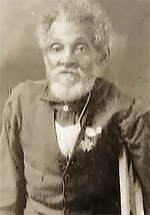 Kevin recently highlighted a story done by a local news station in Florida on Richard Quarls, in honor of Black History Month. Quarls is one of the better-known “black Confederate soldiers,” and in 2003 had a Confederate headstone placed over his grave by the local SCV and UDC groups.
In watching the video it occurred to me that, as presented, there are two narratives being told in the segment about Richard Quarls. One, as told by his great-granddaughter, Mary Crockett, is that of a slave who accompanied his master’s son to war. Ms. Crockett’s account, passed through her family, is clear about his status and role in the war, recounting that “when the master’s son got shot, and fell, [Quarls] picked up the gun, started firing the gun, and defending him while he laid on the ground.” The son is identified here as H. Middleton Quarles, who was killed in fighting at Maryland Gap, Maryland on September 13, 1862. It may have been in that action that Richard Quarls picked up Private Quarles’ rifle. There’s no reason to doubt Ms. Crockett’s account of her great-grandfather’s experience although, as always, family reminiscences are invariably subject to the vagaries of oral traditions passed from one generation to the next.
The second narrative is that overlaid by the SCV, which “discovered” Quarls’ military service and sponsored the headstone and memorial service. This second narrative is largely reflected in the dialogue of the news report, which is sprinkled with dramatic-sounding but vague phrases that blur the distinction between soldier and servant, slave and free. We are cautioned that “historians disagree about their numbers and how they served,” but also assured that “he may have been a servant and rifleman.” It’s suggested that he may have fought in thirty-three battles, and the viewer is told that at the end of the war Quarls was “honorably discharged.” It’s an impressive story to a general audience, but the historian immediately notices that there are very, very few specific facts presented that can be cross-checked against primary sources.
As noted in the video clip, the key element in identifying Quarls’ supposed service as a soldier is his pension record from the State of Florida (10MB PDF). The pitfalls of working with Confederate pension records have been discussed in detail elsewhere, and generally speaking, are less than fully-reliable in determining an individual’s status in 1861-65. They are particularly problematic on the case of Richard Quarls, and actually raise more questions about his wartime service than they answer.
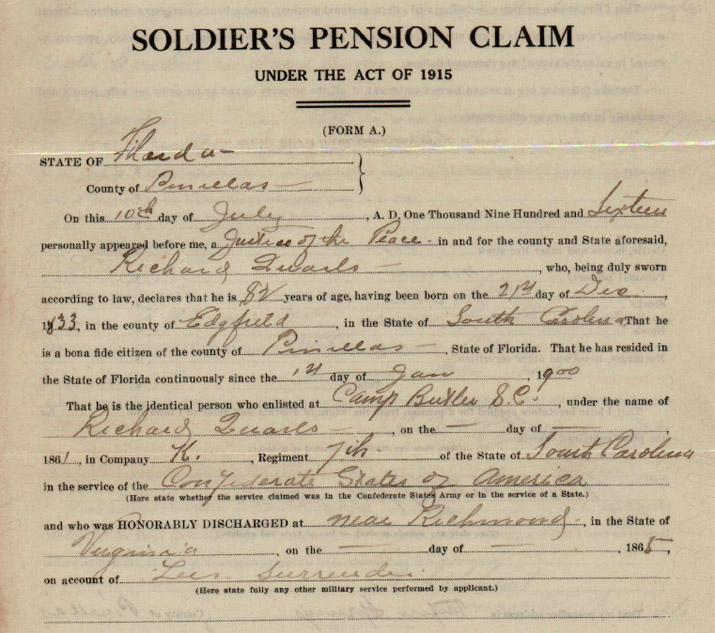
Quarls applied for a pension in Pinellas County, Florida on July 10, 1916. On the first page of the application, he claims that he enlisted in Company K, 7th South Carolina Infantry, at Camp Butler, South Carolina, sometime in 1861. He gives his name upon enlistment as Richard Quarls. He claims to have been discharged in 1865 “near Richmond” Virginia, in 1865, on account of “Lee’s surrender.” The inference is that Quarls served almost the entire war with the 7th South Carolina Infantry. Quarl’s service claims were attested to by two witnesses, T. B. and O. W. Lanier. Both testified to have known Quarls during the war, affirmed his membership in the unit, and that they witnessed his full service as described in the application. These basic elements of his record during the war, claimed on the initial application, appear to have been accepted without question by the SCV, and form the wartime history of Richard Quarls that is now repeated as historic fact, his story being picked up by even non-Civil War authors, including Ann Coulter. (Coulter says Quarls’ grave was unmarked before the installation of the SCV’s stone, which is not true.) In fact, those self-same pension records cast serious doubt on much of what is “known” about Richard Quarls’ service during the Civil War.
Jubilo! on the Appeal of Black Confederates to African Americans
A new blog came online a few weeks back, that I want to highlight because of some very smart writing by a blogger going by the handle lunchcountersitin. Jubilo! The Century of Emancipation deals with much more than the Civil War, but as the central event in American history during the nineteenth century, that conflict gets particular attention. Here’s what strikes me as an insightful read on the phenomenon of modern-day African Americans embracing Southron Heritage™ groups’ designation of their ancestors as Confederate soldiers, willingly fighting for the Confederate cause:
We’ve seen this before: black families filled with honor at the recognition given to their enslaved ancestors, for the reason that those ancestors somehow fought for what was a pro-slavery regime. The sense of conflict inherent in that is hardly mentioned. I got to thinking: how is it that so many black families ignore these details of their ancestors’ lives, status, and circumstances? Why is it that they are not addressing a key part of the story? After a little bit of thought, the answer was obvious. Black folks are like everyone else: they want to feel that their ancestors were heroes.
Simply put, there is no honor or glory in acknowledging that a long deceased relative was near a battlefield solely to do menial work as act of submission and service to a slave master. People would much rather believe that their ancestors were called to fight – which would be a recognition of their manhood, of their worthiness to do battle, and of their willingness to make the ultimate sacrifice.
But here’s the rub: if these slaves were in fact recognized for their manhood and worthiness – then why were they slaves in the first place? The reality is, black men were seen as degraded, to use a common term of the era, and subservient. Loyalty, not the capacity for courage, was most valued in a slave. After all, a bondsman who was intrepid enough to flee for his freedom – and perhaps fight for the Union – was of no use to a slavemaster on the battlefield.
But people of today want to see their ancestors through their own eyes, and they want to see those ancestors as brave and courageous. This focus on “bravery not slavery” dovetails perfectly with the “heritage not hate” narrative of groups like the Sons of Confederates Veterans. By maintaining an unspoken rule to avoid the unspeakable – the horrors of slavery and the contradiction of a slave fighting for a slave nation – both sides get to honor their ancestors without pondering the issues this “service” raises.
Obviously this is generalizing, and as such can’t really be ascribed to this or that specific descendant. People were complicated in 1865, and they’re complicated in 2011. But on a human level, it makes a lot of sense that this is at least part of the equation.

What Did You Think Would Happen, Colonel Perry?

On January 28, 1861, seventy members of the Texas House of Representatives voted to endorse a convention to determine whether Texas should follow South Carolina, Mississippi, Florida, Alabama, Georgia and Louisiana out of the Union. Only nine representatives voted “nay.” Though the vote was nominally just to authorize the convention, the outcome of such a meeting was a forgone conclusion, and the House vote was, to all intents and purposes, a vote on secession itself.
The Texas Senate passed the resolution that same day, by a vote of 25 to 5. Governor Sam Houston, who opposed secession and would soon be removed from office as a result, signed off on the resolution on February 4, with an appended notation cautioning the convention “against the assumption of any powers on the part of said convention, beyond the reference of the question of a longer connection of Texas with the Union to the people.” It was a moot gesture; the Secession Convention had been called to order in the Capitol the same day the Legislature voted to approve it, and had adopted an ordinance of secession on February 1. The following day the convention adopted its Declaration of the Causes which Impel the State of Texas to Secede from the Federal Union. Texas’ secession was already a fait accompli.
My great-great-great-grandfather, Aaron Perry, was one of the men in the House of Representatives who voted in favor of the resolution to authorize a secession convention. He was born in North Carolina around 1804, lived for a time in Alabama, and moved to Texas in 1846. He farmed in Limestone County, near present-day Waco. In the 1850 U.S. Census non-population schedules, Perry is shown as farming 625 acres, most of which was left uncleared for raising hogs. In the previous season he’d produced 1,500 bushels of corn as well, most of which I suspect went to hog feed before killing time in the fall. By the time of the 1860 census, the value of his land holdings (which may have been expanded in the preceding decade) had grown to $3,000, and the value of his personal property had grown to $11,150. Much of this latter number represented the value of seven slaves he held.
He was known as “Colonel” Perry, although I don’t know what military service of his such a title would be based on. He was active in politics, serving as a delegate from Limestone County to the Texas Democratic Convention in 1857. Later that year he began serving the first of two terms (1857-61) in the Texas House of Representatives. By the time his second term ended, Texas had seceded from the Union, Sumter had fallen, and the Battle of Manassas had been fought. Aaron Perry disappears from the historical record at that point, so far as I’ve been able to determine; I don’t know how or when he died. Two of his sons, William and Marcus, went on to serve in the Confederate cavalry. Both survived the war.
There are lots of Confederate soldiers in my family tree. But “Old Colonel Perry,” as he was recalled in the family, is the only direct ancestor I know of who was a civil official, a legislator, who took an affirmative step toward secession. He voted “yay.” I wonder what he thought the ultimate outcome of that would be.
__________________
Image: Texas State Capitol, Austin, in the 1870s. Southern Methodist University, Central University Libraries, DeGolyer Library.

An Update on the “Last Confederate Reunion”
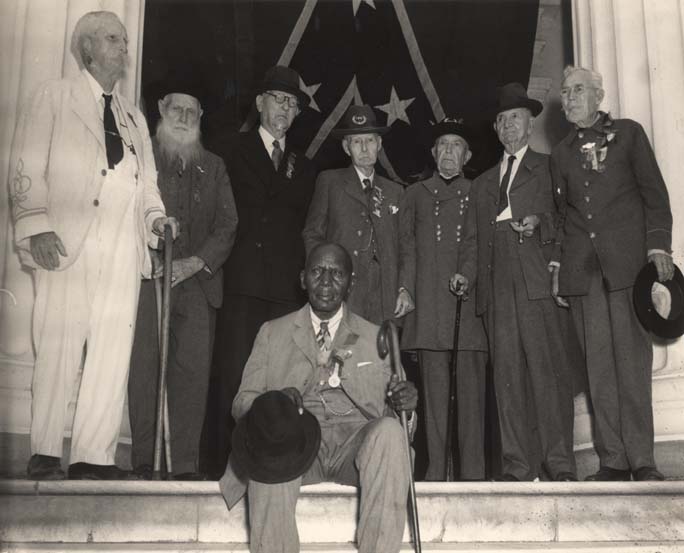
A couple of months ago I did a post on a 1944 event in Montgomery, Alabama that was billed as the “Last Confederate Reunion.” In late 2009, the blog Confederate Digest had posted the image above, under the triumphant headline “Black Confederate, Dr. R. A. Gwynne, among the last Confederate Veterans of Alabama.” As I posted in November, it’s a dubious claim. A long, contemporary account of the reunion in the Alabama Historical Quarterly (Vol. 06, No. 01, Spring Issue 1944) mostly ignores Gwynne’s presence relative to the seven white attendees, but also mentions that he was 90 years old at the time. If that were true, he could not have been more than 11 at the end of the war — an child even by 19th century standards. Confederate Digest apparently overlooked this detail, in its intent to establish what one commenter referred to as “the indisputable fact that thousands of blacks, both slave and free, willingly served in the Confederate armed forces, defending their homeland against a brutal, invading northern army.”
I couldn’t find much more about R. A. Gwynne at the time, but last week I reposted my November piece at The Atlantic, and in response got a lot of very interesting and helpful comments. One regular commenter there, Alabama_Girl, noted that Guinn was a common name in north-central Alabama, and asked if I’d tried alternate spellings for the name. I hadn’t, but having now done so, I think we may know considerably more about Gwynne’s personal history. It also casts further doubt on Gwynne serving in any military capacity, given that he may in fact have been even younger at the time than previously suggested. He likely had not seen his tenth birthday by the time the war ended.
This is My Rifle; This is My Gun. . . .
 I’m in the middle of Benton McAdams’ Rebels at Rock Island: The Story of a Civil War Prison. It’s a good read, and reinforces what I’ve long understood: there’s nothing funny about Civil War military prisons, North or South.
But I did laugh out loud at this passage, describing the tenure of one of the Union units assigned as guards at Rock Island, the 133rd Illinois. The 133rd was a regiment of “hundred dazers,” men who’d enlisted for a short, 100-day term, had little training, and still less interest in becoming professional soldiers. An inordinate proportion of them were teenagers, which compounded the discipline problems within the regiment. Here, after discussing the very real, and very serious, problem of guards from the 133rd firing into the prison compound with little (or often no) provocation, McAdams continues:
When no other targets presented themselves, the soldiers in the 133rd shot each other. William Sutton accidentally shot off two of his own fingers. He was luckier than George Lowe. While going on guard one morning, one of the men being relieved engaged in a bit of horseplay, bringing up his musket and making as if to attack his relief. Unfortunately, the hammer of his weapon caught on the strap of his cartridge box, cocking the weapon, and when the man untangled it the musket discharged, killing Lowe. In light of these activities, it had been wise of [Commissary General of Prisoners William] Hoffman to deny [Camp Commandant Colonel Adolphus ] Johnson artillery.
The men had other bad habits as well. One of them was losing their equipment. The regimental files show a phenomenal number of pay stoppages for lost haversacks, gun tools, canteens, and other equipment. To replace at least some of this equipment the men turned to theft, raiding the hospital for whatever they needed. Colonel Phillips despaired of apprehending the offenders because, as he told Surgeon Watson, “of the difficulty which generally attends the ferreting-out of the parties perpetrating these depredations.” Phillips also tried to ferret out the men stealing commissary, stores and selling them to citizens, but he could conclude only that it must be enlisted men, not officers, and they were probably not aware it was illegal.
Women were another hobby of the hundred dazers. Although Johnson had ordered all laundresses to live in Laundressville, a set of buildings erected especially for them, at least some of the 133rd’s women moved into the men’s quarters with them, prompting an order sending the women to their proper place. Shortly after being deprived of the women’s company, Corporal George Brown was reduced to the ranks for “committing an offense calculated to bring infamy and disrepute upon the command.” Corporal Francis Woodcock was also reduced, not for masturbating, but for persuading another man “through misrepresentation to engage in an unlawful act which would and did result in pollution, disease, and misery.”
What a bunch of fools. But pity the unfortunate descendant of Corporal Woodcock, hot on the genealogy trail, jumping at the discovery of his or her ancestor’s name in McAdams’ index. . . .





10 comments