“The Hashish of the West”

John Bull (center) goes shopping for cotton in an 1861 cartoon from Frank Leslie’s Illustrated Newspaper. The proprietor of “Davis & Co.” urges Bull to “break the door open” (i.e., lift the blockade). John Bull declines, saying, “I’ll wait till yer open the door yourself, or that man with the club [the U.S. Navy] opens it for you.” Meanwhile, India (right) is eager to make the sale.

Over at The Atlantic, Sven Beckert has an essay up, based on his book, Empire of Cotton: A Global History. It’s a good read, and well worth your time. Coming as it does on the heels of Edward Baptist’s The Half Has Never Been Told: Slavery and the Making of American Capitalism and Jürgen Osterhammel’s The Transformation of the World: A Global History of the Nineteenth Century, 2014 seems to be the year when broader studies of cotton, slavery, and their role in the new global economy rose to the forefront.
Southern planters understood that their cotton kingdom rested not only on plentiful land and labor, but also upon their political ability to preserve the institution of slavery and to project it into the new cotton lands of the American West. Continued territorial expansion of slavery was vital to secure both its economic, and even more so its political viability, threatened as never before by an alarmingly sectional Republican Party. Slave owners understood the challenge to their power over human chattel represented by the new party’s project of strengthening the claims of power between the national state and its citizens—an equally necessary condition for its free labor and free soil ideology.
Yet from a global perspective, the outbreak of war between the Confederacy and the Union in April 1861 was a struggle not only over American territorial integrity and the future of its “peculiar institution,” but also over global capitalism’s dependence on slave labor across the world. The Civil War in the United States was an acid test for the entire industrial order: Could it adapt to the even temporary loss of its providential partner—the expansive, slave-powered antebellum United States—before social chaos and economic collapse brought their empire to ruins?
The day of reckoning arrived on April 12, 1861. On that spring day, Confederate troops fired on the federal garrison at Fort Sumter, South Carolina. It was a quintessentially local event, a small crack in the world’s core production and trade system, but the resulting crisis illuminated brilliantly the underlying foundations of the global cotton industry and with it of capitalism.
The outbreak of the Civil War severed in one stroke the global relationships that had underpinned the worldwide web of cotton production and global capitalism since the 1780s. In an effort to force British diplomatic recognition, the Confederate government banned all cotton exports. By the time the Confederacy realized this policy was doomed, a northern blockade effectively kept most cotton from leaving the South. Though smuggling persisted, and most smugglers’ runs succeeded, the blockade’s deterrent effects removed most cotton-carrying ships from the southern trade. Consequently, exports to Europe fell from 3.8 million bales in 1860 to virtually nothing in 1862. The effects of the resulting “cotton famine,” as it came to be known, quickly rippled outward, reshaping industry—and the larger society—in places ranging from Manchester to Alexandria. With only slight hyperbole, the Chamber of Commerce in the Saxon cotton manufacturing city of Chemnitz reported in 1865 that “never in the history of trade have there been such grand and consequential movements as in the past four years.”
A mad scramble to secure cotton for European industry ensued. The effort was all the more desperate as no one could predict when the war would end and when, if ever, cotton production would revive in the American South. “What are we to do,” asked the editors of the Liverpool Mercury in January 1861, if “this most precarious source of supply should suddenly fail us?” Once it did fail, this question was foremost on the minds of policy makers, merchants, manufacturers, workers, and peasants around the globe.
In the end, secession not only didn’t result in the coronation of King Cotton, but in fact spurred Europe to look to other sources of the staple. Go read Beckert’s whole piece.
____________

Prosecute Them

If the United States is (1) a nation of laws and not men (as we often say), and (2) we actually give a shit about human rights and due process (as we often say), then our obligation is clear:
The United States participated actively and effectively in the negotiation of [this] Convention. It marks a significant step in the development during this century of international measures against torture and other inhuman treatment or punishment. Ratification of the Convention by the United States will clearly express United States opposition to torture, an abhorrent practice unfortunately still prevalent in the world today.
The core provisions of the Convention establish a regime for international cooperation in the criminal prosecution of torturers relying on so-called ‘universal jurisdiction.’ Each State Party is required either to prosecute torturers who are found in its territory or to extradite them to other countries for prosecution.
President Ronald Reagan, in a signing statement on the ratification
of the United Nations Convention on Torture, 1984
Part of morality, whether for a person or a state, is not doing bad things. The other part is owning up to them when you do. We blew the first part, and I suspect we’re going to blow the second, as well.
__________
h/t Andrew Sullivan. Image via Architect of the Capitol.

Comments Off on Prosecute Them
Gary Leva’s Southern Education
The Bitter Southerner is an online magazine focusing on contemporary southern culture. Occasionally it strays off into history, as in a recent article by filmmaker Gary Leva, on his experience traveling and shooting in the South while making a companion documentary to a new release of MGM’s Gone with the Wind. Leva grew up in Dallas and always considered himself a southerner, but was quickly corrected on that point by one of his first interviews with Kathryn Stockett, author of the best-selling novel, The Help.
“Honey, that ain’t the South.”
So begins Leva’s journey, literal and figurative, into the complex and contentious world of how southerners view — or in some cases, remain willfully blind to — their own history. Go read the whole thing.
Here’s a clip from the documentary:
___________
Half a Million Pageviews
Sometime around 7:30 Saturday evening Dead Confederates passed 500,000 pageviews. Thanks, y’all.
________
Supreme Court to Hear Texas License Plate Case

I’m a little surprised they agreed to hear this one:
The Supreme Court agreed this afternoon to rule on a state government’s power to set up a specialty license plate program that controls the messages that may be displayed. It accepted for review an appeal by the state of Texas, seeking to defend a state agency’s refusal to allow an organization to use a Confederate flag on a specialty plate because it found that display offensive. . . .
The key issue in the license plate case (Walker v. Sons of Confederate Veterans) is whether the messages that are displayed on specialty tags are a form of government speech, so that officials can decide which to allow or to forbid. If, however, they represent the views of the car or truck owner, then the government’s power to veto a message is more tightly restricted.
In a 1977 ruling, in Wooley v. Maynard, the Court treated a license plate message as a form of private speech displayed on private property, but it did not rule explicitly whether this was government speech or private speech more generally. In the 2009 decision in Pleasant Grove City v. Summum, the Court decided that a government entity has a right to speak for itself, and thus has the authority to refuse to accept a symbolic monument for display in a public park.
The Court was asked in the Texas case, and in a separate North Carolina case that is now apparently being kept on hold, to clarify a split among federal appeals courts on whether vanity plate messages are to be treated as government or private expressions. In the Texas case, a group that seeks to preserve the memory and reputation of soldiers who fought for the Confederacy sought state approval for a plate design that included the Confederate battle flag.
Ultimately, after a series of conflicting votes, a state agency turned down that design, saying that many people regard the rebels’ flag as associated with hatred toward groups. The Texas Division of the Sons of Confederate Veterans sued, and ultimately won a decision by the U.S. Court of Appeals for the Fifth Circuit, declaring that specialty plate messages are a form of private speech, and that the state agency had engaged in forbidden viewpoint discrimination.
I’m not a fan of the plates, but for reasons I’ve outlined previously, my own view is that the Fifth Circuit ruled correctly. We’ll see what the Supremes have to say next spring.
___________
Talkin’ Blockade Runners (and Other Stuff)
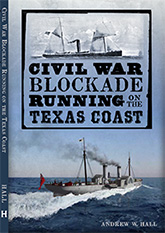
 I’d like to extend my thanks to the Terry’s Texas Rangers 2426 Chapter of the UDC in Richmond for having me back to speak to them again on Monday. It’s always good to have an excuse to talk about the conflict as it happened here in this part of Texas. The Terry’s Rangers Chapter also honored me (and caught me totally by surprise) with a presentation of the UDC’s Jefferson Davis Historical Gold Medal for the blockade running book. Thanks, y’all!
I have a few more presentations scheduled so far for 2015. I hope to see some of you there.

Houston, Texas 77030 Lieutenant H. M. Stringfellow, C.S.A. Thursday, April 9, 2015 at 6 p.m. Henry Martyn Stringfellow Home 7902 Highway 6 Hitchcock, Texas 77563
____________
Patrick Cleburne and the Battle of Franklin
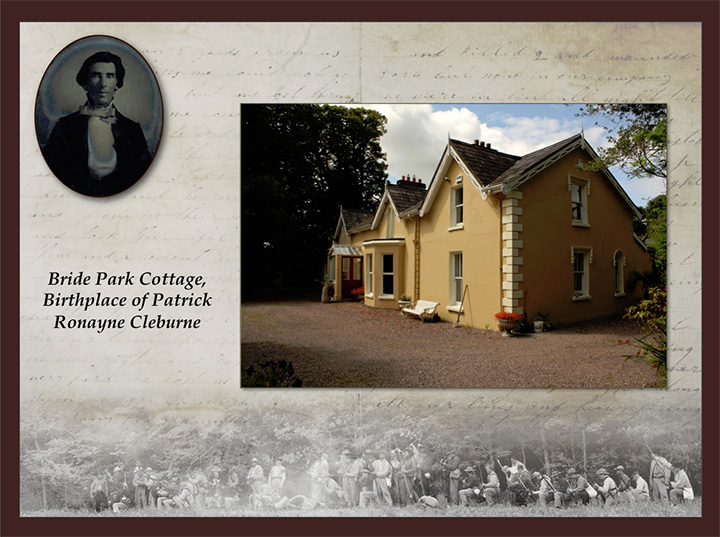
Damian Shiels’ keynote address from the 2014 Tennessee Civil War Sesquicentennial Signature Event in Franklin is online at his blog, The Irish in the Civil War. Well worth your time, because Damian’s presentation is not simply a straightforward biographical sketch of the man, but a detailed example of how the research was done to compile his story. Exemplary.
By the way, have you picked up a copy of Damian’s book yet? Check it out.
__________
Update, December 5: Damian says the talks from that session will be broadcast on C-Span 3 on Saturday, December 13, 2014, 6 p.m. EST.
__________


Change Coming to VA Marker Rules

As many of you know, the Veterans Administration revised its rules in 2009, restricting applications for headstones to those who could establish their bonafides as next-of-kin. That caused, naturally, a considerable uproar among various historical and heritage groups, who spend a lot of time researching and placing grave markers.
Via CWT user CMWinkler, the VA has formally proposed broadening the definition of “applicant” to a wider range of family members, and others who are auhtorized to make decisions on behalf of the decedent (PDF). And while they will still require the involvement of family members for veterans of the First World War and later, for earlier service that will be waived in recognition of the fact that, for a great many of them, there are no traceable family members.
This seems like the crucial part of the policy to me, as it regards CW veterans:
My emphasis. So as I read this, a heritage group would have to make the request through the cemetery, which pretty much has to be done anyway, in order to get the stone placed. This seems like a step in the right direction.
___________
New in the Civil War Monitor

The new issue of the Civil War Monitor is now online, and will be appearing in mailboxes and on newsstands shortly. In this issue:
- Ulysses S. Grant’s Campaign Promise — Defeating Robert E. Lee’s army was only one of the challenges facing Ulysses S. Grant in 1864. Just as crucial was ensuring President Abraham Lincoln’s reelection. By Brooks Simpson
- The Radicals’ War — The story of the Joint Committee on the Conduct of the War, the Republican-led congressional oversight body that hounded generals, pressured the president, and bore witness to atrocities. By Fergus M. Borderwich
- The Civil War and the Southern Belle. By Karen Abbott
- The Fugitives — For the thousands of Union soldiers who escaped Confederate captivity in South Carolina in the war’s final months, the parth to freedom was long and treacherous. By Lorien Foote
- Last Words — Final statements of some famous and not-so-famous soldiers.
- Rebel Raider Overseas — A rare image of a famous Confederate warship in foreign water. By Bob Zeller
- The Minie Ball — Anatomy of a dead-simple killer.
- The Best Civil War Books of 2014 — Civil War historians A. Wilson Greene, Kathryn Shively Meier, Kevin M. Levin, Gerald J. Prokopowicz, Lesley J. Gordon, and Andrew Wagenhoffer name their best picks of 2014.
Kudos as well to Mads Madsen, whose colorized images of Grant are featured both on the cover and inside the magazine. Now would be a good time to subscribe to the Monitor.
_____________




 Dead Confederates, A Civil War Era Blog
2 comments