Sunday Funnies
So apparently there’s an online poll somewhere that asks whether people approve of those big-ass Confederate flags out on the highway. And apparently the “disapprove” votes are leading at the moment. There’s also a “secede now” option that barely moves the needle. But, of course, that’s because globalist librul conspiracy:


Because Americans not only support the Confederate flag, they also support secession from America. Or something like that.
________

A Monumental Mystery
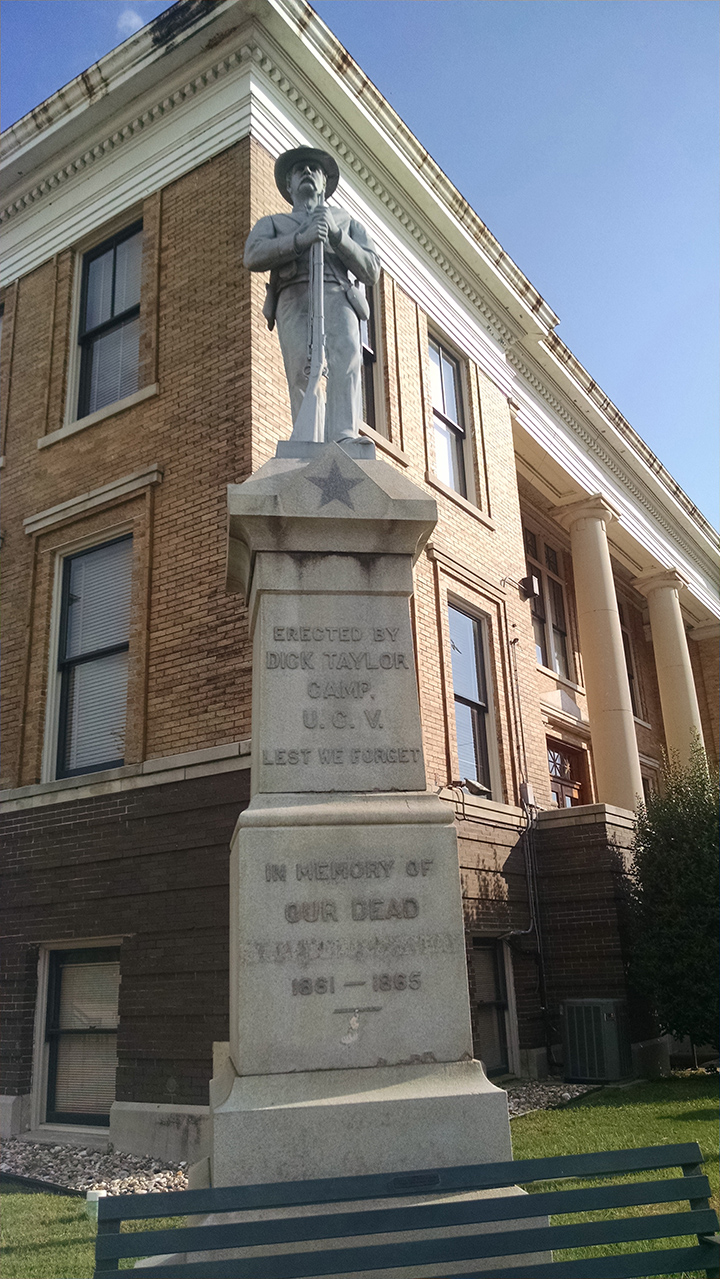
Image by Houston Civil War Round Table member Bobby Dover, used with permission.

If you’ve been through Jefferson, in far northeast Texas, you’ve probably seen this Confederate monument on the grounds of the Marion County Courthouse. It’s fairly typical of the monuments found in towns across the South, but this monument had a bit of a mystery to it, according to Mitchel Whitington’s Jefferson: The History and Mystery of the City on the Bayou. According to the book, the monument was initially placed at Polk and Line Streets, facing south, with his back turned to the north (natch!), in 1907. Later, in the 1930s, the monument was moved to its present location at Polk and Austin, in front of the county courthouse. Now the soldier faces north, presumably to keep an eye out for perfidious Yankees. The inscription on the monument reads:
IN MEMORY OF
OUR DEAD
1861 — 1865
But there’s a large gap between the last two lines, where another line of text had originally been, that was very clearly chiseled off the stone before the dedication in 1907. For 75 years, no one in Jefferson knew, or admitted to knowing, what that line originally said or referred to. People tried all sorts of tricks – chalk rubbings, reflected light, séances – nothing revealed the mysterious, lost text.
Then in 1982, according to Whitington, a member of the Garden Club, Katherine Wise, used a puff and Fabergé makeup powder to reveal the hidden lettering:
IN OAKWOOD CEMETERY
Apparently the monument had originally been intended for the cemetery on the north side of town, where many Confederate veterans were buried. (Which also helps explain why the monument is dedicated to “our dead,” rather than to veterans more generally.) But sometime before the stone was delivered, the decision was made to place the monument in a more conspicuous location at Polk and Line, and the stonecutter was instructed to adjust the inscription accordingly. Who made that decision and why, remains lost to history; the solution to one mystery serves to create another.
_________

Friday Night Concert: Pickin’ in Jefferson
An impromptu pickin’ session with Curt Locklear on the banjo (l.), and Frank Reedy on the guitar (r.) at the 5th Annual Jefferson, Texas Civil War Symposium last Saturday. This was unplanned, and I believe these men had never met before. They just saw each had their instruments, and it happened. Didn’t even know if anyone was watching. Unrehearsed, unsynthesized, unamplified, unmixed, and unvarnished. Wish I’d caught the whole thing.
Curt is the author of the new Civil War novel, Asunder. Check him out.
_______________
Confederate Monuments and “Motivated Reasoning”
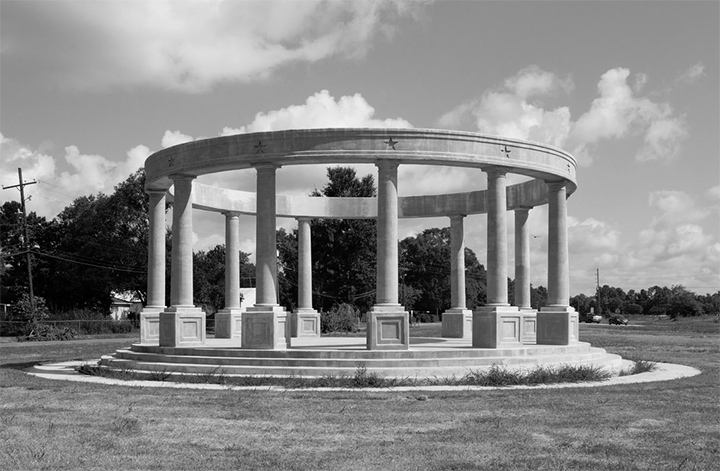
“Confederate Memorial of the Wind” on Martin Luther King, Jr. Drive in Orange, Texas. Photo by Flickr user Patrick Feller, used under Creative Commons license.
One of my regular readers pointed out this article at Politico Magazine, about the SCV monument currently under construction in Orange, Texas close to the Louisiana border. It’s not a very long article, and well worth your time. It does a good job of pointing out both Confederate Heritage™ advocates’ direct refusal to acknowledge relevant historical evidence, and the way their views of the past are inextricably intertwines with their own, present-day politics (my emphasis):
[Historian Kevin] Levin pointed to the words of Confederates themselves, particularly Texas’ Ordinance of Secession. The document, which officially separated Texas from the Union in 1861, declared that African-Americans were “rightfully held and regarded as an inferior and dependent race.” It says that Texas seceded because non-slave-holding states “demand the abolition of negro slavery throughout the Confederacy.” The document does not mention tariffs or any state right other than the right to own black people.
[SCV camp adjutant Jim] Toungate waved it off the document when I show it to him later. “People have a distorted view of the Confederacy because liberal Northern historians wrote the history books,” he insists. But these are primary sources, I noted, the words of the Confederates themselves. Toungate went silent for a beat, and then changed the subject. “I’m sick of the federal government wasting money,” he said, and “people living off welfare.”
There’s also a good bit of projection going on, to justify his own heritage activities:
“I had five grandfathers who fought for the Confederacy, and they were religious people who didn’t treat black people badly,” Toungate said, earnestly, his Southern drawl growing thicker as he spoke. “They were fighting for states’ rights, not slavery.”
I wonder how he thinks he knows that, since it’s extremely unlikely that he ever actually met a Civil War veteran, his own ancestors or any other.The author, John Savage, goes on to look at the bigger picture, how heritage folks willingly put themselves in a near-impenetrable bubble of ideology:
The SCV’s rejection of unequivocal historical fact, can, in part, be attributed to what psychologists call “motivated reasoning,” says Sander van der Linden, a Princeton University psychologist and director of the school’s Social and Environmental Decision-Making Lab. When people are emotionally invested in a belief, says van der Linden, they are inclined to accept information that confirms pre-existing beliefs and to dismiss conflicting evidence. It helps explain climate change denial, creationism, the anti-vaccine movement, and the belief that Obama is a closet Muslim (which, incidentally, Toungate also believes).
Neo-Confederate adamancy is as much about reactionary politics and identity as it is about history. It’s a declaration of values, a way of seeing the world, and its prevalence divides along political lines. Polls show that Democrats tend to view Confederate symbols, such as the battle flag, as emblems of racism, while Republicans more often see them as representations of Southern heritage.
Go read the whole thing, y’all.
____________
“Remember in November!”
Found this recently on the Internet machine:

“Hitlerry.” Y’all keep it classy.
Tim Kaine was Governor of Virginia from January 14, 2006 to January 16, 2010. The flags were taken down under terms of the Virginia Museum of Fines Arts’ lease with a local SCV camp in June 2010, five months after Kaine left office. If either Tim Kaine or his successor, Bob McDonnell, had any direct involvement in the decision to remove the flags, I’ve never seen evidence of it.
Confederate Heritage™ is fueled by outrage and resentment; whether that anger is based on reality is immaterial. The Virginia Flaggers, whose catch phrase is “are you mad enough yet?” have learned this very well. But I’ve said it before — if you have to make stuff up to “defend” your heritage, it’s not worth defending.
_______
Talkin’ Blockade Runners, and the Texas Navy, Too

On Saturday, August 13, I’ll be one of the speakers at the 5th Annual Civil War Symposium in Jefferson, Texas. I’ve never been to the symposium before, but they’ve had some wonderful speakers in the past, and Jefferson itself is a great town, full of historic structures and a tremendous amount of history. It’s a steamboat town, which is like a railroad town, but better. (I kid, I kid!) My presentation is titled, “Captain Dave and the Yankees: A Tale of the Texas Blockade.” Other speakers include Mark K. Christ, “The Camden Arkansas Expedition of 1864;” Vicki Betts, “Pray for this War to End: The Civil War Letters of William Smith Herndon, 13th Texas Infantry, and Mary Louise Herndon, Tyler, Texas;” and Charles D. Grear: A Trying Time for All: Texas Indians During the Civil War.” Grear is a prolific author and (as we learned at the Houston CWRT) an effective speaker. I’ve never met Vicki Betts, but have corresponded with her, and she’s done yeoman’s work transcribing and cross-referencing many hundreds, probably thousands, of period newspapers and documents. This event should be great fun.
Then on Saturday, September 17, I’ll be giving a short address for Texian Navy Days at the Battleship Texas, at the San Jacinto Battleground in La Porte. The event there starts at 10 a.m., and should be done around 11:15 — plenty of time to explore the last surviving World War One dreadnought in the world.
_______
That’s One Tough Old Bird. And the Plane’s Not Half Bad, Either.
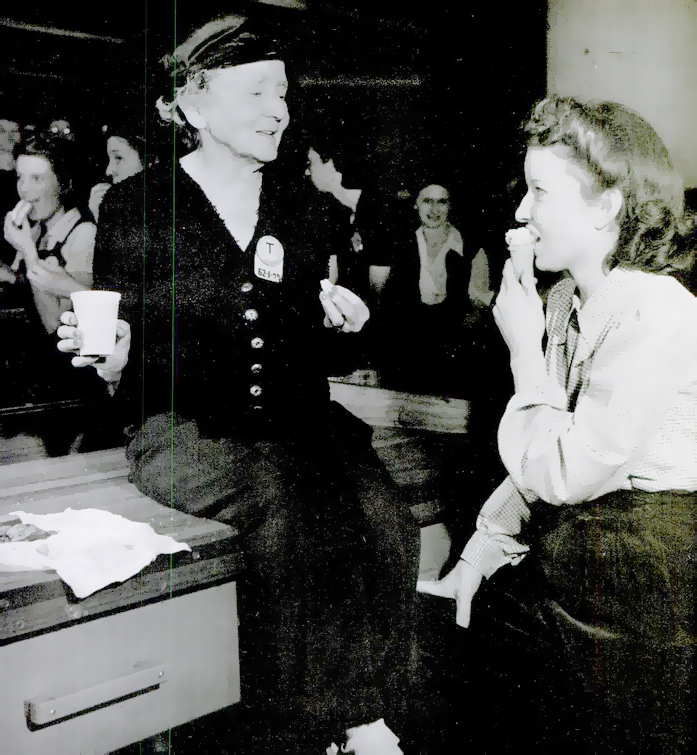
Did you know that Helen Dortch Longstreet, the widow of Old Pete Longstreet, helped build B-29 Superfortresses during World War II? Neither did I.
________
Image: Life Magazine, December 27, 1943.

Celebrating Independence Day in Vicksburg, 1877


It’s an old saw that the citizenry of Vicksburg, Mississippi, did not celebrate the Fourth of July until well into the 20th century. While it’s certainly true that the anniversary of the fall of that city to Grant in 1863 continued to resonate with Vicksburg residents down through the years, in fact the date was observed by plenty of local residents, white and black, even if the celebration was unofficial and somewhat more muted there than elsewhere. And they were celebrating it even when the war itself was a recent memory. From the Vicksburg Daily Commercial, July 3, 1877:
To-morrow being the anniversary of our Nations independence, all patriotic citizens of this great Republic are expected to observe it as a holiday. We desire to be reckoned among this class of patriotic citizens, consequently no paper will be issued from this office to-morrow. The glorious Fourth happens to come in hot weather this year, and we are glad to be able to observe it ‘neath the shade of country forests.
And a follow-up, on July 5:
The people of Vicksburg came nearer celebrating the glorious Fourth yesterday than they have done for several years. True, there was no general suspension of business, as indicated by closed doors, but so far as the profits of trade were concerned doors might as well have been closed, for the salesrooms were deserted almost entirely. Everybody was out of town, apparently, enjoying the holiday in some way. Several hundred people attended the Hibernian picnic at Newman’s Grove, and not withstanding the extreme heat, all seemed to enjoy the festivities of the day. The colored population turned out in large force, fully one thousand men of them going down the river on excursion boats to picnic-grounds, yet there were enough of them left in the city to form a very respectable procession of colored Masons, and a very large audience to listen to the oration of Judge J. S. Morris, and to assist in laying the corner-stone of King Solomon’s Church. There was no prolific display of fire-works on the streets, but occasional reports from fire-crackers and large torpedoes could be heard, accompanied now and then by a patriotic cry, “rah for the Fourth of July!” We do not wonder at the lack of patriotic enthusiasm displayed on our streets. No amount of patriotism could have induced any sane man to exert himself very considerably on such a day when the thermometer registered very nearly 100° Farenheit [sic.] in the shade. However, the observance of Independence Day yesterday, slight as some may have thought it, was yet sufficient to indicate the prevalence of a broader National sentiment and a determination to at least partially forget the past which renders the Fourth of July especially distasteful to Vicksburgers, and make it in future “The Day We Celebrate” as much as any other National holiday.
To be sure, the Fourth of July remained a bitter date for many Vicksburg citizens, for a long time. Undoubtedly there are some who still reject the date as one for celebration. But in this, as in so much else about the legacy of the war, the reality is more complex than some would have us believe.
_____________
A version of this post originally appeared here on July 4, 2011.
Southern Home Front Online Collection Moved
Some of you will be familiar with the online newspaper archive that Vicki Betts, a researcher and librarian at the University of Texas at Tyler, has been diligently transcribing for years. It is a valuable resource, and deserves to be better known.
Vicki recently shifted the archive to a new, more reliable server, that should stand it in good stead going forward. The new address is:
http://scholarworks.uttyler.edu/cw_news/
This is the introduction to the new site:
The following files of transcribed articles from Civil War era newspapers are predominantly from the South, and focus on the homefront, including women, Confederate industry, and material culture. The scattered military articles usually relate either to camp life or to Texas units or events. These articles do NOT include foreign affairs, politics, monetary policy, or general battle accounts. All were gathered in the course of researching various topics of personal interest and do not reflect any systematized indexing.
The articles under “By Title” are listed by newspaper title and then within each file, chronologically. The articles under “Special Topics” have been pulled from those files, across newspaper titles, then arranged chronologically.
If these excerpts are to be used for published research, authors are urged to double check with either the microfilm or the originals to verify the transcription, especially when the quotations include numbers or proper names. The combination of the deteriorating ink and paper of Confederate newspapers and poor microfilming has made some issues difficult to read.
As usual, researchers are also encouraged to approach the “truth” in historic newspapers cautiously. Even more so than now, nineteenth century newspapers often expressed extremely partisan positions. Editors gathered reports and rumors from correspondents, travelers, and other newspapers, usually with little or no verification. At the same time, these papers do reflect what people of the period were reading and perhaps believing. As such, they remain a valuable source, used wisely.
Vicki has done a remarkable job compiling this resource, a slow and laborious process that has made research so much easier for the rest of us.
Tracking Confederate Deserters in East Texas
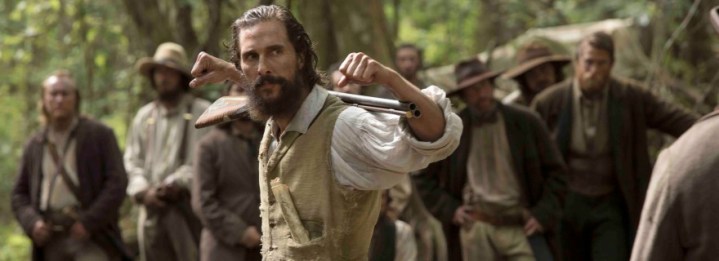
Saturday evening we went to see Free State of Jones. It’s a powerful and, in many places, a disturbing film. I may have more to say about it later, after I cogitate on it some. In the meantime, I’d encourage you to read both Christian McWhiter’s and Glenn Brasher’s reviews.
During the movie, watching the Knight Company grow and organize in the relative safety of the swamps, I was reminded of similar encampment that grew up here in Texas, deep in the Piney Woods, that I wrote about near the end of 2013:
__________
Both desertion and men running from conscription was a big problem in Texas, as it was in other parts of the South during the war. I recently came across this account of using “Negro dogs,” bred and trained to hunt runaway slaves, to track deserters in East Texas. The place mentioned, Winter’s Bayou, runs through the Sam Houston National Forest, southeast of Huntsville. From the Houston Tri-Weekly Telegraph, December 21, 1864, p. 1:

___________
Update, June 27: Kevin Levin has his own review of the film over at The Daily Beast.
___________
Update 2, June 27: I just realized that Vikki Bynum recently published an essay on this, “East Texas Unionism: Warren J. Collins, Big Thicket Jayhawker,” in Lone Star Unionism and Dissent: The Other Civil War Texas, edited by Jesus F. de la Tejas. 2016.




 Dead Confederates, A Civil War Era Blog
20 comments