Mrs. Grant’s Donation

Rusty Williams, over at My Old Confederate Home blog, makes a great find: President Grant’s widow, Julia Dent Grant, made a $25 donation to the Confederate Soldier’s Home in Austin. Sure enough, the Galveston Daily News of March 15, 1889, confirms:
Aiding the Confederate Home
New York, March 14 — Secretary Oliver Downing of the New York Citizen’s committee, to aid the National Confederate Soldier’s home at Austin, Tex., has received a letter from General Alfred Pleasanton containing money. Another letter from Mrs. Grant incloses [sic.] a check for $25. The letter is as follows:
Oliver Downing, Secretary, Etc. — Dear Sir: General Grant’s kindly feelings toward the southern people, though they were once his enemies, is Mrs. Grant’s reasons for sending the inclosed check. She wishes you success in your efforts.
Fred D. Grant, for Mrs. Grant
War So Terrible: A Civil War Combat Film

Kevin Levin at Civil War Memory recently highlighted a short film produced by Pamplin Park (Virginia) and the National Museum of the Civil War Soldier, War So Terrible: A Civil War Combat Film. It’s a most unusual piece of film-making, and now that I’ve seen it, I can second Kevin’s endorsement.
 War So Terrible follows two fictional soldiers, one Union and one Confederate, who both enlist early in the war as enthusiastic recruits. They each survive a bloody encounter between their units early in the war, and then come face-to-face in a Federal assault on Confederate earthworks in the closing days of the war, when both men have become older, wiser, more jaded. The Civil War sequences are told as flashbacks in the memory of these two men, who are meeting for a third and final time in 1895 at a commemoration ceremony led by an unctuous local official determined on warm reconciliation and treacly sentiment. Neither of the old soldiers have any use for those notions; after three decades, the bitterness still remains.
Aside from presenting a much more realistic view of soldiers’ attitudes — both as young men and old — War So Terrible is far more honest than anything I’ve seen in its depiction of the carnage on the battlefield and the psychological trauma these men endured. The footage is, an many places, as explicit as any image by Brady or Gardner, but in color and live-action. It’s not fun to watch. Documentaries, aiming for as wide an audience as possible, generally avoid recreating such scenes; feature films like Gettysburg and Gods and Generals, for all the effort that went into historical verisimilitude and sweeping battle scenes, are almost entirely sanitized for the same reason.
There are two versions of War So Terrible on the disk; the full (and fully graphic) 48-minute version, and an edited, 23-minute educational version more appropriate for students.
The film is not perfect. The plot is a bit contrived and the acting is stiff. But it’s a brave departure from the norm in both concept and execution, and should be required viewing for anyone prone to romanticizing this country’s most horrific conflict.
War So Terrible can be ordered through the Civil War Store at Pamplin Park (US$9.95 plus shipping).

Simkins Hall Update
From the Houston Chronicle:
The University of Texas’ governing board voted unanimously this morning [Thursday, July 15] to rename a dormitory and park named after former leaders of the Ku Klux Klan. . . .
The new names will be Creekside Residence Hall and Creekside Park.
The dormitory, built in 1955 on the banks of Waller Creek, was named for William Stewart Simkins, who taught at the law school from 1899 to 1929 and previously had been a leader of the Ku Klux Klan in Florida.
The park had been named for Simkins’ brother, former UT regent Judge Eldred Simkins, who also was involved with the Klan.
Good move. Some have argued that changing the name of the dorm is an attempt to cover up or deny an ugly historical fact — “history is history,” they say. That’s wrong. This move is exactly the opposite, in that it exposes a more complete view of both the Simkins brothers and the University of Texas in the first half of the 20th century. Professor Simkins contributed a great deal to the early university. That is widely recognized, and will not change. But he brought with that a shameful and hateful advocacy for racial violence and intimidation. He never repudiated that; in fact, he reveled in it. That is not something that should be honored, and you cannot honor the man without honoring the whole man. And in the Simkins brothers’ case, theirs is a deeply disturbing legacy.
Houston City Marshal

Shannon Perich, Associate Curator for the Photographic History Collection at the National Museum of American History in Washington, is looking to identify this man, photographed at the Barr & Wright studio in Houston, probably in the 1870s. A note scratched into the emulsion on the edge of the plate suggests he ordered a “½ dozen plain” cartes-de-visite. On his vest he wears a badge reading, “City Marshal.” Perich suggests this may be R. Van Patton, who was appointed City Marshal in 1873, but there were others who served in that role during that decade as well. And it may not even be a Houston official — perhaps a lawman from another city who happened to sit for a portrait while visiting the Bayou City. In any case, it’s a great photo.
Fight of the Century

Jack Johnson in training in Chicago, c. 1907. Library of Congress.
Today is the centennial of the “Fight of the Century” in Reno, Nevada, between Jack Johnson and Jim Jeffries. More than 20 years ago, one of my first “for reals” published pieces was on this famous bout, appearing in the July 1989 edition of Sports History magazine. It’s not very good, and suffers both from my own inexperience and the red pen of an editor who wanted to make it more appealing to a general readership. (I really, really hate the title he gave it.) It lacks both deep analysis and novel insight, but if there’s ever going to be an opportune moment to foist this article off on others, this is it.
(more…)
A Strained Composition
John Paul Strain is a successful artist whose specializes in Civil War subjects. His style is precise, with vibrant colors, but tends too much toward treacly sentimentality for my taste. He does, however, do “magic hour” lighting very well.
He doesn’t do much marine work, a genre that interests me greatly, but he did do one of a Confederate privateer, called “Cavalier of the Sea.”
By the summer of 1861, President Lincoln had placed into motion his plan to isolate the secessionist Southern States by imposing a blockade of their shipping ports. The South’s economy was based on “King Cotton” and trade with England and other countries. Four million English textile jobs relied on the importation of southern cotton, and in turn southern leaders would need immense amounts of arms and equipment from Europe to defeat the oncoming threat from the north. Blockade runners would become the lifeline of the Confederacy.
Before the Federal blockade was fully in place in the latter part of 1861, supplies were primarily carried across the Atlantic on sailing ships able to handle large quantities of goods. One ship could supply thousands of Enfield rifles and enough ammunition for 30 thousand troops in the field. As the blockade became more fully implemented, newer, faster and smaller steamships were utilized to elude Union vessels.
On May 28, 1861 Charleston received notification that it’s port was to be blockaded and that any ship approaching the city would be warned off or seized. A fifteen day grace period was to be given to neutral ships to leave the harbor. Undeterred, Confederate leaders went into action and readied war ships and privateers to counter the threat. The exploits of these bold sailors serving in the Confederate Navy, on privateers and supply ships became greatly romanticized in the newspapers as “Cavaliers of the Sea”.
Man, that composition seems familiar. . . .
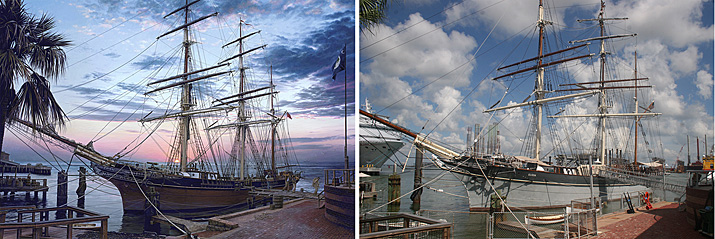
“Cavalier of the Sea” (l.) and 1877 Iron Barque Elissa at Galveston, June 26, 2010.
Q. How Old was General Hood at Gettysburg?
A. Thirty-two.

Hood as portrayed by (l. to r.) Patrick Gorman in Gettysburg (1993) and Gods and Generals (2003), Levon Helm in In the Electric Mist (2009) and himself in real life (c. 1865).
Picking up a thread of an idea from David Woodbury at Of Battlefields and Bibliophiles, I’ve been thinking about how film and television typically portrays Civil War figures. Most often they’re depicted substantially older than they really were. I’m not necessarily speaking of the actor’s actual age versus character’s (because actors routinely play much younger characters), but more generally his apparent age — how he’s made to look. It’s easy to see why this would be the case. When an actor portraying a Civil War figures actually is about the right age for the character, it’s often jarring for the viewer, to whom it doesn’t “feel” right even if, in fact, it is. Matthew Broderick was 25 or 26 when he shot Glory; his character, Robert Gould Shaw, was exactly that age at the time of the events depicted in the film. Nonetheless, although the actor and the role were perfectly matched for age, it still didn’t “look right” for a lot of people, and probably harmed the overall public reception of the movie. People just couldn’t see someone that young, in that role. (Being known at the time primarily for his role as as Ferris Bueller didn’t help.)
But this just highlights something that we might easily forget — the vast majority of these men, from private to general, were very young by modern standards. At the beginning of the war, Ulysses S. Grant was 39. George Meade was 45. George McClellan was 36. George Pickett was 36. James Longstreet was 40, as was John George Walker. Stonewall Jackson was 37. William Tecumseh Sherman was 41, and so on. Robert E. Lee was 54, the “old man,” not just because of the senior position he held, but because he was, by the standard of the day, objectively and factually old.
There are lots of exceptions, of course — Albert Sidney Johnston was nearly 60 when he got plinked at Shiloh — but still it amazes me how young these men were when so much rested on their shoulders.
Update: Argghh! Dimitri Rotov has stolen a march on me on this very topic over at Civil War Bookshelf.
In Which I Make the Neoconfederates Cry
“Old Rebel,” writing at the League of the South’s Rebellion blog, highlights Dead Confederates along with Kevin’s Civil War Memory, Corey Meyer’s Blood of My Kindred and Edward Sebesta as “anti-Southern cyberstalkers” who hold a “seething hatred against an entire people and their culture” and who lead a “a shallow, unfulfilled life.”
These people remind me of the creepy serial killers from a Patricia Cornwell thriller. Cornwell’s villains can’t have meaningful human relationships, so they stalk and murder those who do. Young couples are the usual victims of these ghouls because the couples possess something the stalkers can’t have. My guess is that anti-Southern cyber-stalkers resent a living, vibrant culture with rich traditions and a sense of belonging and meaning that’s been denied them, so they snipe at those who do. If they can’t have cultural moorings, no one else can, either.
There’s no point in trying to refute this sort of name-calling, since there’s no actual substance to it. But I would like to make a few points of my own.
- Getting denounced by the official blog of the League of the South after being online for only nine days is indescribably awesome.
- That my dinky little blog should be mentioned in the same breath as Kevin’s, Corey’s and Ed Sebesta’s work is just staggering. I am genuinely humbled.
- Getting linked by the League of the South’s blog has really bounced my web traffic over the last couple of days — Dead Confederates isn’t exactly burnin’ up the Intertubes (yet), but I’m getting more referrals from Rebellion than from all other sources combined. Thanks, Old Rebel!
Kidding aside, Corey Meyer highlights a much more serious problem, one that speaks to the lengths some people will go to denounce their detractors. Some time back, Corey sent the Rebellion blog a photo he’d found online of someone wiping a commode with a Confederate Battle Flag. Snarky? Yep. And in retrospect, probably not a good idea, because instead of ignoring it — which Old Rebel argues that “that’s what the “Delete” key is for” — it seems Old Rebel or one of his/her confederates subsequently Photoshopped a p*rn magazine into the picture, and is now distributing the altered image as actually having originated with Corey.
This is dishonest. This is lying.
Old Rebel — who unlike Corey, Kevin, Ed Sebesta and me, seems unwilling to blog under his or her real name — and the League of the South are welcome to their views, both of current politics and historical events. They’re welcome to express those views, and have proved to be passionate and energetic in doing so. But neither they nor anyone else has the right to use this sort of dishonest, childish and shameful tactic to smear those they perceive as their opponents. In doing so, they forfeit the right to be taken seriously, about this or anything else.
Not for Megan Fox, Not Even for the CGI Ironclad. . . .
I do like those double, horse-mounted Gatling guns, though. Anybody know if Dixie Gun Works will be carrying them? H/t Blood of My Kindred.
I Was Praying for Intermission, Myself

It doesn’t really bother me so much that the 2003 film Gods and Generals portrays Stonewall Jackson as a bit of a hyper-religious crank because, you know, he was.
What bothers me is that the film portrays this as a good thing.




 Dead Confederates, A Civil War Era Blog

4 comments