NatGeo’s Secret Weapon of the Confederacy

Update: I didn’t see the show myself, but I hear (from some highly-discerning folks) that it was pretty good.Anybody here catch it? Let me know in the comments.
_____________________________
On Thursday evening the National Geographic Channel will air “Secret Weapon of the Confederacy,” exploring the short, eventful life of the submersible H. L. Hunley. From the website:
It was the first submarine ever to sink an enemy ship, but after only one successful mission the H.L. Hunley vanished with its crew and lay hidden for more than a century. The circumstances surrounding the disappearance of the Confederacy’s secret weapon have remained an enduring mystery since the Civil War era, but now NGC has uncovered what may have brought it down.
Hunley has always been a favorite of mine. Some old renderings of my model of the boat, based on plans by Michael Crisafulli, after the jump:
For the Ferroequinologists
What? Did someone say trains? OK, if you insist. . . .
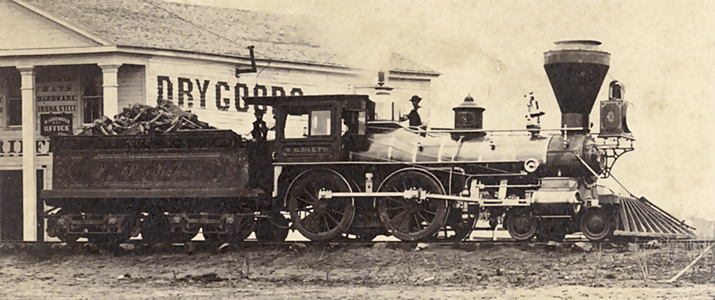
Houston & Texas Central locomotive W. R. Baker, c. 1868. The years immediately after the Civil War brought a surge in railroad construction across Texas, particularly in lines like the H&TC, fanning out from Houston. William Robinson Baker (1820-1890) held a variety of senior offices with the railroad between 1852 and 1877, and served as mayor of Houston from 1880 to 1886. Image from the Lawrence T. Jones III Texas Photographs Collection at Southern Methodist University.
Samuel Oliver Young’s True Stories of Old Houston and Houstonians (1913) includes a description of railroading in Texas during this period:
Before the close of the war all the railroads except the Houston and Texas Central and the Galveston, Houston and Henderson had gone out of commission and had ceased to run at all. In some way these two roads were kept in such condition that they could be used, but that was all. Using them was not a safe thing by any means. They crept along so slowly that while wrecks were so frequent as to attract no attention, it was a rare thing for any one to get killed or even hurt.
If full justice were done the name of Mr. [Paul] Bremond [1810-1885, president of the H&TC] would be perpetuated by the Houston and Texas Central road. It is true there is one of the principal towns on the line named after him. It is true he received loyal support and assistance from W. R. Baker, M. M. Rice, William Van Alstyne, William J. Hutchins, Cornelius Ennis and others, but theirs was money help and soon gave out. The real credit for building the road belongs to Paul Bremond, for he did what others could or would not do, pulled off his coat and went in the trenches and, figuratively, on the firing line of railroad construction in Texas.
I do not know what the reason for doing so was, but in those days the builders of locomotives always put immense smoke- stacks on them. The smokestacks were funnel-shape and several feet in circumference at the top. The locomotives burned wood and every few miles there were big stacks of cordwood piled alongside the track.
There was no such thing as spark-arresters and every time the fireman put fresh wood in the box the passengers got the full benefit of the sparks, cinders and smoke. It beat traveling by stage, however, and as the people knew nothing of oil- burners, spark-arresters and Pullman cars, everybody was content.
The old-time fireman earned every dollar that was coming to him, for he had to keep busy all the time. It was not child’s play to have to keep steam up with only wood for fuel. Then too, it took more steam to keep an engine going at that time, for the engineer was using his whistle 10 times as often as he uses it now.
There were no fences along the right of way and as there were thousands of cattle on the prairies and woods where the road ran, the track was generally filled with them every few miles. As soon as the trains would get out of the city limits, the whistle would begin tooting and this was kept up almost without cessation. Of course, a great many cattle were killed and this led to bitter warfare between the cattlemen and the railroads.
Wrecks and attempted wrecks were frequent, for there were not wanting men, who, to get revenge on the railroad company by destroying its property, were willing to run the risk of destroying the lives of innocent passengers. The first wreck of this kind that ever occurred in Texas, was on the Houston and Texas Central, near where the water tank is, about 12 miles from Houston. Some scoundrel drove spikes between the ends of the rails and wrecked the train. No one was killed, but Mr. Bremond, who was on the train, received quite serious injuries and was laid up for repairs for several days.
And while we’re at it, Bernard Kempinski at United States Military Railroads blog has a great photo of a more famous locomotive.
_____________

So Much for Reconciliation
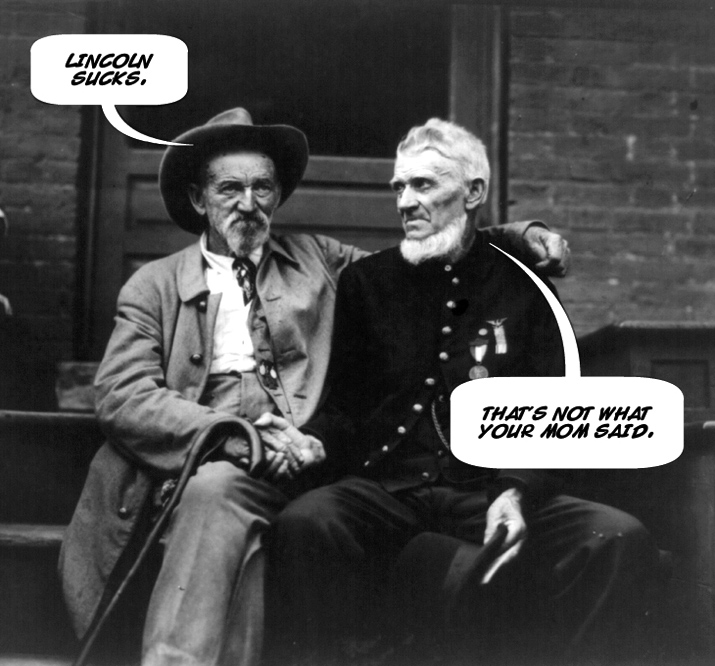
From the New York Times, July 3, 1913:
Stabbed at Gettysburg.
Affray Over Abraham Lincoln in Crowded Hotel Dining Room.
Gettysburg, Penn., July 2. — Seven men attending the Gettysburg Battle Celebration were stabbed to-night in the dining-room of the Gettysburg Hotel in a fight which started when several men aroused the anger of an old veteran in blue by abusing Abraham Lincoln.
The wounded men were:
- Edward J. Carroll, Sergeant of the Quartermaster’s Corps, U.S.A.
- David Farbor of Butler, Penn., a member of the State Constabulary.
- John D. Maugin of Harrisburg.
- Malcolm Griffin of Bedford City, Penn.
- Charles Susler of West Fairview, Penn.
- Hayder Renisbecker of Gettysburg.
- Harry A. Root, Jr., of Harrisburg.
Farbor, Maugin and Griffin are in the most serious condition. Their wounds were in the left breast, and the surgeons at the Pennsylvania State Hospital would not venture predictions as to their chance of recovery.
The fight started suddenly and was over in a few minutes. The dining room was full, and the disturbance caused a panic. The old veteran, who was unhurt and who disappeared in the melee, was sitting near Farbor and Carroll when he heard the slighting remarks about Lincoln. He jumped to his feet and began to defend the martyred President and began to berate his detractors. The men who were stabbed jumped to the defense of the veteran when the others closed in. Knives were out in a second. Women fled for the doors and crowded to the windows, ready to jump to the street.
The row was over before the rest of the men in the room could get their breath. The fight spurred the medical men again to-night to an effort to have the Gettysburg saloons closed during the remainder of the celebration.
The Constabulary later arrested a man who said he was W. B. Henry of Philadelphia on a charge of having been in the affray.
Henry said he was the son of R. R. Henry of Tazewell, Va., a General in the Confederate Army. According to witnesses, it was Henry who applied the epithet to Lincoln. The Union veteran seized a glass or bottle and threw it at Henry, who, it is alleged, drew a knife and began slashing at those nearest to him. After a fierce fight he was subdued.
H. N. Baker of Pennsylvania is said to bet [sic.] the veteran who took offense at the remarked about Lincoln. C. A. Goldthwaite of Salem, Mass. seized the knife and turned it over to the police.
________
The old Union soldier may have been former Private Henry N. Baker of the 9th Regiment, Pennsylvania Reserve Infantry (38th Volunteers) . The regiment was present at Mechanicsville, Malvern Hill, Second Manassas, Sharpsburg, Gettysburg and the Wilderness before being mustered out in May 1864. No Confederate General Henry appears in either Warner or Allardice, so I have no idea about that. Image: Library of Congress.

“Lee at the Alamo”
Alternative history is pretty far down the reading list for me. But this “what if” from Harry Turtledove, based on a germ of an idea tossed off decades ago by Bruce Catton, is a fun one. Lieutenant Colonel Robert E. Lee, acting in stead of the ailing General David Twiggs, finds himself in command of the U.S. Department of Texas at San Antonio when Texas secedes from the Union in February 1861:
Lee frowned at the needless profanity, but agreed with the sentiment. “Well, then, ah, Colonel” —he used the rank and denied it at the same time— “perhaps you will be so good as to tell me what I can do for you. Since you say you do not need the Army’s help, I cannot imagine that you were looking for me in particular.” A genuinely modest man, he meant that.
“I don’t need the U.S. Army’s help, Colonel Lee,” McCulloch said, his voice deep and raspy and fierce. “I need the God-damned U.S. Army gone.”
“I beg your pardon?” Lee knew—knew only too well—that Texas was in the process of dissolving the bonds linking her to the Union. He knew as much, yes. That a jumped-up militia colonel should dare to speak to him so took him aback all the same.
“Gone,” McCulloch repeated, as if to a simpleton. “If you will surrender your forts and your guns and muskets and munitions without kicking up a fuss, you and any of your men who don’t care to join the great Southern cause can march on out of Texas, and nobody will touch a hair on your head. But if you say no, sir, I cannot answer for the consequences, and that is the Lord’s truth.”
__________________

Lincoln Documents Returned to National Archives

Here’s a rather notable video segment about a dealer in historical documents who, upon being notified that a document he’d sold had been missing from a file held by the National Archives, took active steps to see that it was returned.
I’ve been to too many collections, and asked to see too many documents listed in the catalog, only to find a note in the folder that reads, “Missing since [date].” The theft of materials from archives — with shrinking staff and often poor security — is a terrible problem. I’ve long believed that a not-insignificant proportion of the documents market is made up from material gone missing from archives, and especially so with autographs — whole letters can often be traced back to their source, but a signature excised from a larger document cannot.
As retired National Archives Civil War Subject Specialist Mike Musick notes in the video, there’s no way to know when the original theft in this case occurred; it may have happened while the documents were still under the stewardship of the War Department, decades ago. No matter; what’s important is that the material is back where it belongs.
_______________

Texas Drought Exposes African American Burial Site

Over at Interpreting Slave Life, Nicole Moore highlights a recent news item from north Texas, where a previously-unknown African American burial ground has been exposed by the drought in Navarro County, near Corsicana:
Forensics experts told Bailey the remains appear to belong to an African-American man, about 40 years old, who was likely a freed slave.
“We believe it was a person who worked on a plantation in that river bottom [sic.],” [Navarro County Sheriff’s Deputy Frank] Bailey said.
The reservoir is one of Tarrant County’s [i.e., Fort Worth’s] water sources.
Cemeteries were noted and moved before it was filled in the 1980s, but this small cemetery was not marked, and the graves did not have tombstones.
Boaters first found the remains in 2009 along the shoreline. But lake levels rose again within days, quickly reclaiming the site.
So, for three years, archaeologists and historians have waited for the reservoir to reveal them again.
The site was uncovered by the receding waters of the Richland Chambers Reservoir. It’s not actually a river bottom, but formed by the flow of Richland and Chambers Creeks. The Navarro County Times is also covering the story, as is the Corsicana Daily Sun.
There weren’t a lot of what what’s commonly thought of as plantations in that area in the mid-19th century. Navarro County had a total of 251 slaveholders in 1860, owning in aggregate 1,890 slaves. Seventeen slaveholders owned twenty or more slaves — one of the common standards for what designated a planter as opposed to a mere farmer — and only one of who owned more than a hundred.[1]
The largest slaveholder in Navarro County was Anderson Ingram (c. 1799 – c. 1875), who with three brothers purchased thousands of acres of land along the Trinity River, which forms the county’s eastern boundary.[2] In 1859, Ingram was actively farming 900 acres, on which his slaves cultivated 6,500 bushels of corn and 382 bales of cotton.[3]
Far more common were relatively small farming operations like that of Aaron Perry in neighboring Limestone County, who raised hogs and corn, much of the latter likely used for fattening the former before killing time in the fall.
I haven’t been able to locate Anderson Ingram’s property on plot maps from the General Land Office dated to 1858 and 1872, but if it was in the eastern part of the county, it was in the same general part of the county as the reservoir. In any event, the exact location of the site is held in confidence by local authorities to prevent its disturbance by both looters and the curious. There are likely more burials nearby, which may help present a more complete picture of north central Texas on the eve of secession.
[1] University of Virginia, Geospatial and Statistical Data Center. “Historical Census Browser.” Retrieved September 06, 2011, from the: http://fisher.lib.virginia.edu/collections/stats/histcensus/index.html.
[2] Christopher Long, “Ingram, Anderson,” Handbook of Texas Online (http://www.tshaonline.org/handbook/online/articles/fin07), accessed September 06, 2011. Published by the Texas State Historical Association.
[3] Ralph A. Wooster, “Notes on Texas’ Largest Slaveholders, 1860,” Southwestern Historical Quarterly 65 (July 1961).
Image: The Richland Chambers Reservoir, Navarro County, as imaged in ArcGIS Explorer. In this view, which incorporates bathymetry data, the original courses of Richland and Chambers Creeks can be seen faintly. The city of Corsicana appears at upper left. Full-size image here.

The Third Assistant Engineer

In response to my recent post on Monitor‘s turret, one of my readers writes:
One photo of all but one officers in chairs, shows at viewer’s left, seated before the turret, my Woollen kinsman, USS Monitor 3rd Asst. Engr. Robinson Woollen Hands, sitting atop a jury-rigged stool of two Monitor armored deck-light covers. He perished at his engine-room duty station when the Monitor foundered. His memorial stone is at Baltimore. The enlisted of the Monitor survivors group, the Starboard Watch Society, voted Robinson the most beloved of all the officers by the enlisted.. The first item recovered from the deep that identified the wreck as thee USS Monitor, and not just a monitor class vessel, was not the earlier lantern, but the armored deck-light cover. Possibly Robinson is sitting on the one first one recovered from the deep?

My correspondent goes on to say that Hands’ brother, George Washington Hands, Jr., was a captain in the Virginia infantry and “considered Robinson a traitor and never bespoke Robinson’s name again.” Their father, George Sr., was the civilian master of the steamer River Queen that was the scene of the famous meeting between Lincoln, Sherman, Grant and Porter in the closing days of the war.
It’s quite amazing how many stories there are like this; there’s the story of Edward Lea and his father Albert, the former a U.S. naval officer on the Harriet Lane and the latter an engineer officer on Confederate General Magruder’s staff at the Battle of Galveston. And of course Farragut’s Flag Captain, Percival Drayton, son of a prominent South Carolinian family who, early in the war, participated in a naval bombardment of forts commanded by his brother Thomas.
“Brother against brother” was too often literally true.


Robinson W. Hands’ memorial stone in Baltimore, via Find-a-Grave; a deck porthole cover like one of those Hands is sitting on, recovered from the wreck site, via National Geographic.
______________
Image: Officers of U.S.S. Monitor, July 9, 1862. Front, l. to r.: Robinson W. Hands, Edwin V. Gager. Seated, l. to r.: Louis N. Stodder, George Frederickson, William Flye and Daniel C. Logue and Samuel Dana Greene. Standing, l. to r.: Albert B. Campbell, Mark T. Sunstrom, William F. Keeler, and L. Howard Newman of U.S.S. Galena. Library of Congress photo; identifications from The Monitor Chronicles.

The Uneasy Remembrance of Private Albert Cashier
Many of you will have heard the story of Pvt. Albert D. J. Cashier, Co. G, 95th Illinois Infantry. Private Cashier was born a woman, Jennie Hodgers (1843-1915). My colleague Damian Shiels, who blogs at Irish in the American Civil War, recently told Cashier’s story here.
Apart from the wartime masquerade, there are a couple of other remarkable things about Cashier’s life. (I use that name and the masculine pronoun, because that’s how Cashier chose to present himself for more than 50 years.) The first is that, whatever his reasons for adopting a male identity and entering the Union army, Cashier continued to present and live as a man, settling in the village of Saunemin, Illinois, about 90 miles southwest of Chicago. Cashier lived in Saunemin for more than 40 years, supporting himself with small jobs and living alone. As independent radio producer Linda Paul discovered two years ago, Albert Cashier was a strange, eccentric person:
For me though, probably the most fascinating part of this project was trying to unpeel the onion to find a more nuanced portrait of Jennie Hodgers. I found a person who could be kind to children, offering them a treat whenever they came to her home. But there was also a hot-headed, disingenuous, petty and unquestionably eccentric Jennie Hodgers. She had her foibles, just like the rest of us. . . .
A few years before the rest of the world found out about Cashier’s true gender, Cathy Lannon’s great grandmother made the discovery. She had heard that Albert was sick one day and so she asked a nurse to go over to help him out. In short order the nurse came running back and spluttered,“ Mrs. Lannon, he’s a full fledged woman!“ The nurse was so upset that she packed up and left town and Lannon’s great-grandmother in a great act of empathy, didn’t tell anyone about it, including her husband.
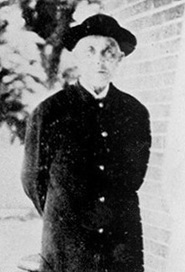 In Cashier’s final years (right, c. 1913), it seems, a series of injuries resulted in a handful of people discovering his secret, but they kept quiet, and it was not until a year or so before Cashier’s death that the story became public and Cashier was revealed publicly as being female. Cashier was eventually confined to a state asylum where he was forced to wear a dress, very much against his will. By that time, Cashier was somewhat famous, and in August 1915 the Rockford, Illinois Republic noted that he was “failing rapidly. . . mental state is rapidly deteriorating.” When Cashier died in October, he was buried with full military honors, in the uniform of the Grand Army of the Republic, with a standard veteran’s headstone. (Six decades later, in the 1970s, a larger stone was dedicated, with both Cashier’s names on it.)
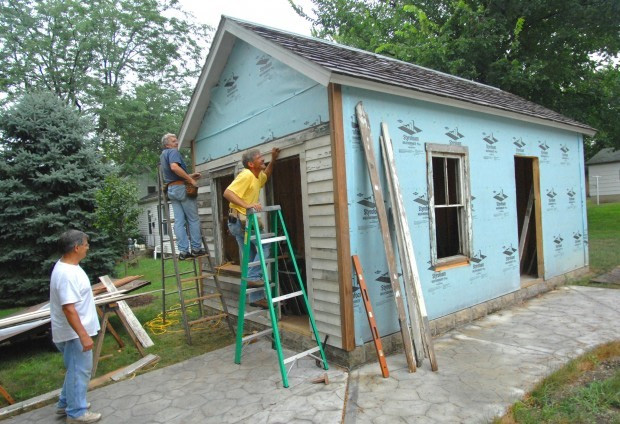
Now one of my readers has passed along a news story from public radio WBEZ 91.5 in Chicago, telling the story of the restoration of the old soldier’s tiny house — and the unease that some locals still feel about discussing Cashier’s legacy. Returning in 2011 to Saunemin, Linda Paul resumes the story:
I’ve only just met the very affable Mayor Bob Bradford, but in no time flat, I’ve managed to get on his nerves.
See, the last time I was in town, a few years back, a couple of folks – a small number, really – weren’t so sure they wanted their town to celebrate the life of someone they considered a “cross-dresser.” So I may have gotten off on the wrong foot by asking Mayor Bradford if that’s still the case today.
“Well, I get a little perturbed when you use the word cross-dresser,” said Bradford.
Bradford said that anyone who uses that term just really doesn’t understand the story.
“And the story was, is, that Jennie Hodgers – Albert Cashier – was trying to make a living,” he notes. “And back in those days, a woman could not make a good dollar by being a housekeeper or doing laundry and so forth. But a woman could get three squares a day, and could make a good salary by serving in the army. So I think that was the reason. I don’t think it had to do with cross-dressers.”
I suppose if Mayor Bradford gets all squirmy at the mention of cross-dressing, maybe we shouldn’t even bring up the notion of transgender. 😉
In any event, it’s great that Saunemin’s residents have finally gone to the trouble and expense of restoring this small reminder of a very unusual Civil War story. I suspect that, in the coming years, they will wonder why they didn’t do it sooner, and why they were so uncomfortable with Albert Cashier’s legacy for so long.
___________
Image: Albert D. J. Cashier’s tiny house in Saunemin , Illinois, under restoration in 2010, via Pantagraph.com. Cashier photo via Abraham Lincoln Presidential Library and Museum.

Blue and Grey, Red and Blue

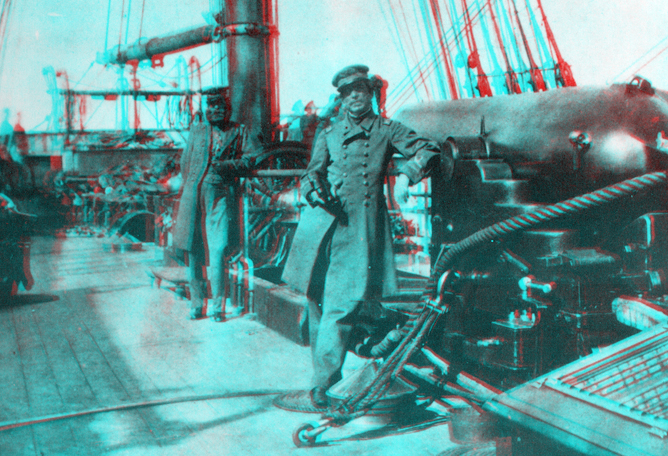
So I’m reading this new (to me) blog, Lancaster at War, where Vince has taken a 19th century stereo pair and converted them into one image that can be viewed with those red/blue glasses you can get more-or-less anywhere. At his suggestion, I tried it out using these instructions and this Civil War stereoview. This is the result; it seems to work best if you lean back from the screen a bit.
Then there’s Captain Semmes of infamous Confederate raider Alabama. More background to this image here.
______________

“Prepared for It this Time”
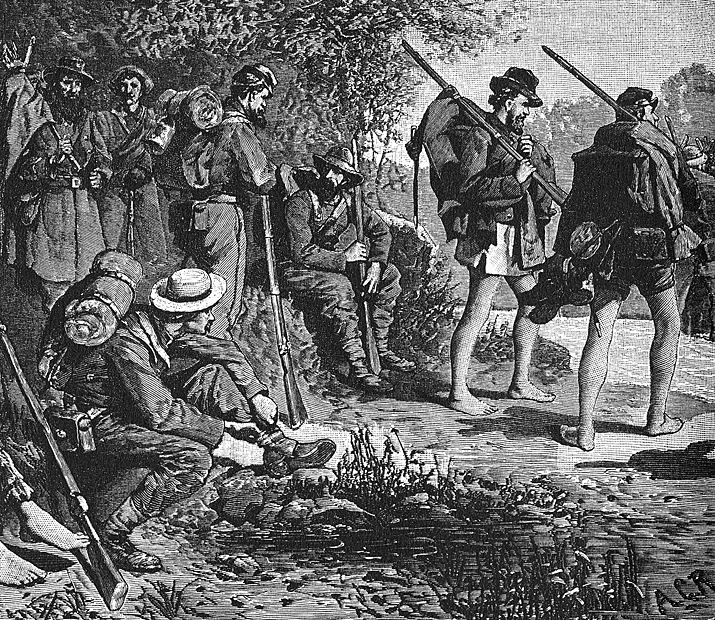
While posted near Suffolk, a six-foot Georgian from the up country of his State, and a member of the Fourth Georgia, attempted one morning to cross a little stream when the tide was in. Encumbered with his clothes, the poor fellow had to swim for his life, and narrowly escaped being drowned.
The regiment in the afternoon saw him sit down on the opposite bank of the creek, deliberately take off his shoes and socks, next his clothes, and tie them up carefully in a bundle for his back. All these preparations being made, he hesitated before proceeding any further; but at length having made up his mind like a gallant soldier, as he was, he plunged boldly into the water, which was nowhere more than two feet deep, the tide having gone out. The cheers with which he was received by his regiment, when his perilous feat was safely accomplished, were prolonged, enthusiastic, and somewhat vociferous.
________
From “A Confederate,” The Grayjackets: How They Lived, Fought and Died, with Incidents & Sketches of Life in the the Confederacy (Richmond: Jones Brothers & Co., 1867). Image: “Confederates at a Ford” by Alan C. Redwood (1844-1922).





 Dead Confederates, A Civil War Era Blog

2 comments