Conservation of the Marshall House Flag
__________

Well, I Never Thought of That. . . .
The other day I mentioned the incident near Chappell Hill, where nooses were hung from a Sons of Confederates Veterans billboard along Highway 290, the main road between Houston and Austin. It seemed like a pretty crude and unfocused sort of protest at the time, and now columnist Bud Kennedy of the Fort Worth Star-Telegram, wonders if something else isn’t going on here:
But that was nothing compared with the silliness in Central Texas, where a Confederate heritage society e-mailed reporters early Tuesday with photos of two nooses hanging from a giant Rebel battle flag billboard on U.S. 290.
“It’s racist — a hate crime,” rancher Donnie Roberts said.
Washington County Chief Deputy Mike Herzog laughed.
“They were the first people who saw those nooses, and then they alerted the media,” he said.
I got the feeling he won’t bring in the FBI.
“It’s on a busy highway, and nobody else saw it,” he said.
It would have taken three people with a bucket truck and extension ladder to hang the nooses, he said.
Coincidentally, members of the Sons of Confederate Veterans history and heritage group responded quickly with a bucket truck and extension ladder to take them down.
Chappell Hill physician Robert Stark, also a Sons member, said Roberts saw the nooses first.
So what did they do?
Why, they were so insulted and threatened that Stark immediately took a bunch of photos and e-mailed them to a radio station.
KWHI/1280 AM’s website headlined “Local Billboard Vandalized.”
Roberts declared a “degradation of our historic heritage.”
At the sheriff’s office, Herzog called it a “prank.”
Deputies will investigate it as criminal mischief, he said.
Roberts said he wants the national SCV to investigate a “crime against our people” and will offer a $5,000 reward.
He said the suspect might be “white or black.”
But he added: “Well, it did happen on Martin Luther King’s birthday.”
“A crime against our people,” really?
I don’t know the truth of the matter here. Bud Kennedy’s obviously suspicious, and it doesn’t sound like Chief Deputy Herzog is especially concerned about it, either. Compared to other, very real cases of destructive, criminal vandalism, this latest event seems, well, curiously quaint.
What do I know? I know that, if someone did something like this on my property, calling the media to broadcast that fact would be pretty far down on my list of priorities. I would not be sending pictures of the thing to the local radio station. I would not be shooting my mouth off to reporters about it.
If this was indeed perpetrated by some stranger as a form of protest, I understand why the local SCV folks are unhappy about it. But whatever the real story behind the nooses, the local SCV seems quite content to play this “crime against our people” business for all it’s worth.
____________

Discovering the Civil War at the Houston Museum of Natural Science
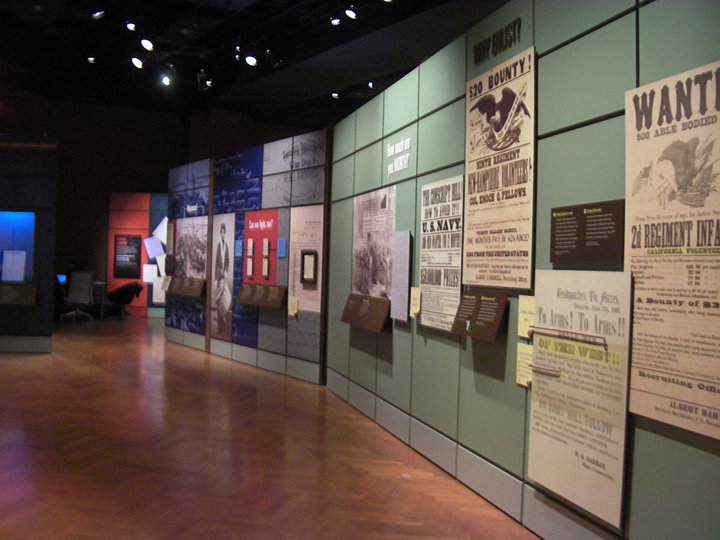
The Discovering the Civil War exhibition at its previous venue, the Henry Ford Museum. Via here.
On Saturday the fam and I took the afternoon to visit the exhibition, Discovering the Civil War, currently at the Houston Museum of Natural Science (HMNS). The exhibit runs through April 29, and is produced by the U.S. National Archives and Records Administration and the Foundation for the National Archives. It’s hard to do a compelling museum exhibition based almost entirely on documents and images; people want to see stuff, and that’s understandable. This particular exhibit succeeds pretty well, I think, in part because the documents they’ve included are genuinely compelling, and do a very good job of telling the story. The exhibition includes, for example, facsimiles of the 1861 Corwin Amendment, the Emancipation Proclamation, and the original text of the 13th Amendment ending slavery in the United States, bearing the signatures of Speaker of the House Schuyler Colfax, Vice President and President of the Senate Hannibal Hamlin, and President Lincoln. (The original holograph copy of the Emancipation Proclamation will be on exhibit on February 16-21.)
One of the common complaints among Southron Heritage™ folks is that the limitations of the Emancipation Proclamation “isn’t taught in school” or “you never hear about that” or some such. So I almost laughed out loud when, not a minute after stepping into the first section of the exhibit, an HMNS guide stepped up to explain to us and others some of the featured documents in the show, and drawing very careful distinctions between the limited, wartime scope of the EP, and the permanent, legislative accomplishment of the 13th Amendment.
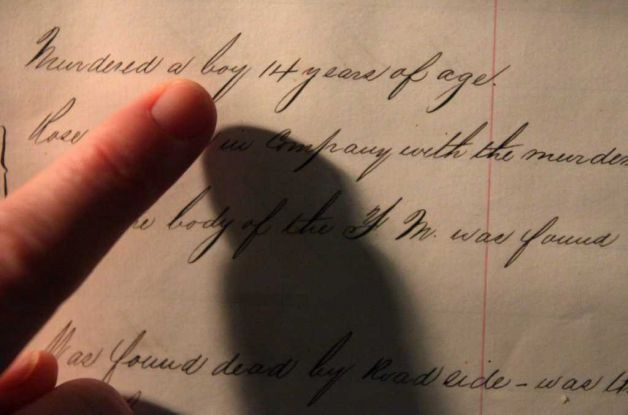
A curator at the Houston Museum of Natural Science points to entries in the Freedmen’s Bureau “Texas Record of Criminal Offences” from 1868. Photo: Mayra Beltran / © 2011 Houston Chronicle
The exhibit doesn’t only cover the war years; it goes back into the decades-long tensions over slavery and other sectional issues that led to the war, and devotes considerable space to the postwar period, including the creation of veterans’ groups like the GAR and UCV, reunions, monuments, and so on. It was in the area on the Reconstruction period that I came across a particularly chilling artifact, a big ledger in which the officers of the Freedmens’ Bureau in East Texas recorded assaults and murders of African Americans, attacks believed to be part of the terror campaign led by the Ku Klux Klan and allied groups to limit the new citizens’ participation in the electoral process and to intimidate anyone who challenged the pre-war power structure. The pages on display opened to 1868, the year such depredation came to a climax, in anticipation of that year’s general election. The the neatly-penned columns of names of the victims, alleged perpetrators, and nature of the crime — almost all listed simply as “homicide” — were deeply unsettling.
There is some hands-on material, including a section where visitors are asked to view an illustration from a wartime patent application, and then guess what the object is. The HMNS has also set up a kids’ discovery room, about halfway through, where young visitors can try on period costumes and work puzzles involved Civil War-era cryptography.
The museum has also appended a display at the end of the NARA exhibit, focusing on Texas during the war, with lots of arms and other artifacts from local units. These are, I believe, materials from the John L. Nau III, Civil War Collection. The recent recovery of artifacts from the wreck of the U.S.S. Westfield is discussed, as well.
Finally, there’s an extensive series of public presentations being given on different aspects of the conflict, including one on the recovery of the U.S.S. Westfield artifacts on March 27, and one by myself on March 27, “Patriots for Profit – The Blockade Runners of the Confederacy.” Hope to see y’all there.
_______________

The 7th Virginia Electric Calvary at Spotsylvania
Something new today. Guest blogger Cole Grinnell is a scientist, writer, and actor who works, when he works, out of Baltimore, Maryland. He should have a blog, but strangely, he doesn’t.

The 7th Virginia Electric Calvary at Spotsylvania: Reflections on a Modern Attempt at Battlefield Traversing
by Cole Grinnell
It is a crisp, windy late spring day in Spotsylvania. A random patchwork of clouds and clear sky drifts over an open plain, casting shadows like roving armies maneuvering below. We stand facing small overgrown V of earthworks, scarcely more than a hundred yards long, and listen to ranger describe the shear brutality of this place. He describes nearly a solid day of constant hand to hand fighting, thousands of men filling in and tamping down the bodies of the dead and dying, soldiers overcome with mad surges of energy abandoning their rifles, and fighting for hours with hatches and knives, people so utterly exhausted from endless combat that their legs had forgotten their function and they had to be pulled from the trenches by their comrades. We stood and listened to the last of this, his final words carried out over the trench line by the wind; a deafening silence was felt in our chests. We look on ahead, over onto the field, where the Union men rushed to open the breach and finally crush the army that had dragged them all over Virginia. We look behind, in to the trees, where Confederate regiments surged forward, one at a time, to try and and buy their compatriots behind them enough time to construct new defenses. We look to our left, up the road from where we had just come, to see a Segway humping a tree.
Protest #FAIL
 News comes today that the well-known Texas SCV billboard (right) on Highway 290, near Chappell Hill, has had a noose affixed to it.
“I think it’s very disrespectful. It’s not right,” said Jeff, a utility worker.
A Chappell Hill business man, who is also a lifetime member of Sons of Confederate Veterans personally donated the billboards to the national SCV organization. He alerted authorities Wednesday afternoon after noticing a noose dangling from the confederate [sic.] flag.
“My great grandfather fought in the confederate war, and several peoples grandparents’ fought in the confederate war. Yes we know the war was between the North and the South and it was over slavery, but that’s, I mean that’s ridiculous,” added Jeff.
How the noose got there is one question authorities are trying to figure out — but more importantly — why?
“They had to do some serious climbing to get up there to tie that up and drape it on the side,” added Jeff.
The Washington County Sheriff’s Department is investigating this as a case of “criminal mischief,” while the local SCV is calling it vandalism. As with the recent case in Richmond, Virginia, where persons unknown attached home-made historical “plaques” to the fencing around several Confederate monuments, I’m unconvinced this case is outright vandalism, which to me requires actual physical damage to be done. As in Richmond, there’s no indication of that happening here.
But otherwise, this case sure has FAIL written all over. The intent — I guess — is to equate the SCV, or Confederate heritage efforts generally, with lynching and racial terrorism. Those latter things are damn deadly serious, and their long history in this country is often willfully ignored by the heritage crowd, but the connection here is awfully tenuous. The home-made plaques in Richmond were carefully thought out and had a clear point; they counterpoised historic African Americans against the Confederate heroes being honored by the monuments. By comparison, this is just angry and unfocused, a gesture that’s dramatic, but also clichéd.
Candidly, I have an appreciation for smart, well-executed (as opposed to merely loud) protest, even when I don’t agree with the cause being advocated. Tossing up a noose on a billboard, late at night, leaving motorists driving between Houston and Austin to try to make some vague association between the SCV and lynching, doesn’t cut it. Try harder next time.
__________

Everyone Knows the Past was Sepia-Toned

Corey has an interesting post up, tracing the history of efforts to locate the exact location of the famous “Harvest of Death” photos, taken shortly after the Battle of Gettysburg. Corey highlights John Cummings’ recent findings (here and a follow-up here), and asks what his readers think. I don’t know, myself — I’ll have to give it more study — but it did get me thinking about colorizing historic, black-and-white photos.
It’s a practice that’s ubiquitous now; there are entire cable teevee series based largely on retroactively colorizing historic footage, presumably to lend some brilliant new insight into the past. Mostly this technique results in a very poor-quality product, and sometimes it’s not even necessary. Here are two images of the destruction of U.S.S. Arizona, on the left a still frame from actual color footage of the blast, and on the right, a still frame from the video linked above, a colorized version of a black-and-white print of the same footage. (I’ve “flopped” the right frame left-to-right; the footage is also usually shown reversed.) In neither case is the footage very clear, but the original color frame is far more natural than the artificial one on the right:

The practice is even more prevalent in print media; historical magazines do it all the time, presumably because they feel it makes the publication more visually appealing.
I was also reminded of the pitfalls of colorizing images by this article about Swedish artist Sanna Dullaway, who’s taken some of the best-known portraits and news images, shot originally in black and white, and colorized them. Her colorized image of Lincoln appears at the top of this post; other subjects include Winston Churchill, Albert Einstein, the summary execution of a Viet Cong prisoner during the Tet Offensive, and the famous V-J Day kiss in Times Square.
 But her own rendering of the famous “Harvest of Death” image points out one of the obvious limitations of the practice; she gets the uniform colors really, badly wrong. Such errors can be obvious, in cases like this, but in most cases the viewer could have no idea what’s correct. The blue coat, brown vest and scarlet necktie of Lincoln (right), don’t strike me as very plausible — though perhaps they’re more believable than the Great Emancipator’s self-evident spray tan. (Knocking down the color saturation of the image would take care of that distinctly Boehner-like orange glow.)
I’m ambivalent about the practice, myself; I don’t really object to it on grounds of authenticity, if it’s make clear that such an alteration has been made, but it’s rarely done very well. (Sanna Dullaway is much better at it than most Photoshop hacks like me, but even hers are of mixed effectiveness.)
So what do you think? Do colorized images — still or moving — have a place in historical interpretation? What cautions or disclaimers should accompany them? What are the pitfalls, and the benefits? And most important, are there any really good colorizing tutorials out there? 😉
______________
Images: Colorized Lincoln image by Sanna Dullaway. U.S.S. Arizona images by (left) U.S. Naval Historical Center and (right) The Military Channel.

“Having finished life’s duties, they rest.”

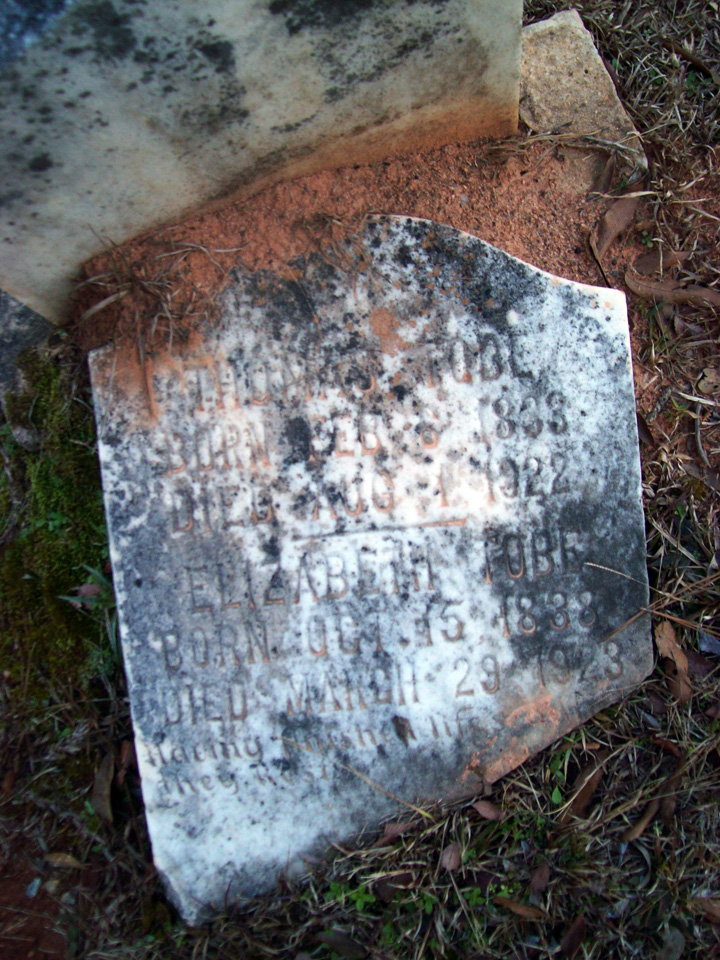
About a year ago, I put up a post about Thomas Tobe, a free African American man from South Carolina who was conscripted to work at General Hospital No. 1 in Columbia, South Carolina during the summer of 1864. Tobe later received a state pension based on service he claimed with Company G of the 7th South Carolina Cavalry, Holcombe’s Legion. This latter claim is problematic, as there are no contemporary records verifying his attachment to that unit. Critical details are missing from the pension application, such as Tobe’s attested rank, and the men who swore as witnesses to his service were from different regiments. Tobe may well have been attached to that unit, perhaps as a cook, a personal servant or in a similar capacity, but there’s no direct evidence that he served as a trooper.
At the time of the post, I understood that Thomas and his wife Elizabeth were buried in the cemetery at Fairview Baptist Church, near Newberry, South Carolina. Recently I received confirmation of this from Kevin Dietrich, a member of the area SCV camp. Dietrich was out visiting cemeteries recently, looking for graves of persons from the Civil War era, and made a note of Tobe’s gravesite, not knowing anything else about him, just based on the dates on the stone. A Google search on Tobe’s name led Dietrich to this blog and my post on Thomas Tobe. Mr. Dietrich has generously consented to having his recent photos of the site posted here. The marble stone Thomas and Elizabeth share carries the inscription, “having finished life’s duties, they rest.”

__________

Battle of Galveston Weekend, 2012

This weekend is the annual commemoration of the Battle of Galveston, in which that city was retaken by the Confederates on New Year’s Day, 1863. The events held were similar to last year, which I blogged about then. I don’t have any long-winded commentary about today’s event, but I do want to extend my thanks to blogger and author Jim Schmidt and Hood’s Texas Brigade Association officer Rob Jones, for making it a memorable outing. Thanks, gentlemen!
More photos after the jump:
Virginians at Gettysburg, Fifty Years On

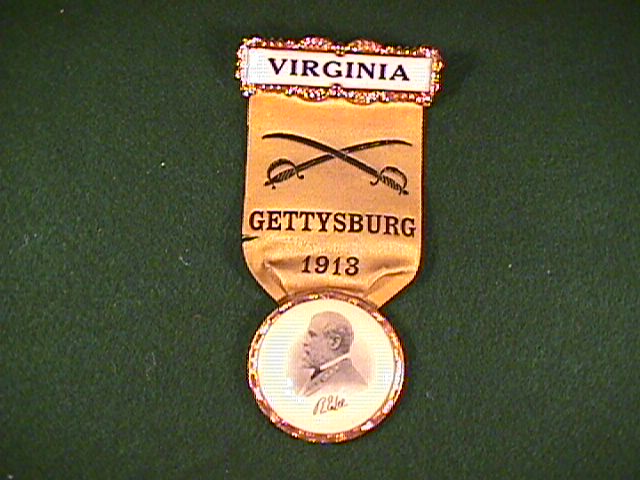
 Three unidentified Confederate veterans at the Gettysburg reunion, 1913. The event, held between June 29 and July 4, 1913, the 50th anniversary of the battle, was the largest Civil War reunion ever held, with over 50,000 veterans in attendance. These three unidentified Virginians were among the approximately 8,750 former Confederates at the event. Each wears a ribbon (long, with fringed end) marked “R. E. Lee Camp / No. 3 / Hampton, Va.” Each also wears a reunion badge similar to this one, though possibly with stacked rifles in place of the cavalry’s crossed sabres. The man at center, directly facing the camera, wears a single metallic bar on each collar, while the one at right wears two stars. These correspond, respectively, to Confederate officer ranks of Second Lieutenant and Lieutenant Colonel; do these indicate wartime ranks, or perhaps posts within the UCV? I don’t know. The two men at right also appear to wear the Southern Cross of Honor on their lapels, presented to veterans by the UDC. Photo by Harris & Ewing, via Library of Congress.
_____________

Hey, I Know that Guy. . . .
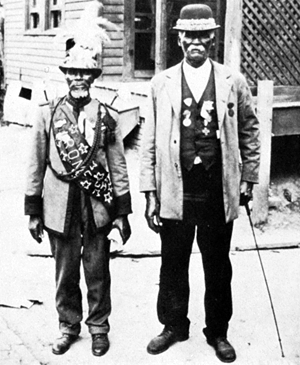 While looking for something else, I came across this photo of Steve Perry, a.k.a. “Uncle Steve Eberhart,” and another, unidentified man at a Confederate reunion in Houston, Texas. The image is undated, but I believe it to be from the time of the big United Confederate Veterans reunion at Houston in October 1920. Although Perry appeared as “Uncle Steve Eberhart” at reunion activities for more than 20 years, his costume here closely matches that worn in photographs of him like this one, appearing in a 1922 history of Rome and Floyd County, Georgia. In that book, Perry is quoted as saying about the 1920 Houston reunion,
I want to thank the good white people of Rome for sending me to Texas to the Old Soldiers’ Reunion. I am thankful. I shall ever remain in my place, and be obedient to all the white people. I pray that the angels may guard the homes of all Rome, and the light of God shine upon them. I will now give you a rest until the reunion next year, if the Lord lets me live to see it. Your humble servant. Steve Eberhart.
As I’ve said before, such framing is painful to modern ears, but it reflects the difficult line African Americans had to tread not so many generations ago. It makes clear how these men, even as they swapped old tales and enjoyed themselves with the white veterans, were also expected to reinforce specific, stereotyped roles of African Americans in the Jim Crow South — obsequious, grateful, and non-threatening to the status quo antebellum. It’s a difficult, multi-layered dynamic that defies simple tropes of egalitarian patriotism.
_______________
Image credited to Houston Metropolitan Research Center, Houston Public Library.





 Dead Confederates, A Civil War Era Blog



leave a comment