Kerosene Billy in Fact and Fiction
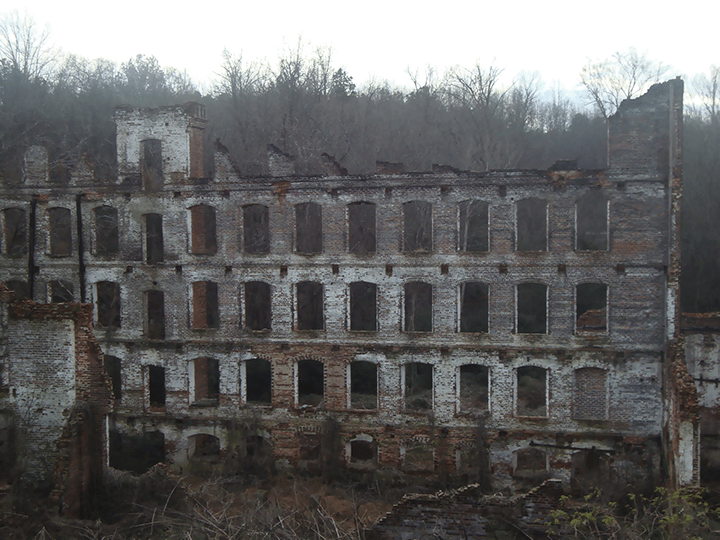

This image, posted recently at SHPG, caught my eye, particularly given its description:

It’s a dramatic and potent symbol of the ravages of the war on the South. Or it would be, if it were true.
The ruins in question are those of the Great Falls Cotton Mill in Rockingham, built in 1869, that were destroyed in a fire in October 1972. It’s a well-known local landmark, and is even included in the Historic American Buildings Survey. As near as I can tell, Uncle Billy’s bummers were not suspected in the 1972 conflagration.
Now, there was a large mill on (or near) this site that was reportedly burned by Sherman’s troops, but this one ain’t it, and ninety seconds with “teh Google” would have made that clear. This misattribution is not a huge, hairy deal, but is it too much to ask for folks to expend a little effort — just a little — in getting this stuff right?
__________

Free Access to Confederate Records on Fold3 in April
 The commercial subscription service, Fold3, is providing free access to Confederate records for the month of April in recognition of Confederate History Month. It’s a good opportunity to become familiar with the resources available, particularly compiled service records (CSRs) of individual soldiers. Have at it.
________
How Crowded Was Monitor‘s Turret?
Very.
Samuel Dana Greene’s account of the action with C.S.S. Virginia gives the following description:
It’s not clear to me whether the two gun captains, Stocking and Loughran, were being counted by Greene as part of the eight men assigned to their respective guns, so the total number in the turret during the action was either nineteen or twenty-one. To get a visual sense of what that looked like, I dropped nineteen figures into a model of Monitor‘s turret. This is the result:
![[IMG]](https://i0.wp.com/farm9.staticflickr.com/8264/8612835528_d4dd68fb14_b.jpg)
![[IMG]](https://i0.wp.com/farm9.staticflickr.com/8544/8611730013_b6a0e89361_b.jpg)
![[IMG]](https://i0.wp.com/farm9.staticflickr.com/8397/8611730149_e7229435a7_b.jpg)
This model doesn’t include any of the other necessary gear that would have been inside the turret, and there was additional plating on the interior surface of the turret (over the joints in the primary plating) that’s not reflected in the model. (Haven’t got to it yet.) So in reality, it was likely more cramped than shown in the model. I haven’t made any particular attempt to put crewmen in exact gun drill positions, either. Also note that the heavy, iron pendula that closed the gunports could not be opened simultaneously — there was too little space between the ports for both to swing clear toward the centerline at the same time. In practice, you would not see both guns run out at the same time.
Nonetheless, a very crowded and chaotic place.
Previous, incomplete renders of this structure are on Flickr, although those show the two hatches on the top of the turret incorrectly — the slid backwards, not inboard as specified on Eriocsson’s original plan.
________

Confederate Flag Cases at the Fourth Circuit
Quick updates on two Confederate flag cases covered previously here:
 The United States Court of Appeals for the Fourth Circuit in Richmond declined to reinstate the case of Candice Hardwick of Latta, South Carolina, who was twice suspended from school for wearing a Confederate flag t-shirt back in 2006. The case was dismissed by a (federal?) court in South Carolina in 2009, and subsequently reinstated. She initially lost her case in 2010, and the case was dismissed again just about exactly a year ago. Federal case law, particularly in the wake of Morse v. Frederick (the infamous 2007 “Bong Hits 4 Jesus” case), gives school administrators very wide latitude in restricting student speech. Lots of folks across the political spectrum have deep reservations about the Supremes’ ruling in Morse, but that’s where we are right now.
That same Fourth Circuit recently rescheduled a hearing to reinstate the SCV’s lawsuit against the City of Lexington over its 2011 ordinance barring all but official, government flags from its light poles and other public fixtures. The hearing was originally scheduled for March 20, but at the last minute the court pushed it back to May 15. The change was not requested by either party. The U.S. District Court had dismissed the case last June, calling the ordinance on its face to be “reasonable, nondiscriminatory, [and] content-neutral.” If the plaintiff, the SCV’s Stonewall Brigade, wins reinstatement of the case, it will presumably go back for trial to the same district court that dismissed it in the first place.
The United States Court of Appeals for the Fourth Circuit in Richmond declined to reinstate the case of Candice Hardwick of Latta, South Carolina, who was twice suspended from school for wearing a Confederate flag t-shirt back in 2006. The case was dismissed by a (federal?) court in South Carolina in 2009, and subsequently reinstated. She initially lost her case in 2010, and the case was dismissed again just about exactly a year ago. Federal case law, particularly in the wake of Morse v. Frederick (the infamous 2007 “Bong Hits 4 Jesus” case), gives school administrators very wide latitude in restricting student speech. Lots of folks across the political spectrum have deep reservations about the Supremes’ ruling in Morse, but that’s where we are right now.
That same Fourth Circuit recently rescheduled a hearing to reinstate the SCV’s lawsuit against the City of Lexington over its 2011 ordinance barring all but official, government flags from its light poles and other public fixtures. The hearing was originally scheduled for March 20, but at the last minute the court pushed it back to May 15. The change was not requested by either party. The U.S. District Court had dismissed the case last June, calling the ordinance on its face to be “reasonable, nondiscriminatory, [and] content-neutral.” If the plaintiff, the SCV’s Stonewall Brigade, wins reinstatement of the case, it will presumably go back for trial to the same district court that dismissed it in the first place.
Update, March 28: This story from the Courthouse News Service provides much more background on the Candice Hardwick case than I’ve seen in other news reports. Disputes with the school over her flag attire go back to early 2003, at least three years before the suspension that resulted in the lawsuit, when she insisted on wearing a “Southern Chicks” shirt with a Confederate Battle Flag. In middle school. Subsequent attire included the legends, “Offended by School Censorship of Southern Heritage,” “Daddy’s Little Redneck,” “Jesus and the Confederate Battle Flag: Banned from Our Schools, but Forever in Our Hearts,” a black Confederates shirt, and one with a picture of the U.S. flag with the caption, “Flew over legalized slavery for 90 years!” This is less a case of a naive kid wanting to honor her ancestors, than a deliberate and years-long intent to force a showdown. And she got it.
__________
Aye Candy: The Confederate Ironclad That Almost Was
![[IMG]](https://i0.wp.com/farm9.staticflickr.com/8524/8587301585_4855a4e2ec_b.jpg)
This model of the Confederate casemate ironclad Wilmington is based on reconstruction plans drawn in the 1960s by W. E. Geoghagen, a maritime specialist at the Smithsonian Institution. Geoghagen’s drawings, in turn, are based on surviving plans prepared by the Confederate Navy’s Chief Constructor, John L. Porter (1813-1893). Full-size images are available on Flickr.
Wilmington was the last of three ironclads built at her namesake city during the Civil War. Neither of the first two had accomplished much during its service. The first, North Carolina, was structurally unsound and, like many of her type, was woefully underpowered. North Carolina was used in the brackish Cape Fear River as a floating battery until she sank at her moorings in September 1864, her bottom eaten through by teredo. The second ironclad, Raleigh, had been completed in the spring of 1864 and sortied to attack the Union blockading fleet off Fort Fisher. Raleigh managed to drive off several blockaders but upon her return upriver grounded on a sandbar and broke her keel, effectively making her a total loss.
Construction on the new ironclad began soon after Raleigh’s loss, in the late spring of 1864. In designing the vessel, Porter sought to remedy two serious flaws exposed by Raleigh’s brief sortie against the Union fleet: first, that she lacked sufficient speed to close the range and force a fight, and second, that she drew too much water to safely operate in the Cape Fear estuary.
Porter’s design is almost unique among Confederate ironclads, with a long length-to-beam ration of more than 6.5-to-1, perhaps in imitation of the long, fast blockade runners that operated between Wilmington, Bermuda and Nassau. The new ship, dubbed by locals as the future C.S.S. Wilmington, was unusual above deck, too. While almost all Confederate ironclads built or planned for construction in the Confederacy during the war followed the pattern set in 1862 by the famous C.S.S. Virginia (ex-U.S.S. Merrimack), by using a single, large armored casemate to house the ship’s battery, the vessel being built at Wilmington would have two small, low, casemates, each with a single, heavy gun working on a pivot on the inside. Each miniature casemate was fitted with seven ports, 45 degrees apart, giving the guns a wide (if narrowly segmented) field of fire. While the Confederacy lacked the resources to construct a revolving turret like those fitted on the Union Navy’s monitors, Porter’s design was a serious attempt to replicate the monitors’ greatest tactical advantages: all-around fire by a few, very heavy guns, and presenting the enemy’s gunners with a very small target. She is somewhat unusual for Confederate ironclads in that she was not built to be fitted with a ram.

Unfortunately, Wilmington never saw action, and was never formally commissioned. (Nor was the vessel ever officially named Wilmington; that’s what the locals called her.) She was still on the stocks, nearing completion, when the city of Wilmington was evacuated. This vessel, representing perhaps the most advanced design of ironclad built in the Confederacy during the war, was put to the torch to keep her from falling into the hands of Union troops.
Because Wilmington was never completed, we cannot know exactly how she would have appeared in service. Bob Holcombe, in his masters thesis “The Evolution of Confederate Ironclad Design” (East Carolina University 1993), notes that 150 tons of one-inch plate taken from the decrepit old North Carolina might have been intended for Wilmington’s open deck. In recreating the ship, I’ve left the deck unarmored, but I did put plating over the timbered knuckle that extends outboard on either side of the ship. This model represents a “what if” depiction of the ship as she might have looked if she’d been completed and fully commissioned, sometime in the summer of 1865. I don’t think this ship (or several of them) would’ve changed the overall equation at Wilmington and Fort Fisher, but it’s intriguing to imagine how she would have performed in action. With the right engines (probably a practical impossibility in that time and place) she might have been a real menace to the blockaders as a hit-and-run raider.
Special thanks to Kazimierz Zygadlo for his assistance in compiling material on this remarkable warship-that-almost-was.
![[IMG]](https://i0.wp.com/farm9.staticflickr.com/8527/8587301749_8f582fa25a_b.jpg)
![[IMG]](https://i0.wp.com/farm9.staticflickr.com/8531/8588402400_5988740d2c_b.jpg) Alongside the Union river monitor U.S.S. Onondaga, for comparison.
Alongside the Union river monitor U.S.S. Onondaga, for comparison.
![[IMG]](https://i0.wp.com/farm9.staticflickr.com/8227/8587302463_82a66cae63_b.jpg)
![[IMG]](https://i0.wp.com/farm9.staticflickr.com/8105/8587302829_850ca88059_b.jpg)
![[IMG]](https://i0.wp.com/farm9.staticflickr.com/8505/8588403410_51cb1d9769_b.jpg)
![[IMG]](https://i0.wp.com/farm9.staticflickr.com/8531/8588403814_02fd6edeef_b.jpg)
________________

Privates Wyatt and John W. Vaughan, Texas State Troops

A brief ceremony was held on Saturday morning in Galveston to recognize the memory of two Confederate soldiers who died here 149 years ago this month. Privates Wyatt and John Vaughan were father and son, respectively, serving with a regiment of state troops stationed here during the latter part of the war. Both contract typhoid fever. Eighteen-year-old John died on March 25, 1864; his 44-year-old father died three days later. Both were buried in graves in the city’s old potter’s field, which lies about 100 yards west of the site of today’s ceremony.
The old UCV plot where the Vaughans’ memorial stones were placed today contains several modern stones, but as far as I know none of the men so memorialized are actually interred there. At least one, H. R. Ostermeyer, survived the war, only to die in the hurricane that swept Galveston in September 1900.
Today’s service was sponsored by the Veuve Jefferson Davis Chapter No. 7 of the UDC, with support and assistance by the John Bell Hood Camp of the SCV, which also provided the color guard. Several Vaughan descendants attended the event.


____________
Aye Candy: C.S.S. Virginia

Updated renders of C.S.S. Virginia (formerly U.S.S. Merrimack), showing revisions done last year for an illustration in the Civil War Monitor magazine. Special thanks to Anna Holloway of the Mariners Museum for providing guidance on the model. Full-sized renders on Flickr.


____________
Sabine Pass Update
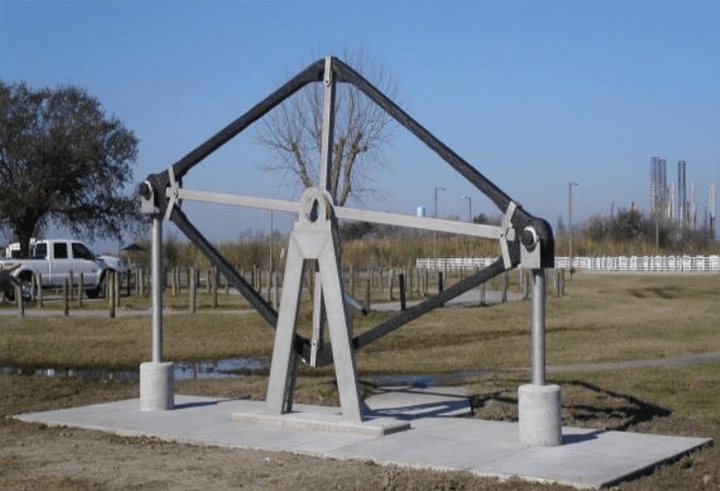
My colleague Ed Cotham shares the latest issue of the Sabine Pass Beacon (PDF), the newsletter of the Friends of Sabine Pass Battleground. This issue includes important information about sesquicentennial events planned for September, and the recent installation at the park of the walking beam (above) from the Union gunboat U.S.S. Clifton.
____________
So Much for “Boot Elrod” and the Lexington Boycott
Not sure how I missed this, but Lexington Mayor Mimi Elrod was re-elected to another four-year term last November with a vigorous 63% of the vote. That was Elrod’s second electoral win against her opponent, Council Member Mary Harvey-Halseth, whom she defeated for mayor in 2008, with 59%. (Harvey-Halseth’s term on council is staggered with the mayor’s, so she retains her council seat.) Harvey-Halseth voted against the ordinance barring non-governmental flags on city-owned poles back in 2011, but I don’t get the impression that the dispute over the Confederate flag played much of a role in the 2012 mayoral race. There seems to be much more focus on efforts to revitalize the downtown area of Lexington.
 “Boot Elrod” has been a watchword of the Flaggers practically since the flag ordinance was passed in 2011; even then, a change in the composition of the city government offered the best hope for reversing the ordinance. A court challenge has always been a long shot, as Susan Hathaway acknowledged at the time. But I’ve never been convinced that the ordinance has been a particularly important issue for more than a handful of Lexingtonians, and the results of November’s city election there seem to bear that out.
After the election, Billy Bearden complained that the “Boot Elrod Campaign so gloriously began was allowed to die an inglorious death by the people in and around Lexington that should have kept it alive.” My guess is that “the people in and around Lexington,” as a whole, aren’t nearly so torqued about Confederate flags as Bearden, Hathaway and others think they ought to be. The make-believe Confederates should know better; the News-Gazette noted at the time of the ordinance vote that opposition to it came overwhelmingly from people — like Bearden, Hathaway, and peripatetic Confederate beard H. K. Edgerton — who don’t actually live in Lexington:
One factor in Elrod’s re-election may be that things are looking up economically in Lexington, as in most other parts of the country. Unemployment remains high compared to the state and national averages, at 9.8% in December 2012, but still lower than at the time of the ordinance in September 2011 (11.3%), and well below its Great Recession peak of 14.0% in June 2010.
By contrast, the Flaggers have been working against economic recovery in Lexington, in a way that undoubtedly caught the attention of many residents. Along with the “Boot Elrod” campaign, Hathaway, Bearden, and folks like local SCV leader Brandon Dorsey have been pushing a campaign to boycott Lexington businesses, in the hopes of pressuring them to get the city council to reverse its position. That effort, too, appears to have accomplished little or nothing. The City of Lexington recently released its financial report for FY 2012, covering the period from July 1, 2011 to June 30, 2012, ten months of which fell after the adoption of the flag ordinance and during the period of the boycott. In the three categories of city revenue that directly reflect business activity and tourism — sales taxes, restaurant taxes and hotel/motel taxes — revenues all increased:
From the City of Lexington’s Comprehensive Annual Financial Report for FY2011, p. 32:

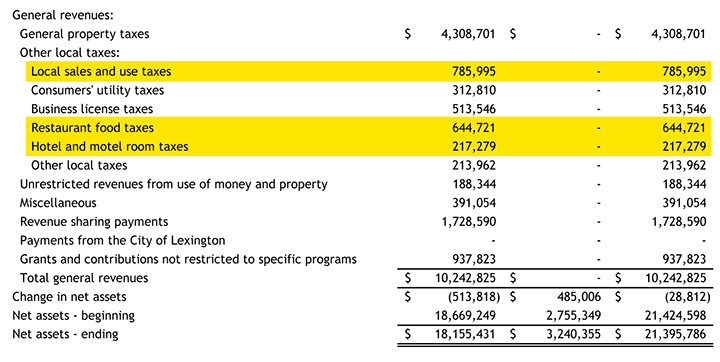
And from the Comprehensive Annual Financial Report for FY2012, p. 32:

And in summary:

Last month I contacted Lexington’s Director of Finance, who confirmed that the rates in these categories did not change from FY2011 to FY2012, meaning that these numbers reflect an actual increase in relevant business activity. These are strong numbers — substantially stronger than current national GDP, which is dragging along at an anemic 2% annual growth rate. Business in Lexington is looking up. To be sure, not every business in Lexington is doing well — some businesses will go bust, even in boom years — but overall, local business activity in Lexington is trending up, not down.
The Flaggers aren’t likely to give up their boycott or the campaign to “Boot Elrod” anytime soon, and that’s their prerogative. But it’s hard to see any substantive effect of either initiative, any more than they’ve restored the flags to the exterior of the Pelham Chapel. They’ll continue to stir the pot — “Are YOU mad enough yet? RISE UP, VIRGINIA!”, etc., etc. — and keep the faith.
After all, November 2016 is just around the corner!
___________
UPDATE, March 20: I almost forgot — a big thank-you goes out to Billy Bearden, who was the first to point me to the city’s annual financial report as a source of economic data for Lexington. Couldn’t have done this post without you, my friend!
___________
Aye Candy: C.S.S. Manassas
![[IMG]](https://i0.wp.com/farm9.staticflickr.com/8236/8565080381_49db1dc5fb_b.jpg)
Everybody knows about the famous Confederate ironclad Virginia, even if they insist on calling the vessel by its previous name, Merrimack. But there was an earlier Confederate ironclad, that went into action in the defense of New Orleans in the fall of 1861, almost five months before Virginia steamed out of Norfolk to attack the Union fleet anchored in Hampton Roads.
C.S.S. Manassas was originally conceived as a privateer, a privately-owned vessel that, holding a commission from the national government, would be formally authorized to attack (and hopefully capture) enemy shipping. Like Virginia, Manassas was built up from the hull of an existing vessel, in this case the twin-screw steamer Enoch Train. Soon after her completion in the fall of 1861, Manassas was taken over by local military authorities for use in the defense of New Orleans and the mouth of the Mississippi. In October 1861, Manassas participated in a surprise attack on the Federal fleet at the Head of the Passes. The ironclad was seriously damaged in that fight, losing her iron ram, chimneys and having one of her engines knocked off its mount. Under the command of A. F. Warley, however, Manasssas managed to withdraw successfully. The vessel was soon thereafter directly purchased by the Confederate government, and formally commissioned as a C.S. warship.
Manassas went into action again in April 1862, when the Union Admiral Farragut ran his fleet past Forts Jackson and St. Philip. Manassas was in the thick of the action, successfully striking both U.S.S. Mississippi and U.S.S. Brooklyn. A the Union fleet continued upstream, Manassas followed, until Mississippi came about and charged the ironclad. Lt. Warley avoided a collision, but grounded his ironclad on the bank in the process, where she was pounded by Mississippi‘s broadside. Manassas eventually slipped off the bank and drifted downstream, on fire, until the flames reached her magazine. The explosion completely wrecked the vessel.
____________

There are many modern illustrations and models depicting C.S.S. Manassas, and they vary considerably. Many appear to be based on a 1904 drawing by R. G. Skerrett (above), that was used in the ORN. Although Skerrett was a skilled artist who brought much of the Civil War at sea alive with his artwork, he’s most reliable when working directly from photographs or other contemporary sources. In the case of ships for which he had no detailed contemporary image sources to work from (e.g., U.S.S. Westfield), he’s less reliable. In the case of Manasssas, Skerrett’s drawing seems to make the vessel too small overall, with a tiny pop-gun mounted in her bow. Sources conflict on exactly what type of gun Manassas carried — and she may well have been fitted with different pieces at different times in her short career — but generally they agree that the piece was at minimum a 32-pounder, not an insignificant piece, especially at short range.
![[IMG]](https://deadconfederates.com/wp-content/uploads/2013/03/manassas11jp.jpg?w=614&h=382)
Several contemporary sources suggest, for example, that the ironclad had two chimneys, arranged side-by-side like contemporary river steamers. South Carolina digital artist Dan Dowdey, for example, used this arrangement in his recreation of Manassas (above). I like Dowdey’s work generally, and particularly his envisioning of Manassas, with the additional nautical bits (e.g., actual bitts) that aren’t mentioned in most accounts, but are necessary to make the real vessel functional.
A colleague recently shared with me reconstruction drawings of C.S.S. Manassas prepared by W. E. Geoghagen in the mid-1960s. Geoghagen was a maritime specialist with the Smithsonian Institution, working with Howard Chapelle, the dean of historic American naval architecture. Geoghagen was also working in that period with Ed Bearss and the National Park Service on the U.S.S. Cairo recovery and reconstruction. I don’t know what sources Geoghagen used for reconstructing the upperworks of the C.S.S. Manassas, but the lower hull of the vessel he drew does conform to the known dimensions of Enoch Train, 128 feet between perpendiculars, and 26 feet in beam. Geoghagen’s drawing depicts a single, thick chimney very similar to Skerrett’s, but with a pronounced rake; I’ve chosen to go with two chimneys, with minor alterations of the topside openings necessary to accommodate them.
But enough prattle. Here’s the pics. Full-size versions available on Flickr:
![[IMG]](https://i0.wp.com/farm9.staticflickr.com/8378/8565079291_36619d97b7_b.jpg)
![[IMG]](https://i0.wp.com/farm9.staticflickr.com/8248/8566176320_38d0c23cdf_b.jpg)
![[IMG]](https://i0.wp.com/farm9.staticflickr.com/8107/8565079597_8efaf3f93f_b.jpg)
![[IMG]](https://i0.wp.com/farm9.staticflickr.com/8097/8565079851_462de62281_b.jpg)
![[IMG]](https://i0.wp.com/farm9.staticflickr.com/8532/8565080057_2d53f5c428_b.jpg)
![[IMG]](https://i0.wp.com/farm9.staticflickr.com/8390/8566177396_0744134797_b.jpg)
![[IMG]](https://i0.wp.com/farm9.staticflickr.com/8100/8565080821_77a2fea9dc_b.jpg)
![[IMG]](https://i0.wp.com/farm9.staticflickr.com/8532/8565081047_a3f90ef45c_b.jpg)
![[IMG]](https://i0.wp.com/farm9.staticflickr.com/8371/8565081307_474a01b975_b.jpg)
_________




 Dead Confederates, A Civil War Era Blog

32 comments