In Which I Make the Neoconfederates Cry
“Old Rebel,” writing at the League of the South’s Rebellion blog, highlights Dead Confederates along with Kevin’s Civil War Memory, Corey Meyer’s Blood of My Kindred and Edward Sebesta as “anti-Southern cyberstalkers” who hold a “seething hatred against an entire people and their culture” and who lead a “a shallow, unfulfilled life.”
These people remind me of the creepy serial killers from a Patricia Cornwell thriller. Cornwell’s villains can’t have meaningful human relationships, so they stalk and murder those who do. Young couples are the usual victims of these ghouls because the couples possess something the stalkers can’t have. My guess is that anti-Southern cyber-stalkers resent a living, vibrant culture with rich traditions and a sense of belonging and meaning that’s been denied them, so they snipe at those who do. If they can’t have cultural moorings, no one else can, either.
There’s no point in trying to refute this sort of name-calling, since there’s no actual substance to it. But I would like to make a few points of my own.
- Getting denounced by the official blog of the League of the South after being online for only nine days is indescribably awesome.
- That my dinky little blog should be mentioned in the same breath as Kevin’s, Corey’s and Ed Sebesta’s work is just staggering. I am genuinely humbled.
- Getting linked by the League of the South’s blog has really bounced my web traffic over the last couple of days — Dead Confederates isn’t exactly burnin’ up the Intertubes (yet), but I’m getting more referrals from Rebellion than from all other sources combined. Thanks, Old Rebel!
Kidding aside, Corey Meyer highlights a much more serious problem, one that speaks to the lengths some people will go to denounce their detractors. Some time back, Corey sent the Rebellion blog a photo he’d found online of someone wiping a commode with a Confederate Battle Flag. Snarky? Yep. And in retrospect, probably not a good idea, because instead of ignoring it — which Old Rebel argues that “that’s what the “Delete” key is for” — it seems Old Rebel or one of his/her confederates subsequently Photoshopped a p*rn magazine into the picture, and is now distributing the altered image as actually having originated with Corey.
This is dishonest. This is lying.
Old Rebel — who unlike Corey, Kevin, Ed Sebesta and me, seems unwilling to blog under his or her real name — and the League of the South are welcome to their views, both of current politics and historical events. They’re welcome to express those views, and have proved to be passionate and energetic in doing so. But neither they nor anyone else has the right to use this sort of dishonest, childish and shameful tactic to smear those they perceive as their opponents. In doing so, they forfeit the right to be taken seriously, about this or anything else.
Bobby Lee Has Left the Building. . . .
The Associated Press asks its readers to be on the lookout for a figure of the general that was stolen — 35 years ago:
A bronze statue of the Confederate general was taken from the grounds of Midland Lee High in 1975, a decade after the class of 1965 gave the statue to the school.
With Midland Lee’s 50th anniversary approaching later this year, an event organizer hopes someone will return the statue. Maridell Fryar told the Odessa American that no one would be prosecuted; the statute of limitations on the theft has run out.
She says the statue swiping may have started a prank. She [is] hoping someone from the West Texas community will offer information that might recover the stolen Lee in time for the anniversary celebrations.
Just a little prank, right? Sure, it’s all fun and games until someone loses an eye a statue.
Fun Fact: The Associated Press was organized in 1846 by five New York dailies to share the cost of reporting on the Mexican War.
“I’m a Son of Confederate Veterans as well as a son of slavery.”
Cary Clack, a columnist for San Antonio Life and a descendant of both a Confederate cavalry officer and a slave, attends an SCV meeting and finds it to be an odd, but not-entirely-unpleasant experience:
I’d written a column sarcastically dismissive of Virginia Gov. Bob McDonnell and Texas Gov. Rick Perry. While proclaiming my pride in being a child of the South and Southwest, I took issue with McDonnell’s initial declaration of Confederate History Month — on behalf of the Sons of Confederate Veterans — which ignored slavery, and with Perry’s earlier suggestion of secession.
The Heritage of Honor page on the SCV website didn’t mention the word “slavery” either, but I saw that membership is open to “all male descendants of any veteran who served honorably in the Confederate armed services” and that I qualified.
I wrote, “I’m a Son of Confederate Veterans as well as a son of slavery” and expected an application.
I got one, as well as an invitation to attend the May meeting, from Russ Lane, the affable head of Alamo Camp #1325. I never doubted I’d go, just as I never doubted I would be treated kindly.
Including wives, there were about 30 people in the meeting that began with “the Pledge of Allegiance” to “the United States of America,” which heartened me to know I wasn’t in the presence of secessionists.
Mr. Clack’s take on the encounter is interesting, and doesn’t easily fit into preconceived notions. It’s complicated, that’s for sure, and I hope he continues to write on this particular journey of his. It’s challenging enough thinking about one’s Confederate ancestors, who marched and fought and sometimes died in the uniform of a nation established to preserve and expand the institution of slavery; I can’t even imagine how to begin approaching the knowledge that one of your ancestors considered another to be his personal property.
But Aren’t They All Dead?
Cousin Katie‘s gonna haunt me for being flip about Confederate widows.
The new 2010 Texas GOP platform calls for (PDF, p. 6), among other things, “restoration of plaques honoring the Confederate Widow’s Pension Fund contribution that were removed from the Texas Supreme Court building.” That short sentence, of course, leaves out an embarrassing part of the backstory, and lies about another, much more important fact. First, the plaques were removed in 2000 by order of then-Governor George W. Bush, who is widely reported to be a Republican himself, and second, the bronze plaques do not “honor the Confederate Widow’s Pension Fund.” They are actually paeans to the Confederacy and Texas’s role in it, complete with the Confederate Battle Flag and national seal. They have nothing to do with Confederate widows; they’re classic Lost Cause memorials.
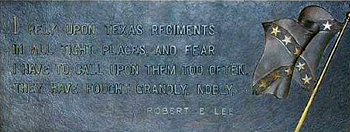
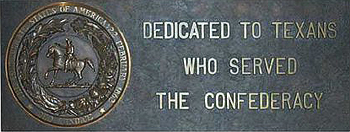
I honestly was, and still am, conflicted about the removal of these plaques a decade ago. They’re offensive to many Texans, but I also dislike the idea of removing established monuments, even when they reflect sentiments that are badly, badly out of touch with current values and history. (Better, I think, to acknowledge that they are themselves artifacts of their time, and interpret them in that way in situ.) I also understand that these were located in not just a public building, but in the state friggin’ Supreme Court — you know, where all people are equal in the eyes of the law, and so on. That latter point, I think, raises the stakes in this dispute for all sides.
I would almost certainly be against the original removal of these plaques had they been as represented by the Texas GOP — “honoring the Confederate Widow’s Pension Fund contribution.” But that’s not what they are. They’re definitely better gone, and placed in a state history museum where they can be both preserved and interpreted as artifacts of their day. As it happens, there’s a pretty good one just up the street. But the question is no longer whether they should stay; the question is, should they be brought back?
And the answer is, “no.” Let them go, folks — we’ve all got more important things to deal with.
Bonus Fun Fact: The Texas Supreme Court Building is so fugly that the Texas Supreme Court Historical Society uses a picture of the Capitol on its website.
Not for Megan Fox, Not Even for the CGI Ironclad. . . .
I do like those double, horse-mounted Gatling guns, though. Anybody know if Dixie Gun Works will be carrying them? H/t Blood of My Kindred.
“America’s most persecuted minority”
African Americans? Muslims? LGBT folks? Nope, nope and nope.
Confederates.
Seriously.
Kevin Levin over at Civil War Memory highlights North Texas, where the Sons of Confederate Veterans has opened a summer camp for youth ages 12-20.
This summer, you can help turn the tide. For one week, our Southern young men and ladies (ages 12-20) will gather to hear the truths about the War for Southern Independence. This camp (named for the great young Confederate Sam Davis) will combine fun and recreation with thoughtful instruction in Southern history, the War Between the States, the theology of the South during the War, lessons on Southern heroes, examples of great men of the Faith, and for the first year, special programs and sessions for our Southern ladies!
In addition to conventional summer camp activities like riding horses, firing percussion-cap muskets and shooting off field artillery, campers will take classes in “The Theology of the South During the War” and “Lessons on Southern Heroes.” A key theme, according to SCV Texas Division Commander Ray W. James, is the belief that
the Civil War was not about slavery, James said. Too many people have bought into that notion, he said, and wrongly exalt then-President Abraham Lincoln as wanting to end slavery.
Lincoln was “a bigger racist than I ever knew,” James said.
Naturally, one of the instructors is the Odious Kirk Lyons.
The Southern Poverty Law Center describes him as a “darling of the neo-Confederate world,” in part because of his work as an attorney representing white supremacists.
Lyons’ current job is chief trial counsel for the Southern Legal Resource Center. The North Carolina-based group says it exists to preserve the “dwindling rights” of the Confederate community, referring to it as “America’s most persecuted minority.”
One of Lyons’ latest efforts was to urge people to answer the race question on the U.S. Census by writing in that they are “Confederate Southern American.” It was part of a larger push by his center to have Confederate descendants recognized as an ethnic minority.
Lyons is also infamous for his marriage to the daughter of a top Aryan Nations official, [the SPLC’s Heidi] Beirich said. The ceremony was held at an Aryan Nations church and was officiated by its longtime leader.
“I think it’s concerning to have extremists like Kirk Lyons teaching kids the South was right,” Beirich said.
James responded by saying Lyons’ “baggage is a problem” but that it’s unfair to cast him as a racist.
Thanks for clearing up that it’s “unfair” to characterize someone, based on a mere twenty-five years of their public, professional conduct and close personal associations.
For myself, I’m just glad to know that Lyons, with whom I share a vague physical resemblance, is only carrying the ‘stache these days. Looks like I’ll be keeping the beard a while longer.
Update: Nat Turner’s Son provides a link to a camp photo album. This one made me shoot Diet Coke out through my nostrils.
I Was Praying for Intermission, Myself

It doesn’t really bother me so much that the 2003 film Gods and Generals portrays Stonewall Jackson as a bit of a hyper-religious crank because, you know, he was.
What bothers me is that the film portrays this as a good thing.
“What? What? This isn’t in the program!”
Rusty Williams, author of “My Old Confederate Home,” gets invited to be the speaker at a Confederate memorial service:
Traditionally, these ceremonies surrounded a lengthy Lost Cause oration, a passionate and animated stem-winder that spoke of the valor of the Confederate soldiers, the constancy of their devotion to the Lost Cause, their patriotism, and their desire for reconciliation. A first-rate orator had lungs like saddlebags, a diaphragm as solid as a manhole cover, and vocal cords more resilient than piano wire. When he chose to turn on the charm, it flowed in irresistible waves; when he intended pathos, women sobbed and men reached for handkerchiefs.
Instead, all they got was me.
I was the keynote speaker for the memorial ceremony, and there was a noticeable lack of oratorical flourish or expertise. (About the only audience response was when a lady keeled over from heatstroke and had to be carried away by paramedics. My father-in-law said he wished he’d thought of it first.)
It’s nice to think that the good folks of Pewee Valley, Kentucky got a good dose of actual historical content rather than the tearful paeans to Lost Cause mythology that are standard fare at such events.
No word if the Black Rose reenactors were there.
Juneteenth, Historicity and Tradition
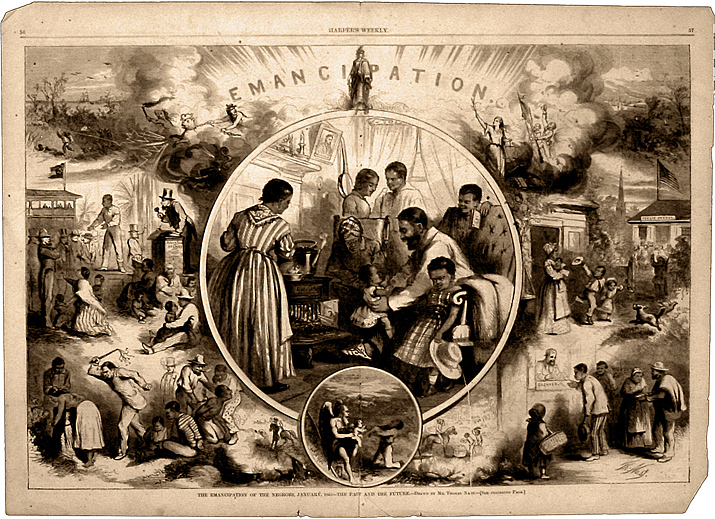
“Emancipation” by Thomas Nast. Ohio State University.
Juneteenth has come again, and (quite rightly) the Galveston County Daily News, the paper that first published General Granger’s order that forms the basis for the holiday, has again called for the day to be recognized as a national holiday:
Those who are lobbying for a national holiday are not asking for a paid day off. They are asking for a commemorative day, like Flag Day on June 14 or Patriot Day on Sept. 11. All that would take is a presidential proclamation. Both the U.S. House and Senate have endorsed the idea.
Why is a national celebration for an event that occurred in Galveston and originally affected only those in a single state such a good idea?
Because Juneteenth has become a symbol of the end of slavery. No matter how much we may regret the tragedy of slavery and wish it weren’t a part of this nation’s story, it is. Denying the truth about the past is always unwise.
For those who don’t know, Juneteenth started in Galveston. On Jan. 1, 1863, the Emancipation Proclamation was issued. But the order was meaningless until it could be enforced. It wasn’t until June 19, 1865 — after the Confederacy had been defeated and Union troops landed in Galveston — that the slaves in Texas were told they were free.
People all across the country get this story. That’s why Juneteenth celebrations have been growing all across the country. The celebration started in Galveston. But its significance has come to be understood far, far beyond the island, and far beyond Texas.
This is exactly right. Juneteenth is not just of relevance to African Americans or Texans, but for all who ascribe to the values of liberty and civic participation in this country. A victory for civil rights for any group is a victory for us all, and there is none bigger in this nation’s history than that transformation represented by Juneteenth.
But as widespread as Juneteenth celebrations have become — I was pleased and surprised, some years ago, to see Juneteenth celebration flyers pasted up in Minnesota — there’s an awful lot of confusion and misinformation about the specific events here, in Galveston, in June 1865 that gave birth to the holiday. The best published account of the period appears in Edward T. Cotham’s Battle on the Bay: The Civil War Struggle for Galveston, from which much of what follows is abstracted.
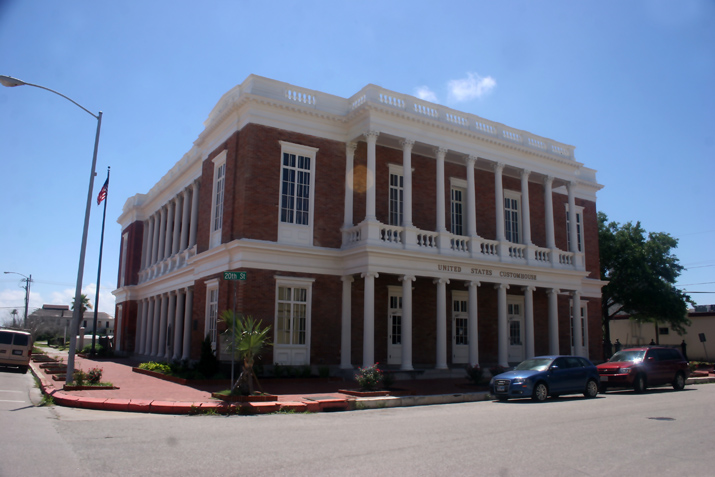
The United States Customs House, Galveston.
On June 5, Captain B. F. Sands entered Galveston harbor with the Union naval vessels Cornubia and Preston. Sands went ashore with a detachment and raised the United States flag over the federal customs house for about half an hour. Sands made a few comments to the largely silent crowd, saying that he saw this event as the closing chapter of the rebellion, and assuring the local citizens that he had only worn a sidearm that day as a gesture of respect for the mayor of the city.

Site of General Granger’s headquarters, southwest corner of 22nd Street and Strand.
A large number of Federal troops came ashore over the next two weeks, including detachments of the 76th Illinois Infantry. Union General Gordon Granger, newly-appointed as military governor for Texas, arrived on June 18, and established his headquarters in Osterman Building (now gone) on the southwest corner of 22nd and Strand. The provost marshal, which acted largely as a military police force, set up in the Customs House. The next day, June 19, a Monday, Granger issued five general orders, establishing his authority over the rest of Texas and laying out the initial priorities of his administration. General Orders Nos. 1 and 2 asserted Granger’s authority over all Federal forces in Texas, and named the key department heads in his administration of the state for various responsibilities. General Order No. 4 voided all actions of the Texas government during the rebellion, and asserted Federal control over all public assets within the state. General Order No. 5 established the Army’s Quartermaster Department as sole authorized buyer for cotton, until such time as Treasury agents could arrive and take over those responsibilities.
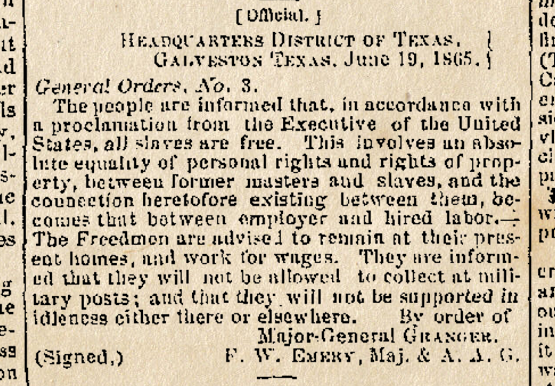
It is General Order No. 3, however, that is remembered today. It was short and direct:
Headquarters, District of Texas
Galveston, Texas, June 19, 1865General Orders, No. 3
The people are informed that, in accordance with a proclamation from the Executive of the United States, all slaves are free. This involves an absolute equality of personal rights and rights of property, between former masters and slaves, and the connection heretofore existing between them, becomes that between employer and hired labor. The Freedmen are advised to remain at their present homes, and work for wages. They are informed that they will not be allowed to collect at military posts; and that they will not be supported in idleness either there ro elsewhere.
By order of
Major-General Granger
F. W. Emery, Maj. & A. . G.
What’s less clear is how this order was disseminated. It’s likely that printed copies were put up in public places. It was published on June 21 in the Galveston Daily News, but otherwise it is not known if it was ever given a formal, public and ceremonial reading. Although the symbolic significance of General Order No. 3 cannot be overstated, its main legal purpose was to reaffirm what was well-established and widely known throughout the South, that with the occupation of Federal forces came the emancipation of all slaves within the region now coming under Union control.
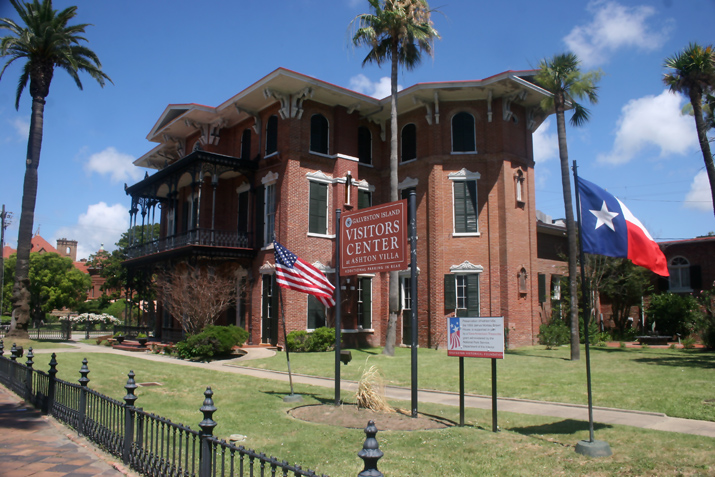
The James Moreau Brown residence, now known as Ashton Villa, at 24th & Broadway in Galveston. This site is well-established in local tradition as the site of the original Juneteenth proclamation, although direct evidence is lacking.
Local tradition has long held that General Granger took over James Moreau Brown’s home on Broadway, Ashton Villa, as a residence for himself and his staff. To my knowledge, there is no direct evidence for this. Along with this comes the tradition that the Ashton Villa was also the site where the Emancipation Proclamation was formally read out to the citizenry of Galveston. This belief has prevailed for many years, and is annually reinforced with events commemorating Juneteenth both at the site, and also citing the site. In years past, community groups have even staged “reenactments” of the reading of the Emancipation Proclamation from the second-floor balcony, something which must surely strain the limits of reasonable historical conjecture. As far as I know, the property’s operators, the Galveston Historical Foundation, have never taken an official stand on the interpretation that Juneteenth had its actual origins on the site. Although I myself have serious doubts about Ashton Villa having having any direct role in the original Juneteenth, I also appreciate that, as with the band playing “Nearer, My God, to Thee” as Titanic sank beneath the waves, arguing against this particular cherished belief is undoubtedly a losing battle.
Assuming that either the Emancipation Proclamation (or alternately, Granger’s brief General Order No. 3) was formally, ceremonially read out to the populace, where did it happen? Charles Waldo Hayes, writing several years after the war, says General Order No. 3 was “issued from [Granger’s] headquarters,” but that sounds like a figurative description rather than a literal one. My bet would not be Ashton Villa, but one of two other sites downtown already mentioned: the Osterman Building, where Granger’s headquarters was located and where the official business of the Federal occupation was done initially, or at the United States Customs House, which was the symbol of Federal property both in Galveston and the state as a whole, and (more important still) was the headquarters of Granger’s provost marshal, Lieutenant Colonel Rankin G. Laughlin of the 94th Illinois Infantry. It’s easy to imagine Lt. Col. Laughlin dragging a crate out onto the sidewalk in front of the Customs House and barking out a brief, and somewhat perfunctory, read-through of all five of the general’s orders in quick succession. No flags, no bands, and probably not much of a crowd to witness the event. My personal suspicion is that, were we to travel back to June 1865 and witness the origin of this most remarkable and uniquely-American holiday, we’d find ourselves very disappointed in how the actual events played out at the time.
Maybe the Ashton Villa tradition is preferable, after all.






 Dead Confederates, A Civil War Era Blog

6 comments