Deny, Deride, Deflect
My post yesterday about the doctored photograph purporting to show a Marine raising the Confederate Battle Flag on Okinawa was intended as a one-off – direct, self-contained, and not really necessitating a follow-up. But it turns out that it prompted a response that’s a near-perfect example of how the True Southrons™ insulate themselves from information that challenges their preferred notions.
A few hours after my post, this thread popped up on the Southern Heritage Preservation Group, one of the largest and oldest “heritage” forums on social media:

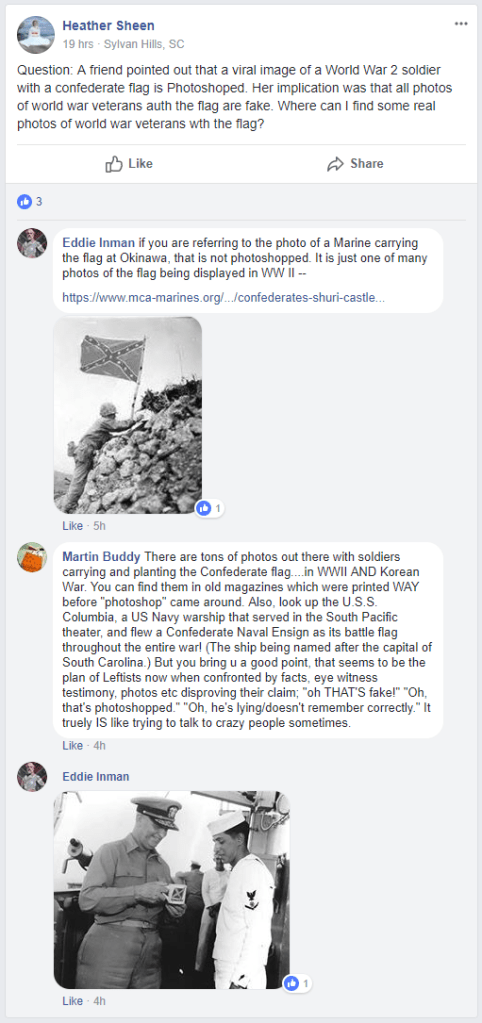
It follows a well-established pattern:
First, make a vague inquiry about the truth of a claim, that doesn’t cite the specific image challenged, doesn’t provide the detailed critiques made of it, and doesn’t include a link where others can review and assess it for themselves.
Second, make a flat assertion that the image is authentic, with a link to one of the many websites that feature it.
Third, post a follow-up complaining that anyone who questions the image is obviously “crazy” or a “Leftist,” and so presumably shouldn’t be taken seriously.
And finally, post an image completely unrelated to the one in question, that (again, presumably) is to be taken as evidence that the first one is authentic.
Deny, deride, deflect. Repeat as often as needed.
It seems obvious to me that the original inquiry wasn’t about getting to the observable, knowable truth about the Okinawa image; it was seeking assurance that yes, in fact, that really was a Confederate Battle Flag in the picture. No wonder these folks seem impervious to observable, empirical evidence – they work awfully hard at it.
_________

More Dishonest “Heritage”: Photoshop Phun Edition
 If you follow the debates over the public display of the Confederate Battle Flag online, you’ve likely seen this image (right), purportedly showing a World War II Marine in the Pacific. Why, the argument goes, if the Confederate flag was good enough for the Greatest Generation, are you precious librul snowflakes all up in arms about it?
You can see this image in about a bajillion places. But it turns out that this is (yet another) little bit of dishonesty from the True Southrons™.
As Corey Meyer noted recently on the Facebook machine, the image has been Photoshopped to replace the United States flag with the Confederate one. Here’s the original, via the U.S. Marine Corps Archives on Flickr:

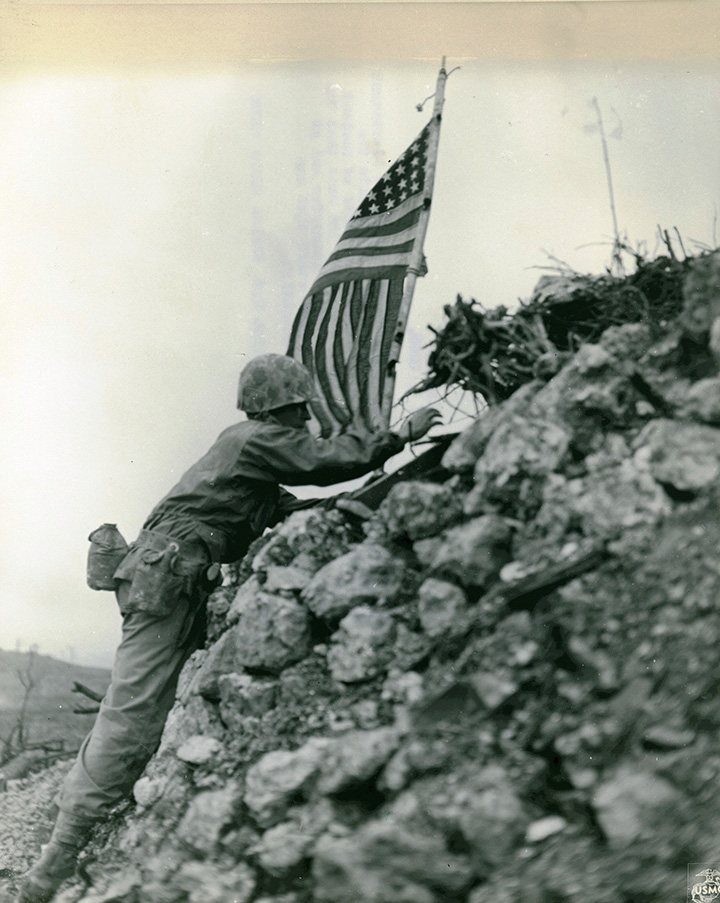
Marine Corps Archives caption:
The Stars and Stripes on Shuri Castle-Marine Lieutenant Colonel R.P. Ross, Jr., of Frederick, Md., plants the American flag on one of the remaining ramparts of ancient Shuri castle on Okinawa. This banner was the same that the First Marine Division raised at Cape Gloucester and at Peleliu. The flagpole is a Japanese staff that was battered and bent by American shellfire.
And here’s the Confederate flag that’s been Photoshopped into it:

Here they are together:
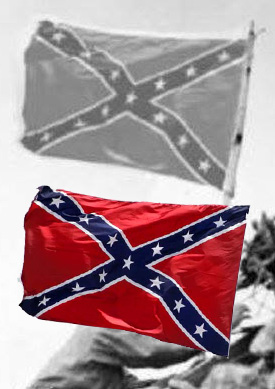
I’ve said it before, but it bears repeating: if you have to make up phony evidence to support your “heritage,” it’s not worth saving.
_______
Officers of the First Hawai’ian Cavalry, c. 1855
A colleague returned recently from a trip Hawai’i, and brought me a copy of Neil Bernard Dukas’ A Military History of Sovereign Hawai’i. This was a neat image, although not very strictly CW.
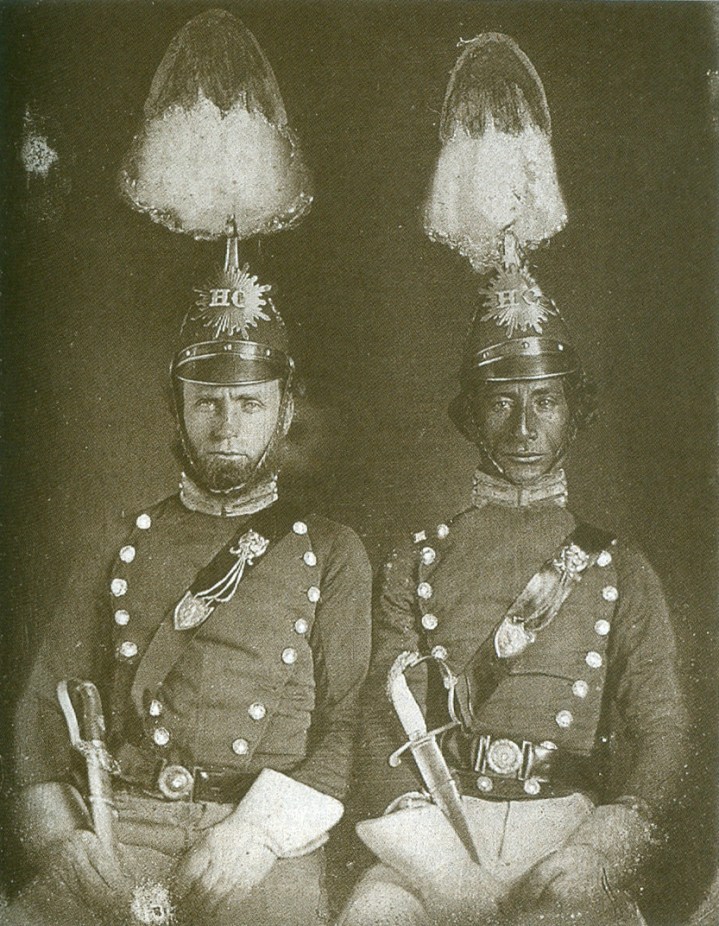
Major Henry Neilson (l.) and Lieutenant Paul Manini (r.), First Hawai’an Cavalry, c. 1855. The First Hawai’ian Cavalry was organized in response to a riot by thousands of sailors off the whaling ships at Honolulu. The book says the uniforms were purchased from France, and were essentially off-the-shelf, including French Imperial Eagle emblems — which some locals, worried about the prospect of U.S. annexation of the islands, took for American eagles. The uniform colors are not recorded but a few years later, after having been disbanded and then re-organized, they wore a “Garibaldi costume” with a red shirt and blue pants. Image source: Queen’s Hospital Museum.
______
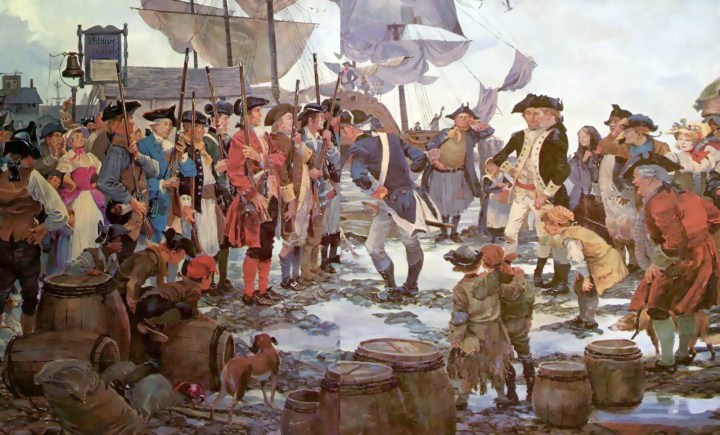
The Continental Marines at New Providence
Friends and Colleagues:
On Saturday, February 17 at noon, I’ll be presenting “First Ashore: The Continental Marines at New Providence, March 1776” at the monthly meeting of the Bernardo de Gálvez Chapter of the Sons of the American Revolution at Galveston, at Landry’s Restaurant on Seawall Boulevard. I hope some of my Galveston-area friends will be able to attend.
The Marines are well-known as the primary amphibious fighting force in U.S. history, but in fact their service in that role is older than the nation itself. When the Continental Navy was faced with a growing conflict with the United Kingdom and the Royal Navy, it (together with the Continental Marines) adopted an aggressive, preemptive posture and set about to seize British munition stores in the Bahamas. This first action helped set the stage for the coming conflict, and established a military tradition that remains central to the Marines’ role right down to the present day.
Folks who are interested in attending should contact chapter Vice President Larry Tidwell (ltidwell011-at-yahoo-dot-com, or call 713-four-zero-eight-2679) to RSVP for the event. Hope to see y’all there!
____________
Image: “The First Recruits, December 1775,” by the late Col. Charles H. Waterhouse, USMCR (Ret.).
Pathetic and Dishonest
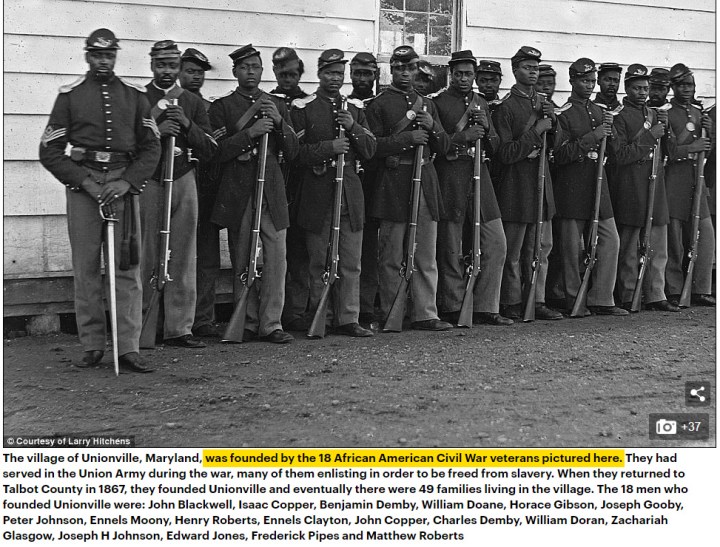
There’s a story from the Daily Mail that’s making the rounds about a small community in Maryland, called Unionville, that was founded by African American veterans of the Civil War. It’s a neat story, but one of the first things I noticed stood out, an image that (according to the Daily Mail) shows the eighteen veterans who would go on to establish the town in 1867, two years previously while still in service (highlighted):

I’m calling bullshit on this.
Many of you know this picture; it’s one of most-often published images of African American soldiers from the war. As my friend Bryan Cheeseboro says, it has “become the face of the history of the Black Civil War soldier.” But this image isn’t what the Daily Mail — and presumably the local sources the paper was working with, claim it to be. It is, of course, Company E of the Fourth U.S. Colored Infantry, taken in November 1865. You can view the original at the LoC here.
Set aside for a moment the implausibility of there being an extant photo that shows the soldiers — and only those soldiers — who would go on two years later to establish Unionville. There’s deliberate misrepresentation going on here. As some of you might have guessed, in order to get the desired number of eighteen soldiers, someone carefully cropped out roughly a third of men who appear in the original image from the Library of Congress:

But wait — it gets worse.
Even with careful cropping, there’s still one too many men in the image — so someone Photoshopped him out entirely:

There’s not much more to say about this, other that it’s deliberate misrepresentation and manipulation of an historical photo, apparently for no purpose other than to juice the story about the veterans who founded Unionville. Pathetic and dishonest.
______
Coming Soon to a Beltway Near You

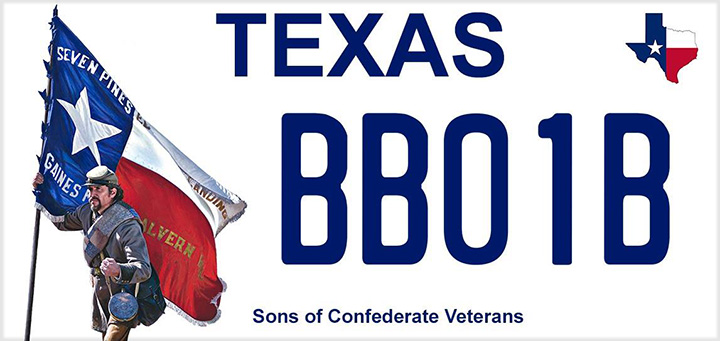
Some of you may recall that in 2015 the U.S. Supreme Court sided with the State of Texas, that had disallowed the Texas Division of the SCV to sponsor specialty license plates of the same type that many organizations and causes do. It was a fight that had gone on for years.
The Texas SCV recently announced a new plate design, that does away with the SCV logo (and its Confederate Battle Flag), in favor of artwork by John Paul Strain depicting a color bearer of the First Texas Infantry, carrying the colors of the regiment. The First Texas suffered an 82% casualty rate in the fight for the cornfield at Sharpsburg, reputed to be the highest loss in a single day’s fighting of any regiment in the war, U.S. or Confederate.
I’m not a fan of Strain’s worked generally, but (as the saying goes) this one, I like. The design here is crisp and clean and, unlike the previous pattern, focuses the attention on the soldier, not the sponsoring organization. Such a novel idea — I wonder why no one had thought of it before.
______
Civil War Navy Magazine
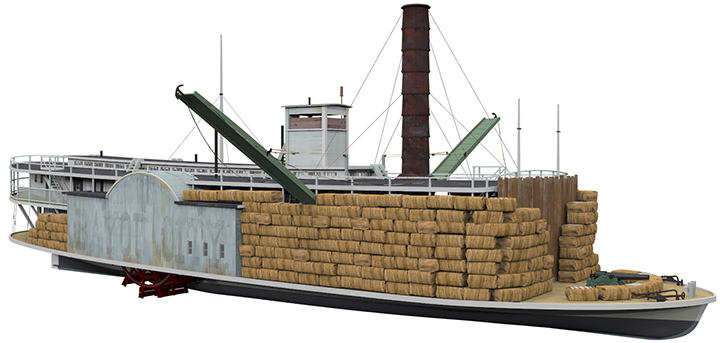
The Winter 2018 issue of Civil War Navy Magazine magazine arrived today, with Jim Schmidt‘s and my cover article on the Battle of Galveston. It’s a nice magazine, and this issue has some great stuff (besides Jim’s and mine).
_____
“Brave Men Are Ever Generous to the Unfortunate”
On Saturday I have the privilege of giving the address at the annual Battle of Galveston Memorial Service at Old Episcopal Cemetery here. There’s strong participation from the local CW history community; in addition to the host organization, the Lea Camp of the SUVCW, there’s also the camp’s Sarah Emma Seelye Auxiliary, the Sons of Confederate Veterans, United Daughters of the Confederacy, and the Freemasons. The U.S. color guard was composed of Army JROTC cadets from Ball High School.
Here is the prepared text of my talk:

“Brave Men Are Ever Generous to the Unfortunate”
An Address at the Edward M. Lea Memorial Service
Galveston, Texas
January 6, 2018
Andrew W. Hall
[Thanks to hosts and guests]
We’re here today to remember Lieutenant Commander Edward Lea, Commander Jonathan Wainwright, and all the others who lost their lives during the Battle of Galveston, one hundred fifty-five years ago. It is, as someone said, altogether fitting and proper that we should do this.
But it’s also true that funerals, and memorials, are not for the benefit of the honored dead, who are beyond such earthly concerns; they are for the living, for those who remain behind. So today, I want to speak briefly about someone left behind, the man who stood on this spot a century and a half ago, and read the prayer service for his own, dead son – Major Albert Miller Lea.
Albert Lea was a Tennessean of Quaker descent, although he himself was Episcopalian. At the age of 18, in July 1827, he was admitted to West Point on the recommendation of a relative, U.S. Representative Pryor Lea of Tennessee. Albert Lea graduated near the top of his class in 1831, fifth out of thirty-three cadets graduating that year. During his time at the Point, he came to know several other cadets who would go on to be well-known names a generation later. Albert Lea graduated a year behind John Bankhead Magruder, on whose staff he served during the Battle of Galveston, and William Pendleton, who would rise to fame as the artillery commander of the Army of Northern Virginia. He was two years behind Robert E. Lee and Joe Johnston, and three years behind Jefferson Davis himself.
Albert Lea was assigned to the engineers, which was typical practice with West Point graduates who stood near the top of their class. He was sent to the West, which in the 1830s consisting of places like Iowa and Minnesota. After several years he resigned his commission and took up a series of engineering positions with local governments and as a civilian employee of the federal government. In the 1850s he moved to Texas, where he settled in Aransas County working as a civil engineer.
By this time Edward Lea, Albert’s eldest son, had graduated from the U.S. Naval Academy at Annapolis, and was actively serving with the fleet. When the war came in 1861, Edward Lea was serving as a Lieutenant aboard USS Hartford in the East Indies. When Hartford returned to the United States, her officers were asked to re-swear their allegiance to the United States. Only two of the six did; one of those men was Lieutenant Lea.
The story of Albert and Edward’s reunion of board Harriet Lane is well known to everyone here today. It is difficult to imagine — unfortunately most of us will never experience — the heavy burden imposed upon Albert Lea when he undertook the sad duty of leaving the burial service for his own son and Commander Wainwright. Beyond the natural grief that any father would have in that situation, Albert Lea must also have wondered if he himself, as one of the officers who had helped plan and execute the Confederate assault, had also played a small, indirect role in Edward’s death.
But there was yet another dimension to Albert Lea’s responsibilities, that cold Friday morning one hundred fifty-five years ago. In addition to his own heavy responsibility, Lea found himself as the protector of the federal prisoners against the gibes and contempt of his fellow Confederates. It was not, as we might like to think today, a situation where men of the opposing armies easily bonded through their shared experience as opponents the battle. Albert Lea was forced to reach deep down, past his own enmity, to extend a hand to men that he and his fellow Confederates held personally responsible for the bloodshed and suffering in the conflict. He made it a point to remind all those present at the burial that their opponents had “brave and honest parts as well as ourselves.” It was incumbent upon the victors to extend a hand to their defeated enemy, and to treat them with dignity. He urged his fellows to “honor them for their virtues and as the faithful servants of a once common country, a skillful officers, as honorable gentlemen, and his Christian brethren.” “Brave men,” Albert Lea reminded his fellow Confederates, “are ever generous to the unfortunate.”
We don’t know how Albert Lea’s words were received by the men, Confederate and United States officers alike. But the speak to a greater truth that comes down to us through the decades, and can guide us through our own times of trouble and challenge. “Brave men are ever generous to the unfortunate.”
Albert Lea reminds us that our success brings with it an obligation to extend a hand to those who have met with failure. Albert Lea reminds us that as victors, we must be willing also to embrace the vanquished. “Brave men are ever generous to the unfortunate.”
We live today in difficult, disputatious times. There have been few periods in our history as a nation that we have been so polarized and divided over myriad issues as we are today in 2018. We are divided by culture and religion, politics and gender, race and ideology. Those are all difficult and perhaps intractable conflicts to solve. But surely we can all understand the experience of Albert Lea 155 years ago on this spot, and take his words as a guide as we go on our separate ways. We are not so divided as the men were stood here then, and if Major Lea could recognize the brave and honest hearts of his opponents, so can we. We can extend the hand of shared interests and come together in support of common goals. “Brave men are ever generous to the unfortunate.”
© 2018 Andrew W. Hall, all rights reserved.
_______
In Search of the Black Confederate Unicorn
Many of you will have heard of the proposal by two State Representatives in South Carolina to put up a monument at the State House in Columbia honoring African-American Confederate war veterans. They have apparently been surprised to discover that serious historians who’ve actually examined the primary source records are telling them that there essentially were none, at least the way the bill’s sponsors seem to think there were. I suppose that’s what happens when you get your understanding of history from Facebook.
I don’t have much else to say about this, except to point to this short comment by Josh Marshall over at Talking Points Memo, wherein one finds this gem of a line:
The specifics of this story challenge my ability to pry apart pure bad faith… from its second cousin, willful self-delusion.
I think I’m going to have a lot of opportunity to quote that line in the future.
Y’all have a great 2018, now!
______
Battle of Galveston Memorial Service, January 6

Friends and Colleagues:
Next Saturday, January 6, I will be giving a brief address at the memorial service for Lieutenant Commander Edward Lea, who was killed at the Battle of Galveston on January 1, 1863. The ceremony is an annual event that remembers those killed on both sides of the battle. The lead organization sponsoring the event is the Edward Lea Camp of the SUVCW, with additional participation from the SCV, UDC, the Masonic Lodge, and other groups.

The service will be held at Old Episcopal Cemetery, near the 40th Street. entrance to the cemetery complex on Broadway in Galveston. The event will begin with a short procession from the 43rd Street entrance starting at 10:30 a.m. I hope to see many of my Houston/Galveston friends there.
Happy New Year to all!
______





 Dead Confederates, A Civil War Era Blog
13 comments