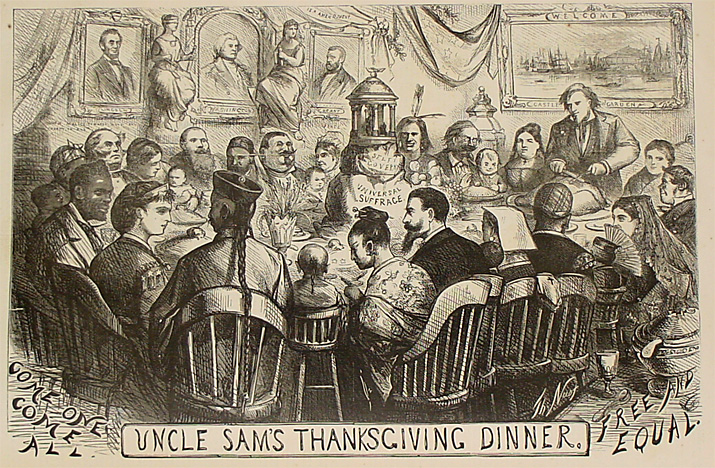
Happy Thanksgiving, Everyone!
__________________
Image: Harper’s Weekly, 1869.

Is a Wirz Execution Photo Misidentified?
A repost on the 153rd anniversary of the event.
____________
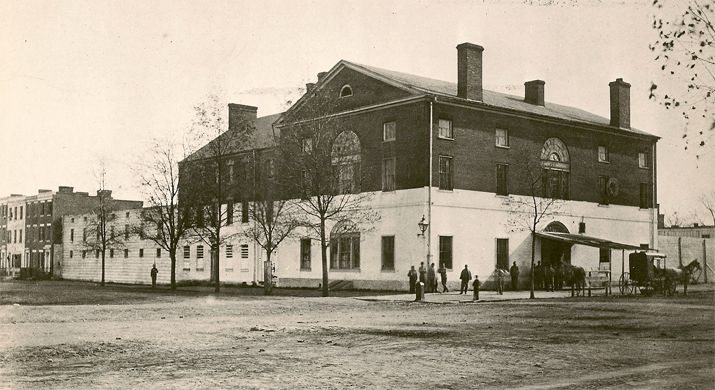
Henry Wirz (1823-1865) remains one of the most controversial figures of the American Civil War. Reviled in the North for his role as commandant of the notorious Confederate prison camp at Andersonville, Georgia, Wirz was tried in the summer of 1865 in Washington, D.C. and condemned to death. He was hanged on November 10, 1865, on a scaffold set up in the courtyard of the Old Capitol Prison (below), on what is now the site of the U.S. Supreme Court.
Wirz continues to have many supporters, who argue that he did the best he could to care for the Federal soldiers imprisoned at Andersonville, with the very limited resources he had at his disposal. The Confederacy, they argue, had not sufficient means to care for its own population, much less enemy prisoners, and point to hard conditions in Northern prisons, where lack of resources was far less a problem, in response. They also point out that one of the key witnesses in the prosecution’s case against Wirz was apparently an imposter, who could not have witnessed the things he testified to under oath. Nearly a century and a half after his death, efforts are still being made to exonerate Wirz and restore his reputation.
This post isn’t about any of that.
Wirz’ execution was the subject of a famous sequence of four photographs, now part of the collection of the Library of Congress, taken by Alexander Gardner. The sequence of the photos, as indicated by both their captions and catalog numbers, is usually given as follows:
- Reading the death warrant to Wirz on the scaffold, LC-B817- 7752
- Adjusting the rope for the execution of Wirz, LC-B8171-7753
- Soldier springing the trap; men in trees and Capitol dome beyond, LC-B8171-7754
- Hooded body of Captain Wirz hanging from the scaffold, LC-B8171-7755
The four images were taken from three different locations (below). The first two appear to have been taken from the roof of the prison kitchen (Point A), looking diagonally across the yard where the scaffold is set up. For the image of Wirz’ body hanging from the beam, Gardner moved the camera to the left, and to a higher position to get a clearer view of the body in the trap (Point B). Gardner may have also wanted to frame his shot to capture the dome of the U.S. Capitol in the background. For the shot labeled “springing the trap,” the camera is again at a lower position, similar to the height of Point A, but still further to Gardner’s left (Point C), again with the dome of the Capitol in the background. Gardner’s framing of these last shots is not subtle.

Plan of the Old Capitol Prison, showing the approximate positions of Gardner’s camera during the Wirz execution sequence. The plan is undated (from here), but shows the facility during its use as a prison during and immediately after the Civil War, 1861-67.
After looking closely at these images, though, I believe that these last two are transposed chronologically; the third image, labeled “springing the trap,” is properly the last image in sequence, and shows Wirz’ body being lowered from gallows into the space below the scaffold. The evidence – and somewhat graphic images of the hanging – after the jump:

A Tradition of Voter Suppression


On this election day, Keri Leigh Merritt reminds us that voter suppression in the South is as old as, well, the South.
Widespread illiteracy and semi-literacy among the lower classes — as well as the South’s stringent censorship laws — further prevented poorer whites from involvement in the political process. When the rich did allow the non-slaveholders to vote, they were still able to control the outcome of elections, as one man observed, by “means of the votes of the poor whites whom he owns, in owning all by which they can live for another day.”
A lower-class man who owed money to one of the county’s affluent slaveholders, or was in his employ, or lived as a tenant or renter on his land, surely felt compelled to support the rich man’s political causes. Whether this influence was subtle or overt or even coercive, poorer white men’s voting habits were carefully monitored. In some states like Alabama, a man’s right to vote could be challenged not only by the slaveholding election inspectors, but also by “any qualified elector.”
David Reed, a gubernatorial candidate in North Carolina, cunningly reminded the state’s elite in 1850 that “the landlord will always exercise a sufficient influence over his tenants without having an additional vote,” since “those who do not own land can never … remain here long, unless the land holder permits him to do so.” Tenants and sharecroppers undoubtedly felt this pressure. Slaveholders controlled so much of Southern society that some poorer whites had no choice but to conform. Deference and intimidation clearly dominated Southern politics.
Less devious ways to disenfranchise non-desirable voters also abounded. The structure of two-party politics itself was enough to deprive non-slaveholders a real voice in government. As a New York newspaper opined about the South in 1856, “the poor white men, the great mass of the non-slaveholding people, no doubt possess the right of suffrage, but what does that right amount to? Simply to express their preference as between two, three, or more slaveholding candidates.”
These days voter suppression efforts are typically described as being intended to limit the electoral influence of racial or ethnic minorities. But that’s not quite right; it’s about limiting the political power of the underclass as a whole, and only really about race insofar as that can be a convenient proxy for low-income voters with limited resources. In the antebellum period, race wasn’t the consideration at all; voter suppression was about keeping poor whites and the laboring class from casting ballots. The intent remains the same, even if the specific target shifts along with the demographic and political landscape.
_______

U.S. Army Declines Request for DNA Test on Manassas Remains

Members of the 3rd Infantry Regiment carry the remains of two unknown Civil War soldiers to their grave at Arlington National Cemetery on Sept. 6. Associated Press/Cliff Owen
Earlier this year, it was announced that two complete sets of remains had been recovered from what was believed to have been a U.S. field hospital used during the Battle of Second Manassas. Paul Davis knew that a relative of his, a color sergeant in the Second Wisconsin Infantry Regiment of the Iron Brigade, had died under similar circumstances, and petitioned the Army to have a DNA profile run on the remains in hopes of identifying them. Several other families did, as well. The Army refused, saying in carefully-worded, anodyne phrasing that it wasn’t worth the expense:
The Army made the decision that the costs associated with obtaining, storing, and testing of the DNA from these two Unknown U.S. Soldiers was not justified due to the significant passage of time as the possibility of identifying comparator DNA is extremely unlikely.
Even if the prospect of finding a match between this solider and someone living in 2018 is slim, this response from the Army strikes me as a terribly tone-deaf, especially for a nation that makes much of the principle of “no man left behind.” Yes, the costs associated with DNA testing can be substantial, but they pale in comparison to the multi-billion-dollar boondoggles the U.S. government (including the Pentagon) pour money into every day. Remember that the United States has an entire laboratory established to do exactly this kind of work; they’re professionals at doing it. It’s also worth noting that the Navy, not very long ago, went to great lengths, including DNA testing and facial reconstruction, to identify the remains of the two sailors recovered from the turret of USS Monitor.
With these unidentified remains now interred at Arlington, it seems unlikely that Paul Davis and the other families will ever have a chance to find out if, in fact, the remains recovered at Manassas are related to them. That’s a shame, but perhaps they’ll get enough criticism about this case they they will respond differently when the next case comes along.
___________
H/t Robert Moore and Phil Gast.






 Dead Confederates, A Civil War Era Blog
leave a comment