Harriet Tubman, Confederate Scout
Today’s history lesson comes via Kevin Jolley of Southern Heritage News & Views:

There was black regiments that fought in the Civil War for the south to. Don’t for get Harriet Tubman who scouted for the 2d South Carolina.
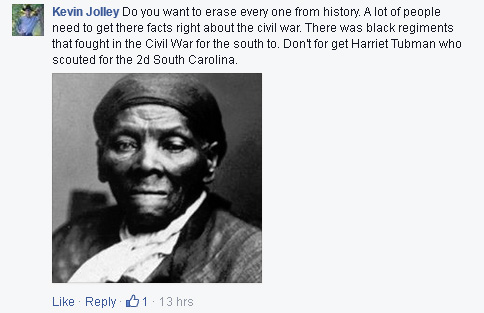
The Second South Carolina Volunteer Infantry (African Descent) was one of the first African American units in the Union army, organized in early 1863, and composed of former slaves from the coasts of Georgia and South Carolina. The regiment was made somewhat infamous by its commanding officer, former Kansas Jayhawker James Montgomery. I’m pretty sure the folks in Darien, Georgia didn’t view that regiment as as fighting “for the south [sic.].”
On the positive side, though, I’m sure we can count on Mr. Jolley’s support for putting Tubman on the new $10 bill, right? Right?
___________
UPDATE, July 26: After being challenged about the Second South Carolina on Facebook, Mr. Jolley claims he never suggested they were a Confederate unit:
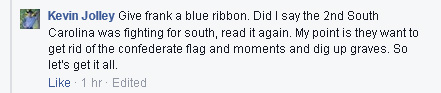
Um, sure. OK.
_________

“My remains shall rest with those of brave men”
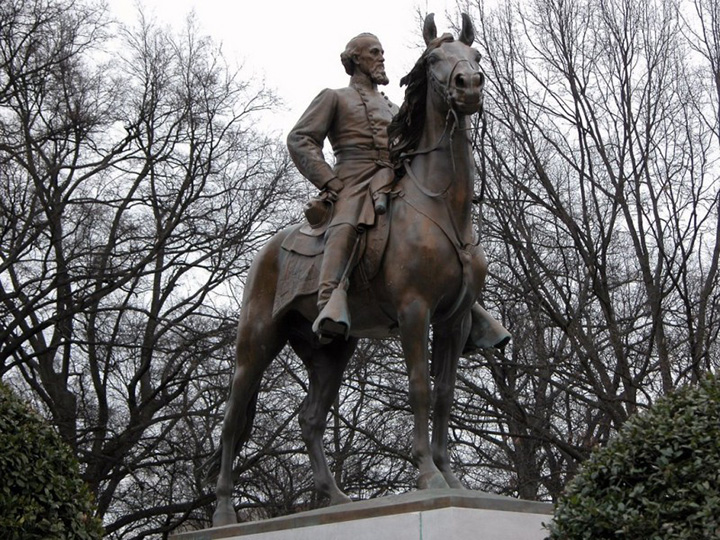
My blogging colleague Rob Baker recently passed along a link to this transcript of Nathan Bedford Forrest’s will:
FIRST I commit my body after death to my family and friends with the request that it may be entered among the Confederate dead in the Elmwood Cemetery near the City of Memphis, it being my desire that my remains shall rest with those of the brave men, men who were my comrades in war and shared with me the danger and peril of battle fields fighting in a cause we believed it our duty to uphold and maintain.
Return Nathan Bedford and Mary Ann Forrest to Elmwood. It’s the right thing to do.
___________
You Were Warned, America!
Jade Helm is here, people. Chris Martin uncovers the irrefutable evidence at the Sam’s Club in San Angelo:
_______
Return Forrest to Elmwood Cemetery
Last week Memphis Mayor A. C. Wharton called for the remains of Nathan Bedford Forrest, his wife, and the monument that stands above them, to be returned to the city’s Elmwood Cemetery. This move is not unexpected, as monument and the park surrounding it — renamed Health Sciences Park in 2013 — have been contentious in the city of Memphis for a long time now.
This call for Forrest’s return to Elmwood comes, of course, in the wake of several states taking action to remove or end official display of Confederate iconography, from flags to specialty license plates to statues. While I think we, as southerners, need to catch our breath and think a little more deliberately when it comes to monuments of long-standing, there is actually a strong and affirmative case — a pro-Forrest case, if you will — when it comes to the site in Memphis. I’ve communicated with several people who have been interested in Forrest for a long time, and know his story well. They point out that he and his wife, Mary Ann Montgomery Forrest, were originally interred at Elmwood, and it was not until the early 20th century, three decades after the general’s death, that their remains were moved to a central park downtown. It’s a case, in many respects, like that of Robert E. Lee at Washington College, now Washington and Lee University, where a later generation decided they knew better than the general himself what he wanted.
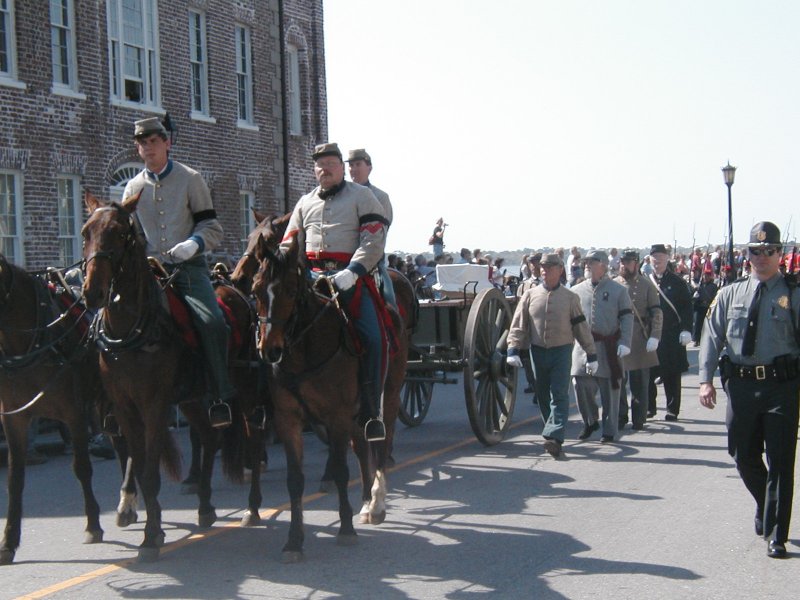
At Elmwood, he and Mary Ann would lie again among twelve hundred other Confederate soldiers. (Perhaps it’s not mere coincidence that the statue’s bronze gaze has been fixed on Elmwood all these years.) Besides which, a transfer of Forrest’s remains and re-interment a mile away at Elmwood would give the heritage folks the opportunity for a procession and pageantry the likes of which haven’t been seen since the burial of the H. L. Hunley crew at Charleston in 2004. Lord knows, to so many of Forrest’s fans practicing history consists mainly of dressing up and solemnly parading with Confederate flags. It’s a win for all concerned — for the Forrests, who apparently preferred being at Elmwood; for the city of Memphis that, rightly or wrongly, wants to be done with what used to be known as Forrest Park; and for the heritage crowd that, with a little nudging, can undoubtedly be convinced that a move is actually the right and proper thing to do. A recent Tennessee law would seem to prohibit moving Forrest and the monument, but with everyone on board with it, I’m sure enabling legislation in Nashville is a forgone conclusion.  Confederate graves at Elmwood Cemetery in Memphis. Forrest should be here, too. The specific circumstances of the Forrest case make that call easy; the case for moving, or removing, other Confederate monuments is more difficult, and requires more deliberation. Speaking for myself, I’m ambivalent about it. While I adamantly support the authority of local governments to make these decisions, I’m not sure that a reflexive decision to remove them is always the best way of addressing the problems we all face together. Monuments are not “history,” as some folks seem to believe, but they are are historic artifacts in their own right, and like a regimental flag or a dress or a letter, they can tell us a great deal about the people who created them, and the efforts they went to to craft and tell a particular story. In 2015 it would be hard to find someone who would unequivocally embrace the message of the “faithful slaves” monument in South Carolina, but it can’t be beat as documentation of the way some white South Carolinians saw the conflict thirty years after its end, and wanted others to, as well. (Maybe York County could put a sign next to it with an arrow saying, “no, they really believed this sh1t!”)
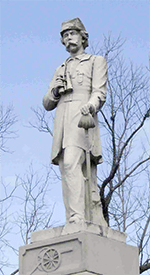 I’ve written before about the Dick Dowling monument in Houston (right). It honors Dowling for his command of Confederate artillerymen at the Battle of Sabine Pass in 1863, but from its dedication in 1905, it was a rallying point for Houston’s Irish community, many of whom came after the war. (It was sponsored, in large part, by the Ancient Order of Hibernians.) Certainly today, as I learned firsthand, the emphasis at the annual ceremony there is much more Irish in character than Confederate. It means a great deal to those folks, many of whose Irish ancestors’ arrival in this country postdates the Civil War by decades. They have no personal connection to the war or to the Confederacy, yet the Dowling monument nonetheless serves as a common bond among them irrespective of the uniform worn by the marble figure at the top. It really would be a shame to lose that.
I think we need to be done, done, with governmental sanction of the Confederacy, and particularly public-property displays that look suspiciously like pronouncements of Confederate sovereignty. The time for that ended approximately 150 years ago. But wholesale scrubbing of the landscape doesn’t really help, either, if the goal is to have a more honest discussion about race and the history of this country. I’m all for having that discussion, but experience tells me that it probably won’t happen. It’s much easier to score points by railing against easy and inanimate targets.
_________
Forrest monument image via PorterBriggs.com. Elmwood Cemetery image via ElmwoodCemetery.org.





 Dead Confederates, A Civil War Era Blog
28 comments