Price: Battle of First Deep Bottom
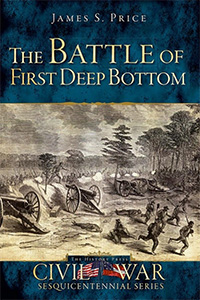 Congratulations to my fellow blogger, Jimmy Price, on the recent publication of his second book, The Battle of First Deep Bottom. From the description at History Press:
This looks to be a fine addition to any library of books on the latter part of the war in the Eastern Theater. If First Deep Bottom is anywhere near as good as Jimmy’s first book on New Market Heights, readers will be in for a treat. Jimmy will be signing books at the Henrico Theatre at the November 9 screening of Glory; enjoy a good movie and get a good book (or two) at the same time!
____________

The Flagger Road Show Comes to Danville

As some of you know, the City of Danville, Virginia announced recently that it would leave in place a Confederate flag on the grounds of the Danville Museum of Fine Arts and History. The museum is housed in the Sutherlin Mansion that, for a week in the spring of 1865, was home to Jefferson Davis and the Confederate government, after their midnight skedaddle from Richmond. This decision is naturally being heralded as a big win for Confederate Heritage™, although city’s announcement was based on a close reading of Virginia state law, not on the actual merits of the flag supporters’ case. Indeed, a Danville political blogger who attended the public hearing on Tuesday felt that the flag supporters did their cause more harm than good. One local SCV member, Glen Scearce, gave a rambling harangue that was
Another reportedly asked “if [the Danville City] council will be the next Hitler and the Nazis, rewriting history.” They do love them some Nazi analogies, those folks.
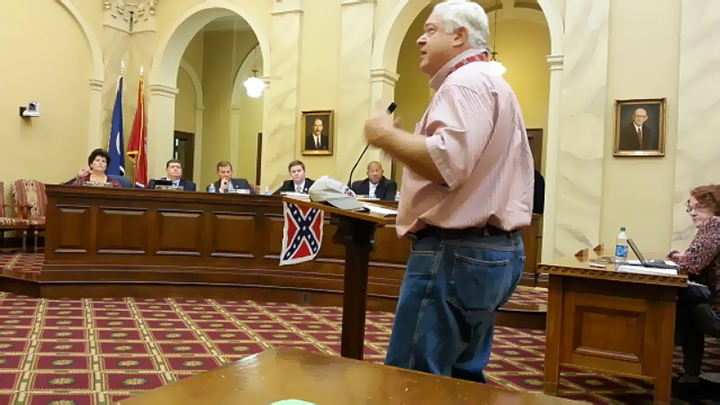
Anyway, one of the speakers was outside agitator Virginia Flagger Barry Isenhour (above), who reportedly said that (in the blogger’s words) “Lexington has a high unemployment rate because they have ran off tourism.” That would be a compelling argument if it were true, but even a cursory look at the actual suggests it’s not.
The Virginia Flaggers have been claiming for a long while now that their boycott of Lexington, initiated shortly after the city council there voted to bar all non-official flags from city-owned display poles, has had a dramatic effect on the city’s economy. They typically latch on to some bit of bad news about business in Lexington, and proudly claim credit for it. Most recently, they were crowing about a report that in June, Lexington had the highest unemployment in the commonwealth. But as I’ve pointed out before, actual economic data shows that tourism-related business in Lexington has been on the upswing all through the Flagger boycott.
Flaggers like Isenhour, Susan Hathaway, Brandon Dorsey and others are good at tossing off anecdotal examples of Very Bad Things happening in Lexington. But anecdotes aren’t data, and economic impact is rarely (if ever) reflected in a single datum point. It’s about trends. And, contra Isenhour’s assertion about unemployment, the overall trend is quite clear:
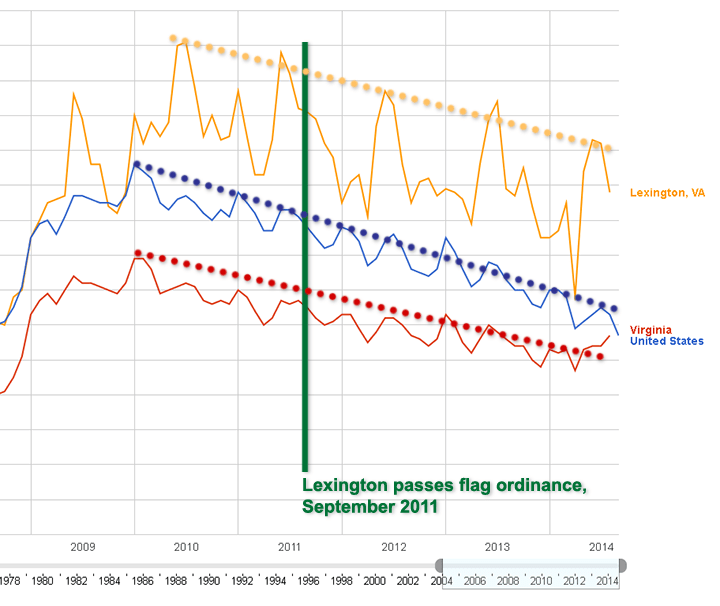
Since peaking in 2010, more than a year before passage of the city’s flag ordinance and the beginning of the Flagger’s boycott of the town, unemployment trends for Lexington, the Commonwealth of Virginia and the United States as a whole have all moved steadily downward.
There are some important takeaways here. The first is that unemployment in Lexington is high, higher than both the Commonwealth of Virginia and the United States as a whole, and it’s inordinately seasonal, spiking consistently every summer. But these are also patterns that have been consistent for years, well before the Virginia Flaggers began their boycott campaign. Any effect that campaign has on employment statistics for Lexington doesn’t appear to move the overall trends at all. The big picture is quite clear — unemployment in Lexington, as in Virginia and the rest of the country, is getting steadily better, not worse.
As for the recent talking point that Lexington had the highest unemployment rate in the commonwealth in June, that’s true, and it’s an unfortunate designation. But it’s also not really surprising, given that Lexington has had much higher unemployment than Virginia as a whole, going back to the winter of 1999-2000, when it shot upward and has never since come back down relative to the rest of the state. Again, this is not something attributable to the Flaggers; it’s been the “normal” course of things in Lexington for well over a decade. The Flaggers won’t tell you that. What else won’t they tell? Among other things, that that horrible peak unemployment in Lexington in the summer of 2014 (11.3%) was lower than the peak in 2013 (12.4), which was lower than the peak in 2012 (12.7%), which was lower than the peak in 2011 (13.8%), which was. . . well, you get the idea.
I don’t need to belabor the point, but the data is clear that when it comes to the effectiveness of the Virginia Flaggers’ boycott of Lexington businesses, they’re not only claiming credit for something they didn’t do; they’re claiming credit for something that hasn’t even happened. I honestly don’t know if they’re too dumb or lazy to see this for themselves, or know better but assume that their audience will believe anything that sounds good for their cause. It doesn’t really matter, though, because the effect is the same.
Anyway. I’m off to San Marcos to talk about how we identified a famous Civil War blockade runner wrecked here 150 years ago next February. Y’all be good to each other while I’m gone.
____________
On H. L. Hunley and U-576
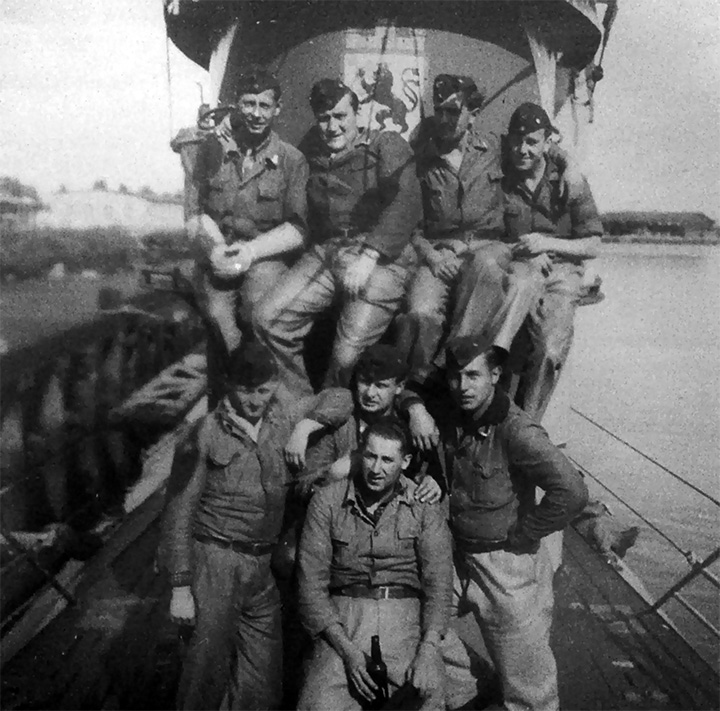
Crew of U-576. Ed Caram via NOAA.
You may have seen the headlines recently about the discovery, off the North Carolina coast, of the remains of U-576 (above), a Type VIIC U-boat sunk in 1942. It’s a remarkable discovery, made more so by the fact that one of her victims, the Nicaraguan freighter Bluefields, lies on the bottom less than 300 yards away. They don’t call that area the “Graveyard of the Atlantic” for nothing.
A discussion came up on SHPG about U-576, and its declared status as a “war grave” that should not be disturbed. Gary Adams started the discussion, contrasting the case of U-576 to that of H. L. Hunley, and concluding that
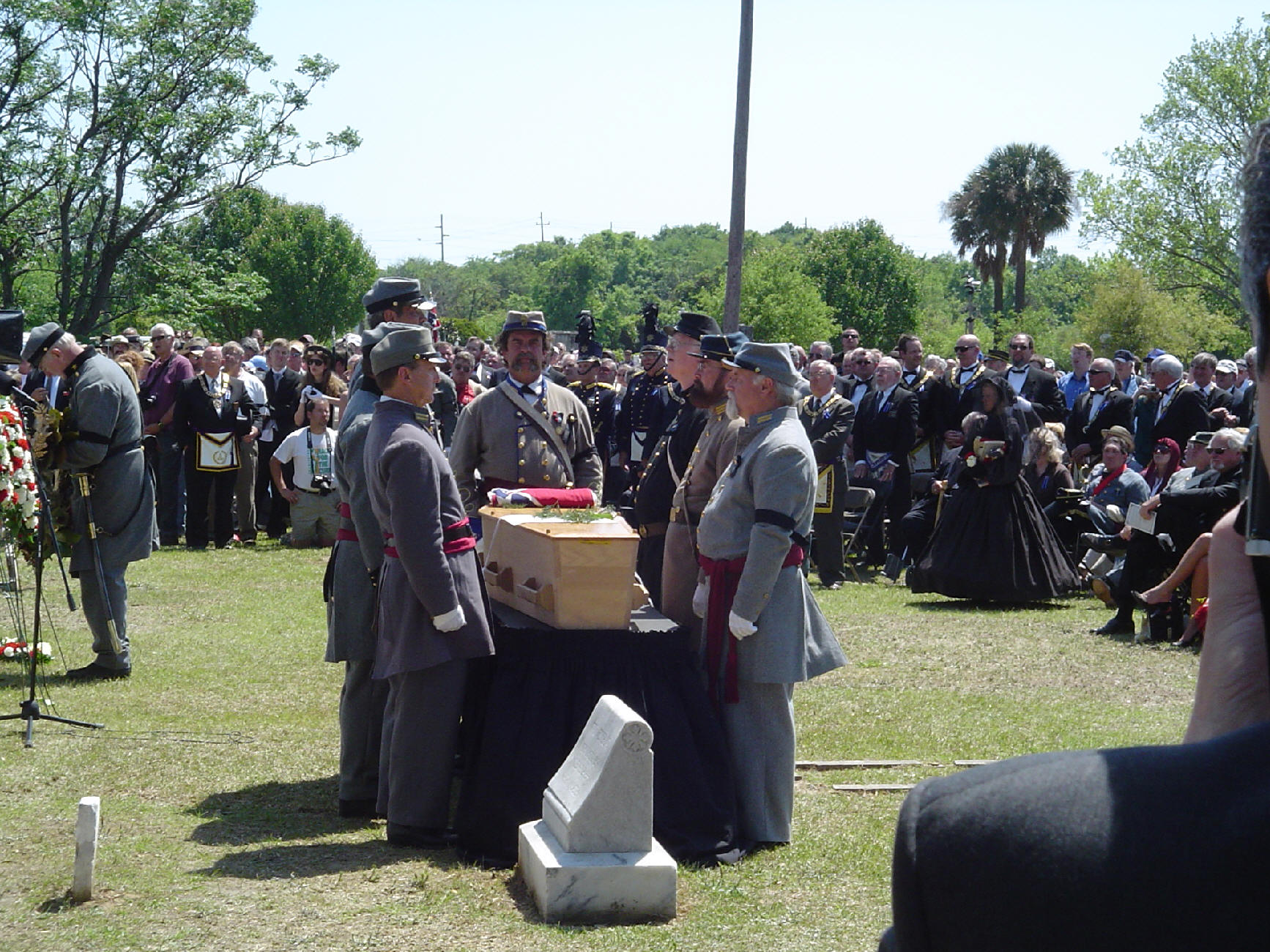
Adams has presumably forgotten about the case of U.S.S. Monitor, of which large components have been removed, including the engine and the famous revolving turret — the latter with the remains of two crewmen inside. Like the crew of Hunley, who were buried with military honors and great ceremony in Charleston in 2004, the two men from Monitor were interred at Arlington in March 2013. So yes, “they” handled the wreck of a famous Union ship in much the same way “they” did Hunley.
Adams’ citing of the case of U.S.S. Arizona is also flawed. That vessel is considered to be an inviolable war grave today, but that designation came long after her destruction in December 1941. The Navy spent months extensively salvaging what was left of the battleship, and removed all the human remains they could find for burial in a conventional cemetery ashore. The human remains there now are there only because divers could not recover them in he 1940s. It wasn’t until 1950 that what was left of the ship was designated a memorial, and the current memorial structure, designed by architect Alfred Preis, did not open until 1962. So “they” disturbed U.S.S. Arizona, too.

A salvage diver emerges from the after magazines of U.S.S. Arizona, Pearl Harbor, October 1942. U.S. Navy photo.
Still — it’s important to look at some of the reasons that H. L. Hunley and Monitor were handled differently than U-576. So I thought I’d share some insights on why there cases were dealt with differently. I know that some folks will not be persuaded, and that’s fine. But there are different circumstances that should be acknowledged.
First and foremost, by international treaty, military vessels that have not been decommissioned or sold remain the property of the governments that employed them, or their successor governments, under the “Doctrine of Succession.” It’s up to those governments to decide if and how those wrecks should be dealt with. In the case of U-576, that’s the present-day Federal Republic of Germany, which issued a statement that it “is not interested in a recovery of the remnants of the U-576 and will not participate in any such project.” Germany’s boat, Germany’s decision.
Legal claim for the wreck of H. L. Hunley, on the other hand, lies with the U.S. government, which assumed the assets of the “so-called Confederate States” under a joint resolution of Congress in 1870. and subsequently codified in June 1965 as part of 40 U.S.C. 310. Thus, Confederate shipwrecks are U.S. government property and, in most cases, assigned to the oversight of the Underwater Archaeology Branch of the U.S. Naval History & Heritage Command. United States’ boat, United States’ decision.
Under this arrangement, the Underwater Archaeology Branch reviewed, approved and participated in the recovery of both the Monitor artifacts and H. L. Hunley. They oversaw the work here on U.S.S. Westfield, and currently have oversight on the work being done on the ironclad battery C.S.S. Georgia at Savannah. This same arrangement also helps protect Confederate ships from plunder, notably the wreck of C.S.S. Alabama, which lies in French waters and was discovered in 1984, and subsequently excavated by a joint U.S./French team under international agreement.

One of Alabama’s guns, lying in French territorial waters. Image via CERES, the European underwater Research Center.
Admittedly, the Navy’s practice when it comes to wrecks where the presence for human remains is either known or presumed — which was the case for both Monitor and Hunley — has been less than absolute. The official policy provides a little discretionary leeway, saying in one place that “the United States Government does not grant [salvage] permission with respect to ships that contain the remains of deceased servicemen,” but also citing an act of Congress in the 19th century requiring “that any salvage must provide for the removal and proper burial of the remains of the crew.” As a result, the Underwater Archaeology Branch has the discretion to authorize the excavation and removal of wrecks that contain human remains, provided that there are compelling reasons to do so.
There’s no doubt in my mind that there were compelling reasons to so so in the case of H. L. Hunley. The amount of information gained about the design, construction, and operation of that unique craft since its recovery in 2000 is just phenomenal — and they’re not done yet. More important, though, by the mid-1990s the wreck itself had become extremely vulnerable to plundering. The boat was buried under several feet of sand, but at a depth of only 30 feet or so, within easy reach of any amateur diver. Worse still, numerous private individuals and groups, including treasure hunter E. Lee Spence and adventure novelist Clive Cussler’s group NUMA, either claimed to have found the boat or were actively looking for it. There’s no question that H. L. Hunley would be found and disturbed; it was simply a matter of when, and by whom.
The case for recovery of elements of U.S.S. Monitor was more controversial in the underwater archaeology community, not because of the prospect of disturbing human remains — sixteen men were lost when she sank on the night of December 31, 1862 — but because of the enormous amount of resources it would consume. The money would be better spent, they argued, on other projects, where more original knowledge might be gained; by contrast, many of the original drawings used to build Monitor still survive. Others countered that, well-documented or not, Monitor was both a unique vessel and of fundamental importance in the progression of maritime and naval technology, one of just a handful of genuinely ground-breaking vessels in history. Furthermore, they argued, Monitor was rapidly deteriorating on the sea floor, large sections of her hull having collapsed in the years since her discovery in 1974. In the end, the pro-recovery argument won out, with the ship’s engine being lifted in 2001 and the 120-ton turret the following year.

Illustration distributed by the Monitor National Marine Sanctuary to show the deterioration of the Monitor wreck site.
The big-picture takeaway here is every shipwreck is different in terms of their historical value, their vulnerability to destruction, and their prominence in society’s collective conscience. As a practical result, they end up getting treated differently. I think that’s probably the right approach, although I know others will disagree. And that’s fine, too.
_____________
They Don’t Teach This in Schools
Clearly, my own politically-correct education is lacking:

I had no idea. I really did not.
__________
In the Heart of the Sea
Via Michael Lynch, Nathaniel Philbrick’s In the Heart of the Sea is coming soon to the big screen:
In the Heart of the Sea tells the story of the whale ship Essex, one of the most harrowing tales of survival at sea every recorded.
____________
Another Mystery Solved
At least for me. I’ve mentioned before how a relative of mine in the Fourth Texas Infantry, Lawrence Daffan, witnessed the wounding of General Hood at Chickamauga, and was sure that Hood had been hit by fire from other Confederate troops. Daffan wrote:
Emphasis added. I’d never understood why the “new, standard uniforms” of the Texas Brigade would have caused such confusion, even for the ill-equipped Confederate troops in the Western Theater. Now, I find this in a discussion of the issue of new uniforms to Longstreet’s corps shortly before the battle:
The Texas Brigade was fired on by other Confederates because they were wearing blue uniforms. Simple as that.
___________
“Hunky-dory”

I’ve come across this term occasionally, and wondered about its origin. It turns up, among other places, in the song “The Fall of Charleston,” in the lines,
We’ll squash poor Jeff’s confederacy, and then get “Hunkydory!”
Sounds like it means happily drunk.
Well, I finally found a near-contemporary source. New York Commercial Advertiser, August 5, 1870, p. 2:
So it means stupid drunk. Close enough, y’all.
_______________
Image from “The Five Stages of Being Drunk in the 1860s.”
Thanks, Y’all!

I’d like to extend my sincere thanks to the Friends of the Library at the University of Texas at Arlington, who hosted me on Friday evening to talk about blockade runners and sign some books, and the Houston History Association, that asked me to speak about Charles Morgan at their annual research conference on Saturday. It made for a convoluted schedule and a lot of road time, but it was Hell’s own fun, and I appreciate the opportunity.
A special thanks goes to the 70 or so people from the Friends of the Library and the Fort Worth Civil War Round Table who braved some atrocious weather on Friday evening in Arlington — I’m glad y’all came out!
_____________
Image: Dr. Debbie Harwell, Managing Editor of Houston History Magazine, discusses the upcoming issue of that publication, celebrating the centennial of the official opening of the Houston Ship Channel.
Friday Night Concert: Def Americans, “Wreck of the Old 97”
Arguably the most widely-known event in Danville, Virginia’s history was the September 1903 wreck of a southbound Southern Railway Fast Mail. Accidents of that sort were sadly common in the late 19th and early 20th centuries, but the Danville wreck was immortalized in the song, “Wreck of the Old 97,” that became a big hit for Vernon Dalhart in 1924. His version was, reportedly, the first country song to sell over a million copies. It’s been covered by many artists since, including Woodie Guthrie, Johnny Cash, Pink Anderson, Boxcar Willie, Hank Snow, Bobby Osborne (featured briefly here) and others. Here’s a Dutch group, Def Americans, doing a worthy effort in tribute to Johnny Cash’s recording.
Y’all have a great weekend. I’m off to Arlington to talk about blockade runners.
__________
Ron Wilson Convicted on Still More Counts

A chandelier seized from Ron Wilson’s home and sold at auction to repay his victims. Via FoxCarolina.
Looks like Ron Wilson, the former SCV Commander-in-Chief who went to federal prison in 2012 for masterminding a decade-long, $57M ponzi scheme — one that ran concurrently with his tenure as C-in-C — wasn’t done cheating his victims:
The money Wilson, his wife, and brother are accused of hiding from investigators would have gone to make partial restitution for his victims. Efforts to recover Wilson’s ill-gotten gain continue. When Ron Wilson was sentenced in 2012, Tim presented himself as a victim, saying,
If the feds’ allegations in this new indictment are correct, those people oughter go away for a long, long time.
You can read the backstory here. Wilson, along with close allies like the odious Kirk Lyons, was a primary mover in the upheaval in the SCV fifteen years or so ago, that resulted in a wide-scale purge of insufficiently un-reconstructed individuals and camps, in favor of a more confrontational, activist group — what Lyons called “a modern, 21st century Christian war machine capable of uniting the Confederate community and leading it to ultimate victory.” Whatever the SCV is today, good, bad, or indifferent, it has Wilson’s nasty, avaricious fingerprints all over it, and will for years to come.
Anyway, enough about that crook. Here are some more items that may be of interest:
- Over at SHPG, Tom Perry is very upset that the Danville Museum is seeking to remove a Confederate flag from its grounds. Also, he wants to know where Danville is.
- The Veterans Administration is looking into the claim that a headstone at Woodlawn National Cemetery, near Elmira, carries the wrong name. Good.
- Reportedly no one got seriously injured in this mess. Someone’s been living right.
- A couple of students hung a Confederate flag at Bryn Mawr; Steve Conn chalks it up to ignorance of history.
- After fourteen years of conservation work, specialists at the Warren Lasch Center in Charleston are finally exposing the actual hull plating of the submersible Hunley.
- The Seven Days: The Emergence of Robert E. Lee and the Dawn of a Legend by Clifford Dowdey, with an introduction by Jeff Wirt, is $1.99 for Kindle (thanks, Chellers!).
______________





 Dead Confederates, A Civil War Era Blog
leave a comment