Confederate Heritage Honors Klan Founder
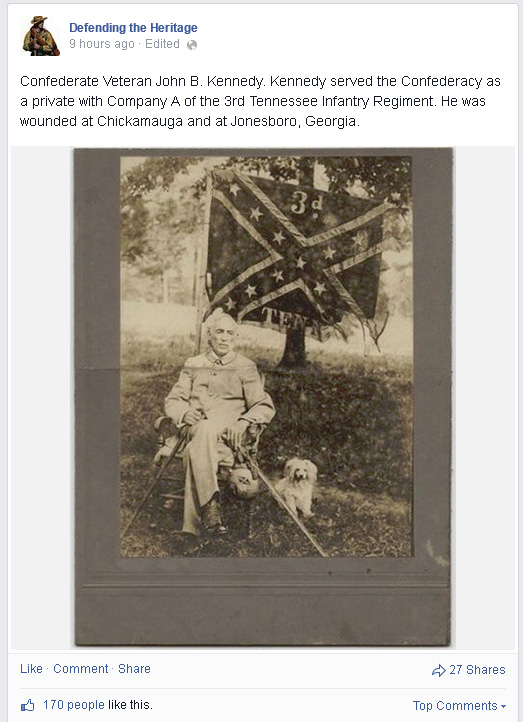
John Booker Kennedy was one of the original six Confederate veterans who organized the Ku Klux Klan in Pulaski, Tennessee. In fact, according to one history of the group, it was Kennedy who suggested they call themselves after the Greek word kuklos, that another member suggested be written as “Ku Klux.” Kennedy’s own obituary in the May 1913 issue of the Confederate Veteran magazine explicitly acknowledges his role in the founding of the group. Confederate Heritage™ folks will trip all over each other in the rush to absolve Nathan Bedford Forrest of the common (and strictly incorrect) accusation that he was a founder of the Klan, but John Booker Kennedy really was.
I do wish these folks would quit pretending that they’re put off by the Ku Klux Klan, and have no truck with it. Confederate Veteran magazine, then (as now) the official publication of the Sons of Confederate Veterans, certainly wasn’t squeamish about embracing the group. Robert Mestas, the proprietor of Defending the Heritage, surely knows about Kennedy’s history, since it appears that he lifted both the image and caption from the Tennessee State Archives. Here’s the full caption:

Kennedy served the Confederacy as a private with Company A of the 3rd Tennessee Infantry Regiment. He was wounded at Chickamauga and at Jonesboro, Georgia. Kennedy was one of the six original organizers of the Ku Klux Klan on December 24, 1865, in the Pulaski law office of Major Thomas M. Jones, and he would be the last of the six founders to die.
I don’t know why I should expect better from Robert. After all, he has a habit of making up fake quotes from Confederate veterans, right?
______________

Did Denbigh Bring Yellow Fever to Galveston in 1864?
_____________
A reconsideration of events in Galveston during the late summer and fall of 1864 suggests a likely linkage between the first steam blockade runners arriving at Galveston after the Battle of Mobile Bay in August 1864 and the outbreak of a yellow fever epidemic the following month. During the first three years of the war, steam blockade runners arrived at Galveston only on rare occasions; the Texas coastal city was too far removed from the main theaters of war to be of much use. After the Union admiral Farragut closed the entrance to Mobile Bay, however, Galveston was left as the only seaport on any significance left in Confederate hands on the Gulf of Mexico. As a result, beginning in late August there was a sudden upsurge in blockade-running activity at Galveston that continued through the end of the war ten months later.
Although yellow fever can now be prevented by an effective vaccine, in the 19th century it was a recurring and serious problem in the southern United States and the Caribbean. Yellow fever is a mosquito-borne viral disease varying widely in severity, exhibiting everything from flu-like symptoms to severe hepatitis and hemorrhagic fever. A large proportion of those infected died. At the time of the American Civil War, the variability of the symptoms made the disease difficult to distinguish from other illnesses, and even today a positive diagnosis is only possible through laboratory testing.
The threat of yellow fever was taken very seriously in Galveston, and on August 3 the Confederate commander in Texas, General Magruder, ordered a strict 30-day quarantine for all vessels arriving from Mexico, the Caribbean and other areas where the fever was endemic. It seems likely that Magruder’s order met with sharp opposition from merchants and others that had an interest in blockade running, because the following day he revised his order to require quarantine only for ships arriving from ports known to be infected with fever, and then only for eight days’ isolation. These watered-down precautions would prove to be woefully inadequate.
The first steam blockade runners arriving at Galveston after the fall of Mobile was the Susanna, arriving about August 24, and the Denbigh, which arrived on August 25. No other steam blockade runner is known to have arrived at Galveston for two weeks following Denbigh‘s arrival. In the days following Susanna‘s and Denbigh‘s arrival, several cases believed to be yellow fever appeared among civilians and soldiers stationed in the town. On September 14, the first deaths positively attributed to the disease occurred. That same day the military command sent out a call for nurses to care for those afflicted, and two days later the city was quarantined (unsuccessfully) to prevent the spread of the disease inland.
Over the next two months, at 259 deaths in Galveston were attributed to the disease. This figure represented nearly ten percent of the town’s military and civilian population at the time. The majority of the dead were civilians, and over a quarter were children ten years and under. The heaviest toll occurred in September, but deaths were recorded as November 20. A heavy frost on the evening of November 22 “dissipated the fever” and the quarantine was lifted soon thereafter.
There was debate at the time about the origin of this particular outbreak of fever. The etiology of the disease, and the role mosquitoes played in transmitting it, would remain unconfirmed for two generations. Some in Galveston argued adamantly that the disease must have come by way of a blockade-running schooner that had sailed from Vera Cruz, Mexico, while others insisted that it sprang from “local causes in the city.”
I believe that case for the schooner from Vera Cruz being the source of the yellow fever outbreak to be somewhat unlikely. The length of the voyage from Vera Cruz, typically a week or longer, would probably be enough time for symptoms to begin appearing among the crew and to draw the attention of authorities inspecting the vessel upon arrival. A steamer from Havana, on the other hand, would normally be able to make the run into Galveston in three or four days, making it much easier for infected seamen to pass undetected. It is also possible that the disease arrived at Galveston not in an infected sailor (who was subsequently bitten by a local mosquito), but in an insect brought along from the vessel’s point of origin. In that scenario, too, a steamer making a quick passage seems a more likely means of transmission than a relatively slow sailing vessel.
The normal course of the disease suggests its first victims in Galveston were infected very shortly after the arrival of the Susanna and Denbigh in late August. There were two interments of victims on September 14 – they same day they died – and three more the following day. The disease has a normal incubation period of three to six days, during which time there are no outward symptoms of the illness. After this incubation period, most victims enter what is now termed the “acute phase” of the disease, during which they experience fever, headache, muscle pain, nausea and vomiting. These symptoms usually subside after three or four days and the patients recover. In some cases, however, within 24 hours the disease enters its “toxic phase,” and the patient experiences develops jaundice (from which appearance yellow fever gets its name) and complains of abdominal pain with vomiting. Patients bleed from the mouth, nose, eyes and stomach. Kidney function drops off and sometimes fails altogether, resulting in a rapid rise in the levels of toxins in the body. About half the patients who enter the toxic phase of the disease die within 10 to 14 days, while the rest usually recover gradually.
If one takes this as the course of the disease in those patients who died on September 14 and 15, and the disease had its normal incubation period of three to six days, they most likely were infected during the last week of August, immediately after the arrival of the two steamers from Havana. Did Denbigh or Susanna bring the dreaded “yellow jack” to Galveston? I think it’s very likely that one of them did.
____________

Nikki Haley Gets Deja Vu All Over Again
As Kevin notes over at Civil War Memory, the Democratic nominee for governor in South Carolina has formally come out in favor of removing the Confederate Battle Flag from the grounds of the State House in Columbia. Kevin argues that while Vincent Sheheen may not win — he currently trails in the polls — what matters is that it’s right out front as part of his platform. “That a candidate for one of the two major parties (and for whatever reason) is campaigning on this issue,” he write, “suggests that we have reached a threshold among South Carolina voters when it comes to this divisive subject.”
 True enough. What interests me is seeing how this plays out politically — not for Sheheen, but for incumbent Republican Governor Nikki Haley. Vincent Sheheen isn’t going to lose votes over his stance on this issue, and he might pick up some. It’s a whole different proposition for Haley, though. Her campaign staff responded quickly to Sheheen’s announcement, arguing that he had never taken a stance against the CBF before, during more than a decade in state politics. Fair enough, but beyond the back-and-forth of winning the 24-hour news cycle, this presents a bigger problem for Haley campaign. Part of Haley’s success has been that she herself stands out against the backdrop of top-tier Republican elected officials, especially in the South (right). Though her policies are reliably conservative, at least superficially she presents a different sort of image — female, youthful, the daughter of immigrants, and so on. The GOP has been working very hard lately to show that they’re not all old white guys, even if they can’t find any actual Republicans to appear in ads touting the party’s diversity.
So far, so good. But by making removal of the CBF an explicit, up-front part of the campaign, Sheheen is making sure that Haley will almost certainly have to make her own position clearly known. And there’s her predicament.
She can (1) come down strong in favor of keeping the flag where it is, and open herself up to criticism that she’s no different than any other unreconstructed Confederate apologist. She can (2) agree with the removal of the flag, and incur the wrath of the actual unreconstructed Confederate apologists, who are as thick on the ground as sand fleas in the Palmetto State. Or she can (3) try hard not to say anything at all, and incur the wrath of pretty much everybody. She doesn’t have any good choices here.
I kinda feel sorry for Nikki Haley, who has to feel like this is deja vu all over again. When she ran for governor first time around, she did an interview with a group called the Palmetto Patriots and found herself getting harangued educated on Confederate Heritage™ issues like “Lonnie [Randolph] and his loonies” of the South Carolina NAACP, how the war was caused by Yankee tariffs, and why the Emancipation Proclamation really was a fraud. Seriously:
Poor deluded woman, she thought was was running for governor of a state in the twenty-first century.
It’s worth noting that the Palmetto Patriots didn’t ask Haley’s (white, male) competitors for the GOP nomination questions about the Confederacy because “all of them are Southerners whose families go back to beyond the war between the states, back to antebellum times, and they would have a deeper appreciation of Southern thinking and mentality.” Because Robert Barnwell Rhett isn’t available to run for governor, maybe.
Naturally, there were political threats, too:
“We do have the power to oust someone. Mr. Beasley learned that the hard way.” Nice political career you got there, lady. It’d be a shame if something was to happen to it.
As far as I know, Governor Haley has managed to avoid controversy regarding the CBF on the State House grounds during her first term. But I don’t see how she avoids the issue now. The media thrives on conflict, and it thrives on disputes over the Confederate flag, especially. (The stories almost write themselves; reporters only need to update the names and places from the one they wrote six months or a year ago.) This story isn’t likely to go away on its own. Not responding doesn’t seem to be a practical option; Governor Haley is going to have to make some hard choices about who she’s willing to infuriate.
__________
Many thanks to Michael Rodgers whose now-defunct blog, Take Down the Flag, provided the transcript of the Haley interview. (For the record, Michael had some very supportive words for Haley at the time.)
Blockade Runners — Arlington, Texas, Oct. 10
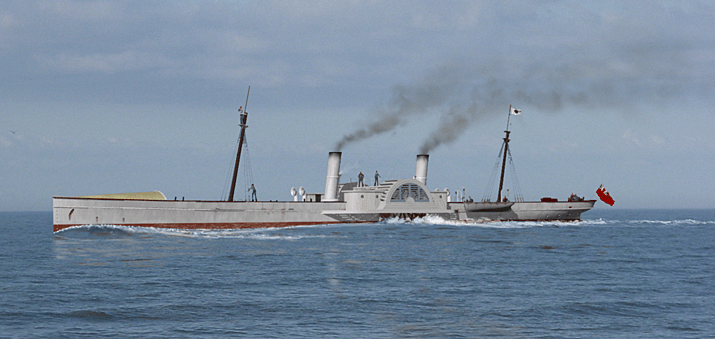
Next Friday evening, October 10, I’ll be speaking on blockade running on the Texas Coast at the University of Texas at Arlington. The talk, sponsored by the Friends of the UTA Library will be at 7:30 p.m. in the Central Library Sixth Floor parlor, will be followed by a reception and book-signing. The event is free and open to the public, but folks are asked to RSVP to 817-272-1413 or LibraryFriends@uta.edu. Hope to see some of my North Texas Friends there!
___________





 Dead Confederates, A Civil War Era Blog
18 comments