Canister!

Small stories that don’t warrant full posts of their own:
- Rob Baker has been doing a great job of following the flag dispute in Ringgold, Georgia.
- To commemorate the 20th anniversary of its first webpage, Microsoft has recreated it here. Ah, memories.
- I see Gary Adams is still lifting entire, first-person passages off other peoples’ blogs and posting them to look like his own writing. Yes, this is the person who describes himself as running a “Civil War Roundtable.” Perish the thought.
- A diver off Jupiter, Florida discovered that Goliath Grouper are territorial and sometimes aggressive. Reminds me of one I encountered off Key Largo a few years ago.
- A priest in Poland says that he’s been getting text messages from Satan. I’m not entirely convinced that the Dark Lord has a 4G data plan, but if he does, it’s probably T-Mobile.
- Susannah Ural’s Don’t Hurry Me Down to Hades: The Civil War In The Words of Those Who Lived It is available for $1.99 on Kindle. Better jump on this one, because it may not last.
- If you ever want or need a digital map of the Roman Empire, here you go.
- Remember: the best defense against the Common Core standards is homeschooling.
- Blogger Championhilz tells a great story about the time the commander of a U.S. tinclad gunboat decided to go ashore in Mississippi for Sunday services.
- Brooks Simpson is running a poll on the location of the next big-ass flag in Virginia.
- The U.S. Fifth Circuit ruled that Texas can’t selectively prohibit the sale SCV specialty license plates. No real surprise there.
- Researchers believe they may have identified “Patient Zero,” the source of the devastating Ebola outbreak in West Africa.
- I put up the video above, of David Kloke’s reproduction locomotives Leviathan and York, because trains.
Got anything else? Put it in the comments below.
__________

Marching with H. K.
It’s the standard Edgerton performance, ending with his dramatic interpretation of “I Am Their Flag.” I hadn’t realized until today that Edgerton has added his own lines to the poem, including references to the Confederate Battle Flag being “the Christian Cross of Saint Andrew, the first Apostle of Jesus Christ.” That characterization would certainly be a revelation to the South Carolina secessionist who designed that flag in the first place, and those lines don’t appear in the original poem. They seem to be Edgerton’s own personal, Christianist embellishment, like Hathaway’s “there is no denying God’s hand in this…” assertion last year about a story that defied credibility on its face. Beware of false prophets, y’all.
But anyway. Edgerton apparently makes a good living assuring his patrons that slavery wasn’t so bad, that the violence against African Americans attributed to the Klan during Reconstruction was a Yankee false-flag operation, and that Jim Crow laws were a burden imposed on white southerners by the Supreme Court.
Entertainment for white people, as Kevin says. I’m pretty sure the white nationalists from the League of the South in Oxford yesterday got some laughs out of Edgerton’s show.
_________
“The passengers got the full benefit of the sparks, cinders and smoke”
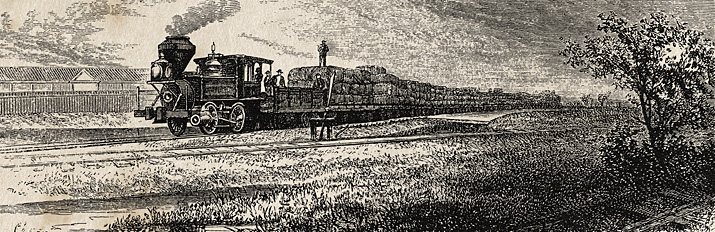
On another forum we’ve been discussing the logistical challenges faced by the South during the war relating to railroads. My colleague David Bright argued — correctly, I think — that the fundamental problem was not just in the relatively limited amount of rail transport extant in the Confederacy at the beginning, but in the inability to expand or even properly maintain what they had at the start:
In my opinion, more serious were: insufficient rolling stock, lack of manpower in the CSA such that the railroads (and their supporting infrastructure — mines, foundries, etc) could not get the manpower they needed, and the inability to replace anything that was lost (rails, rolling stock, depots, etc).
Dave’s observation reminded me of a passage in a history of Houston by S. O. Young (1848-1926), who was a teenager during the war and who later wrote extensively on local history:
There were many difficulties to be overcome in the way of transportation and equally as great ones in obtaining money or credit to pay for construction. Just as the Harrisburg road got under good headway; the Houston and Texas Central got into the game. The first shovel of dirt for this road was thrown by that great railroad genius, Paul Bremond, in 1853. When he threw up that dirt he turned up more trouble for himself than generally falls to the lot of one man. Of course, he did not know this, but I am convinced that had he done so it would have made not the slightest change in his plans. His faith in himself and his confidence in his ability to accomplish whatever he started out to do, was something sublime. When it came to energy he had any engine on his road faded to a standstill. He was a wonderful man, and he did not hesitate, at times, to attempt the apparently impossible. When his first contractor got cold feet and threw up his job, Mr. Bremond promptly undertook to carry out the contract to build the road himself. There is where his troubles began.
Friday Night Concert: “Farragut’s Ball” with Dan Milner
In expectation of Tuesday’s sesquicentennial of the Battle of Mobile Bay. Have a good weekend, everyone.

_____________





 Dead Confederates, A Civil War Era Blog
leave a comment