Dropping by to Borrow Some Dahlgrens
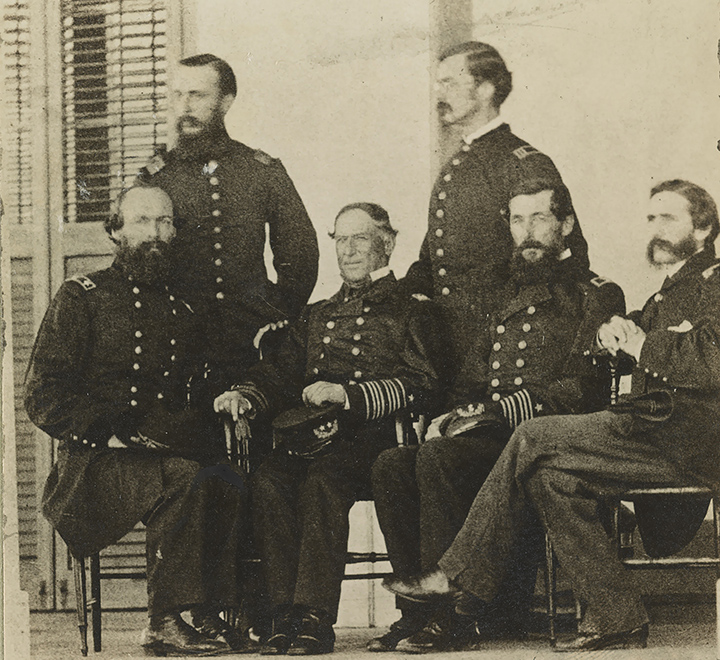

I found this image at LoC this evening. I’ve seen others taken at the same time, but not this combination of officers. The first three seated officers are (l. to r.) Army General Gordon Granger, Admiral David G. Farragut, and Farragut’s Flag Captain, Percival Drayton (of the Drayton Hall Draytons, natch). The fourth seated officer and the two standing, I don’t know. Only Farragut is identified on the LoC site.
The LoC caption is a garbled mess:

What I believe it shows is a meeting on the porch of the Commandant’s House at Fort Gaines, discussing the placement of Hartford‘s IX-inch Dahlgrens on the rear (east) side of Fort Morgan, to assist in the siege of that position. This would date the photo between August 8, 1864, when Gaines fell, and August 22, when Granger’s troops began their bombardment of Fort Morgan. Farragut and Granger got on fairly well; the admiral wrote of the general, “Granger is more of a man than I took him for, [he] attends to almost all the work so far as keeping others up to their mark.” The navy eventually lent Granger four Dahlgrens, with crews to man them from Hartford, Brooklyn, Lackawana and Richmond. Farragut also sent Lieutenant Herbert Tyson from Hartford to take charge of the guns on shore, so possibly Tyson is one of the other officers shown. The four naval guns were placed in two positions, about 1,400 and 1,500 yards from the fort’s walls, collectively designated “Battery Farragut.”

 Update, December 31: The meeting must have been prior to August 19, as well, because on that date Drayton (right) mentioned the planned battery when he wrote to an old friend, warning him not to be taken in by over-optimistic speculation in the North about the Mobile campaign:
.
However your neiqhbours feel, don’t allow yourself to be too sanguine about [the capture of the city of] Mobile. Fort Morgan has at least to be taken first, as until then not a man can be spared for anything else. We are getting a naval battery of four nine inch guns to bear upon it, but you know how difficult breaching is where the glacis entirely protects the scarp, and if the garrison has any endurance, the place must be carried by regular approaches and finally assault. At least our passage of the forts is the single piece of good luck this year. Everywhere else we have either been beaten or remained pretty much at a stand off..
Morgan actually fell four days later, without the assault anticipated by Captain Drayton, saving a great many lives on both sides.
___________

Friday Night Concert: “I Goes to Fight Mit Sigel”
“I Goes to Fight Mit Sigel” is a song that both celebrates and pokes gentle fun at the large number of German immigrants that served in the Union army. Sigel, of course, is Franz Sigel, a former Baden Army officer who had been caught up on the wrong side of the 1848 Revolution, and eventually became one of the German Forty-eighters who emigrated to the United States.
Sigel was one of Lincoln’s “political” generals, and though he didn’t make much of a field commander he was very successful in calling his fellow immigrants to Union arms, and in building the Army of the Potomac’s German regiments into a cohesive fighting unit. That is a significant contribution on its own.
I goes mit regimentals,
To Schlauch dem voes of Liberty,
Like dem ole Continentals
Vot fights mit England, long ago,
To save dat Yankee Eagle;
Und now I gets mine sojer clothes,
I’m going to fight mit Sigel. Chorus: Ya! Das ist drue, I shpeaks mit you,
I’m going to fight mit Sigel. Ven I comes from der old Countree,
I vorks somedimes at baking;
Den I keeps a lager bier saloon,
Und den I goes shoemaking;
But now I was a sojer been
To save dat Yankee Eagle;
To give dem Rebel vellers fits, I’m going to fight mit Sigel. Chorus: I gets ein tam big rifle guns,
Und puts him to mine shoulder,
Den march so bold, like a big jack-horse,
Und may been someding bolder;
I goes off mit der volunteers,
To save dat Yankee Eagle;
To Schlauch dem tam Secession volks,
I’m going to fight mit Sigel. Chorus: For rations dey gives salty pork,
I dinks dat was a great sell;
I petter likes de Sour Kraut,
De Schnitzel Kaize und Pretzel.
If Fighting Joe will give us dem,
Ve’ll save dat Yankee Eagle;
Und I’ll put mine Frau in breechaloons,
I’m go un fight mit Sigel. Chorus: Dem Deutshen mens mit Sigel’s band,
At fighting have no rival;
Un ven Cheff Davis’ mens we meet,
Ve Schlauch em like de tuyvil;
Dere’s only one ting vot I fear,
Ven pattling for dat Eagle;
Ve vont get not no lager bier,
Ven ve goes to fight mit Sigel! Chorus:
__________
Mapping Speech
 The science of speech. That’s my profession: also my hobby. Happy is the man who can make a living by his hobby! You can spot an Irishman or a Yorkshireman by his brogue. I can place any man within six miles. I can place him within two miles in London. Sometimes within two streets.
 So said Henry Higgins in the first act of George Bernard Shaw’s Pygmalion. The New York Times Sunday Review has a short, 25-item quiz on vocabulary and pronunciation of specific words, that compares users’ speech to that of other people around the United States.
According to the survey, my own vocabulary and pronunciation is closest to other folks that live in the area shown in dark red:

The major cities my speech most closely matched were Houston (“feeder road” is apparently a term unique to the Houston metro area), Baton Rouge, and New Orleans. Users should remember that this survey doesn’t claim to predict where you’re from, but how similar your pronunciation and usage are to people in different parts of the country. Still, for me, that looks about right. How about you?
____________
Image: Julie Andrews and Rex Harrison in the Broadway production of My Fair Lady.
Christmas Picket
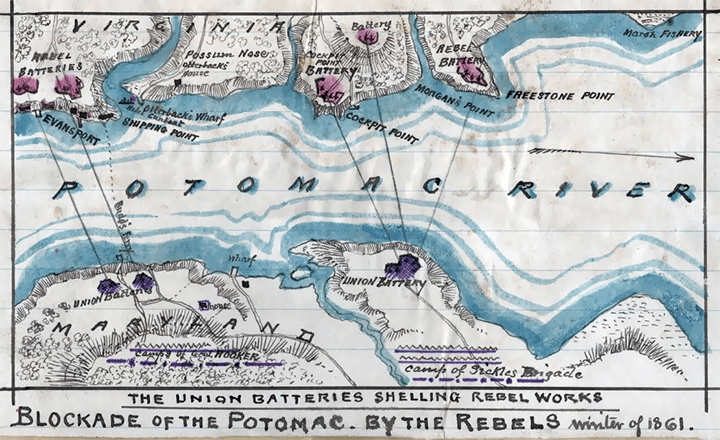
One hundred fifty-two years ago today, a nineteen-year-old Confederate soldier named Valerius Cincinnatus Giles (right, 1842-1915) went out on picket duty along the Potomac.
On Christmas morning a detail of twenty men was sent from the Fourth Texas Regiment to relieve the picket guard along the river. This detail was commanded by Lieutenant R. J. Lambert. The post assigned me was on Cock Pit Point, about 100 yards from the masked battery. This battery of four guns was planted twenty feet back from the edge of the bluff, completely hidden from view by an abatis of pine brush felled and stacked, with the sharpened ends of the trunks pointing outward. as a crude defense. From my post I had a splendid view of the river for two or three miles in each direction. The low range of hills on the Maryland side opposite were covered with white tents and log cabins, the winter quarter of General Daniel E. Sickles’s New York Brigade. The war had just fairly begun, and this was new to me. The novelty of the situation, the magnificent view before me, the river rolling majestically along between white hills and evergreen pines so charmed and captivated me at first that I felt not the bitter cold. The snow was gently and silently falling, deepening the hills and valleys, melting as it struck the cold bosom of the dark river. I had been on post but a short time when I beard the signal corps man sing out from the crow’s-nest high up in a sawed-off pine tree, saying to the officer in charge: “Look out, Lieutenant, a gun boat is coming down the river!” I could hear the artillery officer giving orders to his men, but from my position I could not see them. Looking up the river I saw a cloud of black smoke rising above the tops of the trees. All was excitement at the battery, and I could hear the artillerymen ramming home their shells, preparing to sink the approaching boat. Directly the steamer turned a bend in the river with volumes of black smoke pouring from her smokestacks. She was in the middle of the stream, coming dead ahead under full steam. It was really a disappointment to the fellows at the battery as well as myself, when the soldier in the crow’s-nest called out again: “0h, pshaw, Lieutenant, don’t shoot! She’s nothing but an old hospital boat, covered over with ‘yaller’ flags.” Of course a Confederate battery would not fire on a yellow flag any more than on a white one. The boat came steadily on down the river until she got nearly opposite Cock Pit Point, when she blew her whistle and turned toward the Maryland shore. As she made the turn she came within 200 yards of the Virginia bank and I could distinctly read her name on the wheel house. It was the old Harriet Lane, named in honor of the accomplished niece of President James Buchanan, who was queen of the White House during the administration of that eccentric old bachelor. In the winter of 1861 the Harriet Lane was in the employ of the Hospital Corps of the Army of the Potomac. A few days after that, she left her mooring on the Maryland side and pulled out down the river. She subsequently became a warship of some kind and met defeat at the Battle of Galveston in January, 1863. After the boat bad landed and the excitement was over, a melancholy stillness settled around me. The novelty and fascination of my surroundings soon lost their charm. The lowering clouds above me and the white silence about me became monotonous and I began to feel restless and uneasy. If you are in a forest or on a prairie on a still summer day and will stop and listen attentively, you can bear the songs of birds, the chirping of crickets or the drowsy hum of insects. hut in a piney woods in midwinter, when the earth and green branches of the trees are covered with snow, with not a breath of air blowing, the stillness is oppressive. I must have bad a slight attack of homesickness, for I began to think of home and my mother and father away out in Texas waiting and praying for the safe return of their three boys, all in the army and all in different parts of the Confederacy — one in the Tenth Texas Infantry at an Arkansas post, one in Tennessee or Kentucky with Terry’s Rangers, and one in the Fourth Texas Infantry in Virginia. . . . While I stood at my post on the banks of the Potomac I knew I was perfectly safe from any personal danger, yet something seemed to warn me of approaching evil. I tramped through the snow, half-knee-deep, although I was not required to walk my beat. I tried to divert my mind from the gloomy thoughts that possessed me, but all in vain. Suddenly I was startled from my sad reflections of home and kindred by distinctly hearing a voice I new — my brother Lew’s voice — calling my name. I turned quickly, looked in every direction, heard nothing more and saw nothing but the white world around me and the dark river below me. He was two years my senior, had been my constant companion and playmate up to the beginning of the war. It was then 4 P.M., December 25, 1861. I was not sleeping or dreaming. and firmly believed at the time that I heard my brother calling me, but it must have been a delusion of the imagination. However, Lewis L. Giles of Terry’s Texas Rangers, Troop D, Eighth Texas Cavalry, was mortally wounded at the battle of Mumfordsville, [Woodsonville] Kentucky, December 17, 1861, in the same charge in which Colonel Terry was killed. He was removed by his comrades to Gallatin, Tennessee. and died at the residence of Captain John G. Turner, a lifelong friend of my father. He breathed his last precisely at four o’clock on Christmas Day. 1861, while I stood picket on the banks of the Potomac.[1]


A Sherlock Christmas Cracker

We’re off for Christmas dinner today with family (traditionally on Christmas Eve for us, for reasons I’ve forgotten), so in the meantime, here’s a Christmas cracker courtesy of the BBC, teasing the upcoming third season of Sherlock. If you’re a fan but haven’t seen Season 2, there are spoilers in this clip. (Actually, the whole clip is one long spoiler.) If you haven’t seen the series, but want to get a sense of it, here’ s John Watson’s first encounter with the famous consulting detective:
Have a wonderful and joyous holiday!
__________
The Disappearance of “Bitter Bierce”
Bierce returned to Indiana to answer Lincoln’s call for troops in April 1861. When his three-month stint was up, he signed on for two years more. Rising steadily in rank and cited often for valor, he remained in uniform for the rest of the Civil War. Little of the experience of war escaped him: shameless retreats, hopeless charges, courage, stupidity, confusion, terror, camaraderie, and endless slaughter. He was wounded at least twice before the battle of Kennesaw Mountain, when a bullet to the left temple lodged behind his ear, cracking his head open “like a walnut,” he wrote later, in a phrase that captures his peculiar blend of detachment and precision. Eventually he was forced to return to Indiana for convalescence. He left again as soon as he could. By then the war was effectively over, though of course he could never quite get over it. His rise from enlisted man to officer gave Bierce a vertical view of how men made decisions of life and death under the most miserable conditions. What he saw year after year only confirmed his native cynicism. Stupidity made a deeper impression on him than physical courage, perhaps because he himself had so much more of the latter than the former. The blundering of generals fed his distrust of authority.
And on his disgust with the excesses of the Gilded Age:
The best-known adventure from his newspapering was also the least typical. He and [his employer, William Randolph] Hearst had nothing in common politically except a vague revulsion for the crony capitalism of the Gilded Age and a more pointed hatred for the cronies themselves. The fattest target among the Railrogues, as Bierce called them, was Collis P. Huntington, chairman of the Southern and Central Pacific railroads, and the richest man in California. A useful percentage of Huntington’s fortune fell into the pockets of congressmen and senators in Washington, and when Congress floated a bill relieving him and his railroad of a $75 million debt to the federal government (a loan on which Huntington’s riches had been built), it was assumed that it would pass easily. Hearst’s newspapers exploded. The publisher sent Bierce to Washington to front a relentless campaign to kill Huntington’s bill. Bierce directed a team of reporters and wrote every day himself, sometimes twice a day, always in high spirits: “Mr. Huntington is not altogether bad,” went a throwaway line in a typical column. “He says ugly things of the enemy, but he has the tenderness to be careful that they are mostly lies.” Incredibly, after months of daily coverage, Bierce and Hearst succeeded—an early sign that the Gilded Age had run its course. The bill was withdrawn, though not before Huntington confronted Bierce on the steps of the Capitol among a scrum of reporters. “Name your price,” Huntington demanded, insisting that Bierce call off his campaign. “Every man has a price.” “My price,” Bierce responded cinematically, “is $75 million, handed over to the Treasury of the United States.”
Go read the whole thing. Bierce, of course, is a favorite of mine. Bierce’s disdain for shoddy historians of the war is made evident here, his views on black soldiering here, on Grant’s drinking habits here, and the most frequent invocation of God in battle, here.
Not Surprising, Part Deux
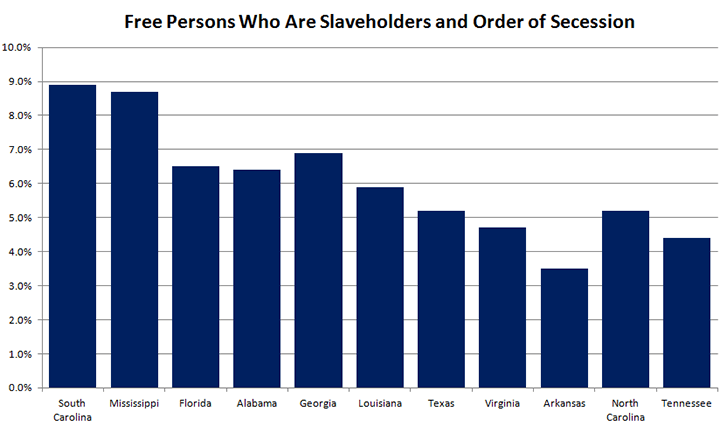
Recently Michael Rodgers reminded me of this post from 2011, in which I pointed out the very tight correlation (beyond -0.9, for y’all stats wonks) between the order in which the states that formed the Confederacy seceded, and both the proportion of slaves and the proportion of slaveholders in their total population. It’s based on a table compiled by David C. Hanson of Virginia Western Community College, and came to my attention via Donald R. Shaffer’s Civil War Emancipation blog. It makes a fundamental point but, in tabular format, the point may not be obvious to all. At the time, Shaffer wrote that “Hanson makes a definite connection between the concentration of slaves and slaveholders in a particular southern states and when it seceded from the Union in 1860-61, and whether it seceded at all. Certainly, there is plenty of anecdotal evidence connecting slavery and Civil War causation, but this table also makes a compelling statistical case.”
It’s more than a “definite connection.” Hanson’s simple data set reveals that for the eleven states that actually seceded, the proportion of free persons owning slaves was an excellent predictor of the order in which they seceded, beginning with South Carolina (highest proportion of slaves and slaveholders) and ending with Tennessee (low proportions of both). The percentage of slaves as part of the state’s overall population was equally reliable as a predictor. In short, each percentage is a nearly perfect predictor of where each state falls in the order of secession. The states with the largest proportions of slaves and slave-holders seceded earliest.
Anyway, back to data presentation: here’s Hanson’s data shown in two simple bar charts. There is absolutely a clear pattern in both cases; if slaves and slaveholding were not connected to the timing of each state’s secession, the tall and short columns would be randomly scattered. They’re not.

__________
A Little Knowledge. . . .
Over at Mid-South Flaggers, the admin there has been doing a little independent research on Confederate pensions from Washington County, Mississippi, and is disturbed by what he’s found — or rather, what he’s not found:
He’s right; the word “slave” does not appear on the documents he’s looking at. Instead, they’re referred to as “servants,” and there are thirteen of them listed on the page he posted to illustrate his findings:
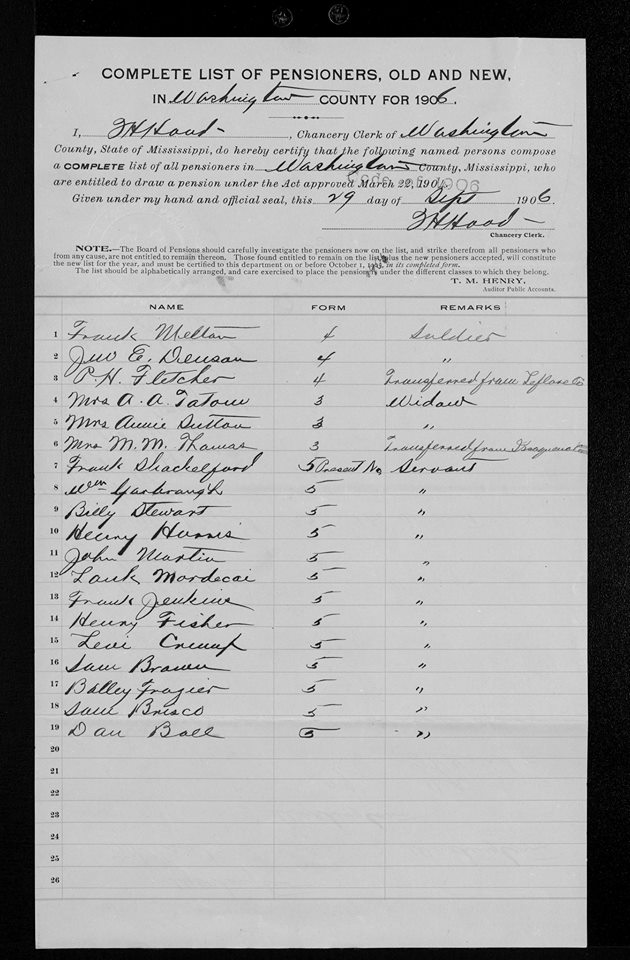
True, an example servant’s pension application he posted requires applicants to identify “the name of the party whom you served,” and the military unit “in which your owner served,” but it doesn’t use the word slave, and that’s what matters, right? 
Yes, Mid-South Flagger, you’ve been lied to. Just not by who you think.
______________
Friday Night Concert: Shovels & Rope, “The Fall of Charleston”
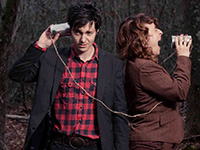 Here’s a third track from the new album, Divided and United. This one is by Shovels & Rope, the Charleston husband and wife duo of Michael Trent and Cary Ann Hearst. You can read more about them and their recording of “The Fall of Charleston” here, or hop over to NPR for a mini-concert. A contemporary broadside of the lyrics is available here.
Charleston is taken, and the rebels put to rout;
And Beauregard the chivalrous, he ran to save his bacon—
When he saw General Sherman’s “Yanks,” and “Charleston is taken!” With a whack, rowdy-dow, A hunkey boy is General Sherman, Whack, rowdy-dow, Invincible is he! This South Carolina chivalry, they once did loudly boast,
That the footsteps of a Union man, should ne’er pollute their coast.
They’d fight the Yankees two to one, who only fought for booty, But when the “udsills” came along it was “Legs, do your duty!” With a whack, rowdy-dow, Babylon is fallen, Whack, rowdy-dow, The end is drawing near! And from the “Sacred City,” this valiant warlike throng;
Skedaddled in confusion, although thirty thousand strong—
Without a shot, without a blow, or least sign of resistance,
And leaving their poor friends behind, with the “Yankees” for assistance! With a whack, rowdy-dow, How are you, Southern chivalry? Whack, rowdy-dow, Your race is nearly run! And again o’er Sumter’s battered walls, the Stars and Stripes do fly,
While the chivalry of Sixty-one in the “Last ditch” died;—
With Sherman, Grant and Porter too, to lead our men to glory,
We’ll squash poor Jeff’s confederacy, and then get “Hunkydory!” With a whack, rowdy-dow, How are you, neutral Johnny Bull? Whack, rowdy-dow, We’ll settle next with you!
__________
Darien, Georgia as a Military Target
Over the last several months, Craig Swain has been doing steady, diligent work in blogging (often in sesqui-real-time) the military campaigns around Charleston. He’s told some familiar stories, but much of his output is wholly original research, put together through a variety of official records, memoranda, and contemporary photos. It’s small-scale, fine-grained history at its best.
Today, Craig has a new post up discussing the role that the little coastal town of Darien, Gerogia played in blockade-running. Darien is best known now as the town that was burned by Union Colonel (and former wild-eyed Kansas Jayhawker) James Montgomery in June 1863. This incident is widely regarded as a wanton and unnecessary act of spite on Montgomery’s part, and formed an important story element in the 1989 film Glory. (If your knowledge of Darien is based primarily on its depiction in that film, you’d never realize it was a small port in the first place.) Craig uses the story of the capture of the blockade runner Chatham in December 1863, though, to make the clear case that Darien was not only a point for bringing supplies in (and cotton out) of the Confederacy, but that it served as a distribution point for Confederate military forces on that part of the Georgia coast. As such, the docks and warehouses of Darien — though not the town itself — was a legitimate military target:
Kudos to Craig for telling these stories, and applying hard research to better understand a singularly inflammatory subject.
__________




 Dead Confederates, A Civil War Era Blog


8 comments