Friday Night Concert: Richmond is a Hard Road to Travel

Another track from the new album, Divided and United , by bluegrass artists Chris Thile and Michael Daves. I love this song, and this is a great cover of it. It has a lot more verses than this, but you get the idea.
___________

Canister!
Small stories that don’t warrant full posts of their own:

- Stephanie McCurry, author of Confederate Reckoning: Power and Politics in the Civil War South, will be giving a 10-week online course beginning in January called “History of the Slave South” (above). Registration is free.
- The SCV has committed $25,000 to help keep the Jefferson Davis Memorial Historic Site in Irwinville, Georgia open to the public. Kudos to them for stepping up.
- The contentious dispute over the Confederate monument at Reidsville may be effectively over, with the installation of a replacement statue atop the restored monument at the UDC plot in Greenview Cemetery. The usual suspects are furious, but given (1) the city’s flat (and repeated) refusal to restore the monument in its original location (which they own), and (2) the fact that the core legal challenge to the UDC’s plans went nowhere, this is not a bad outcome. Glass half full, etc.
- Four Civil War battlefields may soon be rolled into the National Park System. Most of the property is currently held by the Civil War Trust, which should facilitate the process.
- Finally, everyone’s favorite Confederate heritage beard showed up in Florida to protest the possible renaming of Nathan Bedford Forrest High School.
___________
Tracking Confederate Deserters in East Texas
Both desertion and men running from conscription was a big problem in Texas, as it was in other parts of the South during the war. I recently came across this account of using “Negro dogs,” bred and trained to hunt runaway slaves, to track deserters in East Texas. The place mentioned, Winter’s Bayou, runs through the Sam Houston National Forest, southeast of Huntsville. From the Houston Tri-Weekly Telegraph, December 21, 1864, p. 1:
___________
Friday Night Concert: “Kindom Come” with Pokey LaFarge
 A cut from the new album, Divided and United: The Songs of the Civil War, produced by Randall Poster. Divided and United offers more than 30 (!) tracks of period songs, re-interpreted by modern artists, including well-known performers like Loretta Lynn, Ricky Skaggs, Taj Mahal, Lee Ann Womack and Dolly Parton. Some of the best, though, are from less-familiar artists like Shovels & Rope and Pokey LaFarge (right). There’s a neat NPR story on the new album here.
From the interview:
I’ve known this song for years, but I never heard this verse:
- The overseer he makes us trouble, and drive us ’round a spell, We locked him in the smokehouse cellar, with the key thrown down the well. The whip is lost, the handcuffs broken, but the massa’ll have his pay, He’s old enough, big enough, ought to known better than to try an’ run away!
Enjoy.
______________
Mandela and the Complexity of Righteousness

Amid the tributes and commentary on the passing of Nelson Mandela, I didn’t have anything particular to add. But then I read this, by my friend Emily L. Hauser, that cuts like a clarion bell through all the well-intentioned hagiography that’s filling the airwaves right now. I hope she will forgive me for repeating it here in toto:
_____________
Nelson Mandela in 2009 Photo by Media24/Gallo Images/Getty Images.“Too much d—d science on board”
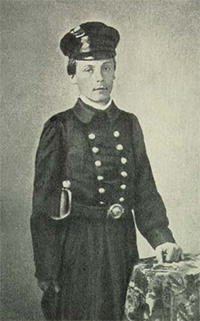 James Morris Morgan (right, 1845-1928) was a 17-year-old Acting Midshipman in the Confederate Navy, serving aboard the ironclad Chicora at Charleston, when he received orders sending him abroad, where he would later join the crew of the commerce raider C.S.S. Georgia. First, though, he had to get safely out of the Confederacy. One of his fellow passengers on the run to Bermuda was the celebrated naval officer and oceanographer, Matthew Fontaine Maury (1806-73). As Morgan would recall decades later in his memoir, Recollections of a Rebel Reefer, Maury’s presence aboard the runner would prove to be a fortuitous circumstance.

A Marker for Lieutenant Colonel Carter
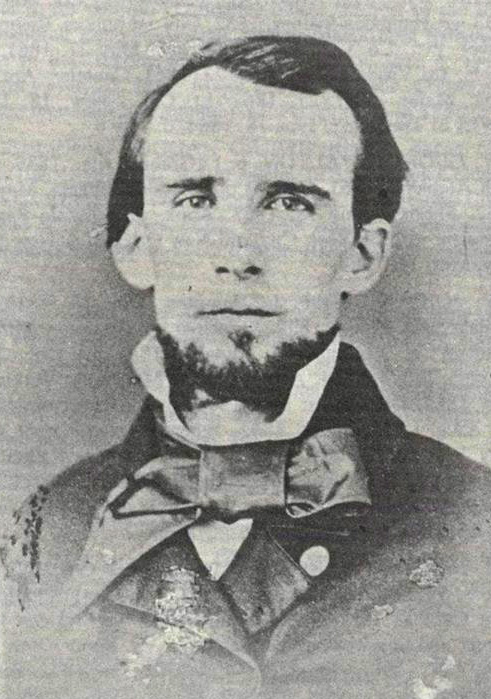
Back in 2010 I started this post about Lt. Colonel Benjamin Franklin Carter of the Forth Texas Infantry, but never finished it. Carter started out as commanding officer of Company B. He was promoted to Major in late June 1862, and advanced to Lieutenant Colonel two weeks later, on July 10, 1862, and commanded the regiment at Sharpsburg. Carter was grievously wounded during the Texas Brigade’s assault on Little Round Top at Gettysburg on July 2, 1863, struck by shell fragments in the face and legs. He lingered for almost three weeks, dying on July 21. My post was occasioned by a June 2010 news story, describing the placement of a marker at his gravesite.

In an interesting two-part story from the North Texas Herald Democrat, an officer of the 4th Texas Infantry killed at Little Round Top gets a grave marker in Pennsylvania:
[Lieutenant Colonel] Carter asked the doctor if there might be some gentleman in town to whom he could appeal for a Christian burial. When the doctor told McClure the story, McClure went to the hospital to visit Carter. Within days Carter died and McClure asked that he be buried in the Presbyterian burial grounds. The request was unanimously denied by the church members. Every other church in town also refused to allow Carter to be buried in their cemeteries. Finally, with help from a member of the Methodist Church, a burial plot was allowed in the Methodist Cemetery and Carter received a Christian burial there. For 33 years Carter lay in that grave with a granite headstone until the cemetery was sold, along with the Methodist Church, to the Brethren congregation. When the church decided to enlarge its facilities, the only way it could build was into the burial grounds. Forty-seven graves of people who had no one to claim their bones, including Carter’s, were disinterred and taken to the Cedar Grove Cemetery and buried in a single grave with no head stone. It was said that Carter’s stone probably was used as ballast when the concrete was poured for the new section of the church.
Benjamin F. Carter was born in Tennessee in 1831. At the time of the 1850 census, eighteen-year-old Carter was teaching school in Giles County, Tennessee. After completing Jackson College, he relocated to Austin, where he worked as an attorney. He served a term two consecutive one-year terms as Austin’s mayor in 1858 and 1859. In the 1860 census, he is listed as 29 years old, with a wife Louisa and two daughters, ages 1 and 3. He reported owning $2,000 worth of real estate, but did not report any personal property. He is not listed that year as a slaveholder.
With the coming of the war he organized a company called the Tom Green Rifles, that ultimately became Company B of the 4th Texas Infantry. Van C. Giles, a member of Carter’s company, noted years later that the entire regiment was teeming with members of the bar:
Of the ten original captains who went to war in Virginia with the Fourth Texas regiment in 1861, six of them were lawyers, two merchants, one a farmer and one a stockman. Of the thirty lieutenants, nearly one-third were lawyers. Of the fifty sergeants, fifteen were lawyers, and of the 1500 men who served in that old regiment from the beginning to the finish, there was no end to lawyers and law students. Of course there were not enough offices in the regiment for all of them. Lawyers in war are like lawyers in peace, they go for all that’s in sight. They held the best places in the army and they hold the best places in civil life. It’s a mighty cold day when a lawyer gets left if chicken pie is on the bill of fare.
Even among the lawyer-soldiers of the 4th Texas, though, Carter stood out:
Captain B. F. Carter of Company B was far above the average of men as you meet them. Intellectually, he had no superior in the regiments. A fine lawyer, a natural born soldier, he was a strict disciplinarian, but practical and just in all things. He possessed the gift of knowing how to explain every maneuver set down in Hardee’s Tactics so thoroughly that the biggest blockhead in the ranks could understand them Physically he was not strong and the long marches used to weary him very much. On those occasions, to help him along, the boys would divide up his luggage, one taking his sword and belt, another his haversack and canteen another his blanket, and so forth. By this means we managed to keep him up. . . . There was not an officer in Hood’s Texas Brigade in the Army of Northern Virginia who was more universally loved and admired by the soldiers of that old command than Lieutenant Colonel Ben F. Carter of the Fourth Texas Regiment, whom I have mentioned earlier. He was the very soul of honor, full of the milk of human kindness, yet at times he appeared harsh and cruel, especially to those who did not know and understand him. . . . After our arrival at Richmond [Virginia] in the summer of 1861, many of the men were sick from exposure and change in climate. They were sent to various hospitals in the city. Captain Carter would send someone every day to see how his boys were getting along, but would never go in person to see them. He would buy and send them little delicacies, and to some of the prodigal fellows who never had a cent he often sent money.He manifested the greatest interest in his men and nothing the quartermaster could issue was too good for old Company B — but he strictly avoided coming in contact with the sick and wounded. He often spoke of this peculiarity, or apparent indifference, explaining it by saying that he could not bear to see any one suffer, and that he had a perfect horror of a sick room.
Giles was writing long after the war, of course, so his profile of Carter undoubtedly includes a certain nostalgia, along with the knowledge that Carter did not survive the war. Nonetheless, it offers a vivid portrait of the man, and evinces affection and respect.
Part 2 of the news story is here.
_________
Carter portrait via user AUG351 at Civil War Talk.




 Dead Confederates, A Civil War Era Blog
5 comments