Jeff Davis
Ulysses S. Grant’s horse, Jeff Davis, at City Point, Virginia, March 1865. Library of Congress image.
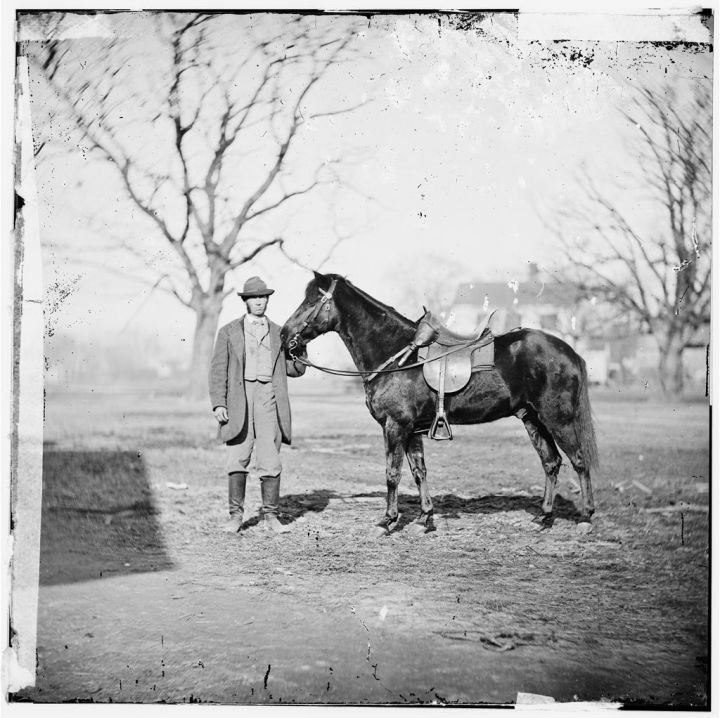
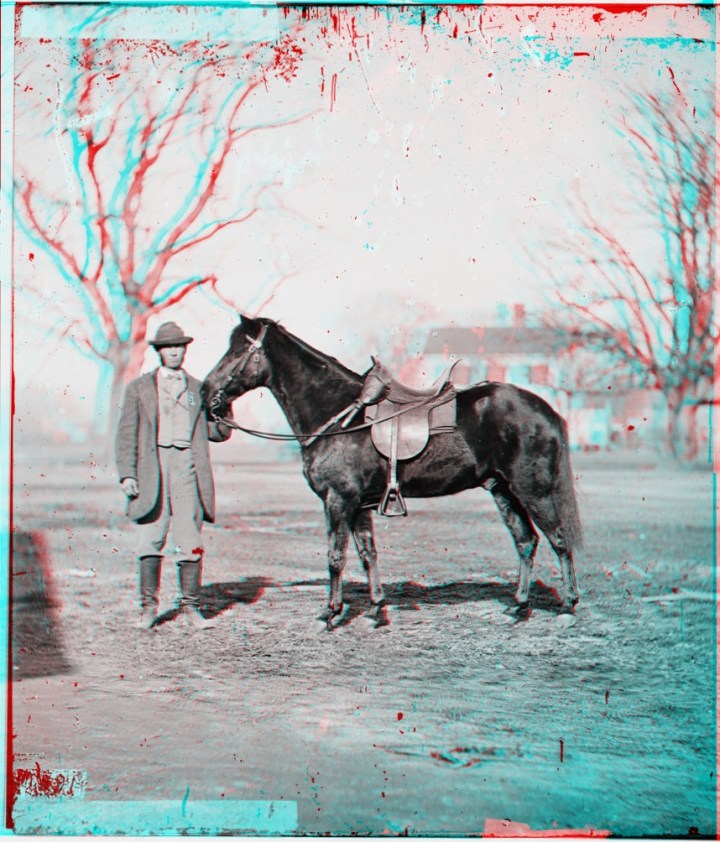
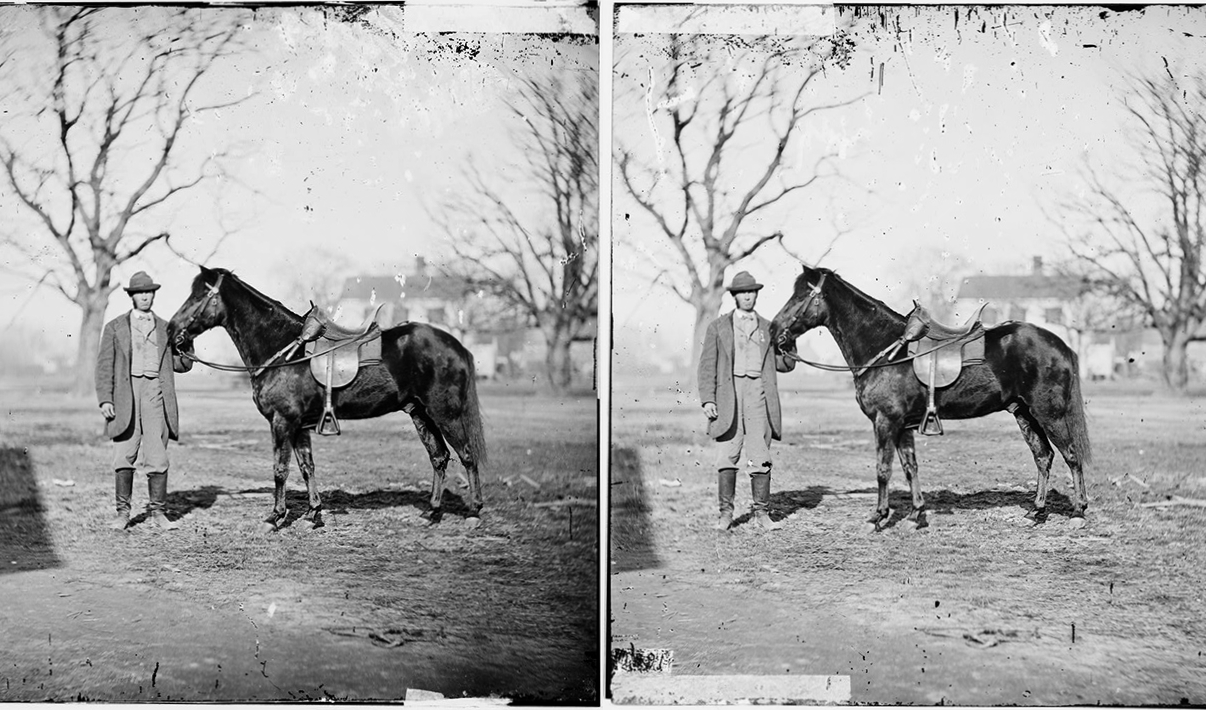
Grant was known from his West Point days as a superb horseman, even though he didn’t cut a very heroic-looking figure when mounted; he was famously described as sitting in the saddle “like a sack of meal.”
Grant’s son Fred described how his father came to value this animal:
In [the Vicksburg] campaign, General Grant had two other horses, both of them very handsome, one of which he gave away and the other he used until. late in the war. During the campaign and siege of Vicksburg, a cavalry raid or scouting party arrived at Joe Davis’ plantation (the brother of Jefferson Davis, President of the Confederacy) and there captured a black pony which was brought to the rear of the city and presented to me. The animal was worn out when it reached headquarters but was a very easy riding horse and I used him once or twice. With care he began to pick up and soon carried himself in fine shape. At that time my father was suffering with a carbuncle and his horse being restless caused him a great deal of pain. It was necessary for General Grant to visit the lines frequently and one day he took this pony for that purpose. The gait of the pony was so delightful that he directed that he be turned over to the quartermaster as a captured horse and a board of officers be convened to appraise the animal. This was done and my father purchased the animal and kept him until he died, which was long after the Civil War. This pony was known as “Jeff Davis.”
___________

Talkin’ Steamboats

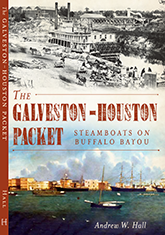
I’ve got three book events scheduled before the end of the year, and I’d really excited about them.
On Thursday, December 13 at 7 p.m., I’ll be speaking at the Houston Maritime Museum, as part of their lecture series sponsored by the UTC Project, Inc. The museum is centrally located in Houston, just west of the Texas Medical Center, off Holcombe. The museum has a fantastic model collection, and is well worth a visit — whether you can make it on Thursday or not.
On Saturday, December 15 from Noon to 5 p.m. I’ll be participating in the G. Lee Gallery Book Bash, in downtown Galveston on Postoffice Street. My longtime friend Jan Johnson will be there with her new book, Beyond the Beaten Paths: Driving Historic Galveston, along with other authors. Please come on down, and have lunch just around the corner at the historic Star Drug Store while you’re at it.
Finally, on Thursday, December 20 at 6:30 p.m., I’ll be speaking at the Brazoria County Historical Museum in Angleton, in Brazoria County. I got to speak there a year or so ago on blockade runners, and it will be great to go back.
All the specifics:
Buffalo Bayou Steamboats Book Lecture and Signing, Houston Maritime Museum Thursday, December 13, 7 p.m. 2204 Dorrington StreetHouston, Texas Buffalo Bayou Steamboats
Book Signing, G. Lee Gallery (with other great authors)
Saturday, December 15, 2012, Noon to 5 p.m.
2215 Postoffice Street
Galveston, Texas Buffalo Bayou Steamboats Book Lecture and Signing, Brazoria County Historical Museum Thursday, December 20, 6:30 p.m. 100 E. Cedar Street
Angleton, Texas
Hope to see you there!
____________
Image: George Catlin’s painting of the steamboat Yellow Stone at St. Louis, Missouri, in the early 1830s. Yellow Stone had already made a name for herself on the Missouri before being brought to Texas, where she ran on the Brazos River and Buffalo Bayou.
Spectators at the Capitol for the Grand Review
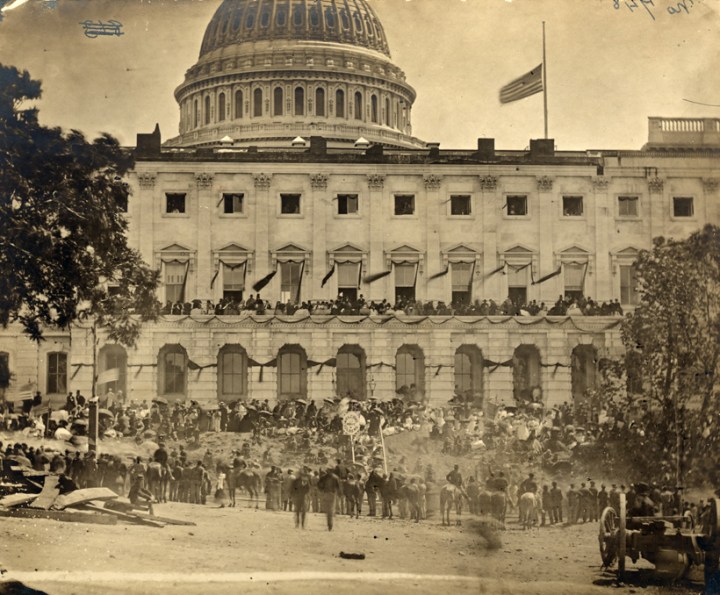
Spectators at side of the Capitol, which is hung with crepe and has flag at half-mast during the Grand Review of the Union Army, May 23-24, 1865. The signboard at lower center reads, “WELCOME BRAVE SOLDIERS.” Viewers of the film Lincoln may have noted that the Capitol’s iron dome was shown in the movie as a dark gray, instead of painted white as it is now; this can be seen at the top of the image. Based on the shadows, I’d say this is the north end of the Capitol, looking south. Library of Congress. Larger version here.
____________
Mariners’ Museum Panel on U.S.S.Monitor Crew Identification
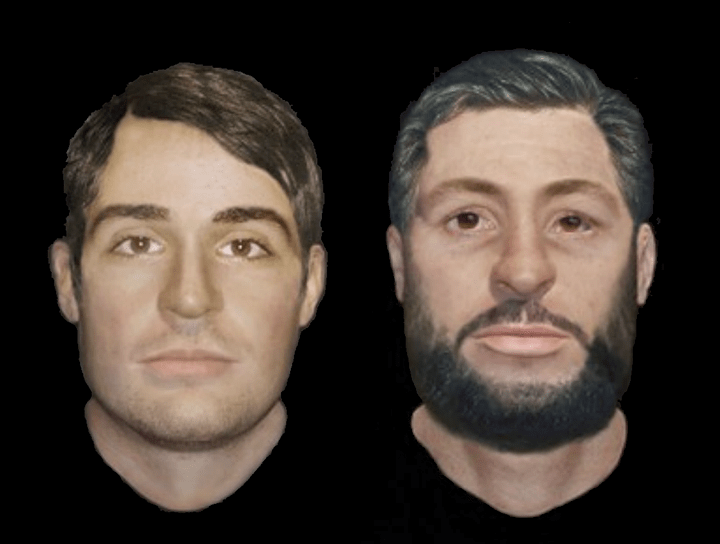
From the museum:
Tuesday, Dec. 11 at 7 PM, The Mariners’ invites you to join us for a special panel discussion entitled Giving Back Their Names: The Effort to Identify the Lost Monitor Boys. The discussion will feature USS Monitor experts from the National Oceanic and Atmospheric Administration and The Mariners’ Museum, who will talk about the ongoing effort to identify two Monitor sailors whose remains were recovered 10 years ago. Panelists will also discuss the night 150 years ago that the Monitor sank, in a gale off the coast of Cape Hatteras, N.C., claiming 16 lives. The discussion will broach facial reconstructions by Louisiana State University forensics experts, and historical and archaeological information about the Monitor‘s final moments. The experts will also discuss the upcoming dedication of a memorial for the sailors, and ongoing efforts to inter the sailors at Arlington National Cemetery. The panelists will also reveal and discuss recently conserved personal possessions from Monitor‘s crew that were recovered by archaeologists from the revolving gun turret. These special artifacts have never before been displayed in the Monitor Center. Panelists at the Dec. 11 event will include David Alberg, Superintendent of NOAA’s Monitor National Marine Sanctuary, John Broadwater, former Chief Archaeologist at the Office of National Marine Sanctuaries, and David Krop, Director of the USS Monitor Center. The session will be moderated by Anna Holloway, Curator of the USS Monitor Center. This event is free and open to the public. Members are encouraged to reserve a seat by calling (757) 591-7751. For information on the fall 2012 lecture series, click here.
The Fiery End of the Buffalo Bayou Steamboat Grapeshot
 A friend of mine e-mailed me the other day, having come across a steamboat name in the Buffalo Bayou book he’d always liked, Grapeshot. I agree — it’s a great name for a steamboat. Or a dog. Or a dog on a steamboat.
Grapeshot was a small, 179-ton sidewheeler built at Louisville in 1855.[1] According to Pam Puryear and Nath Winfield in Sandbars and Sternwheelers, she was built expressly for the Brazos River trade, running between landings on that river and Galveston, Texas’ primary seaport at the time.
The new boat’s arrival was widely anticipated on the Brazos; in late October 1855 the Columbia Democrat and Planter notified its readership that “the Grapeshot passed Vicksburg on the 17th Oct. en route for the Brazos river.” Unfortunately, the boat ran into trouble almost immediately, when in late November she attempted her first trip on the Galveston and Brazos Canal, a route that provided a sheltered passage between Galveston and the river, without boats having to risk the fifteen-mile stretch of the Gulf of Mexico between San Luis Pass, on the west end of Galveston Island, and the mouth of the river. A “norther,” a hard, cold northerly wind blew the boat hard against the edge of the cut channel, and stranded her so firmly that she couldn’t get off again until the wind died down. [2]
This was a common problem on the canal, which at the time was not yet two years old. The canal itself, the part cut through dry land, was short, less than five miles, but dredging and other improvements extended another thirty miles through an existing series of bays and lagoons to Galveston. The canal was only a very modest commercial success – it was found to be too narrow in some places, too shallow in others, and altogether too crooked – and it was found additionally that the steamboats’ sidewheels chewed away at the soft banks of the dredged channel, making repairs and upkeep an ongoing struggle. In time, sidewheelers like Grapeshot were barred from using the channel altogether, which greatly reduced its commercial viability.
Puryear and Winfield say that, having been proved unsuitable for the canal before even having completed a single passage of it, Grapeshot was soon relegated to the safer confines of the river itself, carrying passengers and cargo between river landings and the Buffalo, Bayou, Brazos& Colorado Railroad line at Richmond. But that seems not to be the case, because the very next month Grapeshot was running cotton down to Galveston from Buffalo Bayou, and announcing plans to run up the Trinity, all taking advantage of trade to be had during the fall and winter cotton shipping season. In one trip in January 1856, for example, she brought 564 bales of cotton down to Galveston, consigned to local merchants including J. C. Kuhn and William Hendley. The following week she brought down 548 bales, consigned to various Galveston factors.[3]
But it would be the Trinity where Grapeshot would find a permanent home. After a single trip up that river, the boat’s owners, Captain S. P. McGuire and his clerk, were convinced to sell their boat to Captain H. R. Dawson.[4] By the spring of 1856, Grapeshot seems to have settled into a regular routine of running between Galveston and landings on the Trinity River. In late March, for example, the boat was reported to have a arrived at the mouth of the river, downbound to Galveston, carrying 900 bales of cotton, a cargo almost certainly split between the boat itself and a towed barge, as was becoming common practice at the time. Nonetheless, if true, it was a remarkable haul for a boat that size. By May, with the river rising on from the springtime rains, Grapeshot was reported heading into the upper stretches of the river, well beyond Liberty.[5] Business was good on the Trinity, and Grapeshot’s master, Dawson, took a leading role that spring in organizing the Trinity and Liberty Steamboat Co., an enterprise founded to construct and operate a steamboat between Liberty and Galveston, “and up the Trinity river when the water will admit of it, providing this shall not interfere with her regular trips, between Liberty and Galveston.” The company was capitalized at $10,000, with 200 shares valued at $50 each. Dawson personally went in for one-third of the value of the company, 66 1/3 shares. Dawson, who press accounts described as having “had experience boat building on the Ohio River,” announced he was ready to begin construction of the boat at Green & Branch’s Mill, few miles above Liberty, assisted by Mr. W. Wicks, a “practical engineer,” and Mr. P. Burke, a ship’s carpenter.[6]
Grapeshot continued to run primarily, if perhaps not exclusively, on the Trinity for the next two years. There are several contemporary references to her reaching Parker’s Bluff, a river landing in Anderson County near present-day Palestine, over 500 statute miles from Galveston, following the serpentine bends and twists of the river. (It’s about 170 miles straight-line distance.)
The end for Grapeshot came on May 9, 1858, soon after the boat left the wharf at Galveston for the mouth of the Trinity River. The boat was caught in rough weather, and her master sought shelter in the lee of Pelican Island, just north of Galveston harbor. In the pitching waves her chimneys toppled, crushing the boiler deck down onto the boilers themselves and setting fire to the timbers. All aboard escaped with their lives by clambering onto the barge they had been towing, and then cutting the barge adrift, but the boat and much of her cargo were lost. Grapeshot’s passengers and crew were picked up and returned to Galveston aboard the Houston Navigation Co.’s steamer Island City, while the cargo barge Grapeshot had been towing was taken in charge by the steamer Water Witch. Grapeshot herself burned to the waterline, a total loss.
The Union Insurance Co. of Galveston ultimately paid its full liability of $2,614.86, and other insurers were reported to have settled claims for around $14,000. The total financial loss represented by the boat and her cargo had been estimated at the time to be between fifty and sixty thousand dollars.[7]
Sadly, contemporary accounts do not record whether Grapeshot had a dog for a mascot. But I’d like to think she did.
[1] Frederick Way, Jr., Way’s Packet Directory, 1848-1983 (Athens, Ohio: Ohio University Press, 1983), 197.
[2] Columbia Democrat and Planter, October 25, 1855, 2; Pamela Ashworth Puryear and Nath Winfield, Jr., Sandbars and Sternwheelers: Steam Navigation on the Brazos (College Station: Texas A&M Press, 1976), 88; Texas Ranger, November 29, 1855, 2.
[3] Galveston Commercial, December 27, 1855, 2; ibid., January 10, 1856, 2; ibid., January 17, 1856, 2.
[4] W. T. Block, Cotton Bales, Keel Boats and Sternwheelers: A History of the Sabine River and Trinity River Cotton Trades, 1837-1900 (Woodville, Texas: Dogwood Press, 1995), 204.
[5] Galveston Weekly News, May 27, 1856, 1
[6] Galveston Weekly News, March 25, 1856, 3; ibid., June 17, 1856, 3.
[7] Puryear and Winfield, 88; Palestine, Texas Trinity Advocate, May 19, 1858, 2; San Antonio Ledger and Texan, May 15, 1858, 3; San Augustine Eastern Texian, May 29, 1858, 2; Galveston Civilian and Gazette, June 15, 1858, 2.
____________
Steamer Robert Morris at Yorktown, 1862
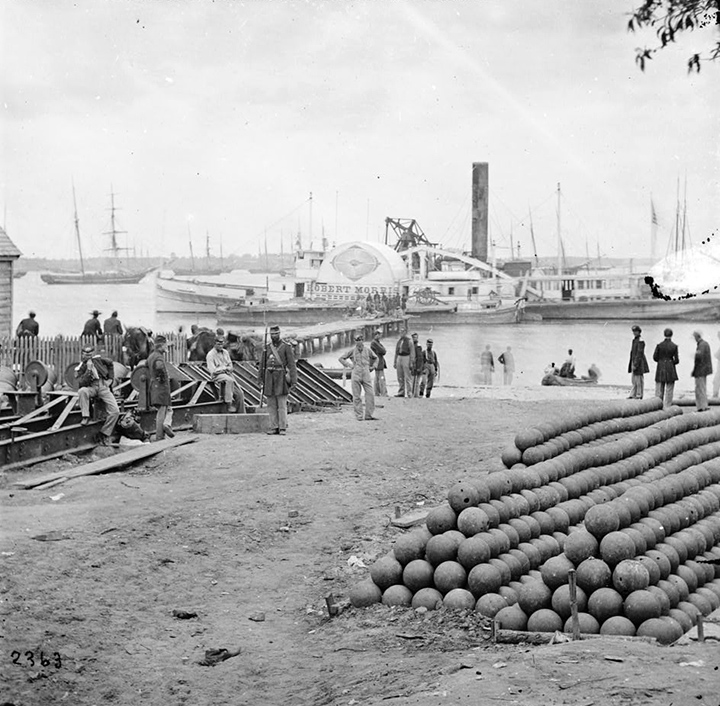
Original caption: Stereograph showing Union soldiers and supplies including stacks of cannon balls at the dock in Yorktown, Virginia. Steamships in the distance will transport the supplies to White House Landing Virgina. Library of Congress photo.
The sidewheel steamer Robert Morris was chartered by the Federal army three times: December 28, 1861 to January 26, 1862; April 1, 1862 to July 3, 1863; and December 19, 1864 to September 21, 1865. This image, published in May 1862, shows her during the Pensinsular Campaign of that spring, when she was primarily employed as a troop transport.


____________
H. K. Edgerton to Seek Presidential Pardon for Ron Wilson


Much to my happy surprise, H. K. Edgerton responded to my recent post about Ron Wilson. He’s going to be requesting a presidential pardon for South Carolina con-man, because, um, too many people hold high regard for Abraham Lincoln, or something:

I am deeply grieved about what happened to the Honorable Ron Wilson and to those who were hurt by his actions. And I pray for them and for Ron equally. There are not many men who have not made serious mistakes in their lives. I shall never falter in my love and respect for Mr. Wilson, and shall never see him as a racist, or the other unkind things that take away from the content of his character that shall always deem him to be an Honorable man. If one chooses to make an Honorable man of Abraham Lincoln, then one should choose to seek a Presidential Pardon for Ron, and one for young Candice Yvonna Hardwick that I have already asked him for. And I care less about the unkind words spoken here about me. Christ and General Nathan Bedford Forrest had to endure worst.
 For those who don’t know, Candice Hardwick (above and right, via Mugshots.com) is a young woman from Latta, South Carolina. In 2006 she was suspended twice from school for wearing a Confederate flag shirt. She sued, and her case became a cause celebré among heritage groups. Just a few months ago, Edgerton participated in a ceremony presenting Hardwick with a medal for her heritage activities. Nonetheless, her case was dismissed in March and three months later, in June, she burglarized a home in Latta and stole eight firearms. In August she was sentenced to six years in prison, but will likely be out in three.
Hardwick’s story is a sad one, and I’m not unsympathetic to it, but it’s not one that represents a gross miscarriage of justice. There are lots of people serving longer sentences, for lesser crimes, than either Hardwick or Wilson. And the notion that Ron Wilson is “an Honorable man” who simply made a “serious mistake” that should not reflect on “the content of his character” is one of the more preposterous things Mr. Edgerton has said over the years.
As to the “unkind words spoken here” about Mr. Edgerton, it’s actually more serious than that. I’ve directly challenged claims made by Edgerton and others that his organization, Southern Heritage 411, actually holds non-profit status, or that contributions to it are tax-deductible. I can find no evidence that either of these things are true. I’m no lawyer, but I can’t help but think that if Southern Heritage 411 is, in fact, the for-profit corporation that it claimed to be in filings with the Georgia Secretary of State, Mr. Edgerton has made a very “serious mistake” of his own.
As always, of course, Mr. Edgerton is welcome to provide documentation that I’ve got this non-profit stuff all wrong. But I don’t think I do.
_________
Alcohol May Have Been Involved. . . .
Over the weekend by colleague, Ed Cotham, offered a sesquicentennial story about a one-armed Confederate scout, collecting intelligence on the position of Union forces in Galveston. It was very nearly disastrous:

As he approached The Strand area, Barnett was carrying a shotgun in his remaining arm. He was also apparently well-fortified with spirits for his scouting assignment. As news reports today might hint, it was strongly suspected that “alcohol may have been involved.” On this night, that decision almost cost Barnett his city and his life. Galveston was in the possession of the Union, the Federal Navy having captured the city in early October. But the Union presence remained almost exclusively a naval one. The infantry forces assigned to Galveston would not arrive for several more weeks. There were, however, a few Union marines acting as sentries along the waterfront. On this occasion, Barnett did not move with the stealth that his job required and was unlucky enough to be challenged by one of the understandably nervous sentries to identify himself. Barnett told the sentry undiplomatically to go to the nether regions and matters went from bad to worse. The two exchanged several off-target shots. Barnett later claimed that he had only fired his shotgun once. This noise, however, drew the attention of the Federal gunboats in the harbor, which became convinced they were being attacked and began firing randomly into the darkened city.

________
Sunday Night Concert: “Pay Me My Money Down”

In 1944 Alan Lomax recorded a song, “Pay Me,” sung by African American stevedores in Brunswick, Georgia. In 1960 Lomax wrote:
They bellowed songs as they hoisted, heaved and screwed down their cargoes, as had twelve generations of their forebears. By the 1940s, however, their songs were no longer nostalgic or oblique. . . . [Their songs] said directly and openly what they thought, and their song has proved enormously appealing to young people all across America.
The song, with a simple melody and simpler lyrics, became a popular his during the folk music revival of the late 1950s and early 1960s. One of the young people Lomax was talking about in the early ’60s was a kid from Freehold Borough, New Jersey named Bruce Frederick Joseph Springsteen. He revived the song a few years ago for his Seeger Sessions Band. Their cover may not sound much like the one Lomax heard in Brunswick sixty-odd years before, but it is guaranteed to lift your spirits.
[This is a repeat post from September 2011, because today I heard someone butcher this song. This repeat will help get that out of my head.]
_____________

Fighting Upon His Own Hook
From an unsourced newspaper clipping, found in a scrapbook compiled by English phrenologist George Burgess (1829-1905):
FIGHTING UPON HIS OWN HOOK. – A Kentuckian, who disdained the restraints of a soldier’s life, with his name on the muster-roll, preferred “going it alone,” fighting upon his own hook. While the battle was raging fiercest, and the shot flying thick as hail, carrying death wherever they fell, Kentuck might have been stationed under a tall maple, loading and firing his rifle, as perfectly unconcerned as though he was “picking deer.” Every time he brought his rifle to his shoulder one of the enemy bit the dust. A general officer, supposing he had become separated from his company, rode up to bring him behind the redoubts, as he was in a position which exposed his person to the fire of the enemy. “Hallo, my man! What regiment do you belong to?” said the general. “Regiment!” answered Kentuck. “Hold ‘em, yonder’s another of ‘em.” And bringing his shooting-iron to his shoulder, he ran his eye along the barrel – a flash followed, and another of the enemy came tumbling to the ground. “Whose company do you belong to?” again inquired the general. “Company be banged!” was the reply of Kentuck, as he busied himself re-loading. “See that ar fellow with the gold fixins on his coat and hoss. Jist watch me perforate him.” The general gazed in the direction indicated by the rifle, and observed an officer riding up and down the advancing columns of the foe. Kentuck pulled the trigger, and another officer followed his companions that Kentuck had laid low in the death that day. “Hurrah for Kentuck!” shouted the free fighter, as his victim came toppling from his horse; then turning to the general, he continued, “I’m fighting on my own hook, stranger,” and leisurely proceeded to reload.
_________





 Dead Confederates, A Civil War Era Blog

11 comments