Why is H. K. Edgerton Claiming Non-Profit Status?
Looks like some of the folks over at SHPG are questioning H. K. Edgerton’s stated appearance fee of $20,000. There seems to be some dispute over how much he actually collects, but twenty grand (plus mileage) is what he claims his services are worth. I happen to think it’s a pretty ridiculous amount for what he does, but that’s my opinion; you may feel otherwise. The bottom line is, Edgerton can ask for whatever he wants.
The far more important question, that his friends and supporters haven’t yet addressed, is why Edgerton continues to claim Southern Heritage 411 is a non-profit organization, and solicit donations with the claim that such contributions are tax-deductible:

To those of you who would like to make a tax deductible contribution to a non- profit organization and support H.K. Edgerton now, please make your checks payable to: Southern Heritage 411 and send it to:’ Southern Heritage 411, Inc.
P O Box 220
Odum GA 31555-0220 Dewey Barber
Owner, Dixie Outfitters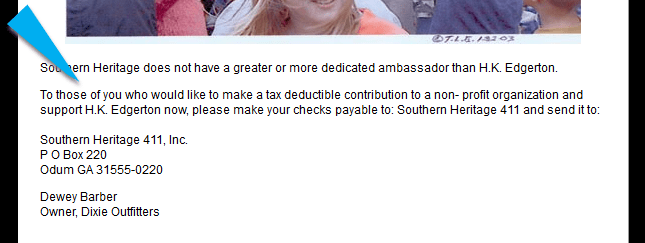

Neither of those things appear to be true now, or ever. I’m no attorney, but I have to think there are very serious legal ramifications in this for both Edgerton, who was listed as Chief Financial Officer for the for-profit company as late as 2010, and for Dewey Barber of Dixie Outfitters, who is the actual CEO and owner of the business, if the IRS ever takes an interest in this stuff.
____________

Did Jefferson Davis’ Son Serve in the U.S. Navy?
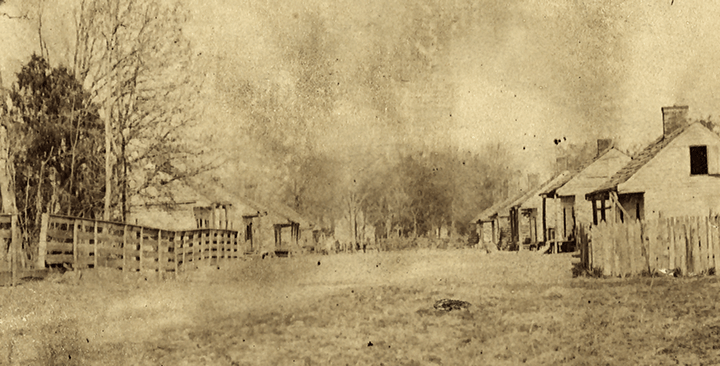
Slave quarters on Jefferson Davis’ plantation, Library of Congress.
Did Jeff Davis’ son by an enslaved woman serve in the U.S. Navy on the Mississippi?
Over at Civil War Talk we had a discussion over this item that appeared, almost word-for-word, in numerous Northern newspapers beginning in February 1864:
The London Star of January 15th says a letter from a gentleman occupying a high position in the United States, contains the following story: This reminds me says the writer, that Jeff. Davis’ son, by his slave girl Catherine, was in the Federal service on board of one of our gunboats, in the Mississippi, for several months—a likely mulatto. Among the letters of Jeff, taken at his house by our Illinois troops, there was a batch of quarrelsome epistles between Jeff. and Mrs Davis, touching his flame Catherine. Mrs. Davis upbraided her husband bitterly. I have this story from one of the highest officers in the squadron, who had the negro Jeff. on board his gunboat, and who himself read the letters and suppressed them.
It sounds exactly like the sort of scurrilous accusation that Northern readers would want to hear about Jeff Davis, like the story the following year about his being captured by Federal troops while wearing a dress. It has the ring of tabloid-y trash, and it’s easy to dismiss on that account.
However, there’s another, longer story from the Bedford, Indiana Independent of July 13, 1864 (p. 2, cols. 3 and 4) that, while differing in several details, largely supports the claim in the London Star, and provides substantial corroborative detail:
Jeff. Davis and His Mulatto Children — Abolitionists are constantly accused in copperhead papers of trying to bring about an amalgamation of whites and blacks; but those papers are very careful to conceal from their readers, as far as possible, such facts as those related in the following extract of a letter from an officer in the Army to a Senator in Washington: “While at Vicksburg, I resided opposite a house belonging to a negro [sic.] man who once belonged to Joe Davis, a brother of Jeff. Learning this, I happened one day to think that he perhaps would know something about the true story told in the London Times, that there was a son of Jeff. Davis, the mother of whom was a slave woman, in our navy. The next time I met the man I asked him if he had ever known Maria, who had belonged to Jeff. Davis, and was the mother of some of his children? He replied that he had not known Maria, but that he knew his Massa Joe Davis’ Eliza, who was the mother of some of Massa Jeff’s children. I then inquired if she had a son in the navy? He replied that she had — he knew him — they called him Purser Davis. He said that Eliza was down the river some thirty miles, at work on a plantation. The next day, as I was walking down the street, I met the man, who was driving his mule team, and he stopped to tell me that Eliza had returned. A few moments afterwards he came back, and pointing to one of two women who came walking along, he said she was the one of whom we had been talking. When she came up, I stopped her, and inquired whether she had not a son who would like to go North. She replied yes and added that she would like to go too. I told her that I only wanted a lad. She said that her son had gone up the Red River on board the gunboat Carondelet, but when he returned she would be pleased to have him go. ‘Well,’ said I, ‘some say that Jeff. Davis is your son’s father — do you suppose it’s so?’ ‘Suppose,’ she cried with offended pride, ‘I’s no right to suppose what I knows — am certain so. Massa Jeff. was the father of five of my children, but they are all dead but that boy, and then I had two that he wasn’t the father of. There’s no suppose about it.’ Perhaps if the boy gets back safe on the Carondelet, you may see him in Boston some of these days.”
Here’s where it gets interesting. The correspondent recorded the young Carondelet sailor’s name he was told as “Purser Davis.” There was, in fact, not a Purser Davis, but a Percy Davis in the crew of U.S.S. Carondelet at that very moment. According the NPS Soldiers and Sailors System, a fourteen-year-old named Percy Davis was enrolled for a term of one year as a First Class Boy on the ship at Palmyra, Mississippi on November 16, 1863 — almost exactly two months before the original news item appeared in London. He remained on board Carondelet at least through the muster dated January 1, 1865. Davis is described as being mulatto in complexion, and five-foot-one. Percy Davis gave his birthplace as Warren County, Mississippi — the county of Vicksburg, and where both Jefferson Davis and Joseph E. Davis were major slaveholders, with 113 and 365 slaves respectively at the time of the 1860 U.S. Census.
Does this prove the original story is true? No, but it does add considerable additional detail, some of which is corroborated. The first news item is vague, without any specifics, but the second is detailed and at least partly verifiable. There’s enough here that the claim of Davis’ natural son having served aboard a Union gunboat cannot, in my view, be dismissed out-of-hand as Civil War tabloid trash. The possibility of its truth merits further digging.
_____________

Canister!
Small stories that don’t merit individual posts of their own:
- The grave of former Confederate Private Hugh McLaughlin was recently marked in Spokane, Washington, thanks to sleuthing by his great-granddaughter, who started out not knowing anything about his wartime service. That’s neat.
- Are the Sons of Union Veterans of the Civil War actually agents of intolerance? Are they really as controversial as, say, the New Black Panthers or the American Communist Party? Clint Lacy seems to think so.
- In a whiplash-inducing, 48-hour turnaround, Lynyrd Skynyrd first rejects, then re-adopts, future use of the Confederate Battle Flag at their concerts. The only question remaining is, which are we supposed to assume was their “principled” position on it? I say, neither.
- If you missed my post the other day about the staff layoffs at the Theater at Lime Kiln in Lexington, it’s worth looking at the comments. Flagger extraordinaire Billy Bearden cites federal unemployment stats from Lexington to show the effectiveness of the Flagger-led boycott of local business, which actually show a slight improvement in employment there since before the boycott took effect. It’s episodes like this that explain why we can’t quit you, man.
- One of the first reviews of Spielberg’s film “Lincoln” is out. Ann DeWitt is unhappy because the movie almost certainly doesn’t include a cameo by Bill Yopp.
- A couple of years ago, we noted the discovery of Camp Lawton, a Confederate PoW camp that was the successor to Andersonville. Work at the site continues, with archaeologists now announcing the discovery of sections of the south and west stockade walls, which help define the exact placement of the compound.
- The odious Kirk Lyons is now yammering something about Lincoln “stealing” the election of 1864. I had no idea ACORN had been around that long.
-
 Five people (right) — and maybe more to come — are facing federal charges for vandalism to a Civil War cannon at the Cumberland Gap National Historical Park in Kentucky. Good.
-
I’ve been very critical of Gary Adams in the past (with good reason) but he does have his moments. Susan Hathaway of the Virginia
FraggersFlaggers posted a newspaper editorial letter written by a member of her group about Robert E. Lee that included some blatant untruths — e.g., that Lee “owned no slaves personally” and that he freed all his wife’s slaves when they married. Hathaway, of course, cheers this foolishness on, adding, “way to get in there and get the victory…FLAGGER STYLE!” Adams, in his own passive, long-winded and way-too-polite-to-get-through-their-thick-skulls way, at least tried to correct some of them. Well done, sir, but may I suggest including a selective use of profanity next time? It helps get your point across.
- In a related note, we now know that “FLAGGER STYLE” means getting coverage in the media without regard to the factual truth of one’s message. (But we already knew that, didn’t we?)
- Happy belated birthday wishes to Donnie and Ron Kennedy, who turned 65 a few days ago. Now the Kennedy Twins, Southern nationalist movement celebrities and authors of The South was Right!, can start collecting full retirement and health benefits from the socialist federal government they so despise.
- Dumbass BuzzFeed intern tweets, “Romney motorcade just passed a hill flying a large confederate [sic.] flag in rural SW VA,” as if that’s supposed to mean something. Doesn’t he know that Mitt dissed that symbol years ago?
- Speaking of the Confederate flag and presidential candidates, Green Party candidate Jill Stein goes the Full Godwin. If she keeps talking like that, the Greens might not carry a single Southern state next month.
- Monocracy Brewing Company in Frederick, Maryland has bottled its first batch of beer based on a Civil War-era recipe, the first of nine releases projected for the CW sesquicentennial. “Antietam Ale” is an English bitter, ruby-red in color and relatively low in alcohol content. It’s available on tap at Brewer’s Alley in Frederick; no word on when it will be available for retail sale.
-
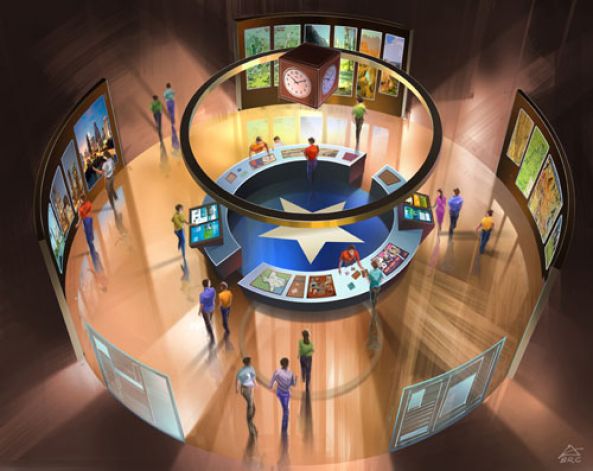
 It’s not really CW-related, but Texas businessman John L. Nau (right) has pledged $8M to the creation of a Southeast Texas history museum in downtown Houston, within a stone’s throw of the George R. Brown Convention Center, the Toyota Center (where the Rockets play) and Minutemaid Park (where the Astros play, sort of). Nau has a long history of commitment to Texas history, having served (among other posts) as Chairman of the Texas Historical Commission from 1995 to 2009. Although I have my doubts about the approach — it sounds more like a Vegas-style theme attraction (above) than a museum — it’s great to see this kind of private-sector commitment to public history. Nau has one of the great personal collections of CW gear, as well, that was featured in the exhibit last winter at the Houston Museum of Natural Science.
- U.S.S. Texas (BB-35) is again offering “hard hat” tours of areas of the ship that are usually closed to the public; I highly recommend them. Here’s one I was able to take a few months back.
- And Spanish archaeologists working in Rome believe they’ve identified the exact spot where Julius Caesar was assassinated in the Curia of Pompey, where the Roman Senate was meeting. They believe they’ve uncovered a monument placed at the spot by his nephew and adopted son, Octavian, who went on to rule as the first Roman emperor, Augustus. That’s cool.
Got any other news? Drop it in the comments below.
_____________

See Y’all at the Houston History Book Fair, November 10
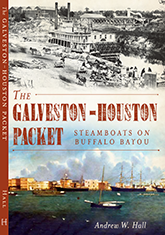
I’ll be speaking on my new book, The Galveston-Houston Packet: Steamboats on Buffalo Bayou, at the Houston History Book Fair and Symposium on November 10. It’s free and open to the public, so y’all have no excuse not to go. There will be some great presentations there by folks like my friends Ed Cotham, author of Battle on the Bay: The Civil War Struggle for Galveston and Sabine Pass: The Confederacy’s Thermopylae, and Jim Schmidt, author of the just-published Galveston and the Civil War: An Island City in the Maelstrom. It’s been a tremendous privilege to know these two men, and an honor to be included with them in this event.
The Galveston-Houston Packet is not a Civil War book per se, but the central (and longest) chapter in it deals with the Texas Marine Department, a unique organization within the Confederacy that used chartered civilian river steamers to create a logistical support and makeshift naval force, run by civilians, but all under the command of the Confederate army. It was a strange arrangement but, as at the Battle of Galveston on New Years Day 1863, it worked better than anyone should have expected it to.
More generally, the book tells the story of one of the vital early transportation routes that shaped the development of Texas. Most people imagine the settlement of the American West as signaled by the dust of the wagon train, or the whistle of a locomotive, but during the middle decades of the 19th century, though, the growth of Texas and points west centered around the 70-mile water route between Galveston and Houston. This single, vital link stood between the agricultural riches of the interior and the mercantile enterprises of the coast, with a round of operations that was as sophisticated and efficient as that of any large transport network today. At the same time, the packets on the overnight Houston-Galveston run earned a reputation as colorful as their Mississippi counterparts, complete with impromptu steamboat races, makeshift naval gunboats during the Civil War, professional gamblers and horrific accidents. The 143-page book includes endnotes, bibliography, rare photos, two original maps, and an index. It’s now available for pre-order at Amazon or Barnes & Noble at a great pre-publication price!
A few of the images included:
Sam Houston on Louis Trezevant Wigfall
 From Harper’s Magazine, August 1868:
The anecdotes of Ex-President Houston in the March Number of the Drawer remind a correspondent of a scene that occurred in the city of Houston in the summer of 1861. “I was wending my way,” says he, “from the Old Capitol down Main Street, when I learned that’ Old Sam’ had just come up from his plantation at the month of Cedar Bayou, and stopped at the Fannin House. Never having seen him I went there. He was seated on the veranda, surrounded by a crowd, who were listening eagerly to all he said. As I came up some one asked, ‘Well, Governor, what do you think of [Louis T.] Wigfall (right)?’ (then a Senator in the Confederate Congress, and Brigadier-General commanding the First Texas Brigade in Virginia, and very popular with Texans, notwithstanding the enmity between him and Houston.) ‘Wigfall,’ said Old Sam, ‘why, Wigfall has always been a good deal of a puppy, and if he continues on in his present course he will eventually become a good deal of a dog!'”
And this, from the April 1870 issue:
On the election of Mr. Wigfall to represent Texas in the United States Senate, Governor Houston was asked, in allusion to the excessively intemperate habits of the Senator-elect, whether he thought Wigfall would be able to make his way to Washington.
“I think he rather will,” replied Governor Houston, “if he avoids Cincinnati.”
“What do you mean, Governor, by avoiding Cincinnati?”
“Why, Sir, the strychnine in the whiskey there will kill any dog!”
___________

“Do you liquor, ma’am?”

In the late winter of 1843-44, an Englishwoman by the name of Matilda Charlotte Houstoun (pronounced “Haweston”) visited Galveston with her husband, a British cavalry officer. The Houstouns were making a tour of the Gulf of Mexico, with Captain Houstoun trying to drum up interest in an invention of his for preserving beef. During their visit, the Houstouns boarded the 111-ton steamer Dayton, Captain D. S. Kelsey, for the trip up Buffalo Bayou to Houston:
It was about two o’clock in the afternoon of a bright frosty day, that we put ourselves on board the Houston steamer – Captain Kelsey. She was a small vessel, and drew but little water, a circumstance very necessary in these small rivers. The American river steamers differ very much in appearance from those to which an European eye is accustomed. They have the appearance of wooden houses, built upon a large raft; there is a balcony or verandah, and on the roof is what is called the hurricane deck, where gentlemen passengers walk and smoke. On the occasion of our taking our passage both ladies and gentlemen’s cabin were quite full, and I therefore preferred spending the evening in the balcony in spite of the cold. I had many kind offers of civility, but I could not help being amused at the terms in which some of them were couched. The question addressed to me of “do you liquor, ma’am” was speedily followed by the production of a tumbler of egg-noggy, which seemed in great request, and I cannot deny its excellence; I believe the British Navy claims the merit of its invention, but this is matter of dispute.
“Mrs. Houstoun,” as she styled herself at the time, would publish her first novel, Recommended to Mercy, in 1862, and go on to become one of the best-known female novelists in 19th century Britain. This excerpt, and the image of Galveston above, is from her travelogue, Texas and the Gulf of Mexico, or Yachting in the New World, vol., II, published in 1844.
______________

Hood’s Texas Brigade Seminar, October 26-27 in Austin

The Hood’s Texas Brigade Association, Reactivated, will hold its sesquicentennial seminar at Camp Mabry, Austin, Texas on Friday, October 26 and Saturday, October 27. The program, “Plowshares Into Swords: Hood’s Texas Brigade in 1862,” includes:

6:00 Socializing, followed by 7:00 dinner
8:00 Speaker: Dr. Susannah Ural, “The Best Material on the Continent: The Rise of Hood’s Texans in 1862” Saturday 8:00-9:00 Registration, Vendors/Exhibitors
9:00-9:05 Welcome by Martha A. Hartzog, President, Hood’s Texas Brigade Assn., Re-activated (HTBAR)
9:05-9:15 Report on the Two New Texas Civil War Battlefield Monuments by William McWhorter, Texas Historical Commission
9:15-10:15 Jack Waugh, Historian, “Granny Lee and the General with ‘the Slows’: The War on the Peninsula”
10:15-10:45 Break: Time to Visit Vendors/Exhibitors 10:45-11:45 Danny W. Davis, Ph.D., “The Bloody 5th at Second Manassas”
11:45-1:00 Lunch, with Speakers’ Q&A & Fund Raising for Restoration of 1st National Banner
1:00-1:30 Time to Visit Vendors/Exhibitors
1:30-2:30 Rick Eiserman, Historian: “The Ragged 1st: The Savage Assaults of Sharpsburg/Antietam”
2:30-3:00 Time to Visit Vendors/Exhibitors
3:00-4:00 Richard McCaslin, PhD: “So Many Leaders Dead or Gone: Rapid & Dramatic Changes in Hood’s Brigade Leadership”

Visitors are reminded that Camp Mabry is an active military installation, and a valid driver’s license or other photo ID is required to enter. There will be signage directing visitors to the Museum and to Building 8, where the Seminar will be held. A flyer and registration form is available here (PDF). Registration deadline is October 19.
_____________





 Dead Confederates, A Civil War Era Blog
4 comments