Kentucky Confederate Pensions Online
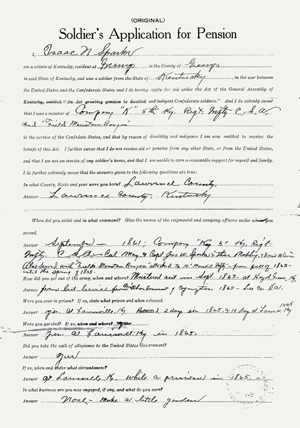 The digitization of important primary source materials continues apace. Yesterday, the Kentucky Department for Libraries and Archives announced that its Confederate pensions holdings are now online. Kentucky never formally seceded from the Union, and didn’t get around to establishing a pension program for Confederate veterans and their widows until 1912. The user interface in this case is dead simple, and the good folks there have added a handy feature I’ve not seen before — applications grouped by regiment, for Kentucky units.
Enjoy.
________
Image: The 1916 pension application for Isaac N. Sparks, formerly of Co. K, 5th Kentucky Mounted Infantry Regiment.

Canister!
Small stories that don’t warrant larger posts all their own.
- NPR had an interesting interview with Reverend Bryant Wright, President of the Southern Baptist Convention, about an initiative within that organization to change its name to something without the word Southern in the title. It’s apparently perceived by some within the church, particularly younger congregants, as a hindrance in attracting new congregations and followers. And it’s been a topic that’s been simmering in the background for over a century. As someone who grew up in SBC churches — RAs, Wednesday night pot-luck fellowship suppers and all that — I feel like I should care more about this than I do.
- Blogger Craig Swain passes along a news item about a new Confederate monument in a cemetery in Socorro, New Mexico, which makes reference to the “War for Southern Independence” and an effort to “liberate our beloved Texas and Southland.” No word if they ever built the monument to the flying saucer that landed there in 1964.
- The “Stainless Banner” variant of the Confederate national flag, displayed aboard the full-size replica of the C.S.S. Neuse in Kinston, North Carolina, is raising some hackles. While I’ve been critical of some public displays of the Confederate flags in the past, this seems to me like a legit context for it.
- In other flag news, NASCAR recently decided to bar the “General Lee” of Dukes of Hazzard fame from an event in Arizona, due to the Confederate Battle Flag emblazoned on its roof. New York resident Valerie Protopapas, one the more outspoken online defenders of Southron Honor™, thinks it’s an ill-conceived move. “If NASCAR is trying to attract blacks,” she says, “they haven’t a chance unless they do something else in those cars other than race around a track.” You stay classy, LadyVal!
- While futzing around YouTube, I stumbled on this Arabic-language documentary shot off Key Largo, Florida. (The good diving video is mostly in Part 4; the segment where he cuts himself with his dive knife is in Part 2) The site is known locally as “the Civil War Wreck,” and I don’t think is explicitly identified in the video. In fact, I’m pretty sure the producers had no idea the actual identity of the wreck, since they spend a lot of time talking about CW ironclads and submarines. It’s actually the remains of civilian merchant vessel Tonawanda, which during the war had been the Navy steam transport U.S.S. Arkansas, which spent much of the conflict with the West Gulf blockading Squadron, running a regular supply route along the coast between Ship Island, Mississippi and the mouth of the Rio Grande. Returned to civilian service under her original name, Tonawanda, she was wrecked on the Florida reef known as “The Elbow” in 1866. And yes, diving in the Keys really is that beautiful. He’s got some nice Great Barracuda video, as well.
- Completely unrelated to the CW, but historians at Hearne, Texas (north of Bryan/College Station) are working to preserve the memory of Camp Hearne, a facility for housing German PoWs during World War II. My father grew up in that area and remembers meeting PoWs as a kid, possibly from Camp Hearne. They were paroled out to work on farms in the area, to partly make up for wartime manpower shortages.
- Historian and Lincoln scholar Harold Holzer just published his 42nd book. Slacker.
 The trailer for Tim Burton-produced Abraham Lincoln: Vampire Hunter is out (above). In the comments below, Jeffry Burden correctly pegs the language as coming out of the Book of Revelation. Anyways, the movie looks like fun. Did you catch the train sequence?
- And on the subject of trains, descendants of Wilson W. Brown (right), a Union soldier and locomotive engineer from Ohio who took part in the famous Great Locomotive Chase, continue their legal wrangling over who’s the rightful heir to his Medal of Honor, one of the first awarded, along with a second, later version of medal. Fortunately, both sides in the lawsuit have agreed to loan the disputed materials to the Southern Museum of Civil War & Locomotive History, now home to the locomotive General, for the sesquicentennial of the Andrews Raid in April.
- Also speaking of trains, William G. Thomas, author of The Iron Way: Railroads, the Civil War, and the Making of Modern America, had a great piece the other day on the use of slave labor during the war in maintaining and expanding railroads across the Confederacy. As one commenter notes, Thomas’ work pretty much decimates the notion that slavery was an institution that only really functioned in an agrarian, plantation-based model and was therefore doomed to fade away in the face of increasing industrialization and mechanization.
- And while we’re on the subject of trains, blogger, historian, and modeler Bernard Kempinski produced this little tongue-in-cheek gem of a movie trailer:
_______________

Talkin’ Blockade Runners. . .

I’ll be speaking at the March 19 meeting of the SCV’s John Bell Hood Camp No. 50, at Shrimp & Stuff Restaurant in Galveston (7 p.m., in the private dining room). My talk will be a preview of my March 27 presentation at the Houston Museum of Natural Science, “For-Profit Patriots: Civil War Blockade Running on the Texas Coast.”
I appreciate the invitation, and am looking forward to it.
_____________
Image: Digital model of the blockade runner Will o’ the Wisp, wrecked at Galveston in February 1865.

A Big Win for Galveston Preservation and CW History

From today’s Galveston County Daily News:
In another coup for conservationists, Mitchell Historic Properties, a company owned by the family of billionaire developer George Mitchell, might as soon as today finalize the acquisition of a long-troubled building.
Mitchell Historic Properties plans to buy the east two bays of the Hendley Building on the northwest corner of 20th Street and The Strand. The building long housed Demack & Co., a produce wholesaler that closed in 1999. Demack & Co. couldn’t survive when the University of Texas Medical Branch and Galveston Independent School District began awarding multimillion contracts to larger grocery supply chains outside the city.
Bill Ross, senior vice president and general manager of Mitchell Historic Properties, said plans call for a major renovation of the building. One idea is that Galveston Historical Foundation would move into the first floor. Officials with the foundation could not immediately be reached for comment.
The Demack building has fallen into disrepair and has made the foundation’s Heritage at Risk list since 2003. Several family members claimed ownership of the building, complicating city efforts during the years to bring the building up to code. Mitchell Historic Properties, which is buying the building from James K. Rourke Jr. and Jack Alexander Demack, has invested many millions of dollars restoring 17 historic downtown businesses. Stay tuned.
This is wonderful news. Hendley’s Row — a single, large building encompassing four separate bays — is, along with the old U.S. Customs House, perhaps the most important war-related structure in town that survives. A cupola on its roof (visible in the top photo) was used as a lookout to track Union blockaders during the war, and Confederates occupying the building on the morning of January 1, 1863, used its back windows as a platform for sharpshooters and even light artillery during the Battle of Galveston. This structure has been slowly crumbling for a long time — even under Demack & Co.’s active proprietorship, it was a pretty sorry sight — and it’s great to see the prospect of serious and long-lasting restoration work being done.
___________Image: The Hendley Buildings on Strand Street, Galveston, in the 1870s and in 2011. As one of the tallest commercial buildings in town at the time of the Civil War, the Hendley Buildings (or Hendley’s Row) were a natural lookout point for observers watching both the Gulf of Mexico and Galveston Bay. A red flag flown from this building on July 2, 1861 announced the much-anticipated arrival of the Federal blockade. Upper image: Rosenberg Library.

Texas Confederate Pension Files on Ancestry


As anticipated, the Texas State Library and Archives Commission’s Confederate pension records are now available online at the subscription genealogy website Ancestry.com. Hard copies will still be available for order as before but, in keeping with a policy change last fall, researchers will be notified of the cost and must send in their payments before the library staff will make the copies. The actual cost is still appallingly, scandalously low.
The correct section at Ancestry is difficult to find, and is not yet indexed in their military pensions catalog. Use this link to go directly to that section, and be sure to select Texas for the state, as below:

The page reproduced above is a more-or-less random example from the files. It’s an affidavit in support of the 1913 application of Mary Ann McKinney of Mesquite, Texas. Her late husband, Eli Harris McKinney, had served in the 17th Alabama Infantry, and to support her application she submitted this affidavit from two men from Alabama who testified that Eli “was a good soldier and served as such untill [sic.] the close of the war.” (Eli’s CSR, available through Fold3, shows him enlisting in September 1862 and being surrendered with Joe Johnston’s army in North Carolina in April 1865.) Eli had died in 1881, ten years after his marriage to Mary; she began receiving a pension in March 1914 and continued to receive it until her own death in Ranger, Texas in August 1922. Mary McKinney’s application also provides an important reminder about Confederate pensions: they were issued by the state in which the applicant lived, not the state he was born in, or of the unit in which he served.
The Texas State Library and Archives Commission had an efficient and inexpensive system for providing these materials before, but efforts to put these materials online (even on a paid subscription site) are really opening doors for both professional and avocational researchers. Records that used to take weeks or months to obtain by postal mail can now be retrieved in minutes. How damn cool is that?
____________

Minnesota City Councilman Weasels Out of “Redneck” CBF Fooferraw


That didn’t take long.
Ed Hansen, the West St. Paul City Council member who caught some flack over the weekend for flying a Confederate Battle Flag with the word “REDNECK” on it at his home, collapsed like a dollar-store lawn chair when faced with his constituents at a council meeting Monday night. Of course, he didn’t admit he’d made a mistake, and instead went off on a self-absorbed whinge about people being “thin-skinned and. . . so easily offended.” He also insisted that
the flag had become a distraction because people “wanted to get into debates about Civil War history.”
Funny how that happens.
Personally, I think the other Confederate-redneck-flag guy, Ken Webber in Oregon, has chosen a wrong path in (first) his refusal to remove the flag from his truck when it was parked at his private employer’s lot, and (second) in pursuing a legal case he’s likely to lose. But I’ll give Webber this much: he’s got more stones than “One-and-Done” Councilman Ed Hansen of West St. Paul, Minnesota.
_________
Original Image Caption: “This is a question of personal liberty. It has nothing to do with racism,” said West St. Paul City Council member Ed Hansen, photographed Monday outside his home in West St. Paul. In addition to the Confederate flag hanging on his deck railing, Hansen is brandishing the Gadsden flag with a coiled rattlesnake, which has been adopted by the tea party movement. Since the photo was taken, Hansen decided to remove the Confederate flag. (Pioneer Press: Richard Marshall)

Canister!

Items that don’t warrant a post of their own, but are of note nonetheless:
- A while back there was some news coverage of the fact that, while other Alabama museums are struggling desperately, funding for the Confederate Memorial Park in Mountain Creek remains substantial as it benefits from a special, set-aside tax in that state, not the general fund. One of those museums is the privately-operated Helen Keller museum, which is fearful of losing valuable documents because state funding programs for conservation has been slashed. Curiously, Keller herself was the daughter and granddaughter of Confederate officers, and was even profiled in the Confederate Veteran magazine in 1903 as a “daughter of the South.” Now a bill has been filed in the Alabama legislature that would redirect those funds to the state’s Medicaid program.
- Did you know the federal government is still paying two Civil War pensions? I didn’t.
 The case of Ken Webber, the rural Oregon school bus driver who was fired after refusing to remove a large Confederate flag from his truck, blazoned “REDNECK,” when it was parked in his employer’s lot, continues. His former employer, a private transportation contractor, has asked for a dismissal of the case. (The school district was also a defendant in Webber’s lawsuit, but I believe was excused by the court because Webber didn’t work directly for them.) The interesting thing about this case to me is that Webber, as far as I can see, hasn’t made any claim that his flag is an expression of Southern culture or Confederate heritage or any particular historic connection; he seemingly equates the Confederate Battle Flag with redneckism/redneckitude/redneckery. Advocates for public display of the Confederate Battle Flag ought to be uneasy about that.
- Update: No sooner did I post this, than there’s a story of another Confederate “redneck” flag, this one in Minnesota, displayed by a city council member. His neighbors are not thrilled. Good times.
- That fiberglass statue of Nathan Bedford Forrest outside of Nashville was seriously vandalized recently, to the tune of several thousand dollars’ damage. The owner of the private monument was quick to assert that it was done because of Black History Month, adding that ” I have to go through something like this every February.” The local cops have no idea what he’s talking about.
- Finally, a production company called Southern Legacy Films, a company organized explicitly “to promote the Southern Cause,” is producing a movie to “tell both sides” of the Great Hanging at Gainesville, Texas. In that infamous event, a mob of local men, supported by Confederate state troops, rounded up and hanged, after a drum-head tribunal, twenty-one men who were suspected of being Union sympathizers. Seven had actually been condemned by the tribunal; incensed, the crowd grabbed fourteen more and strung them up. too. Twenty-one other men were shot, hanged or lynched in other violence, bring the total death toll to over forty. The picture is a joint project between the Texas SCV and Southern Legacy Films. The mob’s actions, according to a local SCV member working with the production company, was simply the result of the “tensions of the time.” I have no idea how one tells the story of the Great Hanging in a way that reflects well on the Confederacy or the mob, but it looks like they’re going to try. Funny how the abuses of Sherman’s bummers (real or imagined) are never waived off by True Southrons™ as simply the result of the “tensions of the times.” (h/t Kevin)
__________

A New Season of Who Do You Think You Are?
My teevee viewing for a long time since has been mostly restricted to current events and, as the general election season gets closer, political news. Regular entertainment television is not usually part of my schedule, but I’ve taken a shine to NBC’s Who Do You Think You Are?, a series that takes celebrities and goes digging for stories of their ancestors. (It’s apparently an adaptation of a British series.) Camera crews follow the celebrities around to different parts of the country and overseas to meet with various genealogists, historians and archivists who help them along in their discovery. The show has done several episodes that had a particular Civil War focus, profiling Matthew Broderick and Spike Lee, but there are other stories that are interesting, as well. Kim Cattrall, for example, uncovered some family secrets that were difficult to learn, but that she found important to know.
 The third season of the show began last Friday with Martin Sheen, whose birth name is Ramón Antonio Gerardo Estévez. Sheen is probably known as much for his political activism as for his acting career. The Sheen episode focuses primarily on two uncles who, in the first half of the 20th century, fought in civil wars in their home countries. Sheen’s parents were both immigrants to the United States, his mother from Ireland and his father from Spain. His mother’s elder brother, Michael Phelan, fought in the Irish Civil War in the early 1920s for the Irish Republican Army against the National (or “Provisional”) government, headed by Michael Collins. His Galician father’s brother, Matias Estévez (right, with his family), fought for the Republicans during the Spanish Civil War against the fascists under Franco. Both men found themselves on the losing side of their respective wars, and both ended up imprisoned by their fellow countrymen. There’s an even more remarkable discovery farther back in Sheen’s family tree, but you’ll just have to watch the episode for that.
One of the things I thought about while watching Sheen’s episode was that, while he felt an obvious natural affinity to those two men, each of whom had taken up arms for a political cause, and found themselves imprisoned for it (in Matias Estevez’ case, for years), there was no indication that Sheen saw their causes as explicitly his cause. There was no suggestion that Martin Sheen saw himself, personally, as obligated to carry on the fight against the current government of the Republic of Ireland, or go go on a loud, chest-thumping rant about Franco’s fascists. (Possibly because he’s still dead.) It seemed very different than the way some people view the legacy of their ancestors in this country, who fought through a much older conflict, now long past any living memory.
There are some things I don’t much like about Who Do You Think You Are?, all of which are probably due to the necessity of condensing complex stories into a 40- or 45-minute package of entertainment. They compress what would normally be months or years of research by an individual to an improbably short period of time. They use historians and archivists with access to records that, while presumably available to the public, are often obscure and not really accessible to non-specialists. They ignore the dead ends and false leads that are bane of any genealogical researcher. They sometimes take what I think of as a “maybe” finding and present it as an established fact. And inevitably, they tend to zero in on the ancestors who seem to have the most entertaining story, or the most relevance to the modern day celebrity, rather than the more mundane folks who much make up the bulk of that person’s tree.
But what the show does right, I think, makes up for those flaws. It makes the point rather well that prior generations lived lives as complex and difficult — often much more difficult — than our own. It conveys the notion that their stories need to be told, too. It makes doing that historical seem easy (much easier than it often is), and undoubtedly inspires a lot of people to try their hands at it. And that seems to me to be a worthwhile thing.
_____________

HMNS Lecture Monday, “They Fought Like Tigers: Skirmish at Island Mound”
A quick reminder that tomorrow evening, Monday, at 6:30, the Houston Museum of Natural Science will present another in its lecture series in conjunction with the Discovering the Civil War exhibition. Historian Chris Tabor will present “They Fought Like Tigers: Skirmish at Island Mound.” From the museum website:
The action fought by the 1st Kansas Colored Volunteers on October 29, 1862, marked the first time that an African-American regiment experienced combat during the Civil War. No quarter was asked and none given by either side during the fight, which involved brutal hand-to-hand combat. A veteran of the U.S. Marine Corps, Chris Tabor has focused his research on the particularly brutal warfare that raged in Western Missouri. He authored The Skirmish at Island Mound which provides the first ever detailed research into the first battle fought by African American soldiers during the Civil War.
_________

Friday Night Concert: “John Henry”
Just try sitting still through this. I dare you. . . .
_____________






 Dead Confederates, A Civil War Era Blog

1 comment