“Devil’s Den”
 S. Thomas Summers’ new volume of poetry, Private Hercules McGraw: Poems of the American Civil War, is out now. I’d highlighted Summers’ work a while back (here and here) during a guest-blogging stint at The Atlantic, but I don’t think I’ve done so yet here. The release of Private Hercules McGraw gives me an opportunity to correct that.
Private Hercules McGraw is a series of interconnected free-verse poems in the voice of the title character, chronicling his experiences during the war. S. Thomas Summers is a teacher of Writing and Literature at Wayne Hills High School in Wayne, NJ and an adjunct writing professor at Passaic County Community College in Wanaque, NJ. He blogs original Civil War poetry at Lint in My Pocket — Artillery on the Ridge. Used with permission.
Devil’s Den
by S. Thomas Summers
I could tell, sun was gonna pour fire
and we was gonna sweat. Found Willy
soaking up as much shade as he could
under an oak big enough to offer Goliath
a place to sit. Willy was glad to see me breathing,told me we was gonna fight again.
that we was gonna run up some hill
named Devil’s Den. Willy was scared.
Seemed a rattler fat as a log lived ‘tween the rocks
on that hill. Guess it was the devil localsspoke about. Anyways we started moving
and Yanks started spitting at us, but Willy
kept an eye out for that snake. Bullets didn’t
bother him none. Once I yelled —
Willy, there’s that devil now. He done fainteddead away. Whole regiment probably thought
he-caught one cause he lay still as death.
It’s the only time the war let me laugh.

______________

Edgar Allan Poe at Gettysburg
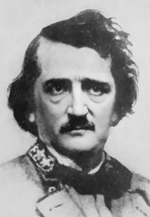 I’ve just finished Walter Jon Williams’ 1989 short story, “No Spot of Ground.” In Williams’ alternate history, Edgar Allan Poe does not die in a dissipated, incoherent condition in a Baltimore charity hospital in 1849, but recovers to conquer his alcoholism with the help of a wealthy Maryland widow, marries the widow’s beautiful young daughter, and founds a successful literary magazine. With the coming of the war, Poe goes south and obtains a commission as a Colonel in the Confederate army.
Poe is old for field command — just two years younger than Robert E. Lee, to the day — but he manages to advance in spite of his prickly relations with his fellow officers. Poe is personally brave enough, but hardly an heroic figure. As depicted by Williams, Poe is vain, dismissive of the skills of other officers, considering them to be his social and intellectual inferiors. They are, he believes, mere vulgar prose in contrast to his elevated poetry. Poe is utterly paranoid about their plots against him. Every burble of disorganization or mislaid communication in the field — things that a later generation would refer to with the acronym SNAFU –Poe views as part of a larger plot to make him look like an incompetent. Poe has little regard for the common Confederate soldier and, one imagines, the feeling is mutual. Poe imagines the entire Federal army facing him across the lines. Williams also gives the reader a glimpse of Poe’s obsession with romantic death, and his inability to move past the loss of his first wife, Virginia Clemm (1822-47), even though he assures himself he’s moved on. Unlike the Confederate officers of another recent bit of Civil War fiction, here Poe carries all the prejudices and attitudes of his day and place.
The main action of Williams’ tale takes place in late May 1864, when Poe unexpectedly takes command of George Pickett’s division at Petersburg, and moves with them into the line north of Richmond near Hanover Junction, just after the Battle of North Anna during the Overland Campaign. But much of the story is told in flashback, including a segment where Poe commands one of Pickett’s brigades in the famous assault on the third day at Gettysburg:
The sound was staggering, the banging and the clanging of the guns, guns, guns, but fortunately Poe had nothing to do but keep his feet moving forward, one after another. The officers had been ordered to stay dismounted, and all had obeyed but one: Dick Garnett, commanding the brigade on Poe’s left, was too ill to walk all that way, and had received special permission to ride.
Garnett, Poe knew, would die. The only mounted man in a group of twelve thousand, he was doomed and knew it.
Somehow there was an air of beauty about Garnett’s sacrifice, something fragile and lovely. Like something in a poem. The cemetery, their target, was way off on the division’s left, and Pickett ordered a left oblique, the entire line of five thousand swinging like a gate toward the target. As the Ravens performed operation, Poe felt a slowly mounting horror. To his amazement he saw that his brigade was on the absolute right of the army, nothing beyond him, and he realized that the oblique exposed his flank entirely to the Union batteries planted on a little rocky hill on the Yankee left.
Plans floated through his mind. Take the endmost regiment and face it toward Yankees? But that would take it out of the attack. Probably it was impossible anyway. But who could guard his flank?
In the meantime Pickett wanted everyone to hit at once, in a compact mass, and so he had the entire division dress its ranks. Five thousand men marked time in the long grass, each with his hand on the shoulder of the man next to him, a maneuver that normally took only a few seconds but that now seemed to take forever. The guns on the rocky hill were plowing their shot right along the length of the rebel line, each shell knocking down men like tenpins. Poe watched, his nerves wailing, as his men dropped by the score. The men couldn’t finish dressing their ranks, Poe thought, because they were taking so many casualties they could never close the ranks fast enough, all from the roaring and the soaring of the guns, guns, guns. . . He wanted to scream in protest: Forward! Guide center! but the evolution went on, men groping to their left and closing up as the shells knocked them down faster than they could close ranks.
Finally Pickett had enough and ordered the division onward. Poe nearly shrieked in relief. At least now the Yankees had a moving target.
But now they were closer, and the men on the Yankee ridge opened on Poe’s flank with muskets. Poe felt his nerves cry at every volley. Men seemed to drop by the platoon. How many had already gone? Did he even have half the brigade left?
The target was directly ahead, the little stand of trees on the gentle ridge, and between them was a little white Pennsylvania farmhouse, picture-book pretty. Somewhere around the house Poe and his men seemed to lose their sense of direction. They were still heading for the cemetery, but somehow Garnett had gotten in front of them. Poe could see Garnett’s lonely figure, erect and defiant on his horse, still riding, floating really, like a poem above the battle.
The cemetery was closer, though, and he could see men crouched behind a stone wall, men in black hats. The Iron Brigade of Hancock’s Corps, their muskets leveled on the stone wall, waiting for Garnett to approach. . . .
And then suddenly the battle went silent, absolutely silent, and Poe was sitting upright on the ground and wondering how he got there.
I don’t consider myself a fan of the alternative history genre, but I liked Harry Turtledove’s “Lee at the Alamo,” and enjoyed this one, as well. Has anyone else read it? Thoughts?
___________

“The volunteers were panting for strife”
Other bloggers have praised the special Civil War issue of The Atlantic, which appeared on newsstands some weeks ago, and is still available for order. It’s really a remarkable collection of essays, published at the time in that magazine, that capture a lot of the detail and color of the period. Although the cover inevitably touts contributions by the great names in American literature and history — Douglass, Hawthorne, Longfellow, Twain — to me, some of the most revealing pieces are those composed by writers much less known today, whose work seems as fresh and new as when it was first published. Much of it was what we now view as reported journalism — not just observations or analyses of current events, but writers to traveled to the center of events, talked to the people there, and reported back what they discovered.
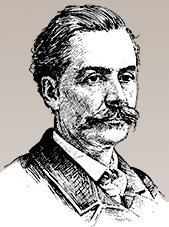 One example of such an essay is one by John William de Forest (right, 1826-1906) who, 151 years ago, disembarked from a steamer in Charleston to spend ten days in the city, trying to gauge the sentiment of the state that, just a month before, had taken the precipitous step of seceding from the Union. Lincoln would not take the oath of office as president for another six weeks, but de Forest quickly discovered that concerns about the president-elect and his party were the things that werre driving secession, and the standoff over Fort Sumter, out in the harbor:
“Why do you venture on this doubtful future?” I asked of one gentleman. . . . “Your great grievance is the election of Lincoln?”
“Yes”
“Is Lincoln considered here to be a bad or dangerous man?”
“Not personally. I understand that he is a man of excellent private character, and I have nothing to say against him as a ruler, inasmuch as he has never been tried. Mr. lincoln is simply a sign to us that we are in danger, and must provide for our own safety.”
“You secede, then, solely because you think his election proves that the mass ofthe Northern people is adverse to you and your interests?”
“Yes.”
“So Mr. [U.S. Senator Louis T.] Wigfall of Texas hit the nail on the head, when he said substantially that the South cannot be at peace with the North until the latter concedes that slavery is right?”
“Well, — I admit it; that is precisely it.”
I desire the reader to note the loyal frankness, the unshrinking honesty of these avowals, so characteristic of the South Carolina morale. . . . All those Charlestonians whom I talked with I found open-heartened in their secession, and patient of my open-hardheartedness as an advocate of the Union. . . .
“But have you looked at the platform of the Republicans?” I proceeded. “It is not adverse to slavery in the States; it only objects to its entrance into the Territories; it is not an Abolition platform.”
“We don’t trust in the platform; we believe that it is an incomplete expression of the party creed,-that it suppresses more than it utters. The spirit which keeps the Republicans together is enmity to slavery, and that spirit will never be satisfied until the system is extinct”. . . .
When I asked one gentleman what the South expected to gain by going out, he replied, “First, safety. Our slaves have heard of Lincoln, — that he is u black man, or black Republican, or black something, — that he is to become ruler of this country the fourth of March, — that he is a friend of theirs, and will free them. We must establish our independence in order to make them believe that they are beyond his help.”
My impression is, that a prevalent, though not a universal fear, existed lest the negroes [sic.] should rise in partial insurrections on or about the fourth of March. A Northern man, who had lived for several years in the back-country of South Carolina, had married there, and had lately traveled through a considerable portion of the South, informed me that many of the villages were lately forming Home Guards, as a measure of defence against the slave population. . . .
De Forest noted a certain fatalism about the coming conflict, with even those who opposed secession convinced that the agitation for war was so strong there, that it would eventually prevail over calmer minds. “The volunteers were panting for strife,” de Forest’s anti-secessionist acquaintances explained, and “Governor [Francis] Pickens was excessively unpopular because of his peaceful inclinations.” Armed hostilities were seen as a foregone conclusion; the only question was, when. Anticipation of the opening bombardment, even in January, already had people on edge:
During the ten days of my sojourn, Charleston was full of surprising reports and painful expectations. If a door slammed, we stopped talking, and looked at each other; and if the sound was repeated. we went to the window and listened for Fort Sumter. Every strange noise was metamorphosed by the watchful ear into the roar of cannon or the rush of soldiery. Women trembled at the salutes which were fired in honor of the secession of other States, fearing lest the struggle had commenced and the dearly-loved son or brother in volunteer uniform was already under the storm of the columbiads.
De Forest returned to New York, and when hostilities began, organized a company of the 12th Connecticut Volunteers. He mustered out in late 1864, and subsequently served with the Veteran’s Reserve Corps. After the war he returned to South Carolina as Assistant Commissioner of the Freedmen’s Bureau at Greenville. De forest wrote extensively about the war, but his graphic descriptions of the conflict were badly out of step with the romantic and idealistic depictions of his day.
_____________


Well, I Never Thought of That. . . .
The other day I mentioned the incident near Chappell Hill, where nooses were hung from a Sons of Confederates Veterans billboard along Highway 290, the main road between Houston and Austin. It seemed like a pretty crude and unfocused sort of protest at the time, and now columnist Bud Kennedy of the Fort Worth Star-Telegram, wonders if something else isn’t going on here:
But that was nothing compared with the silliness in Central Texas, where a Confederate heritage society e-mailed reporters early Tuesday with photos of two nooses hanging from a giant Rebel battle flag billboard on U.S. 290.
“It’s racist — a hate crime,” rancher Donnie Roberts said.
Washington County Chief Deputy Mike Herzog laughed.
“They were the first people who saw those nooses, and then they alerted the media,” he said.
I got the feeling he won’t bring in the FBI.
“It’s on a busy highway, and nobody else saw it,” he said.
It would have taken three people with a bucket truck and extension ladder to hang the nooses, he said.
Coincidentally, members of the Sons of Confederate Veterans history and heritage group responded quickly with a bucket truck and extension ladder to take them down.
Chappell Hill physician Robert Stark, also a Sons member, said Roberts saw the nooses first.
So what did they do?
Why, they were so insulted and threatened that Stark immediately took a bunch of photos and e-mailed them to a radio station.
KWHI/1280 AM’s website headlined “Local Billboard Vandalized.”
Roberts declared a “degradation of our historic heritage.”
At the sheriff’s office, Herzog called it a “prank.”
Deputies will investigate it as criminal mischief, he said.
Roberts said he wants the national SCV to investigate a “crime against our people” and will offer a $5,000 reward.
He said the suspect might be “white or black.”
But he added: “Well, it did happen on Martin Luther King’s birthday.”
“A crime against our people,” really?
I don’t know the truth of the matter here. Bud Kennedy’s obviously suspicious, and it doesn’t sound like Chief Deputy Herzog is especially concerned about it, either. Compared to other, very real cases of destructive, criminal vandalism, this latest event seems, well, curiously quaint.
What do I know? I know that, if someone did something like this on my property, calling the media to broadcast that fact would be pretty far down on my list of priorities. I would not be sending pictures of the thing to the local radio station. I would not be shooting my mouth off to reporters about it.
If this was indeed perpetrated by some stranger as a form of protest, I understand why the local SCV folks are unhappy about it. But whatever the real story behind the nooses, the local SCV seems quite content to play this “crime against our people” business for all it’s worth.
____________

Discovering the Civil War at the Houston Museum of Natural Science
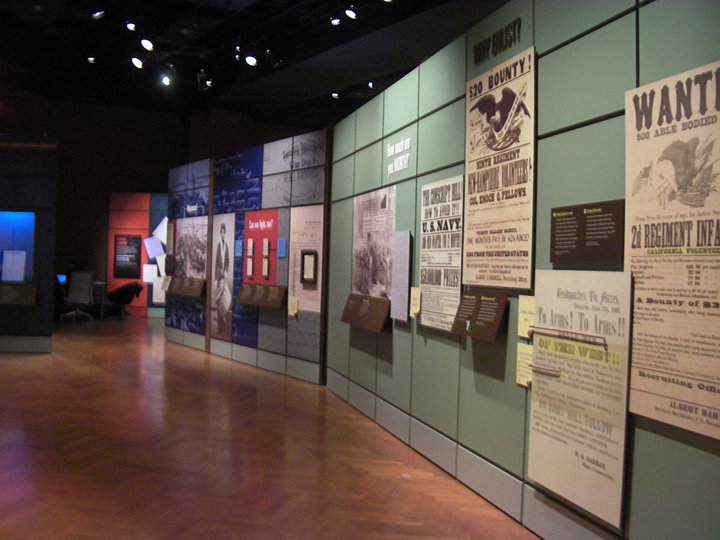
The Discovering the Civil War exhibition at its previous venue, the Henry Ford Museum. Via here.
On Saturday the fam and I took the afternoon to visit the exhibition, Discovering the Civil War, currently at the Houston Museum of Natural Science (HMNS). The exhibit runs through April 29, and is produced by the U.S. National Archives and Records Administration and the Foundation for the National Archives. It’s hard to do a compelling museum exhibition based almost entirely on documents and images; people want to see stuff, and that’s understandable. This particular exhibit succeeds pretty well, I think, in part because the documents they’ve included are genuinely compelling, and do a very good job of telling the story. The exhibition includes, for example, facsimiles of the 1861 Corwin Amendment, the Emancipation Proclamation, and the original text of the 13th Amendment ending slavery in the United States, bearing the signatures of Speaker of the House Schuyler Colfax, Vice President and President of the Senate Hannibal Hamlin, and President Lincoln. (The original holograph copy of the Emancipation Proclamation will be on exhibit on February 16-21.)
One of the common complaints among Southron Heritage™ folks is that the limitations of the Emancipation Proclamation “isn’t taught in school” or “you never hear about that” or some such. So I almost laughed out loud when, not a minute after stepping into the first section of the exhibit, an HMNS guide stepped up to explain to us and others some of the featured documents in the show, and drawing very careful distinctions between the limited, wartime scope of the EP, and the permanent, legislative accomplishment of the 13th Amendment.
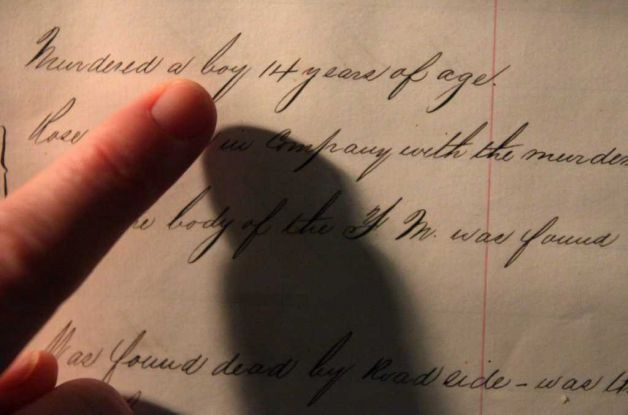
A curator at the Houston Museum of Natural Science points to entries in the Freedmen’s Bureau “Texas Record of Criminal Offences” from 1868. Photo: Mayra Beltran / © 2011 Houston Chronicle
The exhibit doesn’t only cover the war years; it goes back into the decades-long tensions over slavery and other sectional issues that led to the war, and devotes considerable space to the postwar period, including the creation of veterans’ groups like the GAR and UCV, reunions, monuments, and so on. It was in the area on the Reconstruction period that I came across a particularly chilling artifact, a big ledger in which the officers of the Freedmens’ Bureau in East Texas recorded assaults and murders of African Americans, attacks believed to be part of the terror campaign led by the Ku Klux Klan and allied groups to limit the new citizens’ participation in the electoral process and to intimidate anyone who challenged the pre-war power structure. The pages on display opened to 1868, the year such depredation came to a climax, in anticipation of that year’s general election. The the neatly-penned columns of names of the victims, alleged perpetrators, and nature of the crime — almost all listed simply as “homicide” — were deeply unsettling.
There is some hands-on material, including a section where visitors are asked to view an illustration from a wartime patent application, and then guess what the object is. The HMNS has also set up a kids’ discovery room, about halfway through, where young visitors can try on period costumes and work puzzles involved Civil War-era cryptography.
The museum has also appended a display at the end of the NARA exhibit, focusing on Texas during the war, with lots of arms and other artifacts from local units. These are, I believe, materials from the John L. Nau III, Civil War Collection. The recent recovery of artifacts from the wreck of the U.S.S. Westfield is discussed, as well.
Finally, there’s an extensive series of public presentations being given on different aspects of the conflict, including one on the recovery of the U.S.S. Westfield artifacts on March 27, and one by myself on March 27, “Patriots for Profit – The Blockade Runners of the Confederacy.” Hope to see y’all there.
_______________

The 7th Virginia Electric Calvary at Spotsylvania
Something new today. Guest blogger Cole Grinnell is a scientist, writer, and actor who works, when he works, out of Baltimore, Maryland. He should have a blog, but strangely, he doesn’t.

The 7th Virginia Electric Calvary at Spotsylvania: Reflections on a Modern Attempt at Battlefield Traversing
by Cole Grinnell
It is a crisp, windy late spring day in Spotsylvania. A random patchwork of clouds and clear sky drifts over an open plain, casting shadows like roving armies maneuvering below. We stand facing small overgrown V of earthworks, scarcely more than a hundred yards long, and listen to ranger describe the shear brutality of this place. He describes nearly a solid day of constant hand to hand fighting, thousands of men filling in and tamping down the bodies of the dead and dying, soldiers overcome with mad surges of energy abandoning their rifles, and fighting for hours with hatches and knives, people so utterly exhausted from endless combat that their legs had forgotten their function and they had to be pulled from the trenches by their comrades. We stood and listened to the last of this, his final words carried out over the trench line by the wind; a deafening silence was felt in our chests. We look on ahead, over onto the field, where the Union men rushed to open the breach and finally crush the army that had dragged them all over Virginia. We look behind, in to the trees, where Confederate regiments surged forward, one at a time, to try and and buy their compatriots behind them enough time to construct new defenses. We look to our left, up the road from where we had just come, to see a Segway humping a tree.
Protest #FAIL
 News comes today that the well-known Texas SCV billboard (right) on Highway 290, near Chappell Hill, has had a noose affixed to it.
“I think it’s very disrespectful. It’s not right,” said Jeff, a utility worker.
A Chappell Hill business man, who is also a lifetime member of Sons of Confederate Veterans personally donated the billboards to the national SCV organization. He alerted authorities Wednesday afternoon after noticing a noose dangling from the confederate [sic.] flag.
“My great grandfather fought in the confederate war, and several peoples grandparents’ fought in the confederate war. Yes we know the war was between the North and the South and it was over slavery, but that’s, I mean that’s ridiculous,” added Jeff.
How the noose got there is one question authorities are trying to figure out — but more importantly — why?
“They had to do some serious climbing to get up there to tie that up and drape it on the side,” added Jeff.
The Washington County Sheriff’s Department is investigating this as a case of “criminal mischief,” while the local SCV is calling it vandalism. As with the recent case in Richmond, Virginia, where persons unknown attached home-made historical “plaques” to the fencing around several Confederate monuments, I’m unconvinced this case is outright vandalism, which to me requires actual physical damage to be done. As in Richmond, there’s no indication of that happening here.
But otherwise, this case sure has FAIL written all over. The intent — I guess — is to equate the SCV, or Confederate heritage efforts generally, with lynching and racial terrorism. Those latter things are damn deadly serious, and their long history in this country is often willfully ignored by the heritage crowd, but the connection here is awfully tenuous. The home-made plaques in Richmond were carefully thought out and had a clear point; they counterpoised historic African Americans against the Confederate heroes being honored by the monuments. By comparison, this is just angry and unfocused, a gesture that’s dramatic, but also clichéd.
Candidly, I have an appreciation for smart, well-executed (as opposed to merely loud) protest, even when I don’t agree with the cause being advocated. Tossing up a noose on a billboard, late at night, leaving motorists driving between Houston and Austin to try to make some vague association between the SCV and lynching, doesn’t cut it. Try harder next time.
__________

Everyone Knows the Past was Sepia-Toned

Corey has an interesting post up, tracing the history of efforts to locate the exact location of the famous “Harvest of Death” photos, taken shortly after the Battle of Gettysburg. Corey highlights John Cummings’ recent findings (here and a follow-up here), and asks what his readers think. I don’t know, myself — I’ll have to give it more study — but it did get me thinking about colorizing historic, black-and-white photos.
It’s a practice that’s ubiquitous now; there are entire cable teevee series based largely on retroactively colorizing historic footage, presumably to lend some brilliant new insight into the past. Mostly this technique results in a very poor-quality product, and sometimes it’s not even necessary. Here are two images of the destruction of U.S.S. Arizona, on the left a still frame from actual color footage of the blast, and on the right, a still frame from the video linked above, a colorized version of a black-and-white print of the same footage. (I’ve “flopped” the right frame left-to-right; the footage is also usually shown reversed.) In neither case is the footage very clear, but the original color frame is far more natural than the artificial one on the right:

The practice is even more prevalent in print media; historical magazines do it all the time, presumably because they feel it makes the publication more visually appealing.
I was also reminded of the pitfalls of colorizing images by this article about Swedish artist Sanna Dullaway, who’s taken some of the best-known portraits and news images, shot originally in black and white, and colorized them. Her colorized image of Lincoln appears at the top of this post; other subjects include Winston Churchill, Albert Einstein, the summary execution of a Viet Cong prisoner during the Tet Offensive, and the famous V-J Day kiss in Times Square.
 But her own rendering of the famous “Harvest of Death” image points out one of the obvious limitations of the practice; she gets the uniform colors really, badly wrong. Such errors can be obvious, in cases like this, but in most cases the viewer could have no idea what’s correct. The blue coat, brown vest and scarlet necktie of Lincoln (right), don’t strike me as very plausible — though perhaps they’re more believable than the Great Emancipator’s self-evident spray tan. (Knocking down the color saturation of the image would take care of that distinctly Boehner-like orange glow.)
I’m ambivalent about the practice, myself; I don’t really object to it on grounds of authenticity, if it’s make clear that such an alteration has been made, but it’s rarely done very well. (Sanna Dullaway is much better at it than most Photoshop hacks like me, but even hers are of mixed effectiveness.)
So what do you think? Do colorized images — still or moving — have a place in historical interpretation? What cautions or disclaimers should accompany them? What are the pitfalls, and the benefits? And most important, are there any really good colorizing tutorials out there? 😉
______________
Images: Colorized Lincoln image by Sanna Dullaway. U.S.S. Arizona images by (left) U.S. Naval Historical Center and (right) The Military Channel.

“Having finished life’s duties, they rest.”

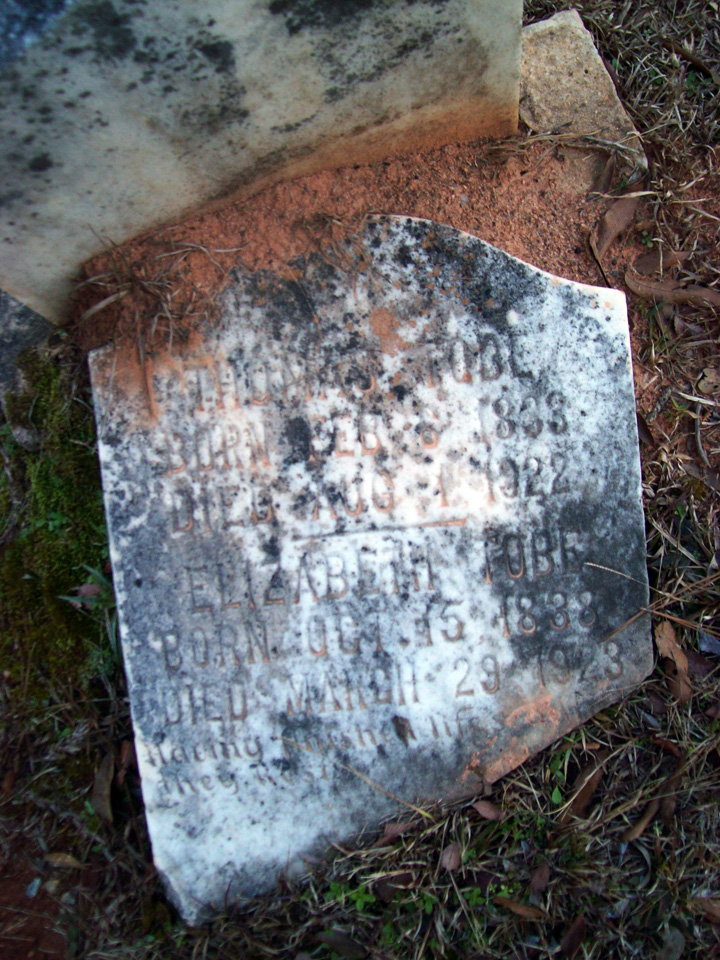
About a year ago, I put up a post about Thomas Tobe, a free African American man from South Carolina who was conscripted to work at General Hospital No. 1 in Columbia, South Carolina during the summer of 1864. Tobe later received a state pension based on service he claimed with Company G of the 7th South Carolina Cavalry, Holcombe’s Legion. This latter claim is problematic, as there are no contemporary records verifying his attachment to that unit. Critical details are missing from the pension application, such as Tobe’s attested rank, and the men who swore as witnesses to his service were from different regiments. Tobe may well have been attached to that unit, perhaps as a cook, a personal servant or in a similar capacity, but there’s no direct evidence that he served as a trooper.
At the time of the post, I understood that Thomas and his wife Elizabeth were buried in the cemetery at Fairview Baptist Church, near Newberry, South Carolina. Recently I received confirmation of this from Kevin Dietrich, a member of the area SCV camp. Dietrich was out visiting cemeteries recently, looking for graves of persons from the Civil War era, and made a note of Tobe’s gravesite, not knowing anything else about him, just based on the dates on the stone. A Google search on Tobe’s name led Dietrich to this blog and my post on Thomas Tobe. Mr. Dietrich has generously consented to having his recent photos of the site posted here. The marble stone Thomas and Elizabeth share carries the inscription, “having finished life’s duties, they rest.”

__________





 Dead Confederates, A Civil War Era Blog


1 comment