Research a Mile Wide, and an Inch Deep
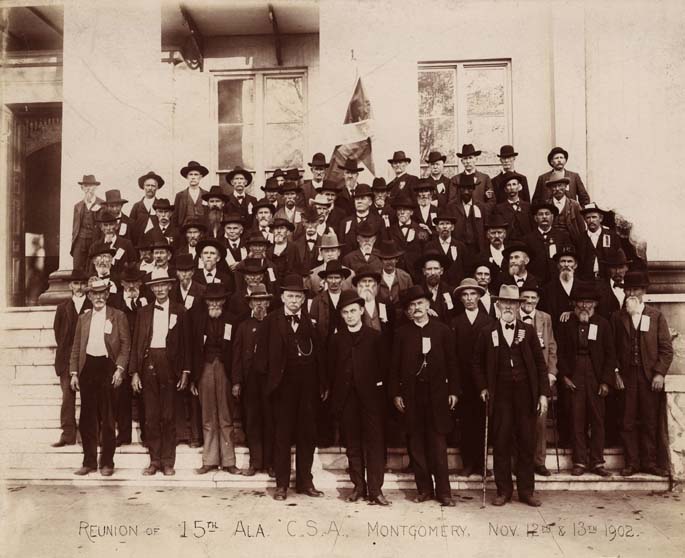
The deeply shallow “research” to prove the existence of black Confederates continues apace. This image, from the Alabama Department of Archives and History, is of men from the 15th Alabama Infantry attending a statewide Confederate veterans reunion in Montgomery, in November 1902. The 15th Alabama, many will recall, is the regiment that made repeated attempts to dislodge the Union flank on Little Round Top on the second day at Gettysburg, facing the famous 20th Maine Infantry. I believe the former commander of the 15th Alabama, William C. Oates, is the first man at left in the front row in the image, directly above the C in “C.S.A.”
The image has become a point of discussion online recently, particularly in reference to the dark-skinned man in the second-to-last row, third from the end on the right. The discussion seems to center around whether the man is African American, of mixed race, or perhaps is a white man with very dark, tanned skin. Whether he’s actually African American or not is critical, because the beginning and end of the question is whether or not a black man attended a Confederate reunion. That fact, in and of itself, is apparently supposed to tell us all we need to know about African Americans and the Confederacy.
Of course, it doesn’t.
Warning: The following includes historical quotes that use offensive language and themes.
Escape from Camp Douglas
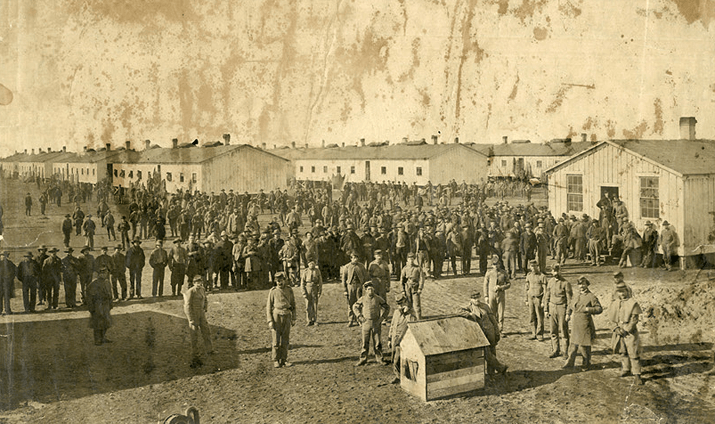
James Knox Thomas (1844-1930) was born in Macon, Georgia. Although his family had subsequently moved to Arkansas, by the spring of 1862 seventeen-year-old Knox, as he seems to have been called, was back in Randolph County, Georgia. There, on May 16, he made his mark in lieu of a signature, and enlisted in Company H of what would become the 55th Georgia Infantry.
The 55th Georgia was sent to eastern Tennessee, where in September 1863 most of its number were captured at Cumberland Gap. Thomas soon thereafter found himself at Camp Douglas in Chicago, one of the more infamous Union prison stockades. There, as he would recall almost 40 years later, he and his comrades plotted an escape on the day after Christmas in 1864:
I was a private in Company H, Fifty-Fifth Georgia Infantry. My company was raised in Randolph and Stewart Counties, Ga.; was commanded by Capt. John Allen, whose field officers were Col. Harkey, Lieut. Col. Persons, and Maj. Printup.
On September 9, 1863, while in Frazier’s Brigade, Buckner’s Division, we were captured at Cumberland Gap, and after a tedious journey, were landed in Camp Douglas, a prison in the suburbs of Chicago. In that prison, on Christmas day, 1864, I was walking across the open premises with Bill James, of Company A. of my regiment, and I remarked that if I could only scale the walls I would turn my head toward Dixie. He replied that he could easily arrange for us to scale the wall, but we had no money and no citizen’s clothes. I was a shifty little red-headed fellow, and could generally raise a small amount in case of an emergency, and had already bought me a suit of citizen’s clothes from a Yankee soldier. I told James that I had the money and would get the clothes, but wished to know how he proposed to scale the wall. His scheme was this: he was a laborer in the kitchen department, and the kitchen superintendent, an old Irishman nick-named “Old Red.” had placed a couple of scantlings parallel along the wall of the kitchen, on the ground, for some barrels to rest on, and James proposed to nail some pieces of plank on the scantlings and thus make a ladder. Seeing that his plan was feasible, I then said : “All right; we will go to-morrow night at seven o’clock, by which time I will have the clothes ready. James then replied that we could not hoist the ladder up on the wall by ourselves, and said we would have to get two more companions. I then said: “You choose one of them, and I will choose the other.” He chose Hope Williams, of his own company (A), and I selected Ben Johnson, otherwise known as “Babe” Johnson, of my own company (H). At the appointed time we met at the kitchen, and I was chosen to walk out and see if any of the inside police were near; and if they were, I was to quietly return; if they were not, I was to walk quickly back, pass the kitchen door, whistle, and pass on toward the prison wall to Barracks No. 72, where they were to follow with the ladder. I quietly took the walk, found no police, hurried hack as agreed, and in a few minutes we had the ladder up against the wall. As we accomplished this a sentinel halted us; Babe Johnson instantly sprang on the ladder, and was killed by the sentinel.[1] As Johnson staggered and fell back, James mounted the ladder, followed by Williams and myself, and we all three escaped amidst a shower of bullets. We were clad with citizen’s clothes, purchased by me from the Yankee soldier, and we safely reached the city, and registered at the Sherman House in our own names, but as hailing from Louisville, Ky.
We remained at the Sherman House until five o’clock, the 27th inst, when we took a train for Detroit. We reached Detroit on the 28th, and immediately crossed the river to Windsor, Canada, where we were under the British flag. From Windsor we proceeded by various points to Halifax. At Halifax we sailed for the Bermuda Islands on a British brig, and reaching them we went to Nassau, on the Bahama Islands, and from Nassau we went to Havana.
At Havana I sat for my “photo,” which is herewith submitted [right] for the inspection of my surviving comrades. We remained in Havana two weeks, and then shipped on the blockade runner Fox for Galveston, Tex. Sometime in March [sic., April 1] we reached Galveston, and in attempting to enter the port our vessel was shot to pieces by the blockading fleet, but we managed to reach the shore safely.[2] From Galveston we went to Marshall, Tex., where James decided to remain.
Williams and I proceeded to Shreveport, and thence down the river by steamer to Alexandria. From Alexandria we took it “afoot” across the country to the Mississippi, and crossed it in a blockade skiff. Continuing, we reached Meridian, and there learned for the first time that the war was ended. [3]
After the war, Thomas married Nancy Elizabeth Cowart (1848-1926), and they eventually moved to Texas, where they settled in Montague County. Knox Thomas died on February 27, 1930, at the age of 85. Both he and Nancy are buried in Restland Cemetery at Olney, Texas.
[1] Private Benjamin “Babe” Johnson was not killed outright; Federal records show he lingered for more than two weeks, finally dying on January 13, 1865. He was buried in Grave 470, Block 2, Chicago City Cemetery. His remains were probably among those later exhumed and reinterred at Oakwoods Cemetery. Benjamin Johnson CSR, National Archives.
[2] Fox was a well-known blockade runner, under the command of Simpson A. Adkins. A detailed account of her dramatic run into Galveston on this occasion appears here.
[3] “Escape from Camp Douglas,” Confederate Veteran, Vol. 9, No. 1, (1901), 30.
________________
Image: Confederate prisoners at Camp Douglas, Chicago, Illinois. Via Abraham Lincoln Bookshop, Chicago.

Christmas Picket
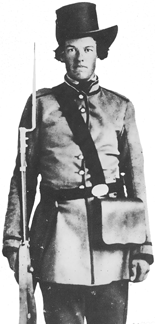 One hundred fifty years ago today, a nineteen-year-old Confederate soldier named Valerius Cincinnatus Giles (right, 1842-1915) went out on picket duty along the Potomac.
On Christmas morning a detail of twenty men was sent from the Fourth Texas Regiment to relieve the picket guard along the river. This detail was commanded by Lieutenant R. J. Lambert.
The post assigned me was on Cock Pit Point, about 100 yards from the masked battery. This battery of four guns was planted twenty feet back from the edge of the bluff. completely hidden from view by an abatis of pine brush felled and stacked, with the sharpened ends of the trunks pointing outward. as a crude defense. From my post I had a splendid view of the river for two or three miles in each direction. The low range of hills on the Maryland side opposite were covered with white tents and log cabins, the winter quarter of General Daniel E. Sickles’s New York Brigade.
The war had just fairly begun, and this was new to me. The novelty of the situation, the magnificent view before me, the river rolling majestically along between white hills and evergreen pines so charmed and captivated me at first that I felt not the bitter cold. The snow was gently and silently falling. deepening 011 the hills and valleys, melting as it struck the cold bosom of the dark river. I had been on post but a short time when I beard the signal corps man sing out from the crow’s-nest high up in a sawed-off pine tree, saying to the officer in charge: “Look out, Lieutenant, a gun boat is coming down the river!”
I could hear the artillery officer giving orders to his men, but from my position I could not see them. Looking up the river I saw a cloud of black smoke rising above the tops of the trees. All was excitement at the battery. and I could hear the artillerymen ramming home their shells, preparing to sink the approaching boat. Directly the steamer turned a bend in the river with volumes of black smoke pouring from her smokestacks. She was in the middle of the stream, coming dead ahead under full steam. It was really a disappointment to the fellows at the battery as well as myself, when the soldier in the crow’s-nest called out again: “0h, pshaw, Lieutenant, don’t shoot! She’s nothing but an old hospital boat, covered over with ‘yaller’ flags.”
Of course a Confederate battery would not fire on a yellow flag any more than on a white one.
The boat came steadily on down the river until she got nearly opposite Cock Pit Point, when she blew her whistle and turned toward the Maryland shore. As she made the turn she came within 200 yards of the Virginia bank and I could distinctly read her name on the wheel house. It was the old Harriet Lane. named in honor of the accomplished niece of President James Buchanan, who was queen of the White House during the administration of that eccentric old bachelor. In the winter of 1861 the Harriet Lane was in the employ of the Hospital Corps of the Army of the Potomac. A few days after that, she left her mooring on the Maryland side and pulled out down the river. She subsequently became a warship of some kind and met defeat at the Battle of Galveston in January, 1863.
After the boat bad landed and the excitement was over, a melancholy stillness settled around me. The novelty and fascination of my surroundings soon lost their charm. The lowering clouds above me and the white silence about me became monotonous and I began to feel restless and uneasy. If you are in a forest or on a prairie on a still summer day and will stop and listen attentively, you can bear the songs of birds, the chirping of crickets or the drowsy hum of insects. hut in a piney woods in midwinter, when the earth and green branches of the trees are covered with snow, with not a breath of air blowing, the stillness is oppressive. I must have bad a slight attack of homesickness, for I began to think of home and my mother and father away out in Texas waiting and praying for the safe return of their three boys, all in the army and all in different parts of the Confederacy — one in the Tenth Texas Infantry at an Arkansas post, one in Tennessee or Kentucky with Terry’s Rangers, and one in the Fourth Texas Infantry in Virginia. . . .
While I stood at my post on the banks of the Potomac I knew I was perfectly safe from any personal danger, yet something seemed to warn me of approaching evil. I tramped through the snow, half-knee-deep, although I was not required to walk my beat. I tried to divert my mind from the gloomy thoughts that possessed me, but all in vain. Suddenly I was startled from my sad reflections of home and kindred by distinctly hearing a voice I new — my brother Lew’s voice — calling my name. I turned quickly, looked in every direction, heard nothing more and saw nothing but the white world around me and the dark river below me. He was two years my senior, had been my constant companion and playmate up to the beginning of the war.
It was then 4 P.M., December 25, 1861. I was not sleeping or dreaming. and firmly believed at the time that I heard my brother calling me, but it must have been a delusion of the imagination.
However, Lewis L. Giles of Terry’s Texas Rangers, Troop D, Eighth Texas Cavalry, was mortally wounded at the battle of Mumfordsville, [Woodsonville] Kentucky, December 17, 1861, in the same charge in which Colonel Terry was killed. He was removed by his comrades to Gallatin, Tennessee. and died at the residence of Captain John G. Turner, a lifelong mend of my father. He breathed his last precisely at four o’clock on Christmas Day. 1861, while I stood picket on the banks of the Potomac.[1]

[1] Mary Lasswell, ed., Rags and Hope: The Memoirs of Val c. Giles, Four Years with Hood’s Texas Brigade, Fourth Texas Infantry, 1861-1865 (New York: Coward-McCann, 1961), 59-62. The compiled service record of Private Lewis L. Giles, Co. D, 8th Texas Cavalry, gives his date of death as Christmas Eve, December 24.
___________
Image: Private Val Giles in the spring of 1861, at the time of his enlistment in the Tom Green Rifles, a company later rolled into the Fourth Texas Infantry. From Voices of the Civil War: Soldier Life.

Military Funeral of an “Ancient Gentleman Cow”
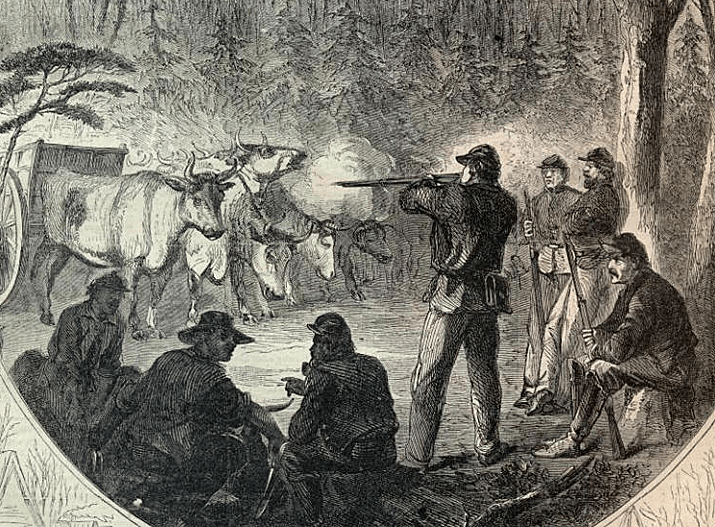
My new blog post is up at The Civil War Monitor, on the dramatic and humorous protest made by some Confederate soldiers here, when issued rations that they deemed unfit for human consumption:
For one company of the 8th Texas Infantry, garrisoned at Galveston, frustration boiled over on the last Sunday of February 1864, when the soldiers were issued as rations the carcass of a scrawny, sickly steer they deemed entirely inedible. Instead of cutting up the beef and distributing it to individual messes, the soldiers instead turned out at 9:30 a.m. with their rifles and organized a formal funeral cortege. They were joined by soldiers from other commands, as well. As Edward T. Cotham, Jr., describes in his book, Battle on the Bay: The Civil War Struggle for Galveston, the soldiers put the rejected beef on a stick and paraded it through the town in grand funereal style, under reversed arms and to the accompaniment of muffled drums. When they reached the public square in front of the courthouse, they held a mock funeral and buried it, reading a formal eulogy over the remains. The ceremony was, according to a contemporary account, “done by the parties quietly, soberly, and mournfully,” though the spectacle “created no little merriment.” The following morning, a headboard had appeared over the “grave,” inscribed with the following tribute in verse:
“Died in the butcher-pen, at Galveston, on Saturday night, 27th inst., an ancient gentleman cow in the 129th year of his age. Disease: poverty. His remains were issued to the troops, and by them buried in the public square with the honors of war. . . .”
The new issue of the Monitor includes great material by authors including Glenn LaFantasie, Ron Coddington, James Marten and more. Did I mention that a subscription to the Monitor would make a great last-minute Christmas gift for a CW buff?
_______________
Image: Shooting beeves for the Union Army of the Potomac, Harper’s Weekly, January 31, 1863. Via SonoftheSouth.com.

Canister!
Items that don’t warrant posts on their own, but are worth mentioning.
- The Galveston Historical Foundation will host another Battle of Galveston weekend on January 13-15, 2012. The program includes lectures, tours and a reenactment of the battle on the Strand. Looks to be a full weekend with lots to do. Thoughts on the 2011 event here.
- The other day, a person (or persons) unknown affixed homemade plaques honoring Barbara Johns, Mildred and Richard Loving, and a leader of a slave insurrection named Gabriel to several Confederate monuments around Richmond. The act prompted the predictable huffing and puffing about “vandalism” and “defacement,” but lost in the self-righteous posturing is the fact that whoever did this went to considerable trouble to clamp the plaques onto the fences around the monuments in a way that avoided damaging them (below). Regardless of what one thinks of the activist’s message, that’s something that ought to be acknowledged. (h/t Kevin)


- As expected, the Texas SCV is suing to overturn the state’s rejection of a special license plate
honoring Confederate soldierspromoting the SCV. The constitutional basis for their legal argument is built, in part, on one of the “Reconstruction Amendments” passed immediately after the Civil War, specifically the Due Process Clause of the 14th Amendment. Irony is alive and well. - Over at Past in the Present, Michael Lynch has a funny take-down of
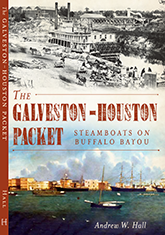
TheHistoryChannel, and its line-up, which includes a new spin-off called Cajun Pawn Stars. (No, really.) Or as the channel’s general manager calls it, “vérité documentaries on people doing history today.” Asshats. - Finally, posts may be less frequent here over the next few months, as I recently signed a contract for a book on local maritime history. This particular story has been a research interest of mine for many years, and I’ll be glad to see it come to a tangible result. But to make that happen, I’m under a deadline. Tick-tock, tick-tock.
Anything else? Put it in the comments.
_____________
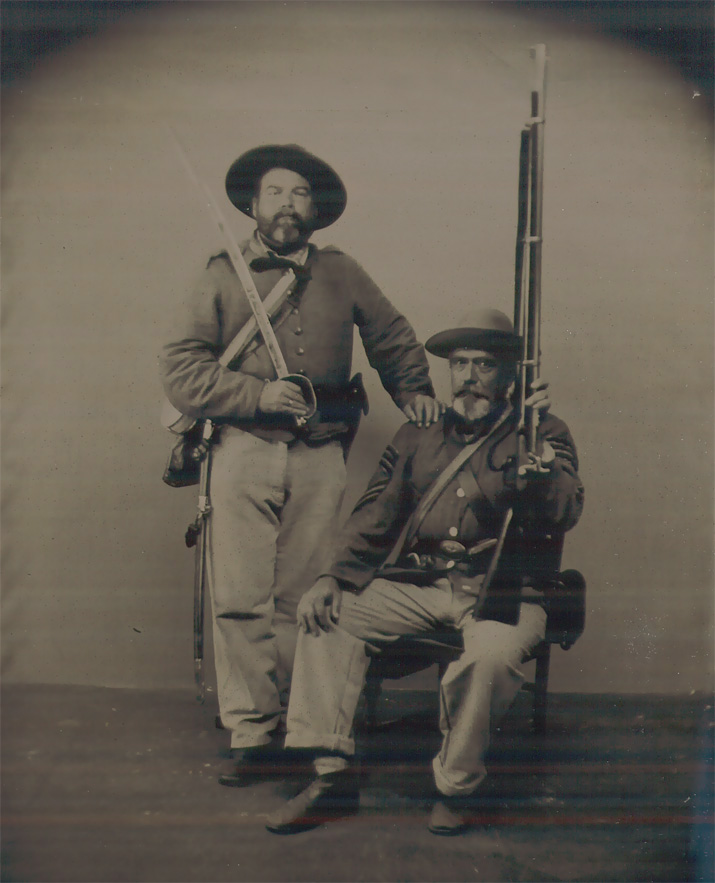
Image: Top: Glass-plate image of Confederate reenactors at Battle of Galveston weekend, 2011, via Galveston Historical Foundation. Middle: Clamps used to affix homemade plaques to the fence around Confederate monuments in Richmond, via http://www.wtvr.com.

Nathan Bedford Forrest Joins the Klan
 Nathan Bedford Forrest is always a popular subject in Confederate heritage, but that’s never been more true than it is today. He’s frequently featured in the secular trinity of Confederate heroes, alongside Lee and Jackson. And like those two – and only those two – Forrest has achieved the modern apotheosis of Confederate fame, having his own page of t-shirts at Dixie Outfitters.
But Forrest’s defenders often hold the line at one claim, that he was a prominent figure in the Reconstruction-era Ku Klux Klan. Even as they struggle to rationalize the Klan of that period as a necessary counter against the supposed excesses of the Union League and other northern influences, they usually deny any involvement of Forrest in the Klan’s organizing or activities, except for the odd claim that Forrest, despite having no authority or connection to the group, successfully ordered them to stand down in 1869.
So did Forrest really join the Ku Klux Klan? Yes, he did. Was he really Grand Wizard of the group? Yes, he was. How do we know this? Because the old klansmen who were there tell us so.
Friday Night Concert: John Hartford, “Turn Your Radio On”

I miss John Hartford.
____________

The NYT Visits the Museum of the Confederacy
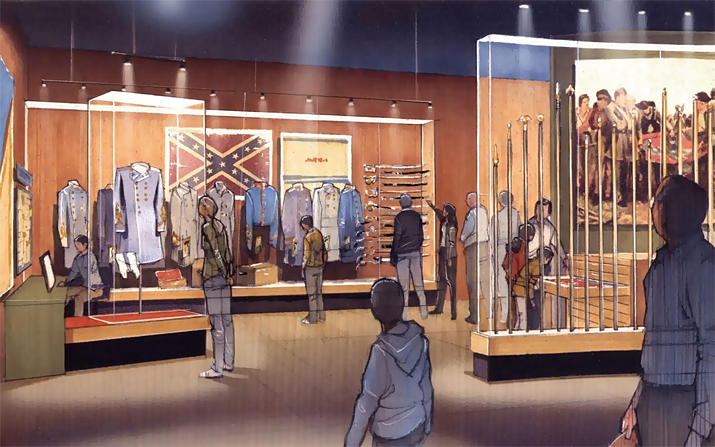
On of my readers, PH, passes along this recent review in the New York Times of the Museum of the Confederacy, and its ongoing effort to chart a new course, away from its founding as a shrine to the Lost Cause, to a more comprehensive, balanced view of the conflict, its origins and its legacy. (Kevin has blogged on it as well.) Edward Rothstein makes a second visit to the MoC, and notes the shifting tenor of the institution’s public exhibitions and programs.
The Museum of the Confederacy embodies the conflict in its very origins; its artifacts were accumulated in the midst of grief. The museum’s first solicitation for donations, in 1892, four years before its opening, is telling: “The glory, the hardships, the heroism of the war were a noble heritage for our children. To keep green such memories and to commemorate such virtues, it is our purpose to gather together and preserve in the Executive Mansion of the Confederacy the sacred relics of those glorious days. We appeal to our sisters throughout the South to help us secure these invaluable mementoes before it’s too late.”
That heritage casts a long shadow over the institution. When I visited in 2008, slavery still seemed an inconsequential part of Southern history. And Southern suffering loomed large.
But changes have been taking place. Several tendentious text panels (in one, Lincoln was portrayed as having manipulated the South into starting the war) have been removed. And gradually, under the presidency of S. Waite Rawls III, the museum, while keeping its name, has been expanding its ambitions, trying to turn its specialization into a strength instead of a burden.
Nonetheless, Rothstein comes away feeling that, while the worst examples of the MoC’s old historical narrative are gone, there’s nothing yet that has taken their place:
The delicacy is strange. There is so much in the exhibition [“The War Comes Home”] that is illuminating about the war. And it isn’t that the Virginia Historical Society is embracing the Lost Cause. Far from it. But the institution is trying to take a path that will least offend those who do. Or is it suggesting with its questions that it would be callous to continue with finger pointing? After all, isn’t one man’s traitor another’s patriot?
The problem, though, is that the Civil War then becomes merely a tragic clash of two sides, each convinced of its virtue and fidelity to national ideals. That is not an embrace of the Lost Cause, but it leaves us a war with no higher cause at all.
Rothstein should be patient, I think. Museums are not shrines; they exist for education and research, and unquestioning hagiography is best left to others. The MoC in particular, with its unsurpassed collection of Civil War artifacts, documents, and images, is far too valuable a resource to give itself over to a fixed story of parochial, navel-gazing victimhood. Like every institution of its type, the Museum of the Confederacy is, and should be, always a work in progress.
______________
Image: “Museum of the Confederacy CEO Waite Rawls announced on Thursday [April 14, 2011] the museum’s plans for interior exhibits. Part of the plan includes bringing the uniform won by Gen. Robert E. Lee, of the Army of Northern Virginia, at the Appomattox surrender in April of 1865 (pictured at left). Also included will be the sword Lee brought to the surrender.” Via Lynchburg, Virginia News & Advance.





 Dead Confederates, A Civil War Era Blog
17 comments