South Carolina Flag Dispute: Heritage vs. Heritage
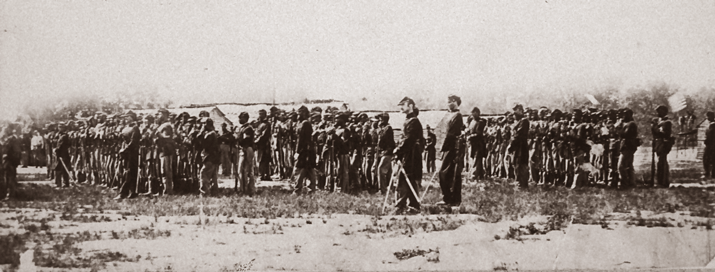
In putting together my recent post on the rancorous neighborhood dispute over a resident’s display of a Confederate Battle Flag in an historically African American neighborhood, I made a passing reference to the fact that the community itself had been founded by former USCTs. In retrospect, I “buried the lede,” as they say, and gave that aspect of the story short shrift — it likely plays a much bigger role in how that community identifies itself, and in its reaction to Ms. Caddell’s display:
Among [Brownsville’s] founding families were at least 10 soldiers stationed to guard the Summerville railroad station at the close of the Civil War. They were members of the 1st Regiment, United States Colored Troops, part of a force of freedmen and runaway slaves who made history with their service and paved the way for African Americans in the military.
At least some of the men were from North Carolina plantations. When the war ended they stayed where they were, living within hailing distance of each other along the tracks. Some of them lived on the “old back road” out of town where outrage has erupted recently over a resident flying a Confederate battle flag. Their ancestors [sic., descendants] still live there.
It’s a striking note in a controversy over heritage that has raised hackles across the Lowcountry and the state.
The community’s past is an obscure bit of the rich history in Summerville, maybe partly because for years the families kept it to themselves. They were the veterans and descendants of Union troops, living through Jim Crow and segregated times in a region that vaunted its rebel past.
The great-great-grandfather of Jordan Simmons III was among them. But growing up in Brownsville a century later, all Simmons remembers hearing about Jordan Swindel, his ancestor, is that he was a runaway slave who joined the Army. The rest, he says simply, “was not talked about.” He didn’t find out about it until he was an adult doing research on the Civil War and the troops and came across Swindel’s name.
Now he’s at work on a book about his family and the Brownsville heritage. Other 1st Regiment surnames in the community include Jacox, Berry, Campbell, Edney and Fedley.
Simmons, 64, has lived through some history of his own. He was one of the South Carolina State University students injured in the infamous 1968 Orangeburg Massacre. He too served in the U.S. Army, a 29-year veteran who fought in Vietnam with the 101st Airborne infantry and retired as a lieutenant colonel. He now lives in Virginia.
It overwhelmed him to see his great-great-grandfather’s name on the wall of honor three years ago when he visited the African-American Civil War Memorial in Washington, D.C. Pvt. Swindel fought in four battles in nine months in 1864, from Florida — where he was wounded — to Honey Hill, S.C. Simmons wishes he would have sought out that history when he was younger.
As I said previously, neither side in this dispute seems much interested in letting go of this game of one-upsmanship. The historical circumstances surrounding the town’s founding don’t change the core legal issues at hand, but given that the Southron Heritage folks routinely dismiss criticism of the Confederate Flag as “political correctness” or as unfairly tarnishing an honored symbol of the Confederacy with its use by hate groups, it’s interesting to see a case where the protestor’s case against the flag is so explicitly based in the very same “heritage” argument that the flag’s proponents righteously embrace. For at least some local residents, pushback against the CBF is every bit as grounded in the history of the American Civil War, and honoring one’s ancestors, as Ms. Caddell’s display of it. For them, it’s personal, and for exactly the same reasons.
I don’t know what the answer here is. What is clear, though, is that there’s an historical dimension to this case — very real and very valid, by the same “heritage” standard that the folks in (say) the South Carolina League of the South embrace for themselves — that needs much wider dissemination, and it plays a big role in how that community thinks and feels and reacts.
_____________
Image: Soldiers of the 1st USCT on parade. Library of Congress.

Nostradamus Totally Called It. Totally.
 And here I thought preoccupation with the prophecies of a sixteenth-century French
 alchemist apothecary was a modern craze. I was wrong. From the Sheveport Daily News, September 28, 1861:
Although many of the predictions made by Nostradamus (especially those concerning the deaths of Henry IV and Louis XVI) have been completely verified, they are generally discredited in our times. But in the “Prophecies at Vaticinations” of that great man, vol. 2d, (edition of 1609) we find the following, which would seem to deserve some attention:
“About that time (1861) a great quarrel and contest will rise in a country beyond the seas–America. Many poor devils will be hung and many poor wretches will be killed by a punishment other than a crowd. Upon my faith you may believe me. The war will not cease for four years, at which none should be at all astonished or surprised, for there will be no want, of hatred and onstinacy [sic.] in it. At the end of that time, prostrate and almost ruined, the people will re-embrace each other in great joy and love.”
Now, here is something very confirmatory of the prophetic genius of Nostradamus, but in no way consoling for us poor devils and wretches (pauvres diables et pauvres heres) who will have to suffer under this war for four years. Let us hope that the astrologer was mistaken at least on this point.
This is, like most citing of mysterious prophecy, a case of what James Randi calls “retroactive clairvoyance,” connecting vaguely-worded prophecies to events that have already happened, or are plainly inevitable to all. For any Daily News readers who might not make the connection between Nostradamus’ writing and then-current events, of course, the editors helpfully insert the date and location he was (obviously) referring to.
Why can’t prophets offer predictions that don’t have to be explained to make sense? 😉
________________

Do (Ever-Higher) Fences Make Good Neighbors?
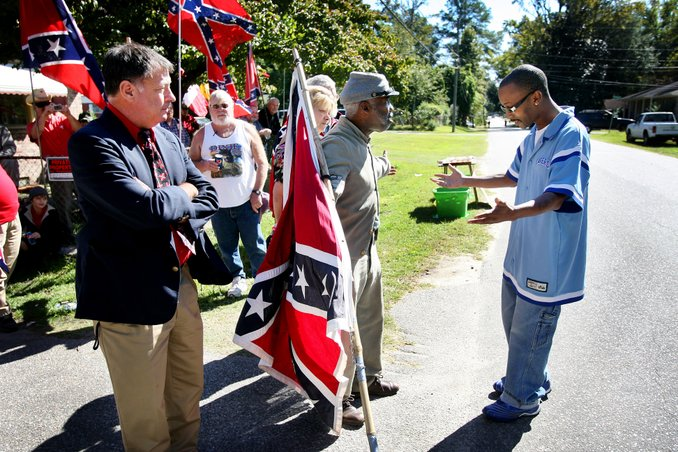
Some folks may recall the case last year in South Carolina where Annie Chambers Caddell moved into a historically African American neighborhood, and put a Confederate flag on the front of her house. Her neighborhood’s origins go back to the close of the Civil War, when the area was settled by several former members of the 1st USCT, who’d been stationed there at the end of their military service. Caddell, who is white, argued she was honoring her Confederate ancestors; her neighbors, not surprisingly, see the flag as a symbol of something else entirely.
Inevitably there were protests against Caddell, and counter-protests in response (above). It got worse; someone reportedly threw a rock through Caddell’s front window. There has been inflammatory, over-the-top rhetoric on both sides. Not surprisingly, both sides have chosen to escalate the dispute.
Earlier this year, two solid 8-foot high wooden fences were built on either side of Annie Chambers Caddell’s modest brick house to shield the Southern banner from view.
Late this summer, Caddell raised a flagpole higher than the fences to display the flag. Then a similar pole with an American flag was placed across the fence in the yard of neighbor Patterson James, who is black. . . .
“I’m here to stay. I didn’t back down and because I didn’t cower the neighbors say I’m the lady who loves her flag and loves her heritage,” said the 51-year old Caddell who moved into the historically black Brownsville neighborhood in the summer of 2010. Her ancestors fought for the Confederacy.
Last October, about 70 people marched in the street and sang civil rights songs to protest the flag, while about 30 others stood in Caddell’s yard waving the Confederate flag.
Opponents of the flag earlier gathered 200 names on a protest petition and took their case to a town council meeting where Caddell tearfully testified that she’s not a racist. Local officials have said she has the right to fly the flag, while her neighbors have the right to protest. And build fences.
“Things seemed to quiet down and then the fences started,” Caddell said. “I didn’t know anything about it until they were putting down the postholes and threw it together in less than a day.”
Aaron Brown, the town councilman whose district includes Brownsville, said neighbors raised money for the fences.
“The community met and talked about the situation,” he said. “Somebody suggested that what we should do is just go ahead and put the fences up and that way somebody would have to stand directly in front of the house to see the flag and that would mediate the flag’s influence.”
Caddell isn’t bothered by the fences and said they even seem to draw more attention to her house.
“People driving by here because of the privacy fences, they tend to slow down,” she said. “If the objective was to block my house from view, they didn’t succeed very well.”
You can see where this is going; by this time next year, one side or the other will have put up a big-ass flag.
More seriously, this is just headache-inducing. The only people benefiting from this rancorous business are flagpole installers and the local lumber yard.
I don’t know what the answer here is. Caddell has a right to display her flag; her neighbors have a right to make their objection to it clear. But neither benefits from continually upping the ante, nor does it help to bring in outside groups and activists to use this case to fight a larger proxy battle for historical memory, as recently happened in Lexington. That only serves to harden the resolve of all concerned, by raising the purported stakes beyond what they actually are. I hope Caddell and her neighbors eventually come to some sort of resolution in this business. But that doesn’t seem likely anytime soon, so long as all parties insist on following the tired script of action and reaction, and insist on having others fight their rhetorical battles instead of talking to each other like responsible grown-ups.
_________
Image (Original Caption): Brownsville Community resident Tim Hudson (right) tells H.K. Edgerton of Ridgeville he looks “ridiculous” in his Confederate uniform as he stands with outside the home of Annie Chambers Caddell Saturday, October 16, 2010. Brownsville community members marched past Caddell’s home to protest her flying of the confederate flag outside her home in the predominantly black neighborhood. Hudson was not a marcher in the protest group. Photo by Alan Hawes, postandcourier.com.

“Can you hang around a couple of minutes? He won’t be long.”

It seems that, in the process of removing and burying the dead from the military hospitals around Richmond, some of those removed weren’t quite ready to go. From the Richmond Dispatch, April 28, 1862:
Burying Soldiers Prematurely.
Most, if not all, of the soldiers who die in the various, hospitals located in this city, are interred at Oakwood Cemetery, in the eastern suburbs.–It cannot be supposed that when so many men are to be attended to, that all can have that care and attention bestowed on them that they would get at home or here under more favorable auspices, consequently many become food for worms that might otherwise be living. It does seem, however, eminently proper that when, to all appearance, the poor volunteer has shuffled off this mortal coil, his body should be retained a sufficient length of time to put the truth beyond doubt. We fear this is not always done. Anxiety for the living swallows up respect for the dead, and the remains of the latter are often hurried too precipitately to the place of interment. It would seem that there should be attached to each hospital a place for the temporary deposit of those who die or are supposed to have died from disease. We are led to make those suggestions from having heard that on two occasions recently parties who were about being subject to the rites of burial in Oakwood Cemetery had signified their disapprobation of the proceeding while on their way thither. The driver of the hearse in one instance, as we hear, was horrified at the vigorous manifestations of the supposed defunct, and quickly carried him to a place where he could be released from his unpleasant predicament. In another instance, as we learn, Mr. Radford, keeper of the cemetery, having undoubted assurance, from the knocking and exclamations of the subject, opened the coffin and sent the supposed dead man back for further medical treatment. While attaching no blame to any one, the matter is mentioned in the hope that it will induce a caution that experience has abundantly shown to be necessary.
___________

The Civil War Monitor


As many of you already know, Terry Johnston’s new magazine — that’s him on the right, I believe — The Civil War Monitor, hits the stands next week. The online version went live Wednesday afternoon, and is available here. It promises to be a great endeavor. I love Terry’s guiding principle for the magazine, that it would be “devoted to the belief that popular history need not be superficial or sentimental.” Damn straight.
I’m both pleased and humbled also to announce that I’ll be blogging at The Front Line, the new magazine’s group blog. It’s a great honor for me to be asked to join other bloggers there whose work I’ve admired for a long time, including Keith Harris, Jim Schmidt, Harry Smeltzer, Robert Moore and Craig Swain. I would also like to thank the Monitor‘s Blog and Social Media Editor, Laura June Davis, who’s been working steadily behind the scenes to make all the electrons go in the right places.
In many respects, I anticipate that my blogging at The Civil War Monitor will be similar to my blogging here. The postings here at Dead Confederates may thin out a bit, but I hope that this new publication will prove to be as exciting and successful as it looks to be.
______________

Book News
 Congratulations to Jimmy Price, who blogs about USCTs at The Sable Arm, on the publication of his new book, The Battle of New Market Heights: Freedom Will Be Theirs by the Sword. It’s a great volume on an action that deserves to be much better known. Everyone knows the story of the 54th Massachusetts, thanks to the 1989 film Glory, but arguably it was at New Market Heights where African American troops proved their courage on a large scale.
In other news, S. Thomas Summers‘ volume of Civil War poetry (some of which has been featured here and here) has been picked for publication by Anaphora Literary Press later this year, or early next. From the press release:
In Private Hercules McGraw: Poems of the American Civil War, poem by poem, Private McGraw, each poem’s speaker, shares with us his journey through the landscapes of the American Civil War. McGraw, a Confederate soldier and racist, steps into the War in order to assure that slavery will exist long enough for him to purchase a slave with hopes that purchase will impress his love, Martha. As McGraw treks through blood and mire, experiencing both triumph and tragedy, he begins to transform into a man of peace and compassion – a man who no longer sees men in shades of black or white.
One of Summers’ poems, “Shards of Night,” deals specifically with Private McGraw’s first encounter with black troops.
Congrats to both these gentlemen on their accomplishment!
__________________

Friday Night Concert: “Pay Me My Money Down”

In 1944 Alan Lomax recorded a song, “Pay Me,” sung by African American stevedores in Brunswick, Georgia. In 1960 Lomax wrote:
They bellowed songs as they hoisted, heaved and screwed down their cargoes, as had twelve generations of their forebears. By the 1940s, however, their songs were no longer nostalgic or oblique. . . . [Their songs] said directly and openly what they thought, and their song has proved enormously appealing to young people all across America.
The song, with a simple melody and simpler lyrics, became a popular his during the folk music revival of the late 1950s and early 1960s. One of the young people Lomax was talking about in the early ’60s was a kid from Freehold Borough, New Jersey named Bruce Frederick Joseph Springsteen. He revived the song a few years ago for his Seeger Sessions Band. Their cover may not sound much like the one Lomax heard in Brunswick sixty-odd years before, but it is guaranteed to lift your spirits.
_____________

NatGeo’s Secret Weapon of the Confederacy

Update: I didn’t see the show myself, but I hear (from some highly-discerning folks) that it was pretty good.Anybody here catch it? Let me know in the comments.
_____________________________
On Thursday evening the National Geographic Channel will air “Secret Weapon of the Confederacy,” exploring the short, eventful life of the submersible H. L. Hunley. From the website:
It was the first submarine ever to sink an enemy ship, but after only one successful mission the H.L. Hunley vanished with its crew and lay hidden for more than a century. The circumstances surrounding the disappearance of the Confederacy’s secret weapon have remained an enduring mystery since the Civil War era, but now NGC has uncovered what may have brought it down.
Hunley has always been a favorite of mine. Some old renderings of my model of the boat, based on plans by Michael Crisafulli, after the jump:
For the Ferroequinologists
What? Did someone say trains? OK, if you insist. . . .
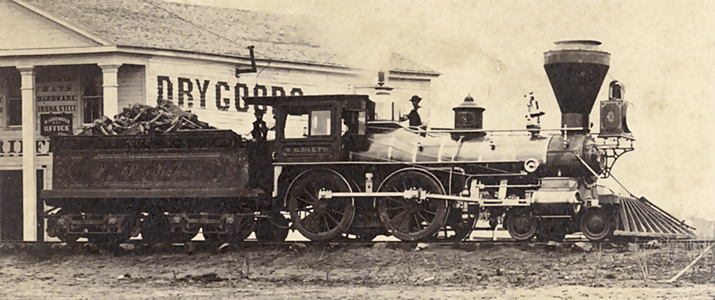
Houston & Texas Central locomotive W. R. Baker, c. 1868. The years immediately after the Civil War brought a surge in railroad construction across Texas, particularly in lines like the H&TC, fanning out from Houston. William Robinson Baker (1820-1890) held a variety of senior offices with the railroad between 1852 and 1877, and served as mayor of Houston from 1880 to 1886. Image from the Lawrence T. Jones III Texas Photographs Collection at Southern Methodist University.
Samuel Oliver Young’s True Stories of Old Houston and Houstonians (1913) includes a description of railroading in Texas during this period:
Before the close of the war all the railroads except the Houston and Texas Central and the Galveston, Houston and Henderson had gone out of commission and had ceased to run at all. In some way these two roads were kept in such condition that they could be used, but that was all. Using them was not a safe thing by any means. They crept along so slowly that while wrecks were so frequent as to attract no attention, it was a rare thing for any one to get killed or even hurt.
If full justice were done the name of Mr. [Paul] Bremond [1810-1885, president of the H&TC] would be perpetuated by the Houston and Texas Central road. It is true there is one of the principal towns on the line named after him. It is true he received loyal support and assistance from W. R. Baker, M. M. Rice, William Van Alstyne, William J. Hutchins, Cornelius Ennis and others, but theirs was money help and soon gave out. The real credit for building the road belongs to Paul Bremond, for he did what others could or would not do, pulled off his coat and went in the trenches and, figuratively, on the firing line of railroad construction in Texas.
I do not know what the reason for doing so was, but in those days the builders of locomotives always put immense smoke- stacks on them. The smokestacks were funnel-shape and several feet in circumference at the top. The locomotives burned wood and every few miles there were big stacks of cordwood piled alongside the track.
There was no such thing as spark-arresters and every time the fireman put fresh wood in the box the passengers got the full benefit of the sparks, cinders and smoke. It beat traveling by stage, however, and as the people knew nothing of oil- burners, spark-arresters and Pullman cars, everybody was content.
The old-time fireman earned every dollar that was coming to him, for he had to keep busy all the time. It was not child’s play to have to keep steam up with only wood for fuel. Then too, it took more steam to keep an engine going at that time, for the engineer was using his whistle 10 times as often as he uses it now.
There were no fences along the right of way and as there were thousands of cattle on the prairies and woods where the road ran, the track was generally filled with them every few miles. As soon as the trains would get out of the city limits, the whistle would begin tooting and this was kept up almost without cessation. Of course, a great many cattle were killed and this led to bitter warfare between the cattlemen and the railroads.
Wrecks and attempted wrecks were frequent, for there were not wanting men, who, to get revenge on the railroad company by destroying its property, were willing to run the risk of destroying the lives of innocent passengers. The first wreck of this kind that ever occurred in Texas, was on the Houston and Texas Central, near where the water tank is, about 12 miles from Houston. Some scoundrel drove spikes between the ends of the rails and wrecked the train. No one was killed, but Mr. Bremond, who was on the train, received quite serious injuries and was laid up for repairs for several days.
And while we’re at it, Bernard Kempinski at United States Military Railroads blog has a great photo of a more famous locomotive.
_____________

So Much for Reconciliation
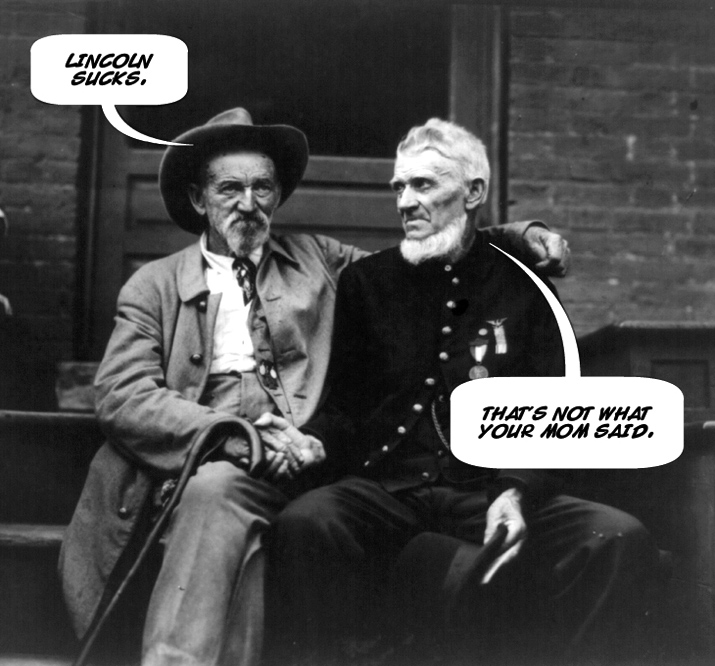
From the New York Times, July 3, 1913:
Stabbed at Gettysburg.
Affray Over Abraham Lincoln in Crowded Hotel Dining Room.
Gettysburg, Penn., July 2. — Seven men attending the Gettysburg Battle Celebration were stabbed to-night in the dining-room of the Gettysburg Hotel in a fight which started when several men aroused the anger of an old veteran in blue by abusing Abraham Lincoln.
The wounded men were:
- Edward J. Carroll, Sergeant of the Quartermaster’s Corps, U.S.A.
- David Farbor of Butler, Penn., a member of the State Constabulary.
- John D. Maugin of Harrisburg.
- Malcolm Griffin of Bedford City, Penn.
- Charles Susler of West Fairview, Penn.
- Hayder Renisbecker of Gettysburg.
- Harry A. Root, Jr., of Harrisburg.
Farbor, Maugin and Griffin are in the most serious condition. Their wounds were in the left breast, and the surgeons at the Pennsylvania State Hospital would not venture predictions as to their chance of recovery.
The fight started suddenly and was over in a few minutes. The dining room was full, and the disturbance caused a panic. The old veteran, who was unhurt and who disappeared in the melee, was sitting near Farbor and Carroll when he heard the slighting remarks about Lincoln. He jumped to his feet and began to defend the martyred President and began to berate his detractors. The men who were stabbed jumped to the defense of the veteran when the others closed in. Knives were out in a second. Women fled for the doors and crowded to the windows, ready to jump to the street.
The row was over before the rest of the men in the room could get their breath. The fight spurred the medical men again to-night to an effort to have the Gettysburg saloons closed during the remainder of the celebration.
The Constabulary later arrested a man who said he was W. B. Henry of Philadelphia on a charge of having been in the affray.
Henry said he was the son of R. R. Henry of Tazewell, Va., a General in the Confederate Army. According to witnesses, it was Henry who applied the epithet to Lincoln. The Union veteran seized a glass or bottle and threw it at Henry, who, it is alleged, drew a knife and began slashing at those nearest to him. After a fierce fight he was subdued.
H. N. Baker of Pennsylvania is said to bet [sic.] the veteran who took offense at the remarked about Lincoln. C. A. Goldthwaite of Salem, Mass. seized the knife and turned it over to the police.
________
The old Union soldier may have been former Private Henry N. Baker of the 9th Regiment, Pennsylvania Reserve Infantry (38th Volunteers) . The regiment was present at Mechanicsville, Malvern Hill, Second Manassas, Sharpsburg, Gettysburg and the Wilderness before being mustered out in May 1864. No Confederate General Henry appears in either Warner or Allardice, so I have no idea about that. Image: Library of Congress.





 Dead Confederates, A Civil War Era Blog
18 comments