“When we arm the slaves, we abandon slavery.”
In the winter of 1864-65, as the war ground down to its dénouement, the proposal to enlist slaves as Confederate soldiers became an increasingly heated matter of public discussion. While proposals to do so had popped up from time to time throughout the war, it wasn’t until the last winter of the conflict that they attracted serious attention by public officials, and the the ensuing debate was rancorous. Robert E. Lee himself reluctantly concluded that the enlistment of slaves as soldiers was an essential move, and endorsed a plan that would reward men who enlisted under it with their freedom. The Confederate Congress finally approved a plan for the enlistment of slaves — though without emancipation in return for their service — in the middle of March 1865, less than three weeks before the evacuation of Richmond. Too little, too late.
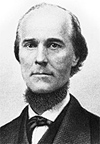 Georgia Governor Joseph E. Brown (right, 1821-94) was one of several high-ranking public officials who went on record to oppose any such measure, while it was still being debated in Richmond. In an address to both houses of the Georgia Assembly on February 15, 1865, Brown vehemently rejected both the notion that slaves could be made soldiers, and that the institution of slavery could survive the the resulting upheaval of social and racial order. Brown’s address was printed in the Athens, Georgia, Southern Watchman on March 1, 1865 (requires DjVu plug-in):
Arming the Slaves
The [Jefferson Davis] administration, by its unfortunate policy, having wasted our strength and reduced our armies, and being unable to get free men into the field as conscripts, and unwilling to accept them in organizations with officers of their own choice, will, it is believed, soon resort to the policy of filling them up by the conscription of slaves.
I am satisfied that we may profitably use slave labor, so far as it can be spared from agriculture, to do menial service in connection with the army, and thereby enable more free white men to take up arms; but I am quite sure that any attempt to arm slaves will be a great error. If we expect to continue the war successfully, we are obliged to have the labor of most of them in the production of provisions.
But if this difficulty were surmounted, we cannot rely on them as soldiers, They are now quietly serving us at home, because they do not wish to go into the army, and they fear, if they leave us, the enemy will put them there. If we compel them to take up arms, their whole feeling and conduct will change, and they will leave us by the thousands. A single proclamation by President Lincoln – that all who will desert us after they are forced into service, and go over to him, shall have their freedom, be taken out of the army, and be permitted to go into the country in his possession, and receive wages for their labor – would disband them by brigades. Whatever may be our opinion of their normal condition or their true interest, we can not expect them if they remain with us, to perform deeds of heroic valor when they are fighting to continue the enslavement of their wives and children. It is not reasonable for us to demand it of them, and we have little cause to expect the blessing of Heaven upon our effort if we compel them to perform such a task.
If we are right, and Providence designed them for slavery, He did not intend that they should be a military people. Whenever we establish the fact that they are a military race, we destroy our whole theory that they are unfit to be free.
But it is said we should give them their freedom in case of their fidelity to our cause in the field; in other words, that we should give up slavery, as well as our personal liberty and State sovereignty, for independence, and should set all our slaves free if they will aid us to achieve it. If we are ready to give up slavery, I am satisfied we can make it the consideration for a better trade than to give it for the uncertain aid which they might afford us in the military field. When we arm the slaves, we abandon slavery. We can never again govern them as slaves, and make the institution profitable to ourselves or to them, after tens of thousands of them have been taught the use of arms, and spent years in the indolent indulgences of camp life.
Brown’s argument that “whenever we establish the fact that they are a military race, we destroy our whole theory that they are unfit to be free,” mirrors the position of his fellow Georgian, Howell Cobb, who had famously written the previous month to the Confederate Secretary of War, James Seddon. “If slaves make good soldiers,” Cobb warned, “our whole theory of slavery is wrong — but they won’t make soldiers.”
Brown then went on to reject the “monstrous doctrine” that the Confederate government had the authority to conscript slaves and emancipate them in return for their service, because to do so violated the fundamental right to property of the slaveholders. Such an act would constitute a “taking” of property that violated the most basic principles of the both national and state constitutions:
It can never be admitted by the State that the Confederate Government has any power directly or indirectly to abolish slavery. The provision in the Constitution which by implication authorizes the Confederate Government to take private property for public use only, authorizes the use of the property during the existence of the emergency which justified the taking., To illustrate: In time of war it may be necessary for the Government to take from a citizen a business house to hold commissary stores., This it may do (if a suitable one cannot be had by contract) on payment to the owner a just compensation for the use of the house. But the taking cannot change the title of the land, and vest it in the government. Whenever the emergency has passed, the Government can no longer legally hold the house, but is bound to return it to the owner. So the Government may impress slaves to do the labor of servants, as to fortify a city, if it cannot obtain them by contract, and it is bound to pay the owner just hire for the time it uses them. But the impressment can vest no title to the slaves in the Government for a longer period than the emergency requires the labor. It has not a shadow of right to impress and pay for a slave and set him free. The moment if ceases to need the labor the use reverts to the owner who has the title. If we admit the right of the Government to impress and pay for slaves to free them, we concede its power to abolish slavery, and change our domestic institutions at its pleasure, and to tax us to raise money for that purpose. I am not aware of the advocacy of such a monstrous doctrine in the old Congress by any one of the radical class of abolitionists. It certainly never found an advocate in any Southern statesman.
No slave can ever be liberated by the Confederate government without the consent of the States. No such consent can ever be given by this State without a previous alteration in her Constitution. And no such alteration can be made without the consent of her people.
It’s useful to remember the context of Brown’s address. Brown was intimately tied into the Confederate government at all levels; having held office since 1857, he was the longest-serving governor in the Confederacy. He spoke to the General Assembly in Macon, because the state government had evacuated its usual seat of Milledgeville in advance of Sherman’s army. While Sherman bypassed Macon, he’d left Milledgevillein ruins, cut a sixty-mile-wide swathe through Georgia to Savannah, and even now was marching north into South Carolina. And yet, even in the death throes of the Confederacy, Brown simply could not fathom the enlistment of African American slaves as Confederate soldiers.
Real Confederates didn’t know about black Confederates.
__________

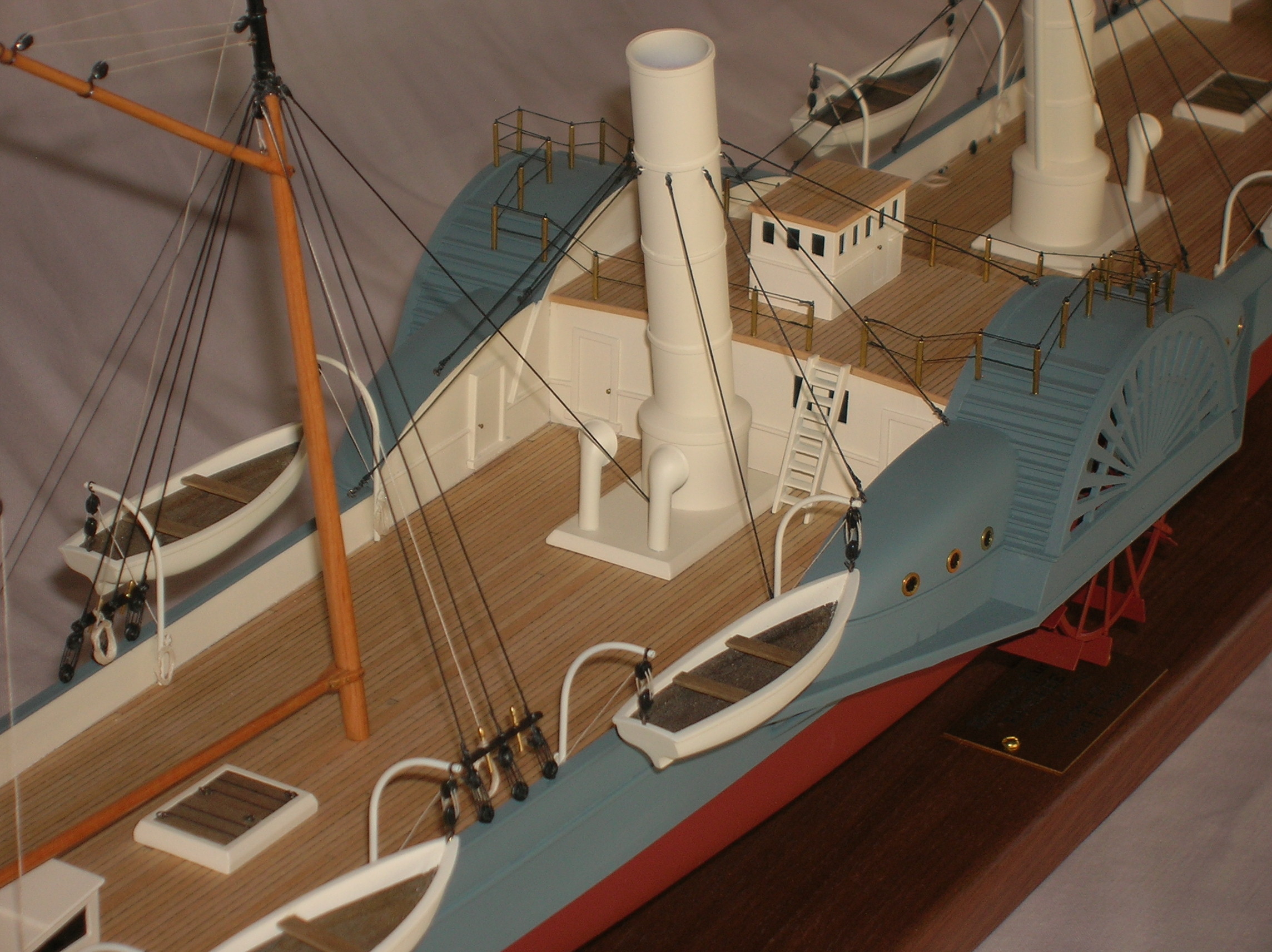
Jean Preckel’s Banshee No. 2
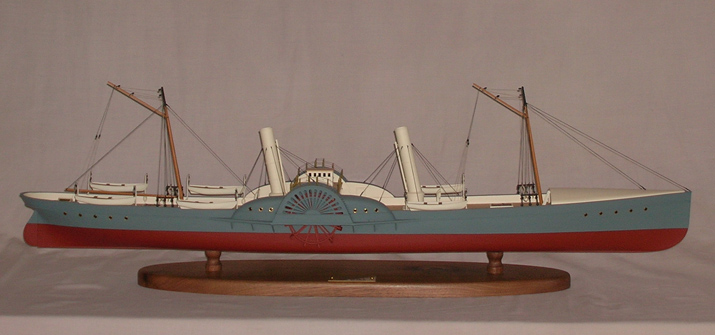
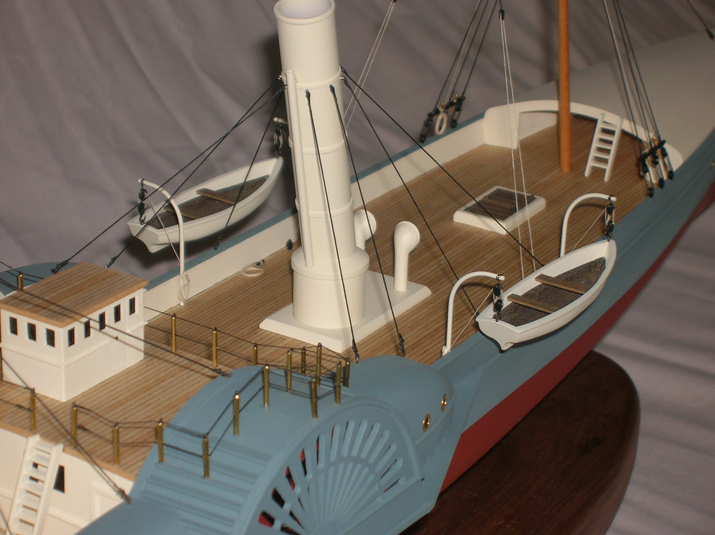
Jean Preckel is a fine arts ship model builder from Blacksville, West Virginia. She contacted me some time ago about her then-recent model of Banshee, a famous blockade runner during the war, and told me she planned to do another one of Banshee No. 2, profiled here. She contacted me again last week, with images of her new model, now complete. I believe this model is, like Banshee, done to eighth-inch (1:96) scale. You can view more of Jean’s models here.


“My humanity revolted at taking the poor devils away from their homes.”
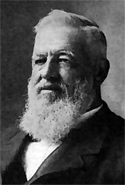 Over at the Encyclopedia Virginia Blog, Brendan Wolfe posts a letter written by Colonel William Steptoe Christian (right, 1830-1910) of the 55th Virginia Infantry during the Gettysburg campaign. Christian’s letter, written from camp, describes the campaign through the Maryland and Pennsylvania countryside so far, and the Confederate army’s efforts at foraging on the march. He also mentions the seizure of African Americans from the free soil of Pennsylvania:
No houses were searched and robbed, like our houses were done, by the Yankees. Pigs, chickens, geese, etc., are finding their way into our camp; it can’t be prevented, and I can’t think it ought to be. We must show them something of war. I have sent out to-day to get a good horse; I have no scruples about that, as they have taken mine. We took a lot of negroes [sic.] yesterday. I was offered my choice, but as I could not get them back home I would not take them. In fact, my humanity revolted at taking the poor devils away from their homes.
They were so scared that I turned them all loose. I dined yesterday with two old maids. They treated me very well, and seemed greatly in favor of peace. I have had a great deal of fun since I have been here.
Christian’s letter is fascinating, both for what it says and what it doesn’t. Undoubtedly Colonel Christian’s perspective was shared by many Confederates, both officers and enlisted men. While he objected to searching and ransacking private residences, he had no qualms about the seizure of livestock for forage and even a personal mount for himself. And while he declined to take captured African Americans for himself personally, both on practical (“I could not get them back home”) and humanitarian grounds (“they were so scared that I turned them all loose”), he never questions whether he had the right to do so, not indeed if it was right to do so. Those larger questions simply aren’t part of his recorded consideration of the question, and one is left to imagine that, had his circumstances been different, might he have decided differently, as well.
Others in Lee’s army were not so scrupulous when it came to the well-being of their captives, many of whom had never been slaves at all, but were born free. In his essay, “Race and Retaliation: The Capture of African Americans During the Gettysburg Campaign,” David G. Smith uses original, primary sources like Christian’s letter to conclude that the total number of African Americans captured by Lee’s army and taken south during the Gettysburg campaign may have been more than a thousand.
_______________

“War of Northern Aggression,” Cont.
Recently I looked at the appearance of the phrase “War of Northern Aggression” in digitally-archived newspapers over the last 150 years, and noted that it seems to be clearly a modern term, one that first starts appearing in newspapers in the mid-1950s, often in conjunction with the Civil War Centennial or, more disturbingly, as part of the rhetoric wielded by segregationists against the federal courts:


So what happens when you search for “War of Northern Aggression” in books, as opposed to newspapers? You get exactly the same phenomenon:

Now obviously this doesn’t measure what people say, and opposed to what people write, but it’s pretty telling nonetheless — if the term had, in fact, been common parlance, it should have shown up in written accounts of one sort or another. But before the mid-1950s, it just doesn’t.
So how does that use of the term compare to its more familiar counterpart, the “War Between the States?” Like this:
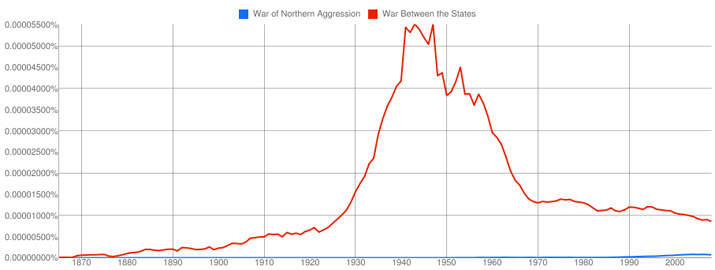
Compared to “War Between the States,” the “War of Northern Aggression” barely registers at all. And note when “War Between the States” peaked — in the 1940s and 1950s, before leveling off since about 1970.
So what happens if we toss in two other terms, “American Civil War” and “Lincoln’s War,” how do they stack up?
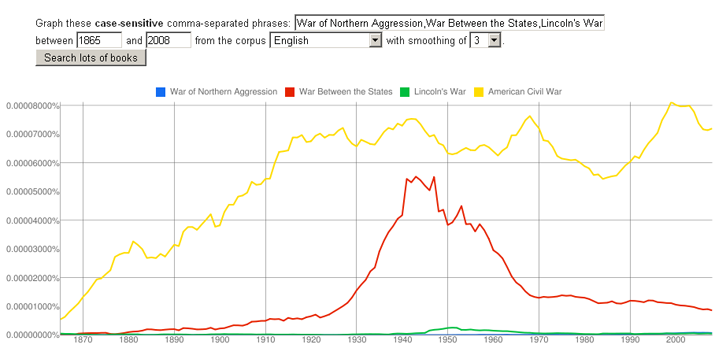
By comparison, “Lincoln’s War” and “War of Northern Aggression” barely move the needle. In 2008, the last year for which data are available, the “American Civil War” showed up something like seven times more often than “War Between the States.” WBTS nets only a fraction of mentions now, than it did in the 1940s and 1950s. More interesting still, “War Between the States” barely registers, compared to “American Civil War,” until around the turn of the 20th century, as the old generation of veterans was passing on, and the next generation took on writing about the conflict. And “War Between the States” didn’t peak until virtually all the old soldiers were gone. You can run these summaries yourself here.
It’s quite fascinating to see how terminology has changed over time. We choose our words based on our perceptions, but then those words, in turn, change the perception of others and reshape our own views. What do you think these changes over time say about how we view the war, and present it to others? (Vague complaints about “political correctness” and “winners write the history” need not apply.)
____________
H/t to Kevin for prompting the idea for this.

“Able-bodied men, who can furnish good horses and a cheap uniform”
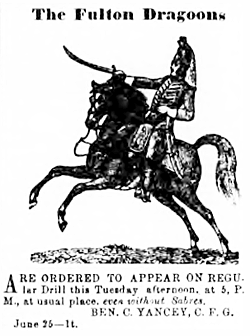 The Atlanta Southern Confederacy, June 25, 1861 (requires DjVu):
INVASION!
TO THE WAR!A “GEORGIA LEGION”
Is being organized. It is to consist of four companies of Cavalry, of eighty men each; four companies of Light Infantry, to act with the Cavalry, as Voltigeurs [i.e., skirmishers]; of two companies of Heavy Infantry, and one of Artillery.The FULTON DRAGOONS have tendered to form part of this Legion.
This Legion is expected to go into Service before the 15th of August, but the companies to be selected IN A WEEK; and to be thoroughly drilled before going into service. The Fultoon Dragoon want about fifty able-bodied men, who can furnish good horses and a cheap uniform. Gov. Brown will arm us — the Legion is to be tendered through him.
Here is offered a fine opportunity for going into service, in a Regiment of novel organization, of picked companies. A distinguished member of the Confederate Congress, from Georgia, who gets up this Legion, will doubtless be appointed Colonel; the other field officers — Lieutenant Colonel, Major and Adjutant are to be appointed by the President, from experienced Army officers.
We appeal to the patriotism of our citizens, not only of Fulton, but of other counties, who feel disposed to join us in the Fulton Dragoons, to send their names at once to us, or to register their names at the store of Lieut. Williams. We have but one week to raise out number, to get in this Legion. All who want to go, inform us at once. Will our friends who can’t go encourage this movement?
B. C. Yancey, Capt. Fulton Dragoons.
Z.A. Rice, First Lieutenant.
Wm. M. Williams, Second Lieut.
A “legion” was a regiment-sized unit of combined arms — infantry, cavalry and artillery — intended to operate as a single, tactical unit on the battlefield. As the early battles of the war quickly expanded to include tens of thousands of soldiers on each side, though, the utility of independent legions waned, and most were broken up and their constituent companies assigned to larger field formations.
The Georgia Legion described here is better known as Cobb’s Legion, after its first commander, Thomas R. R. Cobb. The Fulton Dragoon Company being organized here was eventually incorporated as Company B of the legion’s cavalry component.
______________

Coming to a Farm-to-Market Road Near You. . . .
The SCV in Texas is looking to have the state issue commemorative license plates with the organization’s logo on it. This seems to be part of a larger effort across the country to raise the visibility of the organization, as we’ve seen in other states.
As with the proposed Mississippi plate honoring Nathan Bedford Forrest, I think there’s a better way to approach this, that’s less likely to get the usual suspects riled up. But I suspect also that the SCV isn’t so much interested in that, as in finding another way to plaster the Confederate Battle Flag all over the place, and slap a “heritage, not hate” frame around it. (Maybe it could go with a companion piece that insults people who find the CBF offensive, too.) I suspect the appeal of an SCV license plate, like the flag itself, is as much about belligerence as about “education.” And if the point is “to remember Texans who died fighting in the Civil War,” why does it need an SCV logo at all?
Still, I’m torn. If people want to fly a CBF from their house, fine, whatever — but a license plate is an official document, issued by the state government. It comes very close, I think, to being an official state endorsement of the group, which (I’m sure) is an angle not lost on the plate’s backers. In that way, it’s much more akin to flying the Battle Flag from a public building, which I find inappropriate, than (say) a bumper sticker would be. Given all the ways there are to honor one’s Confederate ancestors — individually and specifically — slapping an SCV license plate on one’s car seems more like flashy historical exhibitionism than respectful recognition.
Your mileage may vary.
___________

In Which I Almost Agreed with Brag Bowling
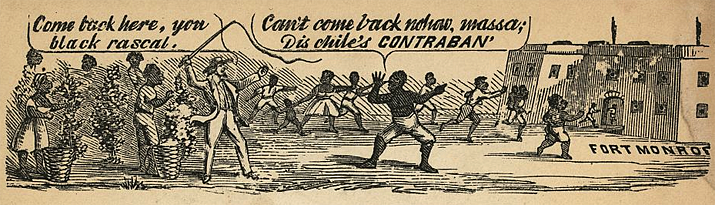
My expectations for Brag Bowling’s contributions to the Washington Post‘s A House Divided group blog are, shall we say, not high. But is it too much ask that he not contradict himself in consecutive sentences? Apparently it is.
In answering the question, “how novel was Gen. Butler’s decision to treat escaped slaves as contraband and did he do it for humane or military reasons?”, Bowling launches into predictable tropes about Butler, identifying him as a “political general” in the first clause, and referencing the nickname “Beast” Butler, in the second sentence. Nothing surprising about that, if you’ve read his earlier contributions to the blog, a couple of which I’ve discussed here and here.
The whiplash-inducing contradiction in this new piece comes in the middle of the third paragraph, to wit:
Butler used the novel legal approach of viewing them as “property” and calling them “contraband of war”. This enabled Butler to ignore both the Constitution and the Fugitive Slave Act of 1850 which would have required that they be returned to their owners.
Did you catch that? Bowling first criticizes Butler as being wrong for recognizing slaves as property, and then wrong again for not returning them to their owners.
More to the point, Bowling seems to forget that Butler’s “novel legal approach of viewing them as ‘property’ ” conforms entirely to their status both under U.S. and Confederate law. Indeed, it was the explicit claim by Southerners of their property rights in the form of slaves that both drove their decision to secede from the Union, and subsequently provided Butler with the rationale to designate those same slaves as “contraband of war” when they were put to work building fortifications. It takes some real chutzpah to deny that slaves are property, then demand their return to you as their owner.
It’s true enough that Ben Butler was never a great battlefield tactician. But his contributions, which Bowling dismisses as being in the political arena, and (presumably) therefore irrelevant to his assessment, were substantial nonetheless. Bowling makes passing reference to Butler’s “ruthless occupation” of New Orleans, but omits that the “political general’s” quarantine and general cleanup of that city almost certainly saved hundreds, if not thousands of lives that would have been lost to that perennial scourge of the Crescent City, yellow fever. He omits Butler’s commitment to African American troops in the Federal army, and his willingness to test them in battle when other, better-known commanders like Sherman, were unwilling to give them a chance. And of course he omits Butler’s postwar career in Congress, when he wrote the first draft of the Civil Rights Act of 1871, a key measure that helped to reign in the abuses of the Ku Klux Klan in the South in the years after the war.
Bowling forgets to acknowledge those things, but you can be certain he remembered to mention the chamber pot with Butler’s picture in the bottom. One has to focus on the important stuff, I guess.

Oh, and that part where I almost agreed with Bowling? It was when I read this:
Northern abolitionists considered contrabands synonymous with emancipation even before Lincoln’s final Emancipation Proclamation on January 1, 1863. General Butler’s treatment of the contrabands, while mired in legal, political and cultural issues, was closely linked to the role of emancipation. When freedom did come to the slaves still in Confederate territory, the Union lines were flooded with the newly freed causing the U. S. government to implement new policies to provide them shelter, food, clothing and even some health care – all in part – because of Butler’s decisions at the beginning of the Civil War.
Then I looked again and realized I’d scrolled too far, and was reading the end of Frank Williams’ answer to the same question. My bad.
____________
Image: “Contraband, Fortress Monroe,” Library of Congress

“The War of Northern Aggression” as Modern, Segregationist Revisionism
On the Diane Rehm show I mentioned earlier, I was struck by an observation made by Chandra Manning, that the term she first learned in elementary school in Florida, “the War of Northern Aggression,” is itself a modern term, one that was not used in the 19th century:
I grew up all over the country on naval bases and the first place that I learned about the Civil War in a classroom was Jacksonville, Fla. And we said the Pledge of Allegiance to the U.S. flag each morning, but we then sang “Dixie” to the pictures of Lee and Stonewall Jackson on either side. And so my introduction to the study of the Civil War has an interesting cast to it.
You can’t pigeonhole me North or South and so I was taken by his noticing of that phrase, “War of Northern Aggression,” because when I was six, that’s how it was introduced to me. So imagine my surprise to learn that that’s a 20th century invention, that nobody called it that during the war itself. Northerners called it “The Rebellion,” Southerners, if they called it anything other than “this awful war,” called it the “Civil War.”
Is that true, that the phrase “War of Northern Aggression” is a modern term? It is:

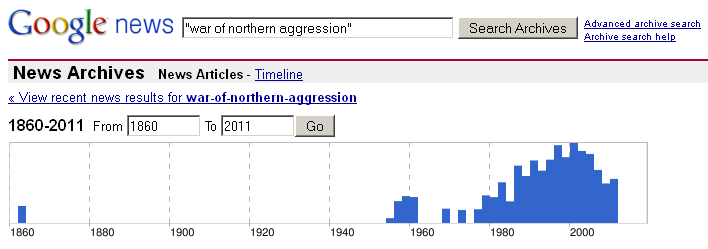
Google News can be used to track the appearance of words and phrases in its archive of hundreds of thousands of pages of historic newspapers, going back through the 19th century and beyond. Not only is “the War of Northern Aggression” a term that was not widely used at the time of the war, it didn’t come into wide use for nearly a century after, from the mid-1950s on. In Google’s indexing, it appears exactly once during the conflict, describing the war, not as a proper name as it is commonly seen today. (The single example in the 19th century comes from an 1862 speech by Union General John Alexander McClernand, who cautioned Tennesseans that “you have been told, gentlemen, that this is a war of Northern aggression. I deny it. It is no war of aggression. It is a war of defence, of defence of our common Constitution and Union.”)
As a proper noun, “the War of Northern Aggression” doesn’t even date back to what may be termed the “golden years” of the Lost Cause, around the turn of the 20th century.
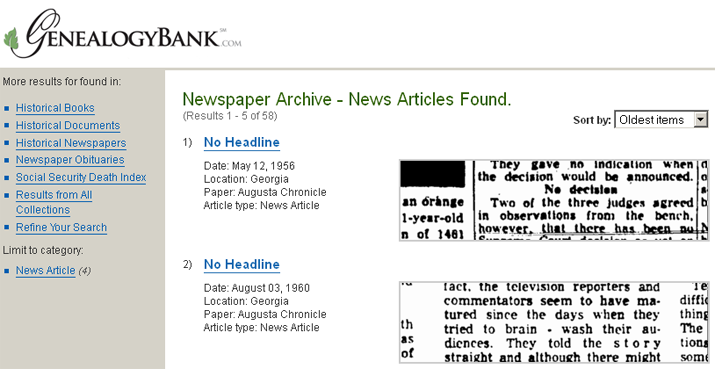
Other large newspaper databases return similar results. GenalogyBank (a subscription service), turns up the earliest reference to “the War of Northern Aggression” in a May 12, 1956 article (above) in the Augusta, Georgia, Chronicle (“S.C. Governor Suggests Negroes Evacuate South”), in which the phrase is set off in quotes, and the governor warns about Northerners “stirring racial strife in the South.”
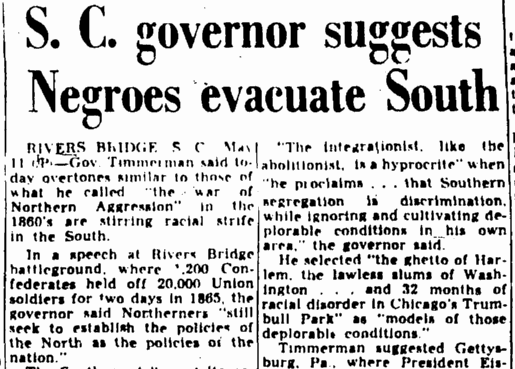
The subscription service NewspaperArchive similarly dates the phrase “War of Northern Aggression” to no earlier than 1957:

Apart from the 1862 example mentioned earlier, the term “War of Northern Aggression” didn’t appear in the New York Times again until 1972.
While there may be other, scattered examples that predate the mid-1950s, it’s clear that the phrase “War of Northern Aggression,” used as a proper noun for the Civil War, only came into regular use in the last 50 years or so. It is not a term that was used during that conflict, or for nearly a century after.
So what, exactly, was happening in the United States at about that time? What was going on the mid-to-late 1950s and early 1960s that caused it to become a popular rhetorical device? Part of it seems to be the Civil War Centennial, but there was also Brown v. Board of Education, Little Rock, Mansfield, the Montgomery Bus Boycott, lunch counter sit-ins, the Citizen’s Councils, the Freedom Riders and so on. There was lots going on, and even a quick perusal of early examples of its usage make clear that “the War of Northern Aggression,” as a proper noun, was routinely employed by Southern segregationists to draw parallels between the civil rights struggles of the mid-20th century and the conflict of a hundred years before, to enlist the memory of Confederate ancestors in opposition to federal court-mandated processes like the desegregation of public schools and integration of public facilities. The phrase “War of Northern Aggression” does not trace its origins to the cause of Robert E. Lee and Jefferson Davis; it finds its champions with the likes of Orval Faubus and George Wallace.
The Southron Heritage™ movement rails continually about “revisionist” history and “presentism,” usually in reference to “politically correct” authors who put the issue of slavery at the center of the conflict. But they should keep in mind that revisionism cuts both ways. Most of the orthodoxy held as The Truth by such folks (secession was about states’ rights, slavery would have gone away on its own, slavery was a benign institution, etc.) aren’t based on original, primary sources from the 1860s so much as they are from the voluminous Lost Cause literature from the 1890s onward, and (to a lesser degree) the Dunning School of historiography that followed it. The tenets of the Lost Cause itself are revisionist, departing from the words and deeds of Southerners during the war, to reshape and redefine the Confederacy and its legacy as something wholly pure and noble, and to deflect moral accountability onto others. It’s old revisionism, but revisionism nonetheless.
Even so, I’m surprised at how new the term “the War of Northern Aggression” actually is. Knowing its genesis, it’s hard to imagine why anyone would want to invoke it, or expect to be taken seriously when they do.
_____________

Too Many Historians, Too Little Time
 Blog reader dmf alerted me this morning to today’s Diane Rehm Show on NPR, that devoted an hour to the subject of The Civil War: America’s 2nd Revolution, with particular emphasis on the coming of the war and the way it’s perceived today. I don’t usually have a chance to listen to Rehm’s show, but the panel today was A-List: Adam Goodheart, author of 1861: The Civil War Awakening; David Blight, author of Race and Reunion: The Civil War in American Memory, the upcoming American Oracle: The Civil War in the Civil Rights Era, and a popular undergrad lecture series available online; Thavolia Glymph, author of Out of the House of Bondage: The Transformation of the Plantation Household; and Chandra Manning, author of What This Cruel War Was Over: Soldiers, Slavery, and the Civil War.
They covered a lot of ground, and easily could have gone on for another hour. I’ll have more to say when the episode’s transcript is posted, but for now you can listen online.

Update: Transcript here.
____________

Clara Barton, Confederate Heroine
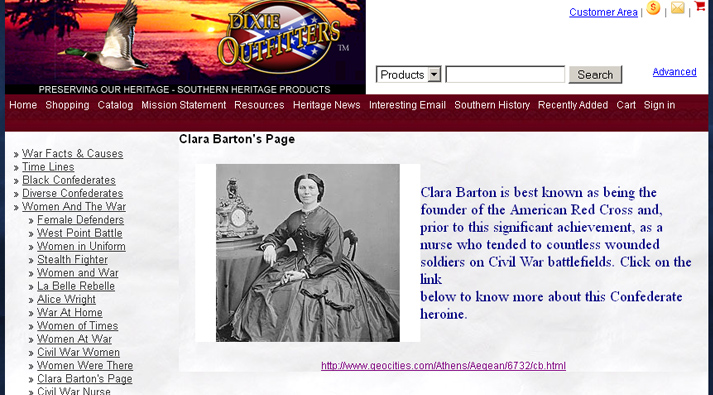

You just can’t make this stuff up.
Under Dixie Outfitter’s “Southern History” section, I stumbled upon this gem. While I don’t doubt that, as a battlefield nurse, Barton tended to wounded Confederates as well as Union troops, it sure seems a bit of a stretch to claim this Unitarian daughter of Massachusetts as a “Confederate heroine.” (This is almost as good as the time recently when I saw a paean to the virtues of traditional antebellum Southern womanhood, headed by a picture of New England Quaker, abolitionist and proto-feminist Lucretia Mott.) It’s hard to imagine what the woman who organized the exhumation, identification and reburial of the remains of over 12,000 Federal prisoners at Andersonville would think of Dixie Outfitters’ honorific. The Geocities link at the bottom died with that online hosting service in 2009, but you can view it here in the Internet Way-Back machine. No “Confederate heroine” foolishness there.
I’m not sure why I should be surprised; the subject of Dixie Outfitters’ “Legends of the Confederacy: Washer Women” shirt was actually the wife of a soldier in the 31st Pennsylvania Infantry.
_______________





 Dead Confederates, A Civil War Era Blog
12 comments