
Nothing to Bragg About
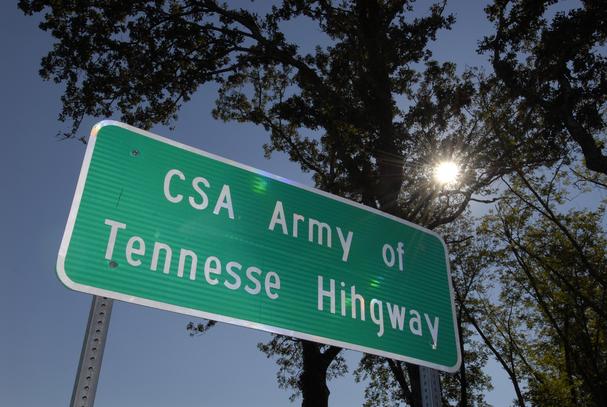
David Woodbury at of Battlefields and Bibliophiles notes some problems with spelling down at the Georgia Department of Transportation’s sign shop.
________________________________
Image: AP Photo/Chattanooga Times Free Press, Laura-Chase McGehee.

Old Dominion Shows the Way

Bloggers Ta-Nehisi Coates and Kevin Levin both call attention to Virginia Governor Bob McDonnell’s announcement Friday that next spring, Confederate History Month will be replaced by Civil War in Virginia Month. This is not only good news, but the governor also chose to make his announcement at the highest-profile venue possible, the 2010 Signature Conference of the Virginia Sesquicentennial of the American Civil War Commission.
The legacies of the Civil War still have the potential to divide us. But there is a central lesson of that conflict that must bond us together today. Until the Civil War, the founding principle that all people are created equal and endowed by their Creator with unalienable rights was dishonored by slavery. Slavery was an evil and inhumane practice which degraded people to property, defied the eternal truth that all people are created in the image and likeness of God, and left a stain on the soul of this state and nation. For this to be truly one nation under God required the abolition of slavery from our soil. Until the Emancipation Proclamation was issued and the Civil War ended, our needed national reconciliation could not begin. It is still a work in progress.
150 years is long enough for Virginia to fight the Civil War.
“Now, on the eve of this anniversary, is a time for us to approach this period with a renewed spirit of goodwill, reverently recalling its losses, eagerly embracing its lessons, and celebrating the measure of unity we have achieved as a diverse nation united by the powerful idea of human freedom.
A modern Virginia has emerged from her past strong, vibrant and diverse. Now, a modern Virginia will remember that past with candor, courage and conciliation. . . .
It’s time to discuss openly how we as Americans, black, white and brown can promote greater reconciliation and trust and greater access to the American Dream for all, so that there is more peace in our hearts and homes, schools and neighborhoods.
This speech is direct, comprehensive, and eloquent. In this address, Bob McDonnell acknowledges and embraces the fundamental truth that so many are unwilling to — that one cannot separate Confederate history from the Civil War, nor the Civil War from this nation’s long, dark legacy of slavery. They are all aspects of the same heritage we share, inextricably intertwined and knotted together.
I have been critical of McDonnell’s original Confederate History Month proclamation — “tone deaf” is about the most charitable thing one can say about it — but today’s remarks really do clean the slate. And while the governor certainly caught a lot of (well-deserved) hell for that earlier document, I’m not going to take a cynical view of his motivations in reversing course here. As Coates said, “You can not ask politicians to do the right thing, and then attack them for doing it.” Amen.
Good for Bob McDonnell. Good for Virginia. Good for the South, and good for our nation. I hope that in this area, has it has so often throughout American history, Virginia sets an example for others to follow.
Added Monday, September 27: Via TPMMuckraker, the SCV responds to McDonnell’s move:
“Our organization is terribly disappointed by this action,” [Virginia SCV Division Commander Brag] Bowling told TPMmuckraker. “[McDonnell] succumbed to his critics, people who don’t support him anyway. And the vast majority of citizens of Virginia support Confederate History Month.”
He said he had spoken with the governor’s office and told them the same thing. He said “Civil War In Virginia Month” is a poor substitute.
“Nobody’s ever been able to reason with me and tell me why we’re honoring Yankees in Virginia,” Bowling said. “The only northerners in Virginia were the ones that came to Virginia and killed thousands of Virginia citizens when they invaded.”
I suppose it’s too much to ask for the SCV to actually respond to the detailed and specific content of McDonnell’s address; instead Bowling drags out the same tired dog-whistles about Yankees and “invasion.” Seriously, folks: get yourselves some new talking points.
Full text of the governor’s address after the jump.
“Possessed of an irascible temper, and naturally disputatious.”

Over at KNOXVILLE 1863, the novel, Dick Stanley has a couple of posts up on Confederate General Braxton Bragg. They paint a picture of a man who was decidedly not popular, either with his men or with his fellow senior officers. He was a prickly man, very much caught up in protocol and form. In his own memoir, Ulysses S. Grant echoes some of their impressions of the man — honest, industrious, and decidedly formal with colleagues. Grant goes on to repeat an anecdote about Bragg from the prewar Army which, accurate or not, vividly captures Bragg’s obsession with procedure:
Bragg was a remarkably intelligent and well-informed man, professionally and otherwise. He was also thoroughly upright. But he was possessed of an irascible temper, and was naturally disputatious. A man of the highest moral character and the most correct habits, yet in the old army he was in frequent trouble. As a subordinate he was always on the lookout to catch his commanding officer infringing his prerogatives; as a post commander he was equally vigilant to detect the slightest neglect, even of the most trivial order.
I have heard in the old army an anecdote very characteristic of Bragg. On one occasion, when stationed at a post of several companies commanded by a field officer, he was himself commanding one of the companies and at the same time acting as post quartermaster and commissary. He was first lieutenant at the time, but his captain was detached on other duty. As commander of the company he made a requisition upon the quartermaster–himself–for something he wanted.
As quartermaster he declined to fill the requisition, and endorsed on the back of it his reasons for so doing. As company commander he responded to this, urging that his requisition called for nothing but what he was entitled to, and that it was the duty of the quartermaster to fill it. As quartermaster he still persisted that he was right. In this condition of affairs Bragg referred the whole matter to the commanding officer of the post. The latter, when he saw the nature of the matter referred, exclaimed: “My God, Mr. Bragg, you have quarreled with every officer in the army, and now you are quarreling with yourself!”
_____________________________

Foredeck


The major work on the foredeck is blocked out, though a good bit of detail to be added (anchors, cables, etc.).Put anchor chain hawsepipes in the forward casing and similar features for the rudder chains aft.
 As I think I mentioned previously, there’s a lot of ambiguity about Virginia‘s appearance. There are no known photos of the ship, and contemporary illustrations are very inconsistent when it comes to specific details. This is particularly true of the ironclad’s foredeck. Sources generally agree that there was a triangular bulkhead/breakwater, but it’s not entirely clear whether this had been decked over (as planned) at the time of the actions of March 8-9, 1862. Thorough-going modelers have depicted it differently; the model in the Smithsonian’s National Museum of American History has the deck open (and displays an incorrect ensign), while another at the Hampton Roads Naval Museum shows complete decks, fore and aft. The model at the Mariner’s Museum (as well as the plans I’m working from, from the same source) show the space open. Even the same source sometimes offers differing versions — Tom Freeman, a modern artist who work I admire greatly and who puts a great deal of research into his paintings, has depicted it both decked over (left) and open.
Also not sure if the planned shutters (also shown) were ever fitted to the angled ports on either side of the bow port.
Took the covers off the boats — the latter to make for a more visually interesting feature.

“He died without a struggle.”

Army of the Potomac
October 6th, 1862Dear Brother — I was surprised to hear of the death of Henry. I had heard that he was wounded, and got a furlough of two days to go and find him. Starting when your letter came to me, I wandered all day over the field at Antietam. I kept going for miles and miles, looking at every grave I saw, and was about to give up the search from fatigue and hunger (for I had already gone over twenty five miles), but I kept on till dark, and just as I was about to lie down for the night, I saw a few graves under an apple tree, a few rods off, and there I found the grave of our dear brother. It was a solemn time for me as I sat by the grave.
I found a person who watched with him, and was present at his burial. He was shot in the early part of the action. He died without a struggle. It will be a hard struggle for mother. To think he was taken away in so short a time after leaving home, while I have been engaged in six or seven battles! But the thought of his dying so peacefully (and no one can doubt his Christian character or fitness to meet his Maker) will lessen the grief of our mother, and brothers, and sisters. We have lost him; but this we know, he was a Christian, and showed a Christian spirit in all his actions. It seems like a dream. As I look from the “Heights” (Bolivar) [near Harper’s Ferry], I can see the rebel army, and a battle is expected in a few days. I am willing to meet them, no matter how hard the battle, or how long and forced the marches are, if we can only finish the war, or make a beginning of the end. I may too, like Henry, be shot down. If I die, I die in the faith of Christ, and have no fears as to what awaits me. I am happy wherever I am. I can lie down with as much ease, and rest for the night within range of the enemy’s guns, knowing that at dawn we may meet face to face, as I could at home upon my bed. It is near midnight, and I must close.
Sergeant S. P. Keeler
Corporal Henry Keeler enlisted in Company C of the 14th Connecticut Infantry on August 20, 1862. He died four weeks later when the 14th charged Confederate positions along a road later called “Bloody Lane.” Corporal Keeler’s remains were later returned for burial at Ridgefield, Connecticut.
The author, Silas P. Keeler of Waterbury, Connecticut, was a twenty-one-year-old sergeant in Company E, 8th Connecticut Infantry. He had originally enlisted in the 1st Connecticut Infantry in April 1861, mustered out a few months later, and re-enlisted in the Eighth in September 1861. He mustered out of the service in February 1865.
Although the addressee of Sergeant Keeler’s letter is unknown, it seems clear it was written to a family member, with the intent that it would be shared. In addition to assuring that Henry had died “without a struggle ” and the typical assurances of religious faith and comfort in the face of danger, Keeler also mentions that “I found a person who watched with him, and was present at his burial.” This was an important consideration in the 19th century, that even when nothing could be done for the man, he did not die alone, and had a mourner at his interment. Sergeant Keeler was making sure that his family knew that Henry had died a “good” death, as it was understood at the time. Even in his own circumstances, the writer was focused entirely on assuaging the fears and unease of his family in Connecticut.
Letter from Soldier’s Letters from Camp, Battlefield and Prison, ed. by Lydia Minturn Post (New York: Bunce & Huntinton, 1865). Image: “Looking for a Friend,” by Walton Taber.

Screwed
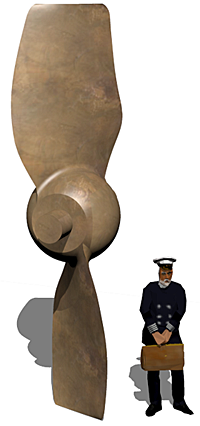 TheRaven asked about the propeller (screw) on the Virginia model and caught me out — it’s a placeholder borrowed from another model. I’m still digging for decent drawings of Virginia’s screw, which would have been her original, fitted when she was in service as U.S.S. Merrimac.
In the meantime, here’s the screw from C.S.S. Alabama, the high-seas raider built by Laird at Birkenhead in 1862. Although fitted out as a steamship, Alabama was intended to spend most of her time at sea under sail to conserve fuel, and so (like many ships of that period) was fitted with a “lifting” screw that could be disconnected from the shaft and hoisted almost entirely out of the water to reduce drag. Alabama‘s screw was 14 feet 3 inches (4.34m) in diameter. This model is based on plans in Andrew Bowcock’s authoritative C.S.S. Alabama: Anatomy of a Confederate Raider, which in turn are based on shipyard-built presentation model of the ship. Ship’s trials data for Alabama are missing, but based on the models and builders’ trials of contemporary vessels, Bowcock suggests that Alabama‘s screw had a pitch angle of 35°, a “slip” — a measure of the difference between the distance that a propeller of a given pitch should have moved forward (as the result of a full rotation) and the distance that it actually moved forward — of 15-20%, and operated at full speed at 60-65 rpm. Alabama‘s screw would have been more technically refined that Merrimac/Virginia‘s, but closer than the one shown in the renders below.

More Virginia
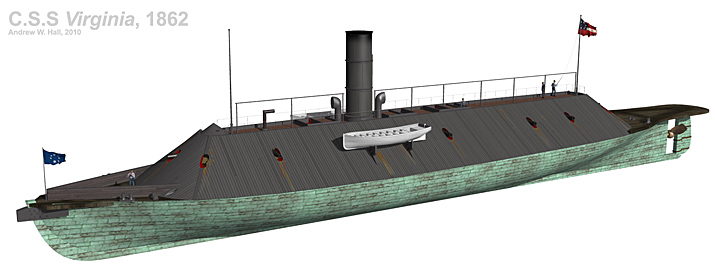
More progress on Virginia. Replaced the appropriate Dahlgrens with Brooke rifles (not that it shows at all), added the upper platform rail, textured the chimney and adjusted the main casemate texture to make sure it lines up properly with the angled gunports, fore and aft. I also replaced the texture on the ship’s boat; the white will stand out better against the dark hull. (Even when striving for as much accuracy as possible, there are lots of situations where, absent actual historical data, there’s room to apply some personal aesthetic.) I’m quickly running out of work above the waterline, and soon will have to dig into the forecastle.


Virginia Progress
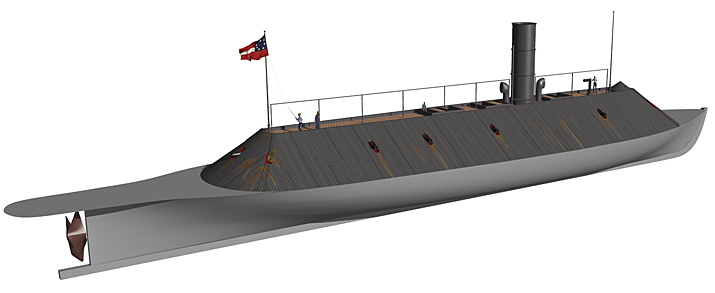
Upper works blocked out and a preliminary texture on the casemate.
Guns added, as well. For now, they’re eight 9-inch Dahlgren smoothbores on the broadside, with a 7-inch Brooke rifle at each end. Two of the Dahlgrens need to be replaced with 6.4-inch Brooke rifles, but I need to be sure of their placement first.
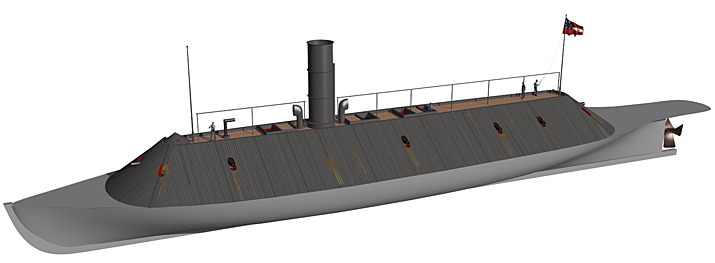
Update: The data cards from the old Yaquinto game Ironclads show the two 6.4-inch Brookes as being the foremost broadside guns. Makes sense.

“Never before was anything like it dreamed of”


A work-in-progress. I’d forgotten what a subtly complex shape Virginia‘s sloped casemate really was. Flat, orthagonal drawings don’t do it justice; there’s not a straight edge in the entire thing. That, and how big the ship actually was. Little wonder they thought it was nigh-on invincible.





 Dead Confederates, A Civil War Era Blog
7 comments