United States Colored Troops Support Amendment 62

Company E, 4th U.S. Colored Infantry. Library of Congress.
I don’t like to get too much into present-day politics on this blog, but when folks drag historical figures (real or imagined) into the fray, it becomes fair game for commentary. Personhood Colorado, an anti-abortion group looking to amend that state’s constitution to designate a fetus a “person” under law, has a new radio ad in which an actor portrays a runaway slave who joins the Union Army to fight in the Civil War:
I’m George Stevens and I’m a person. I was held as property as a child. Even before my birth I was called a slave in an America you wouldn’t recognize. But folks like you helped me escape North to freedom and in 1864, I joined the infantry to fight for my country. I fought so all slaves would be recognized as persons, not property. And we won. But today in Colorado, there are still people called property – children – just like I was. And that America you thought you wouldn’t recognize is all around you and these children are being killed. This November, vote “yes” on Amendment 62. Amendment 62 declares unborn children persons, not property. And that’s the America I fought for. . . .
I’m sure “George Stevens” was chosen as a sufficiently common name to allow the producers to avoid having to answer for pinning any specific individual, even a long-dead one, to this cause. According to the National Park Service’s Civil War Soldiers and Sailors System, there were at least ten “George Stevens” serving in black U.S. regiments during the war, and at least one more among state troops, in the 55th Massachusetts Infantry.
There seems to be a lot of this going on lately, latching on to specific historical figures for a sort of endorsement-from-beyond-the-grave. I’m not talking about your run-of-the-mill, homage to leaders of the past in a gauzy, feel-good sort of way, but taking actual (or in “George Stevens” case, fictional) historical figures and presenting them as explicitly endorsing a particular candidate or position. In many of these cases, it seems, the pairing of the candidate and known, established positions of the historical figure are dubious, or even amusing. Rand Paul, the GOP Senate candidate in Kentucky who has questioned the propriety of the Civil Rights Act and has defended the right of private businesses to discriminate based on race — though he’s also said “it’s bad for business” if they do — published an editorial in the Bowling Green Daily News in which he wrote that “when I read history I side with abolitionists such as William Lloyd Garrison and Frederick Douglas,” apparently forgetting the spelling of “Douglass.” Rick Barber, running in the GOP primary for a congressional seat in Alabama, famously ran an ad where he sits in a bar, surrounded by colonial revolutionaries like Sam Adams and Ben Franklin and asserts that the American Revolution began as a protest over taxes, seemingly unaware that it was about taxation without representation, a legitimate problem that Barber’s own candidacy would seem to disprove on its face. Not quite satisfied with that bit of whiplash-inducing logic, Barber followed up with an ad in which he asked Abraham Lincoln (“Hey, Abe!”) the Great Emancipator’s view on federal income taxes, to which the sixteenth president ominously intones, “slavery!” As with his previous ad, Barber’s history here is a little off, given that the Lincoln administration imposed the first income tax in U.S. history. Oops.
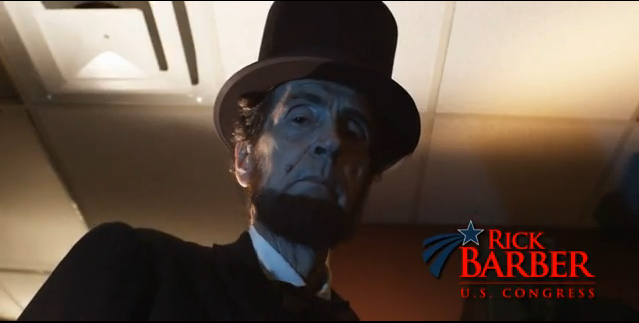
I don’t mind it so much when modern politicians make reference to historical figures, when the parallels actually, you know, make sense, when the current issue or policy position shows a clear and logical lineage. But these recent examples are just silly, made more so by the dissonance between the positions actually taken by the historical figures whose mantles they claim and the modern-day political positions they’ve been exhumed to endorse. Does anyone actually believe that, in their own day, Franklin and Adams would have been considered to stand on the “conservative” side of the political spectrum, or that Douglass favored the federal government keeping out of civil rights issues? Did George Washington really support the idea of violent overthrow of a republic’s elected government? (“Gather your armies!”) And remind me again — what does the historical record say about Private Stevens’ (Stevenses?) position on abortion? I hate to generalize, but I’ve never got the idea that the political forebears of the Tea Party movement — prime backers of both Rand Paul and Rick Barber — were big fans of either Lincoln or strident abolitionists like Douglass, neither of whom were shy about using the force of the U.S. government to pursue their objectives. Is it worth noting that at the same time Personhood Colorado is making a direct and explicit parallel between itself and the abolitionists of 150 years ago, its allies in Washington D.C. are lynching their opponents in effigy?
This is all pretty ridiculous, over-the-top political theater, and I suspect that the vast majority of people see it that way, including those who happen to agree with the candidate in question on the issues. But I’m skeptical that it wins elections. There’s some evidence of that; for all the cable-news airtime and YouTube play Barber’s ads got — over 380,000 views and counting for the “gather your armies!” spot — he got a thumpin‘ a couple of weeks ago in the primary runoff with Montgomery City Councilwoman Martha Roby. And Personhood Colorado may need an entire regiment of “George Stevenses” to pass their constitutional amendment — the last time it came up for a vote, in 2008, it got crushed almost three-to-one.
How to Make a Black Confederate from Nothing at All
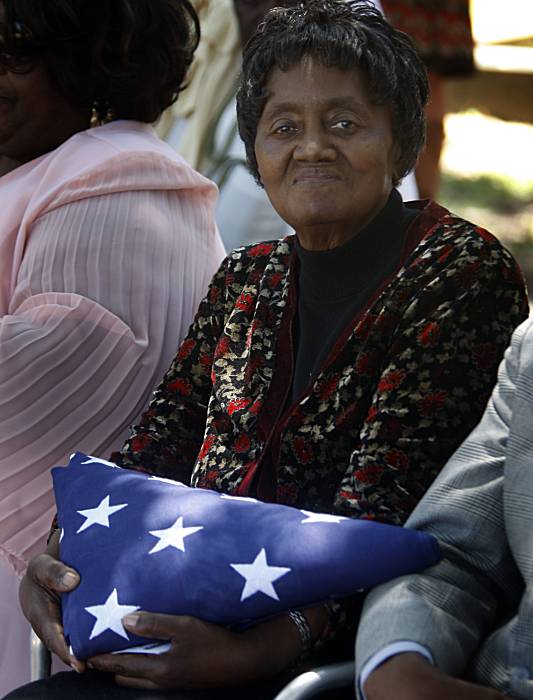
Mary Johnson, granddaughter of Pvt. Samuel Brown, holds an American flag presented to her at the event. Paul Chinn/SF Chronicle
Over the weekend, David Woodbury of Battlefields and Bibliophiles and Kevin Levin at Civil War Memory highlighted a story in the San Fransisco Chronicle, about Samuel Brown, an African American Civil War veteran whose grave in Vallejo, California, was recently marked with a stone commemorating his service with the 137th United States Colored Troops. The event came about because the original stone, which had been on Brown’s gravesite since shortly after his death, designated him as a Confederate veteran. Via the CBS teevee affiliate in San Fransisco, Brown’s grave had originally been marked with a stone that read, contradictorily,

So it was a fnckup at the engravers, simple as that. Someone assumed that a Civil War soldier from Georgia must’ve been a Confederate. Nothing nefarious or conspiratorial. Mistakes like this are unfortunate, but certainly not unheard of. Read the full article here.
What’s most remarkable about this story, though, is not the story itself, but the reaction to it. Corey Meyer, posting at Blood of My Kindred, asks, “is this how Black Confederates are created?”
Why yes, Corey. Yes it is.
As Corey points out, the comments section of the original story is already filling with posters who, based on nothing at all, are accusing the ceremony’s organizers with changing Pvt. Brown’s history to conform to modern-day political correctness, and to cover up the fact that Brown was really a Confederate soldier. Commenter levesque writes, “my uninformed guess is that Mr. Brown was a black Confederate soldier who surrendered to occupying Union Army forces in Georgia.” He continues, “As anyone who has seen Gone With the Wind knows. . . .”
An “uninformed guess,” based on watching Gone with the Wind. There’s some scholarship. Watch out, Blight, you effete liberal hack, levesque is gunnin’ for your endowed chair.
Someone calling him- or herself whiteheat uses Brown as a jumping-off point for a Beckian rant about Lincoln and how he started the long, slow destruction of Real America™:
What this article does not mention is that many African slaves did indeed fight for the Confederacy. Lincoln’s ‘Emancipation Proclamation’ was issued two years into the civil war, and was mostly for propaganda purposes, since Lincoln said repeatedly that he would be willing to retain slavery if it would preserve the Union. Lincoln was all about Federal power and Big government. He also believed that whites and “negros” could not live together as equals.
After presiding over America’s most destructive war (quite a feat) Lincoln’s additional legacy is that he got us lurching towards Empire. America’s decline can (in part) be attributed to this magnificent war-maker.
Yet another commenter, blogorama, brings the snark:
How is this a positive story? For almost 100 years this man was laid to rest under a head stone that identified him as an ignorant buffoon instead of a hero. And his family never noticed. Gee, that’s heart warming.
Enfield53 — get it? — also jumps to the defense of the idea of Black Confederates, saying
Thousands of slaves and free blacks did serve with honor in the Confederate Army. Indeed, twenty percent of the Confederate Navy was black as well. There are hundreds of photographs taken of black Confederates taken with their white mess-mates at reunions held decades after the war. . . .
Dead Confederates regulars are already familiar with the pitfalls of relying on Confederate reunion photographs.
It doesn’t look like Private Brown has been credited as a Black Confederate up to now, but I wouldn’t be surprised if that changes. The claims made for Black Confederates are often based on the flimsiest of evidence, and a headstone reading “CONFEDERATE STATES ARMY” is undoubtedly sufficient in this case, especially if one overlooks that the original stone correctly identified Brown’s regiment. That last part is a detail that, I suspect, will get overlooked in the clamor about “political correctness” and denial of Brown’s “true” Confederate heritage. After all, it is the Bay Area. I’m sure somehow this whole thing is Nancy Pelosi’s fault.
Update: The Sacramento Bee has nice coverage of the story with additional details, and the Long Beach Press-Telegram has a story from last March on Brown’s family in the Vallejo area. Below: One of Private Brown’s pension application index cards, dated January 6, 1894, via Footnote.

Mrs. Grant’s Donation

Rusty Williams, over at My Old Confederate Home blog, makes a great find: President Grant’s widow, Julia Dent Grant, made a $25 donation to the Confederate Soldier’s Home in Austin. Sure enough, the Galveston Daily News of March 15, 1889, confirms:
Aiding the Confederate Home
New York, March 14 — Secretary Oliver Downing of the New York Citizen’s committee, to aid the National Confederate Soldier’s home at Austin, Tex., has received a letter from General Alfred Pleasanton containing money. Another letter from Mrs. Grant incloses [sic.] a check for $25. The letter is as follows:
Oliver Downing, Secretary, Etc. — Dear Sir: General Grant’s kindly feelings toward the southern people, though they were once his enemies, is Mrs. Grant’s reasons for sending the inclosed check. She wishes you success in your efforts.
Fred D. Grant, for Mrs. Grant
How Val Giles Made Second Sergeant
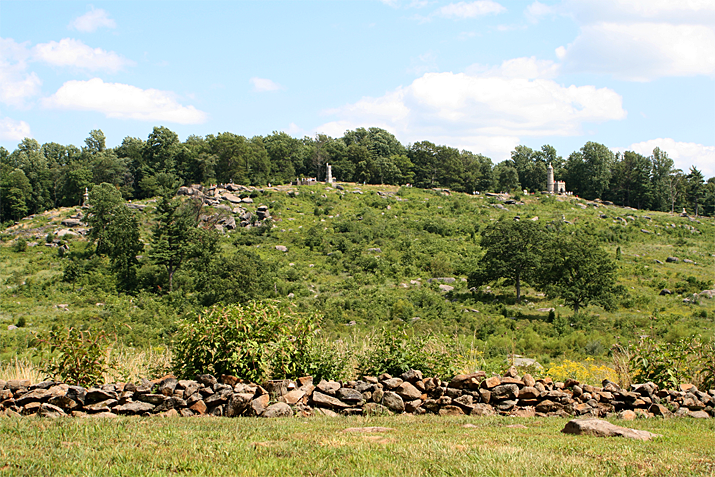
West slope of the Little Round Top, Gettysburg, as seen from the plain along Plum Run. This is the view that presented itself to the 4th and 5th Texas Regiments late on the afternoon of July 2, 1863. Photo by jwolf312, used under Creative Commons License.
Valerius Cincinnatus Giles — inevitably known simply as “Val” — was a twenty-one-year-old soldier in Company B of the 4th Texas Infantry when that unit made its famous, unsuccessful assault on the Federal positions on Little Round Top, late on the second day during the Battle of Gettysburg. In his later years, Giles spent much of his free time compiling a memoir, but did not live to see its completion. Giles died in 1915; his writings, edited by Mary Lasswell, were finally published in 1961. That volume, Rags and Hope, has since become a classic first-person account of Texas soldiers during the war.
It was nearly five o’clock when we began the assault against the enemy that was strongly fortified behind logs and stones on the crest of a steep mountain. It was more than half a mile from our starting point to the edge of the timber at the base of the ridge, comparatively open ground all the way. We started off at quick time, the officers keeping the column in pretty good line until we passed through a blossoming peach orchard and reached the level ground beyond. We were now about 400 yards from the timber. The fire from the enemy, both artillery and musketry, was fearful.
In making that long charge, our brigade got jammed. Regiments lapped over each other, and when we reached the woods and climbed the mountains as far as we could go, we were a badly mixed crowd.
Confusion reigned everywhere. Nearly all our field officers were gone. Hood, our Major General, had been shot from his horse. He lost an arm from the wound [sic.]. Robertson, our Brigadier, had been carried from the field. Colonel Powell of the Fifth Texas was riddled with bullets. Colonel Van Manning of the Third Arkansas was disabled. and Colonel B. F. Carter of my Regiment lay dying at the foot of the mountain.
The side of the mountain was heavily timbered and covered with great boulders that had tumbled from the cliffs above years before. These afforded great protection to the men.
Every tree, rock and stump that gave any protection from the rain of Minié balls that were poured down upon us from the crest above us, was soon appropriated. John Griffith and myself pre-empted a moss-covered old boulder about the size of a 500-pound cotton bale.
By this time order and discipline were gone. Every fellow was his own general. Private soldiers gave commands as loud as the officers. Nobody paid any attention to either. To add to this confusion, our artillery on the hill to our rear was cutting its fuse too short. Their shells were bursting behind us, in the treetops, over our heads, and all around us.
Nothing demoralizes troops quicker than to be fired into by their friends. I saw it occur twice during the war. The first time we ran, but at Gettysburg we couldn’t.
This mistake was soon corrected and the shells burst high on the mountain or went over it.
Major Rogers, then in command of the Fifth Texas Regiment, mounted an old log near my boulder and began a Fourth of July speech. He was a little ahead of time, for that was about six thirty on the evening of July 2d.
Of course nobody was paying any attention to the oration as he appealed to the men to “stand fast.” He and Captain Cousins of the Fourth Alabama were the only two men I saw standing. The balance of us had settled down behind rocks, logs, and trees. While the speech was going on, John Haggerty, one of Hood’s couriers, then acting for General Law, dashed up the side of the mountain, saluted the Major and said: “General Law presents his compliments, and says hold this place at all hazards.” The Major checked up, glared down at Haggerty from his’ perch, and shouted: “Compliments, hell! Who wants any compliments in such a damned place as this? Go back and ask General Law if he expects me to hold the world in check with the Fifth Texas Regiment!”
The Major evidently thought he had his own regiment with him, but in fact there were men from every regiment in the Texas Brigade all around him.
From behind my boulder I saw a ragged line of battle strung out along the side of Cemetery Ridge and in front of Little Round Top. Night began settling around us, but the carnage went on.
There seemed to be a viciousness in the very air we breathed. Things had gone wrong all the day, and now pandemonium came with the darkness.
Alexander Dumas says the devil gets in a man seven times a day, and if the average is not over seven times, he is almost a saint.
At Gettysburg that night, it was about seven devils to each man. Officers were cross to the men, and the men were equally cross to the officers. It was the same way with our enemies. We could hear the Yankee officer on the crest of the ridge in front of us cursing the men by platoons, and the men telling him to go to a country not very far away from us just at that time. If that old Satanic dragon has ever been on earth since he offered our Saviour the world if He would serve him, he was certainly at Gettysburg that night.
Every characteristic of the human race was presented there, the cruelty of the Turk, the courage of the Greek, the endurance of the Arab, the dash of the Cossack, the fearlessness of the Bashibazouk, the ignorance of the Zulu, the cunning of the Comanche, the recklessness of the American volunteer, and the wickedness of the devil thrown in to make the thing complete.
The advance lines of the two armies in many places were not more than fifty yards apart. Everything was on the shoot. No favors asked, and none offered.
My gun was so dirty that the ramrod hung in the barrel, and 1 could neither get it down nor out. 1 slammed the rod against a rock a few times, and drove home ramrod, cartridge and all, laid the gun on a boulder, elevated the muzzle, ducked my head, hollered “Look out!” and pulled the trigger. She roared like a young cannon and flew over my boulder, the barrel striking John Griffith a smart whack on the left ear. John roared too, and abused me like a pickpocket for my carelessness. It was no trouble to get another gun there. The mountain side was covered with them.
Just to our left was a little fellow from the Third Arkansas Regiment. He was comfortably located behind a big stump, loading and firing as fast as he could. Between biting cartridges and taking aim, he was singing at the top of his voice: “Now let the wide world wag as it will, I’ll be gay and happy still”
The world was wagging all right-no mistake about that, but 1 failed to see where the “gay and happy” came in. That was a fearful night. There was no sweet music. The “tooters” had left the shooters to fight it out, and taken “Home, Sweet Home” and “The Girl I Left Behind Me” with them.
Our spiritual advisers, chaplains of regiments, were in the rear, caring for the wounded and dying soldiers. With seven devils to each man, it was no place for a preacher, anyhow. A little red paint and a few eagle feathers were all that was necessary to make that crowd on both sides into the most veritable savages on earth. White-winged peace didn’t roost at Little Round Top that nightl There was not a man there that cared a snap for the golden rule, or that could have remembered one line of the Lord’s Prayer. Both sides were whipped, and all were furious about it.
We lay along the side of Cemetery Ridge, and on the crest of the mountain lay 10,000 Yankee infantry, not 100 yards above us. That was on the morning of July 3, 1863, the day that General Pickett made his gallant, but fatal charge on our left.
Our Corps, Longstreet’s, had made the assault on Cemetery Ridge and Little Round Top the evening before. The Texas Brigade had butted up against a perpendicular wall of gray limestone. There we lay on the night of the 2d with the devil in command of both armies. About daylight on the morning of the 3rd old Uncle John Price (colored) brought in the rations for Company B. There were only fourteen of us present that morning under the command of Lieutenant James T. McLaurin.
I felt pretty safe behind my big rock; every member of the regiment had sought protection from the storm of Minié balls behind rocks or trees. The side of the mountain was covered with both. When Uncle John brought in the grub, he deposited it by a big Hat rock, lay down behind another boulder, and went to sleep.
Sergeant Mose Norris and Sergeant Perry Grumbles had been killed in our charge the evening before, and Sergeant Garland Colvin was wounded and missing.
Somebody had to issue the grub to the men, and as an incentive to induce me to take the job, the Lieutenant raised me three points. He too was located in a bombproof position behind another big boulder just in front of me.
“Giles,” he said, “Sergeant Norris always issued the rations to the men, but poor Mose is dead now and you must take his place. I appoint you Second Sergeant of Company B. Divide the rations into fourteen equal parts and have the men crawl up and get them.”
Every time a fellow showed himself, some smart aleck of a Yankee on top of the ridge took a shot at him. I didn’t even thank the Lieutenant for the honor (or better, the lemon) that he handed me, and must admit that I undertook the job with a great deal of reluctance.
A steady artillery fire was going on all along the line and a sulphuric kind of odor filled the air, caused by the great amount of black powder burned in the battle. Maybe it was the fumes of old Satan as he pulled out that morning leaving the row to be settled by Lee and Meade. We were comparatively safe from the big guns, but it was the infantry just above us that made things unpleasant. I crawled up to the camp kettle of boiled roasting ears and meal-sack full of ironclad biscuits that Uncle John had brought in, and began dividing the grub and laying it on top of a big flat rock.
The Yanks on the hill became somewhat quiet, so I got a little bolder and popped my head above the rock. They saw my oId black wool hat and before you could say “scat,” two Minié balls flattened out on top of the rock, making lead prints half as big as a saucer, and smashing two rations of grub. One roasting ear was cut in two, but the old cold-water ironclad biscuits went rolling down the hill, solid as the rock from which they flew.
Cuss words don’t look well in print, but I don’t see how a fellow can tell his personal experience in the army without letting one slip in now and then. In this case I’ll let it pass!
When those bullets struck the lunch counter, the newly-made Second Sergeant disappeared from view. The remark he made caused that grim old Lieutenant to laugh and say, “Let the boys crawl up and help themselves.” The range was so close that when those bullets struck the solid rock, it flew all to pieces, a small fragment striking me on the upper lip, drawing a few drops of blood and mussing up my baby mustache.
Second Sergeant was my limit in the Fourth Texas Regiment.
War So Terrible: A Civil War Combat Film

Kevin Levin at Civil War Memory recently highlighted a short film produced by Pamplin Park (Virginia) and the National Museum of the Civil War Soldier, War So Terrible: A Civil War Combat Film. It’s a most unusual piece of film-making, and now that I’ve seen it, I can second Kevin’s endorsement.
 War So Terrible follows two fictional soldiers, one Union and one Confederate, who both enlist early in the war as enthusiastic recruits. They each survive a bloody encounter between their units early in the war, and then come face-to-face in a Federal assault on Confederate earthworks in the closing days of the war, when both men have become older, wiser, more jaded. The Civil War sequences are told as flashbacks in the memory of these two men, who are meeting for a third and final time in 1895 at a commemoration ceremony led by an unctuous local official determined on warm reconciliation and treacly sentiment. Neither of the old soldiers have any use for those notions; after three decades, the bitterness still remains.
Aside from presenting a much more realistic view of soldiers’ attitudes — both as young men and old — War So Terrible is far more honest than anything I’ve seen in its depiction of the carnage on the battlefield and the psychological trauma these men endured. The footage is, an many places, as explicit as any image by Brady or Gardner, but in color and live-action. It’s not fun to watch. Documentaries, aiming for as wide an audience as possible, generally avoid recreating such scenes; feature films like Gettysburg and Gods and Generals, for all the effort that went into historical verisimilitude and sweeping battle scenes, are almost entirely sanitized for the same reason.
There are two versions of War So Terrible on the disk; the full (and fully graphic) 48-minute version, and an edited, 23-minute educational version more appropriate for students.
The film is not perfect. The plot is a bit contrived and the acting is stiff. But it’s a brave departure from the norm in both concept and execution, and should be required viewing for anyone prone to romanticizing this country’s most horrific conflict.
War So Terrible can be ordered through the Civil War Store at Pamplin Park (US$9.95 plus shipping).

Simkins Hall Update
From the Houston Chronicle:
The University of Texas’ governing board voted unanimously this morning [Thursday, July 15] to rename a dormitory and park named after former leaders of the Ku Klux Klan. . . .
The new names will be Creekside Residence Hall and Creekside Park.
The dormitory, built in 1955 on the banks of Waller Creek, was named for William Stewart Simkins, who taught at the law school from 1899 to 1929 and previously had been a leader of the Ku Klux Klan in Florida.
The park had been named for Simkins’ brother, former UT regent Judge Eldred Simkins, who also was involved with the Klan.
Good move. Some have argued that changing the name of the dorm is an attempt to cover up or deny an ugly historical fact — “history is history,” they say. That’s wrong. This move is exactly the opposite, in that it exposes a more complete view of both the Simkins brothers and the University of Texas in the first half of the 20th century. Professor Simkins contributed a great deal to the early university. That is widely recognized, and will not change. But he brought with that a shameful and hateful advocacy for racial violence and intimidation. He never repudiated that; in fact, he reveled in it. That is not something that should be honored, and you cannot honor the man without honoring the whole man. And in the Simkins brothers’ case, theirs is a deeply disturbing legacy.
200 Dozen Quails, Larded and Roasted. . . .

President Grant reads his Second Inaugural Address at the East Front of the Capitol, March 4, 1873. Seated, bareheaded, to Grant’s immediate left is Chief Justice Salmon P. Chase, who had run against Grant the previous November. Image: Library of Congress.
In the U.S. presidential election of 1872, Ulysses S. Grant coasted to an easy victory, with 55% of the popular vote and 286 electoral votes, more than a hundred more than needed to win the White House. Washington prepared for a grand inaugural, the first for a president reelected in peacetime since Andrew Jackson. Trains to Washington was swarmed with “inauguralists,” carrying with them only enough hand luggage to accommodate a couple of nights’ stay in the city. But that first week of March 1873 proved to be bitterly, bitterly cold. The president’s speech, delivered on the East Front of the Capitol, was mercifully short at just 1,338 words.

Grant’s inaugural procession marches up Pennsylvania Avenue toward the Capitol. Image: Library of Congress.
But the preparations, months in the making, proceeded apace. The correspondent from the Titusville, Pennsylvania Herald got a sneak peek at the ballroom under construction a few days before the big event:
The ball room, with its sixty chandeliers is nearly completed; the arched ceiling being one mass of crimson and gold ornaments, on a back ground of white muslin. The bases of the arches that span the building and in support the roof, some thirty in number, are covered with a framework running up some twenty feet, and coming to a point at the top, not unlike the gable ends of the ancient buildings of Nuremberg. The woodwork m painted in imitation of columns, the colors used being light brown and yellow. On tho space at the top are painted patriotic legends, such as ”Pro Bono Publico,” “Ecce Homo,” etc. At the back of these the sides of the ball room are covered with white muslin so that the decorations stand out in bold relief.
The designs for the ends of this room are also very elegant. The one at the north end will represent an arch supported by columns, under which a [illegible] ground of red, white and blue will bear the names of Grant and [Vice President-elect Henry] Wilson. The whole finished off with the coat of arms of the United States, banners, festoons, gas-jets, transparencies, etc. The design at the opposite (south) end is not so elaborate, but still very neat. From a red Maltese cross in the center will radiate festoons of the national colors, bearing appropriate inscriptions in frames of laurel and gold. Looking down the immense hall, tbe effect produced is very beautiful.
The planned menu was no less grand. From the Waikato Times (New Zealand), 15 July 1873:
Presidential Bill of Fare — The grand “inauguration ball” in honor of President Grant, was given at Washington on the 5th inst., and if the assembled|guests consumed all the supper provided for them they must hare got almost satisfied by the close of the entertainment, and let us hope comfortable on the morning of the 6th inst. The following is the list of things, which, according to the New York Herald, of the 2nd inst., had been forwarded from that city to Washington in preparation for what it terms ” the grand blowout:” — 10,000 fried oysters; 8,000 scalloped oysters; 8,000 pickled oysters; 65 boned turkeys of 12lb each, 150 roast capons, stuffed with truffles; 15 saddles of mutton, about 10lb each; 40 pieces of spiced beef, 40lb each ; 200 dozen quails, larded and roasted; 100 game pates, 50lb each; 300 tongues, ornamented with jelly; 30 salmon, baked; Montpelier butter; 100 chickens; 400 partridges; 25 bears’ heads, stuffed and ornamented; 40 pates de foie gras, 10lb each; 2,000 head cheese sandwiches; 3,000 ham sandwiches; 3,000 beef tongue sandwiches; 1,500 bundles of celery; 30 barrels salad; 2 barrels lettuce; 350 chickens boiled for salad; 1 barrel of beets; 2,500 loaves of bread; 8,000 rolls; 21 cases Prince Albert crackers; 1,000lb butter; 300 Charlotte russes, 1½lb each; 200 moulds white jelly; 200 moulds blanc mange; 300 gallons ice cream, assorted; 200 gallons ices, assorted; 400lb mixed cakes, 150lb large cakes, ornamented; 60 large pyramids, assorted; 25 barrels Malaga grapes; 15 cases oranges; 5 barrels apples; 400lb mixed candies; 10 boxes mums; 200lb shelled almonds; 300 gallons claret punch; 300 gallons coffee; 200 gallons tea; 100 gallons chocolate; besides “oil, vinegar, lemons, and trimmings of all sorts.” The cost of this feast had not vet been estimated, but for the baking and preparing alone $10,000, and for the hire of the dishes $5,200 (with breakage and damage to be made good) had been paid. The supper would of course have been a little more bountiful, but that unfortunately the Americans are at present clothed in sackcloth, and engaged in rigidly observing the Lenten fast.
Despite such a vast and remarkable menu — and really, who wouldn’t be proud to lay out “25 bears’ heads, stuffed and ornamented” for a few thousand of your closest friends — the inaugural ball didn’t go well. Learning a lesson from his first inauguration, where the space allotted had been insufficicient for the crowds, a cavernous temporary structure was built on Judiciary Square. It was magnificently outfitted and decorated (above), but lacked one critical feature: it had no heat. On the evening of the ball, the mercury dropped to four degrees below freezing. A strong wind rippled through the huge building as guests put on their overcoats and bundled up against the chill. Hundred of canaries, brought in to sing and chirp happily, dropped to the bottom of their cages, frozen.
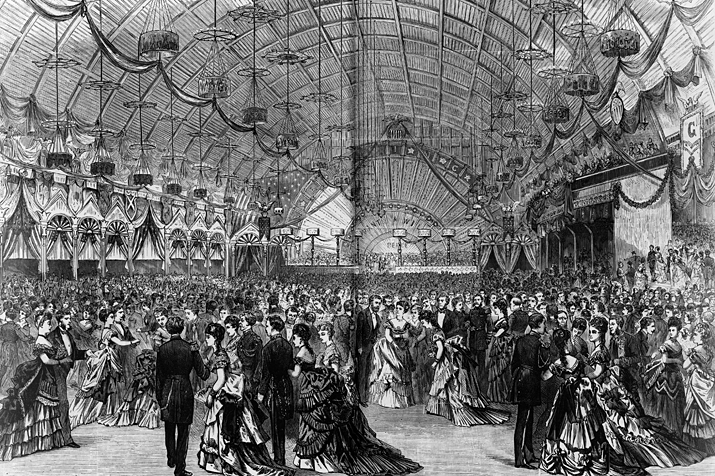
President Grant’s second inaugural ball, March 5, 1873. Library of Congress. The artist discretely omitted the fur coats, overcoats and hats donned by the attendees to keep out the cold. Image: Library of Congress.
Reflecting Grant’s own emphasis on civil rights, the inaugural committee had insisted that the ball be opened to all, “without distinction of race, color or previous condition.” But news reporters recorded disdainful descriptions of well-dressed African American couples, and commented on Naval Academy midshipmen dancing with “the wives of colored congressmen.” The dancing for all, to be sure, was enthusiastic; everyone took regular turns on the dance floor to keep the blood flowing in the deep winter chill. Little of the food was touched, and it soon congealed into a cold mess. Party-goers swarmed the hot coffee, tea and chocolate, which soon were exhausted. The guests, who’d purchased tickets at $20 each (about $370 today), had almost all gone home by midnight.
The Boston Daily Globe reported on March 7 that the ball had posted a net loss of $20,000.
h/t: Suzy Evans, Lincoln’s Lunch.
William Stewart Simkins, the Klan and the Law School
On Friday, University of Texas at Austin President William Powers Jr. issued a statement calling on the university’s Board of Regents to change the name of Simkins Hall, a dorm for graduate and law students. The dorm, built in the 1950s, is named for a famed UT law professor who was a Confederate officer and, as a recent publication points out, a senior leader of the Ku Klux Klan in Florida during Reconstruction and a lifelong, unabashed defender of the “Invisible Empire” throughout his later tenure at the university. The Board of Regents is likely to consider the president’s recommendation at a meeting this week.
 William Stewart Simkins (1842-1929) was a well-known member of the faculty at the University of Texas, teaching there from 1899 to 1929. Although he officially attained emeritus status in 1923, he continued to lecture weekly until his death. “Colonel Simkins,” as he was sometimes called, was a memorable teacher, and something of a character. He was grumpy and irritable. He drank whiskey and once got into a famous argument with the temperance leader Carrie Nation. “Many students were scared of him,” one old alum wrote, “but I always got on well with him and did well in his class.”
Simkins was a South Carolinian by birth, and enrolled at the Citadel in the years just before the outbreak of the Civil War. In January 1861, it was Cadet Simkins who sounded the alarm when lookouts sighted Star of the West, a civilian steamer sent by the Buchanan administration to bring supplies to the Federal garrison at Fort Sumter. (Some contemporary accounts credit Simkins with firing the initial gun, widely recognized as the first shot of the Civil War.) Simkins was subsequently commissioned as an artillery officer in a South Carolina battery, participated in the defense of Charleston Harbor in 1863, and ended the war in 1865 as a colonel.
After the war, Simkins settled in Florida, where he and his older brother, Eldred James Simkins (1838-1903), soon helped organize that state’s Ku Klux Klan. By his own admission, William Stewart Simkins played a central role in coordinating that organization’s violence and intimidation against both white “carpetbaggers” and African Americans who challenged the prewar social or political order. Simkins not only acknowledged his role in the Klan’s violent activities, he fairly bragged about his own deeds. In an infamous speech he gave fifteen years after joining the UT faculty — and a half-century after the war — Simkins told of how he ambushed an African American state senator who had spoken out publicly against Simkins’ and his friends’ publication of a anti-Reconstructionist newspaper:
Now in the same town there was a negro [sic.] by the name of Robert Meacham who was. . . brought up as a domestic servant in a refined Southern family and absorbed much of the courteous manner of the old regime. He had been highly honored by the Republican party; in fact, had been made temporary chairman of the so-called Constitutional Convention heretofore referred to. He was at the time of which I am now speaking State Senator and Postmaster in the town. I could hardly exaggerate his influence among the negroes; glib of tongue, he swayed them to his purpose whether for good or evil; in a word, he was their idol. On one occasion he was delivering a very radical speech in which he referred to the paper which we were editing as that “dirty little sheet.” He was correct as to the word “little,” for it was not much larger than a good size pocket handkerchief; but it was exceedingly warm, a fact which had excited his ire. The next day, being informed by a friend who was present of Meacham’s remark, I called upon him at the post-office and asked an interview. With his usual courtesy he bowed and said he would come over to my office as soon as he had distributed the mail. I cut a stick, carried it up to the office and hid it under my desk. Within an hour he appeared. I told him to take a seat, but I could see that he suspected something unusual as he began to back towards the door. I saw that I was going to lose the opportunity of an interview, so I grabbed the stick and made for him. Now, my office was the upper story of a merchandise building approached on the side by wooden stairs. I hardly think that he touched one of those steps going down; it was a case of aerial navigation to the ground. This gave him the start of me. He was pursued up to the postoffice door and through a street filled with negroes and yet not a hand was raised or word said in his defense, nor was the incident ever noticed by the authorities. The unseen power was behind me. Had I attempted anything of the kind a year before I would have been mobbed or suffered the penalties of the law.
In modern-day Texas, this would be considered aggravated assault — a first-degree felony when committed against a public servant.
Simkins’ active involvement with the Klan may have ended when he and his brother came to Texas and began practicing law in Corsicana in the early 1870s, but his open admiration and promotion of the Klan did not. He continued to be an outspoken champion of the “Invisible Empire” throughout his decades on the faculty in Austin. Simkins’ 1914 Thanksgiving Day speech, excerpted above, was so popular that he gave it again on Thanksgiving the following year, 1915, a date which is widely accepted as the rebirth of the Klan in the 20th century. The speech was subsquently published in the UT alumni magazine, The Alcade.
Professor Simkins’ role as a founder of the Ku Klux Klan in Florida had largely been forgotten until this past spring, when Tom Russell, a law professor at the University of Denver, published a paper (PDF download) on the Klan and its sympathizers as a force that had worked steadily behind the scenes at UT to exclude African American students. Russell had first encountered Simkins’ history when Russell himself had been a faculty member in Austin in the 1990s. Russell presented his paper in March at a conference on the UT campus on the history on integration of the school, and publicly called for Simkins Hall to be renamed. The story was quickly picked up in blogs and editorials, and coverage in the Wall Street Journal and on television news soon followed.
It’s important to remember the time at which the decision was made to name the new dormitory after Professor Simkins. An editorial in the campus newspaper, the Daily Texan, points out that the 1954 decision came just weeks after the Supreme Court issued its famous Brown v. Board of Education ruling. But it’s likely that the regents who considered and approved the move were thinking at least as much about an earlier decision, Sweatt v. Painter (1950), in which a unanimous Supreme Court had rejected Texas’ refusal to admit an African American man, Heman Marion Sweatt, to the University of Texas School of Law on the grounds that there was no other public law school in the state of similar caliber open to African Americans. The Sweatt case was another nail in the coffin of separate-but-equal as enshrined in Plessy, and the State of Texas fought hard against it, going so far as to secure a six-month delay in state court quickly to establish a blacks-only law school at Texas Southern University in Houston — now the Thurgood Marshall School of Law. Considering the rancor that surrounded the Sweatt case — a cross was burned in front of the law school during Sweatt’s first semester — it’s hard to believe that just four years later, when it came time to name the new law school dormitory building, old Professor Simkins’ infamous Thanksgiving lectures, attended by hundreds of enthusiastic and applauding students, had been forgotten.
Russell’s call to remove Simkins’ name from the dorm has generated a lot of interest, and much controversy. Russell has continued to be a strong and steadfast advocate for the change, reminding critics that the issue here is not Simkins’ service as a Confederate officer during the war, but his active involvement with the Klan in the years following, and his enthusiastic support of the violence and intimidation they employed. “Please note that I have no problem with Colonel Simkinsʼs service as a Confederate soldier,” Russell wrote in an opinion piece in The Horn, the UT online news site. “Confederate and Union soldiers alike fought with honor. No one should confuse Confederate soldiers with Klansman. Doing so dishonors the soldiers by equating them with criminals.” I’m not certain, based on his manuscript, that Professor Russell is entirely sincere in drawing a bright line between the conduct of klansmen and wartime Confederates more generally; it may be more of a calculation than a conviction.
Nonetheless, Simkins Hall has got to go.
The Board of Regents is widely expected to accept President Powers’ recommendation to rename Simkins Hall this week. The facility’s new name would be “Creekside Dormitory.”
Additional: At the end of the third-to-last paragraph above, I observed that Professor Russell’s distinction between the action of klansmen like Simkins and Confederate soldiers as a whole was “more of a calculation than a conviction.” After thinking about it a little more, I’m convinced of it, but my comment was somewhat flip and unduly harsh. It’s effective strategy. In adding that short paragraph to his op-ed, Professor Russell takes a necessary and practical step to narrow the focus of his campaign. I have no idea what Russell’s views on the Civil War or the Confederacy are generally, but he very wisely keeps the focus here on Simkins, both his actions as a klansman during Reconstruction and his advocacy for the Klan in the decades that followed. The removal of Simkins’ name from the dorm is an easy case to make, on its own merits; allowing others to redirect the debate into one about the Confederacy (or “political correctness,” or the late Senator Robert Byrd, etc.) is wrong. In three sentences, Russell keeps the focus exactly where it should be in this case, on whether or not a major university should retain the name on one of its dormitories of a man whose explicit and enthusiastically-held actions and attitudes are so entirely out of line with the values the institution stands for. By excluding the Confederacy and the war from his central argument, Russell pares his campaign to its central and essential element, reducing it to a core that is effectively impossible to argue against on its own merits. That’s good lawyering.
Additional, Pt. 2: Tom Russell has a column on this case at the Huffington Post.
Houston City Marshal

Shannon Perich, Associate Curator for the Photographic History Collection at the National Museum of American History in Washington, is looking to identify this man, photographed at the Barr & Wright studio in Houston, probably in the 1870s. A note scratched into the emulsion on the edge of the plate suggests he ordered a “½ dozen plain” cartes-de-visite. On his vest he wears a badge reading, “City Marshal.” Perich suggests this may be R. Van Patton, who was appointed City Marshal in 1873, but there were others who served in that role during that decade as well. And it may not even be a Houston official — perhaps a lawman from another city who happened to sit for a portrait while visiting the Bayou City. In any case, it’s a great photo.




 Dead Confederates, A Civil War Era Blog

3 comments