Talkin’ Texas Navy
 Thanks to the Sam Houston Squadron of the Texas Navy Association for hosting me at their first anniversary dinner Sunday evening, at which I spoke on the role of the little steamboat Laura in the coming of the Texas Revolution. It’s a great little story that deserves more attention than it gets. I’ll have to blog about it some one of these days.
With me on the program were Ed Cotham, who gave a short talk outlining events in Texas during the sesquicentennial year of 1863 — it was a good year for the Union generally, but a disastrous one for them in Texas — and Justin Parkoff and Jessica Stika from the Nautical Archaeology Program at Texas A&M, who gave an overview of the efforts to conserve and exhibit artifacts recovered from the wreck of U.S.S. Westfield.
In his presentation, Justin joked that he tends to be quiet and, because he didn’t speak up soon enough in a meeting where the NautArch students were selecting projects, he got stuck with “the junk.” (At this point he flashed an image of Westfield‘s machinery as it came off the site, in a rusty, unrecognizable jumble of stuff.) In fact, Justin’s dived headlong into this subject with remarkable success, and has gone a long way toward not only reconstructing the gunboat’s machinery, but unlocking details of the vessel’s overall construction and conversion from a New York ferryboat to a warship. Before he’s done, I think we will know more fine-grained detail about U.S.S. Westfield than any other ship of her type. It will be a delicious irony that such knowledge ultimately came about because her commander, 150 years ago, blasted her to smithereens rather than let her fall into enemy hands.
We’ll be hearing more about Westfield in the next few months — a lot more.
________
Image: Wikimedia depiction of foul anchor and star insignia for the Texas Navy rank of Passed Midshipman, by user Glasshouse.
Canister!
Small items that don’t warrant posts of their own:

- Dude gets arrested for digging relics at the Kennesaw National Battlefield Park during the government shutdown. That’s good, but for every one that gets caught I bet there are ten who don’t.
- Savas Beatie has a new book by Donald Hopkins coming out, Robert E. Lee in War and Peace: The Photographic History of a Confederate and American Icon. Seems like one of those books you’d assume always existed, until you discover that it didn’t until now. Check out the video here.
- Jared Elkin is a young filmmaker in Los Angeles who’s using Kickstarter to fund a film project, Between Good Men, set around the Battle of Valverde in New Mexico. Go look at his pitch and, if you’re interested, drop him a few bucks.
- During the federal government shutdown, a man from South Carolina (“too small for a republic. . . .”) has started cutting the grass at the Lincoln Memorial in Washington, D.C. Irony is alive and well, y’all.
- A real estate developer in Warrenton, Virginia has decided not the name his 135-home project “Mosby’s Crossing,” in deference to requests from nearby residents. The usual suspects are infuriated.
- In news from the UK, a drunk Oakland Raiders fan on a flight from Malta was yelling obscenities on the flight, got off the plane, stripped naked, urinated on the side of the terminal and challenged the pilot to a fistfight on the tarmac before being tasered. I think we all know what it’s like to be that guy, amiright?
- You’ve heard the story how, in the 1960s, NASA spent over a million dollars on developing a special ball-point pen that would write in zero-g while the Russians, faced with the same problem, simply used pencils? Great story, but it’s not true.
- If you ever get that time machine you’ve been tinkering with in the basement to work, and you decide to visit 1880s San Fransisco, Susan Schulten has a map to make your visit a memorable one.
- I may have mentioned it before, but Baylor University has what I think its a complete set of plates from the OR Atlas available in high-resolution on Flickr. May want to bookmark this one.

_____________
The Attack on U.S.S. New Ironsides
 [My colleague Mark Jenkins reminds me that October 5 is the sesquicentennial of an important naval event. This post originally appeared on February 16, 2013.]
__________
Virginia native William Thornton Glassell (right, 1831-1879) was a Lieutenant aboard U.S.S. Hartford in Chinese waters when the Civil War broke out. When the ship returned to Philadelphia on December 2, 1861, Glassell refused to take the oath to the United States. He was formally dismissed from the U.S. Navy on December 6, and so was arrested and imprisoned at Fort Warren. In time he was issued a commission by the Confederate government and, now being considered a prisoner of war, Glassell was eventually exchanged. Once in Confederate service, Lieutenant Glassell, C.S.N. assigned to the ironclad Chicora at Charleston.
Chafing for the opportunity to strike more directly at the Federal blockading fleet offshore, Glassell volunteered for duty in one of the more unconventional programs then being organized at Charleston, and took command of the little steam torpedo launch David. These cigar-shaped torpedo boats — the name of the first boat was an allusion to the biblical story of David and Goliath — had ballast tanks that allowed them to run almost completely submerged. They were fitted with a fixed torpedo on the end of a long spar, that could be rammed into the side of an enemy ship. It was a dangerous tactic, as much for the attacker as for the target, but the Confederates at Charleston were increasingly anxious to strike a real blow at the Union Navy. On the evening of October 5, 1863, Lieutenant Glassell and his three-man crew set out to attack the most prominent of the blockading ships offshore, U.S.S. New Ironsides.
 U.S.S. New Ironsides (center) on blockade duty.
The admiral s ship, “New Ironsides,” (the most powerful vessel in the world), lay in the midst of the fleet, her starboard side presented to my view. I determined to pay her the highest compliment. I had been informed, through prisoners lately captured from the fleet, that they were expecting an attack from torpedo boats, and were prepared for it. I could, therefore, hardly expect to accomplish my object without encountering some danger from riflemen, and perhaps a discharge of grape or canister from the howitzers. My guns were loaded with buckshot. I knew that if the officer of the deck could be disabled to begin with, it would cause them some confusion and increase our chance for escape, so I determined that if the occasion offered, I would commence by firing the first shot. Accordingly, having on a full head of steam, I took charge of the helm, it being so arranged that I could sit on deck and work the wheel with my feet. Then directing the engineer and firemen to keep below and give me all the speed possible, I gave a double barrel gun to the pilot, with instructions not to fire until I should do so, and steered directly for the monitor. I intended to strike her just under the gangway, but the tide still running out, carried us to a point nearer the quarter. Thus we rapidly approached the enemy. When within about 300 yards of her a sentinel hailed us: Boat ahoy! boat ahoy! repeating the hail several times very rapidly. We were coming towards them with all speed, and I made no answer, but cocked both barrels of my gun. The officer of the deck next made his appearance, and loudly demanded, “What boat is that?” Being now within forty yards of the ship, and plenty of headway to carry us on, I thought it about time the fight should commence, and fired my gun. The officer of the deck fell back mortally wounded (poor fellow), and I ordered the engine stopped. The next moment the torpedo struck the vessel and exploded. What amount of direct damage the enemy received I will not attempt to say. My little boat plunged violently, and a large body of water which had been thrown up descended upon her deck, and down the smokestack and hatchway.
U.S.S. New Ironsides (center) on blockade duty.
The admiral s ship, “New Ironsides,” (the most powerful vessel in the world), lay in the midst of the fleet, her starboard side presented to my view. I determined to pay her the highest compliment. I had been informed, through prisoners lately captured from the fleet, that they were expecting an attack from torpedo boats, and were prepared for it. I could, therefore, hardly expect to accomplish my object without encountering some danger from riflemen, and perhaps a discharge of grape or canister from the howitzers. My guns were loaded with buckshot. I knew that if the officer of the deck could be disabled to begin with, it would cause them some confusion and increase our chance for escape, so I determined that if the occasion offered, I would commence by firing the first shot. Accordingly, having on a full head of steam, I took charge of the helm, it being so arranged that I could sit on deck and work the wheel with my feet. Then directing the engineer and firemen to keep below and give me all the speed possible, I gave a double barrel gun to the pilot, with instructions not to fire until I should do so, and steered directly for the monitor. I intended to strike her just under the gangway, but the tide still running out, carried us to a point nearer the quarter. Thus we rapidly approached the enemy. When within about 300 yards of her a sentinel hailed us: Boat ahoy! boat ahoy! repeating the hail several times very rapidly. We were coming towards them with all speed, and I made no answer, but cocked both barrels of my gun. The officer of the deck next made his appearance, and loudly demanded, “What boat is that?” Being now within forty yards of the ship, and plenty of headway to carry us on, I thought it about time the fight should commence, and fired my gun. The officer of the deck fell back mortally wounded (poor fellow), and I ordered the engine stopped. The next moment the torpedo struck the vessel and exploded. What amount of direct damage the enemy received I will not attempt to say. My little boat plunged violently, and a large body of water which had been thrown up descended upon her deck, and down the smokestack and hatchway.

The torpedo goes off. I immediately gave orders to reverse the engine and back off. Mr. Toombs informed me then that the fires were put out, and something had become jammed in the machinery so that it would not move. What could be done in this situation? In the mean time, the enemy recovering from the shock, beat to quarters, and general alarm spread through the fleet. I told my men I thought our only chance to escape was by swimming, and I think I told Mr. Toombs to cut the water pipes and let the boat sink. Then taking one of the cork floats, I got into the water and swam off as fast as I could. The enemy, in no amiable mood, poured down upon the bubbling water a hailstorm of rifle and pistol shots from the deck of the Ironsides, and from the nearest monitor. Sometimes they struck very close to my head, but swimming for life, I soon disappeared from their sight, and found myself all alone in the water. I hoped that, with the assistance of flood tide, I might be able to reach Fort Sumter, but a north wind was against me, and after I had been in the water more than an hour, I became numb with cold, and was nearly exhausted. Just then the boat of a transport schooner picked me up, and found, to their surprise, that they had captured a rebel.
Fireman James Sullivan and Engineer Toombs dived overboard with Glassell, as well. Pilot J. Walker Cannon remained with the boat because, some sources say, he could not swim — a remarkable fact, if true, given the semi-submerged nature of his craft, even in the best conditions. Glassell and Sullivan were picked up by Federal picket boats; Toombs scrambled back aboard David and, with Cannon guiding him, managed to return safely to Charleston. In his follow-up report to Confederate authorities, Toombs recounted that “the conduct of Lieutenant Glassell was as cool and collected as if he had been on an excursion of pleasure, and the hope of all is that he may yet be in safety.” Toombs reserrved his highest praise for Cannon, though, who in the engineer’s’ view “has won for himself a reputation that time cannot efface, and deserves well of his country, as, without his valuable aid, I could not have reached the city.” Engineer Toombs succeeded to command of the torpedo boat David.
U.S. Navy Acting Ensign Charles W. Howard, the officer of the deck of U.S.S. New Ironsides who was shot by Glassell, died of his wound on October 10. After Howard’s injury, Admiral Dahlgren had recommended him for promotion to Acting Master, which was formally granted on October 16, 1863, in recognition of his “gallant conduct in face of enemy.” Howard’s remains were subsequently buried in Beaufort National Cemetery. A Wickes Class destroyer, DD-179, was later named for him.
Glassell remained in Union hands until the last few months of the war, when he was again exchanged. This time he was assigned to the naval defenses of Richmond, commanding the ironclad Fredericksburg in the James River Squadron.
After the war, Glassell traveled to California, where his brother Andrew was active in land speculation. The Glassell brothers surveyed much of central and southern California, and Andrew Glassell helped establish the city of Orange, California. William Thornton Glassell died in Los Angeles in January 1879, leaving neither a wife nor children. He is buried in Angelus Rosedale Cemetery in Los Angeles.

Fun fact: William Thornton Glassell’s younger sister, Sarah Thornton Glassell, married George Smith Patton, a Confederate officer killed at the Third Battle of Winchester. The Confederate naval officer who very nearly sank U.S.S. New Ironsides was the grand-uncle of the famous World War II General, George S. Patton, Jr.
_____________


Was James Baldwin a Black Confederate?
The nice folks over at SHPG often have trouble mangling quotes (or misappropriating them), but this is spectacular:
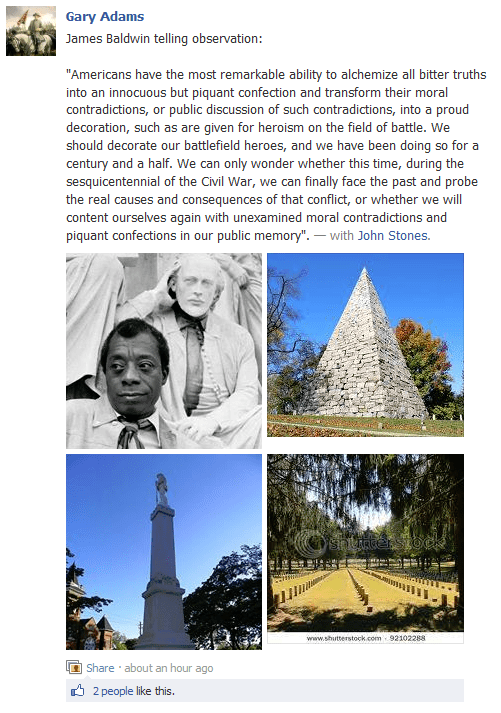
Who knew that James Baldwin, who died in 1987, had written about the Civil War sesquicentennial of 2011-15?
Adams’ and Stones’ quotation is an amalgam of two paragraphs, lifted en bloc from a 2010 essay by David Blight. The first part of the quote actually is Baldwin’s, from a 1951 essay in which he describes Richard Wright’s 1940 novel Native Son, as “the most powerful and celebrated statement we have yet had of what it means to be a Negro in America.” Baldwin was not referring to the Civil War at all, but about Wright’s novel, and offering a critique of the American habit of using patriotic tropes and clichés to paper over the uglier realities — social, political, racial — that underlie so much of the American experience. Note also that Baldwin’s original passage includes the key adverb “unhappily,” that makes his disapproval perfectly clear, and which Adams and Stones omit:
In short, Baldwin is criticizing exactly what “heritage” groups do every day of the week.
The second part, beginning “we should decorate our battlefield heroes. . . ,” are the words of David Blight, the Yale historian who’s written extensively on the legacy of the war, and how it’s been remembered by different generations since 1865. Rounding out his essay with the Baldwin quote, he continues and calls on Americans to put aside convoluted and abstract notions about what caused the war:
We should decorate our battlefield heroes, and we have been doing so for a century and a half. We can only wonder whether this time, during the sesquicentennial of the Civil War, we can finally face the past and probe the real causes and consequences of that conflict, or whether we will content ourselves again with unexamined moral contradictions and piquant confections in our public memory.
Adams and Stone run these two passages together, attributing the whole thing to Baldwin, then omit Blight’s closing lines, where he rejects the appeal of “piquant confections” and instead calls on Americans to embrace the candor of former Confederate General John Singleton Mosby, who wrote in 1907,
Now while I think as badly of slavery as Horace Greeley did I am not ashamed that my family were slaveholders. It was our inheritance – Neither am I ashamed that my ancestors were pirates & cattle thieves. People must be judged by the standard of their own age. If it was right to own slaves as property it was right to fight for it. The South went to war on account of slavery. South Carolina went to war – as she said in her Secession proclamation – because slavery wd. not be secure under Lincoln. South Carolina ought to know what was the cause for her seceding.
To be fair, Blight also left out that critical word “unhappily” from Baldwin’s quote, but — unlike Adams and Stone — he didn’t misunderstand or misrepresent Baldwin’s meaning.
Aside from the gross sloppiness of running Baldwin’s and Blight’s quotes together as one, the lack of comprehension about what either man is saying is just breathtaking, as if either one had any truck with the sort of nonsense Confederate Heritage™ groups have been peddling all these years. Adams and Stones either have no idea who James Baldwin was, or (at least) cynically assume their readers don’t. And that’s probably not a bad bet, if you think about it.
Of course, James Baldwin’s legacy is secure, no matter how his words get chopped and mangled to others’ ends. Among his other attributes, Baldwin had a wicked sense of irony. Somewhere, John and Gary, he’s laughing. And he’s not laughing with you.
___________
“It was a good trick.”

As Union forces gradually moved deeper into Confederate territory, they increasingly had to adjust to the reality that they were in among a civilian population that remained loyal to Richmond. In his memoirs, Grant described his experience of this at Memphis in mid-1862:
Such considerations were compounded by the fact that, very often, large Confederate units were operating the same general area. A few months after Grant’s experience with the citizens of Memphis, his old friend Bill Sherman got his own lesson in the crafty ways of the enemy — though he was later able to look back on it with good humor:
_________
An Open Apology to the Virginia Flaggers
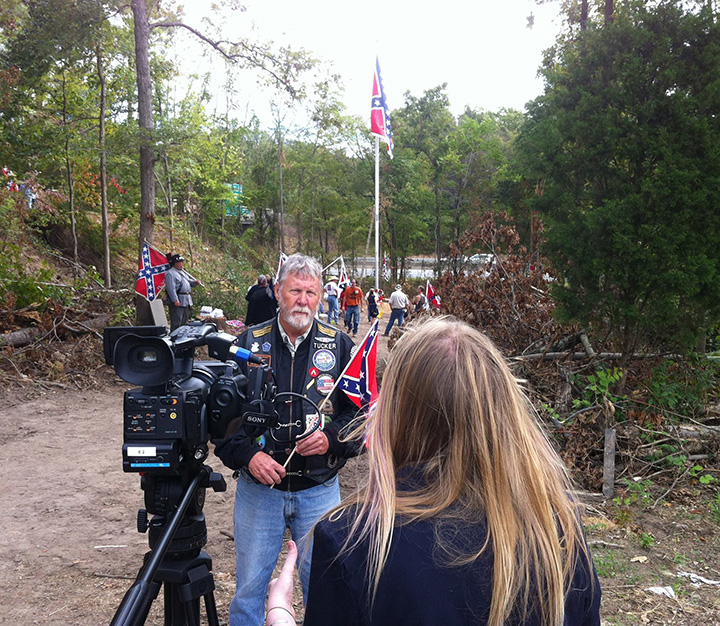
I would like to take this opportunity to apologize to the Virginia Flaggers for my previous blog post, “Welcome to Crackertown (formerly Richmond, Virginia)!” That post was based on an erroneous assumption on my part, specifically that the I-95 flag would be viewed by many thousands of drivers on the freeway daily, a bold, unmistakable, scarlet landmark visible for miles around. What I didn’t fully understand was that the plan all along was to put up a 50-foot flagpole in a clearing completely surrounded by 60- and 70-foot trees — including between the flagpole and the freeway:
Ostensibly the purpose of the flag is to welcome visitors to Richmond driving north on I-95. But just 100 yards away — that’s about 3 seconds at highway speeds — the flag will not be clearly visible to drivers because of the trees. Here’s the drivers’ perspective, via Google Streetview:
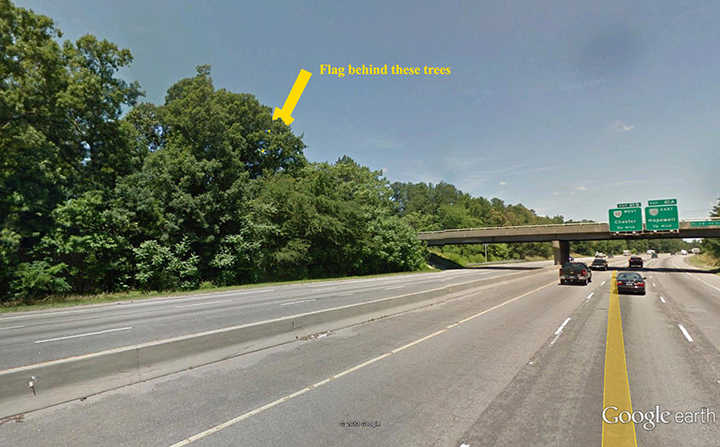
Once you get directly abreast of it, this is the view from the northbound lanes of I-95:

Even the photographer from the Richmond Times-Dispatch had to get up on the Old Bermuda Hundred overpass to get a shot of it, through the trees:

The Times-Dispatch on Sunday, in an article titled, “Confederate flag difficult to see along I-95 in Chesterfield,” has this to say
The good news, of course, is that the nearly-hidden nature of the flag will protect it from would-be vandals, who will have difficulty finding it.
So please, Virginia Flaggers, accept this apology for my accusation that the I-95 flag would be seen as a bold, brash symbol that many view as one of divisiveness and bigotry. I was completely wrong about the “being seen” part, because it doesn’t look like that many people are going to see it at all.
So we’re cool now, right?
_____________
This post was updated Sunday, September 29 to reflect the corrected view of the site from the highway.
_____________
Virginia: Secession in the Defense of the Defense of Slavery
In April 2010, the conservative commentator Pat Buchanan penned an essay called, “The New Intolerance.” The piece was subsequently re-blogged by the Sons of Confederate Veterans, who posted it under the headline, “Buchanan Exposes Yankee Terrorists.” Buchanan’s essay was part of the kerfuffle over Virginia Governor Bob McDonnell’s declaration of Confederate History Month, the text of which was drafted for his office by the SCV, and omitted any mention of slavery at all. McDonnell subsequently reissued a revised proclamation, and in 2011 established a broader statewide commemoration, “Civil War History in Virginia Month.”
Buchanan’s essay revolves around the oft-made claim that “Virginia did not secede in defense of slavery.” He continues:
Buchanan doesn’t bother to explain why Mississippi or Texas should be considered to be Virginians’ “kinfolk,” in a way that much closer states — say, Pennsylvania or Ohio, with which Virginia shared a common border in 1861 — were not. Fortunately, those who wrote Virginia’s ordinance of secession said explicitly what they had in common, citing “oppression of the Southern slaveholding States” as part of the justification for its actions:
Virginia was not a fire-eating state that led the way on secession. But when the chips were down, the Commonwealth recognized slaveholding as the common bond that (1) defined the seceded states, (2) held Virginia to South Carolina, Mississippi, Georgia, Texas and those other states that seceded earlier, and (3) was deemed stronger and more vital to Virginia’s interest than its bond to the Union.
Does that count as ” seceding in defense of slavery?” Maybe. But it certainly counts as seceding in the defense of the defense of slavery.
___________
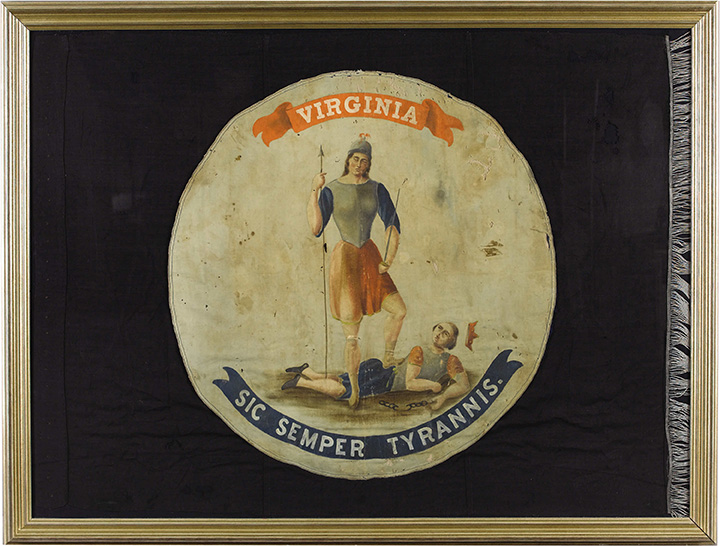
Image: Virginia regimental flag, via Encyclopedia Virginia.
Talkin’ Hatteras and Alabama
On Thursday, October 17 at 6:30 p.m., I’ll be speaking at the Brazoria County Historical Museum on the fight between U.S.S. Hatteras and the famous Confederate raider Alabama, as well as the NOAA-led project to map the remains of the Union warship in 2012. Hatteras holds the unfortunate distinction of being the only Union warship sunk in action in the Gulf of Mexico, and her destruction had (as Ed Cotham and I described earlier this year in the Civil War Monitor) a profound effect on the subsequent history of the Civil War in Texas. Come out on the 17th and I’ll explain exactly why that is.
My talk is being done as part of the BCHM’s annual programming for Texas Archaeology Awareness Month. They have some other great programming lined up, as well:
There’s one other talk coming up soon at BCHM, that I would recommend:
Infinite Monster by Leigh Jones and Rhiannon Meyers, both reporters for the Galveston County Daily News at the time, is the best re-telling of the story of Hurricane Ike I’ve read. Having gone through Ike (five years ago this month), It’s not a happy subject, but this book is really worth your time.
_________
“It is General Hood; say nothing about it.”
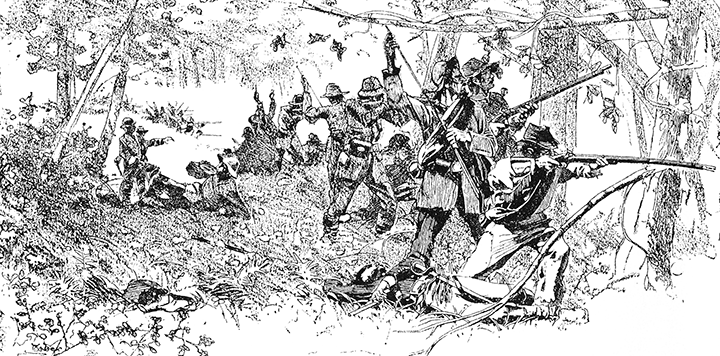 Walton Taber, “Confederate Battle Line at Chickamauga.”
The account of Chickamauga by Private Lawrence Daffan, Company G, 4th Texas Infantry:
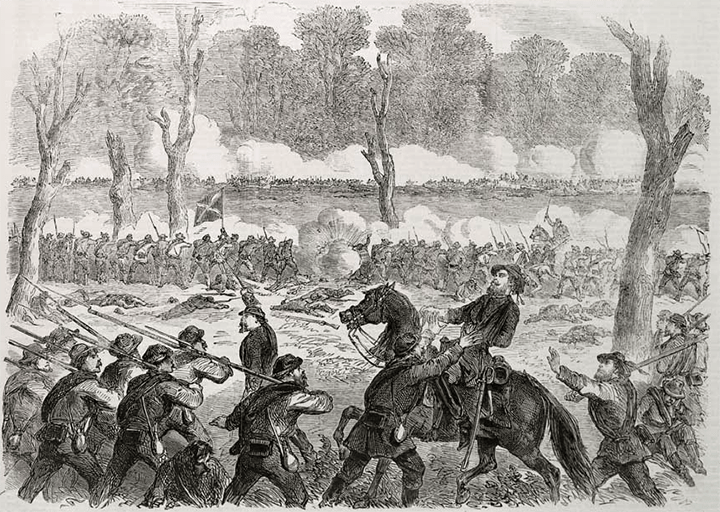 Hood wounded at Chickamauga. Illustrated London News, December 26, 1863.
I saw General Hood wounded, and saw the men wrap him and carry him away in a blanket. I rushed up and pulled the blanket open to be sure that it was General Hood; the officer in charge of the litter corps spoke very rough to me about this, saying, “yes, it is General Hood; say nothing about it.”
This was all under fire. These places all have special names now, but I give my account as a boy soldier.
Hood wounded at Chickamauga. Illustrated London News, December 26, 1863.
I saw General Hood wounded, and saw the men wrap him and carry him away in a blanket. I rushed up and pulled the blanket open to be sure that it was General Hood; the officer in charge of the litter corps spoke very rough to me about this, saying, “yes, it is General Hood; say nothing about it.”
This was all under fire. These places all have special names now, but I give my account as a boy soldier.
___________




 Dead Confederates, A Civil War Era Blog
leave a comment