Patrick Cleburne and the Battle of Franklin
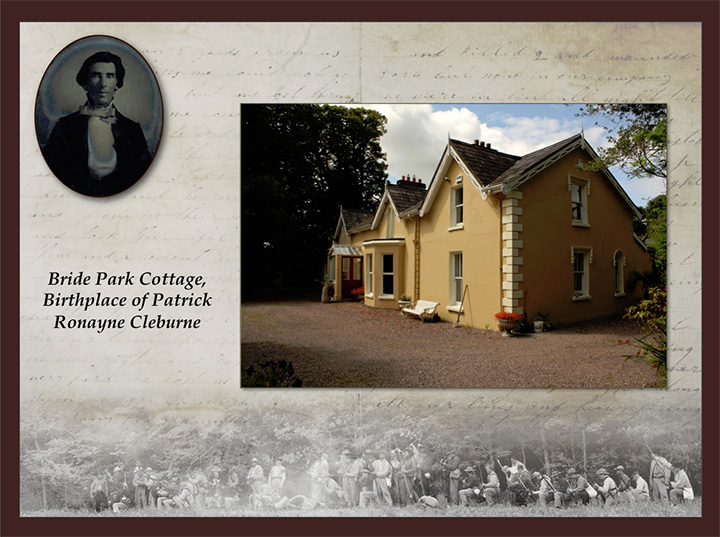
Damian Shiels’ keynote address from the 2014 Tennessee Civil War Sesquicentennial Signature Event in Franklin is online at his blog, The Irish in the Civil War. Well worth your time, because Damian’s presentation is not simply a straightforward biographical sketch of the man, but a detailed example of how the research was done to compile his story. Exemplary.
By the way, have you picked up a copy of Damian’s book yet? Check it out.
__________
Update, December 5: Damian says the talks from that session will be broadcast on C-Span 3 on Saturday, December 13, 2014, 6 p.m. EST.
__________


Change Coming to VA Marker Rules

As many of you know, the Veterans Administration revised its rules in 2009, restricting applications for headstones to those who could establish their bonafides as next-of-kin. That caused, naturally, a considerable uproar among various historical and heritage groups, who spend a lot of time researching and placing grave markers.
Via CWT user CMWinkler, the VA has formally proposed broadening the definition of “applicant” to a wider range of family members, and others who are auhtorized to make decisions on behalf of the decedent (PDF). And while they will still require the involvement of family members for veterans of the First World War and later, for earlier service that will be waived in recognition of the fact that, for a great many of them, there are no traceable family members.
This seems like the crucial part of the policy to me, as it regards CW veterans:

My emphasis. So as I read this, a heritage group would have to make the request through the cemetery, which pretty much has to be done anyway, in order to get the stone placed. This seems like a step in the right direction.
___________
New in the Civil War Monitor

The new issue of the Civil War Monitor is now online, and will be appearing in mailboxes and on newsstands shortly. In this issue:
- Ulysses S. Grant’s Campaign Promise — Defeating Robert E. Lee’s army was only one of the challenges facing Ulysses S. Grant in 1864. Just as crucial was ensuring President Abraham Lincoln’s reelection. By Brooks Simpson
- The Radicals’ War — The story of the Joint Committee on the Conduct of the War, the Republican-led congressional oversight body that hounded generals, pressured the president, and bore witness to atrocities. By Fergus M. Borderwich
- The Civil War and the Southern Belle. By Karen Abbott
- The Fugitives — For the thousands of Union soldiers who escaped Confederate captivity in South Carolina in the war’s final months, the parth to freedom was long and treacherous. By Lorien Foote
- Last Words — Final statements of some famous and not-so-famous soldiers.
- Rebel Raider Overseas — A rare image of a famous Confederate warship in foreign water. By Bob Zeller
- The Minie Ball — Anatomy of a dead-simple killer.
- The Best Civil War Books of 2014 — Civil War historians A. Wilson Greene, Kathryn Shively Meier, Kevin M. Levin, Gerald J. Prokopowicz, Lesley J. Gordon, and Andrew Wagenhoffer name their best picks of 2014.
Kudos as well to Mads Madsen, whose colorized images of Grant are featured both on the cover and inside the magazine. Now would be a good time to subscribe to the Monitor.
_____________
The Christmas Truce of 1914, Sponsored by Sainsbury’s
Sainsbury’s, the big UK supermarket chain, has released an advert based on the 1914 Christmas Truce during World War I. The short film was done in cooperation with the Royal British Legion, a support organization for service members, veterans, and their families. Sales of replica chocolate bars like that featured in the ad benefit the Legion.
The ad has brought a good bit of criticism in the UK, both for commercializing a wartime event, and for supposedly “sanitizing” the grim reality of World War I trench warfare.
That last comparison strikes me as equal parts lazy and fatuous, as Nazi/Holocaust analogies generally are. Nonetheless, there are criticisms to be made. Furthermore, there are a number of similar stories from the American Civil War, where small groups of Union and Confederate soldiers met and fraternized between the lines.
What do you think of the Sainsbury’s ad, or the prospect of something similar set in 1861-65?
____________
Little Phil Walks It Back
My colleague Ed Cotham tipped me to this little gem, from the time in the spring of 1880 that former President Grant and his family passed through Galveston on a tour through Texas. Phil Sheridan was with them, and at a grand dinner at the Tremont Hotel, the former Union general took the opportunity to clarify some intemperate remarks he’d made years before. Galveston Daily News, March 25, 1880, p. 8:
 Speaking so kindly about Texas — and I speak from my heart — probably I ought to explain a remark I once made about it [loud applause], and I can do it this way: It was in 1866. At that time we had some trouble with Mexico, and I went down to the border …. 0n my return to San Antonio I found a dispatch there which required me to go with the greatest haste to New Orleans. I remember that I hired relays and coaches from San Antonio to Galveston . … 1 traveled day and night. It was in August and very warm, the dust being about as deep as it is in Mexico, where it has not rained in several months. One or two officers fell sick and I left them. I arrived in Galveston covered with dust. My eyes and ears and throat were filled with it, and I think I had about as much of the soil of Texas on me as would have raised a cotton crop. I went to a little hotel [the Washington]; and in that condition, as I went up to register, one of these newspaper men rushed up to me and said he: How do you like Texas?” I was mad, and said if I owned Texas and all hell, I would rent out Texas and live in hell. Now I want to assure you that by that expression I only meant to convey how much I was disgusted with that newspaper man. It did not represent my opinion of Texas … , and I have always had the highest regard for Texas. Every time I visit Texas I think a little more of it than ever before ….
I’ve never ridden in a hired coach non-stop from San Antonio to Galveston, but I did once drive from El Paso to Galveston, in a single day, in the summer, in a car with no A/C, with 100-pound dog that was prone to car sickness. I say we cut Little Phil some slack on this one.
__________
Update, November 21: Over at Civil War Talk, author Eric Wittenberg, who knows a thing or two about the subject, says that “Sheridan was a horrid human being, just wretched. He was a pathological liar and a hypocrite–all of which is well-documented–so nothing along these lines surprises me in the least.”
I do wish he would say what he really thinks.
__________
The Texas Homefront, 1861
This account is taken from Marc-William Palen’s 2012 article, “A Canadian Yankee in King Cotton’s Court” (Civil War History 58:2, 224-261). The unknown author, a Canadian, was traveling across Texas in the late spring or summer of 1861, on his way back to Ottawa.
The country from Waco to Nacogdoches, passing through the towns of Crockett and Rusk, as monotonous enough . . . the horrors of civil war could now be painfully realized in the sight of many abandoned settlements and small farms, and private residences either in a state of neglect or closed up. There was a sullenness amongst the population, and a suspicion of all men, which let a sad impression on the mind. In some of the towns and villages two-thirds of the white male population had gone of to join distant detachments of the Southern army; and, though there was no open insubordination, or expressed discontent at the war by those let behind, there was decidedly no enthusiasm manifested auguring either of future hope or satisfaction at the Secession steps already taken. A slight incident will show the state of public feeling. As the road was very heavy and sandy, the passengers in the stage coach got out and walked for about a mile and a half. In company with a gentleman who, like myself, felt thirst, we let the main road about a quarter of a mile, to call at a farm house, in order to procure some water. As we approached, the premises seemed to be abandoned; but, ater knocking and calling, a colored man came to the door and asked our business, but almost immediately in his footsteps followed a woman and a couple of formidable looking dogs. She immediately ordered the “chattel” into the house, seemingly afraid that he might hold any communication with two white strangers. After considerable coaxing she left us to bring the desired beverage, but the dogs were left behind, and to judge from their occasional sulky growling were intended as our custodians for the time the good woman was absent. After the water was drank and paid for, (at the moderate rate of 50 cents!) and we returned to join the stage, we found ourselves followed by two armed men on horseback who did not seem satisfied until they had seen us safely in the coach, and assured from our passes, and the information of the driver, that we were not incendiaries, kidnappers, or secret agents of those “D—d Abolitionists!”
_________
Robert E. Lee’s “lack of a core of greatness”
In this interview from the Civil War Monitor, well-known Civil War author Glenn LaFantasie further fleshes out his recent cover article from the magazine, “Broken Promise,” in which he argued that in his moment of national and professional crisis, Lee failed to measure up to his own role models, George Washington and his own father, “Lighthorse Harry” Lee.
I’m sure this will cause some heartburn in certain quarters.
Have a great weekend, everybody.
___________
Captain Dave versus the Yankees

I’m off this bright Saturday to give a couple of presentations in Houston. The first, “Captain Dave versus the Yankees,” should be a fun one, although a little rough because it’s new material that I haven’t presented before. It’s the outgrowth of an anecdote I told in the blockade running book, about a local mariner who successfully recaptured his schooner from a Federal boarding party. (He may even have done it on two separate occasions, although affirming that requires more digging.) I met some of Captain Dave’s descendants over the summer, which has served as an impetus to dive further into his story. It should be a lot of fun.
Then in the afternoon I’ll be at the Houston History Book Fair, at the Julia Ideson Building downtown. Lots of good authors and publications there.
The image above is by Michael Codd, from Mark Lloyd’s Combat Uniforms of the Civil War. It’s supposed to depict a Confederate privateer, although apart from the revolver it would serve nicely for a blockade-running master, as well. The civilian clothes and lantern are particularly appropriate. Blockade runners generally went unarmed, although in the struggle for Sting Ray, Captain Dave did take trouble to relieve the Union officer of his pistol.
____________
Update and Correction on “Go back to Africa!”
Earlier today I put up a blog post about a confrontation between members of the Southern Christian Leadership Conference and members of the local SCV camp in Danville, over the display of the Confederate flag there. The news story I used as a source quoted an SCV member as saying to one of the SCLC members, “go back to Africa!”
At the suggestion of a reader from Danville, I reviewed the video of the news story, and that shows clearly that the SCV member was inaccurately quoted. What he was saying was, “. . . then you need to go back to Africa and tell them to stop.” Who they are, and what they need to stop doing, I can only guess.
In any event, the news station clearly misquoted the SCV member in the written story that accompanied the video, and I failed to do due diligence in verifying their quote on the video. That’s on me, and I’m sorry. I apologize for putting up a post that was inaccurate and unduly critical. Getting it right is important, and this time I didn’t.
___________




 Dead Confederates, A Civil War Era Blog
2 comments