Would-Be Dowling Monument Bomber Pleads Guilty
The Houston man arrested last summer for attempting to blow up the Dick Dowling monument near the Houston Zoo has pleaded guilty:

Shackled in an olive green jail uniform, Andrew C.E. Schneck, bent forward with his hands in handcuffs, pleaded guilty to willfully attempting to maliciously damage or destroy property in violation of federal law. A federal prosecutor dismissed a sentence enhancement, related to the harm an explosion could have caused, that could have allowed for a longer prison sentence.
The 26-year-old with a history of concocting homemade explosives told U.S. District Judge Ewing Werlein Jr. he was pleading guilty voluntarily and understood he was giving up rights by doing so.
Then the judge asked him to explain his thinking at the time: “Mr. Schneck, I’d like you to tell the court what was going on that day?”
Explaining himself
Schneck paused for nearly a minute and then asked the judge to repeat the question.
He said,“Well uh … I … well, the material … I purchased the batteries and the timer myself from commercial sources. The explosive compound I manufactured myself.”
The look on the judge’s face appeared to indicate his answer wasn’t sufficient.
Schneck continued, saying, “The intent was to damage the statue significantly.”
After several minutes of questioning, the judge said he found Schneck capable of entering a plea. He faces five to 20 years in prison and a fine of up to $250,000 at his sentencing, which the judge set for June 22.
Outside the courtroom Schneck’s attorney Philip Hilder said, “He pleaded guilty because he recognizes his actions and accepts his responsibility and wishes to move on. He has some health issues that we are dealing with that contributed to the event.”
Schneck spent several months of his detention at an intensive inpatient program. He told the judge he is taking mood stabilizing medication under the direction of the detention facility.
Schneck graduated with a degree in chemistry from Austin College in Sherman and had a penchant for experiments, according to a source familiar with the case.
He was convicted in 2014 of storing explosives for which he earned five years of probation.
Following the 2017 attempted bombing in Hermann Park, agents returned to the neighborhood to search the home in Southhampton Place, near the Museum District, where Schneck lived with his parents.
_____

The Odyssey of the CSS Stonewall

Some friends and I were discussing the Civil War the other day—a common topic. The subject came up, when did the war end? “On April 9, 1865, of course, when Lee surrendered to Grant,” said one. “No,” said another, “when Jo Johnston surrendered to Sherman in North Carolina.” “No, No, you’re both wrong,” said a third, “it was in Texas in May.”
 The CSS Stonewall in drydock, probably in France during construction. Millers Photographic History of the War vol. 6.
“You’re all wrong,” said I. “The last Confederate troops to lay down their arms weren’t any of those. It was the Confederate Navy that was the last to surrender, or at least two of their ships.” And therein hangs a curious little tale or two.
 Close up view of the Stonewall in drydock. Millers Photographic History of the War, Vol. 6
There was the CSS Stonewall, for example…
View original post 938 more words
Did a C.S.S. Alabama Crew Member Die in the Titanic Disaster?
[Originally posted April 14, 2012]

__________
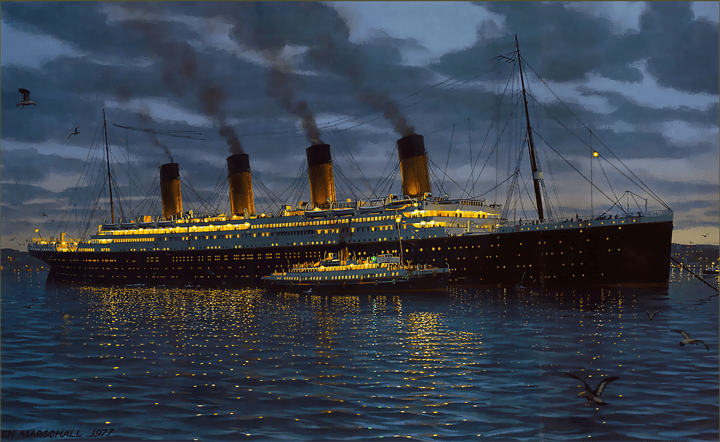
Image: Titanic at Cherbourg on the evening of April 10, 1912. Original painting by Ken Marschall, 1977.

Presentation May 3 in Galveston: “Ship Biscuit & Salted Beef”

Join us on Thursday evening, May 3, at Rosenberg Library in Galveston as Grace Tsai (above at center, with the SBSB team) offers up “Ship Biscuit & Salted Beef: An Experimental Archaeological Study on Shipboard Food.” The Hawkins Squadron business meeting will begin at 1900 hours, with Ms. Tsai’s presentation at 1920. Please note the change of venue; light refreshments will be served.
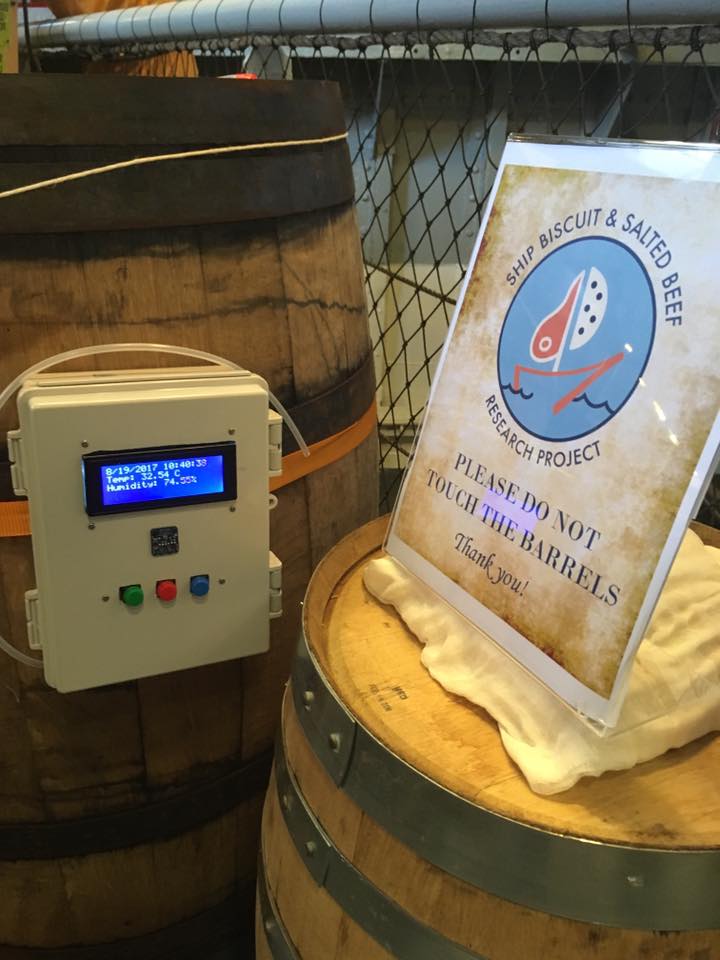
Before canning and refrigeration were invented, strict limitations on shipboard provisions to reduce illness from food spoilage on ships were enforced. Unfortunately, these preservation methods also decreased the nutritional value of food on lengthy voyages. Grace Tsai’s research looks into the effects of shipboard diet on the health of sailors via the nutritional and microbiological intake of seamen on 17th-century ships. However, rather than using traditional methods to determine past health and nutrition, this project involved replicating shipboard food using the exact ingredients and methods of preparation from the 17th century. This data will support or refute historical accounts related to shipboard food and sailors’ experiences on ships, refine our grasp on our shared maritime history, and create new material for further study in maritime history.

Ms. Tsai graduated with bachelor degrees in Psychology and Anthropology from the University of California, San Diego in 2011. Currently, she is a PhD student in the Nautical Archaeology Program at Texas A&M University. Her work focuses on understanding post-medieval seafaring life through analysis of diet and physical labor on sailors’ health. Her most recent field work includes the Gnaliç Project, an excavation of a sixteenth-century Venetian galley that sank off the coast of Croatia, the Burgaz Harbor Project, an excavation of Hellenistic harbors in Turkey, and the Shelburne Steamboat Project, an excavation of a steamboat graveyard in Vermont. She has also helped catalogue lead fishnet weights from Uluburun, a late Bronze Age shipwreck, in Turkey. In her free time, she works as the co-founder and CEO of Bezoar Laboratories LLC, a R&D company focusing on probiotic supplements.
The Texas Navy Association is a private, 501(c)(3) organization, dedicated to preserving and promoting the historical legacy of the naval forces of the Republic of Texas, 1835-46. The mission of the Texas Navy Association is to preserve and promote an appreciation of the historic character and heroic acts of the Texas Navy; to promote travel by visitors to historical sites and areas in which the Texas Navy operated; to conduct, in the broadest sense, a public relations campaign to create a responsible and accurate image of Texas; and to encourage Texas communities, organizations, and individuals, as well as governmental entities, to participate with actions and money, in pursuit of these objectives. Membership in the Texas Navy Association is open to all persons age 16 and over who have an interest in Texas history and want to help support the goals of the organization.
In Galveston, the Charles E. Hawkins Squadron was organized in the fall of 2016, and meets on the first Thursday evening in odd-numbered months.
________
The Ghost and John the Drayman
 As the sun rose off Sisál in the Yucatán that Sunday morning in early March 1836, its rays illuminated a couple of dozen vessels anchored off the beach – small, local trading craft, mostly, with a few larger merchantmen displaying the ensigns of other nations – Americans, Hamburg traders, and the like. Two vessels rode at anchor farther offshore, a Texian warship displaying the tricolor ensign of the 1824 Mexican constitution, and her prize, the Mexican trading schooner Pelícano, that had arrived the morning before after a passage from New Orleans.[1]
It was an audacious thing the commander of the Texian schooner Liberty, William S. Brown, and his crew had done just hours before, cutting out Pelícano from the crowded anchorage, almost under the muzzles of a battery of 18-pounders on shore. The Mexican garrison had not been caught off guard; they had noticed Liberty lying well offshore the previous day, suspected her identity, and had taken precautions against any attempted attack by the Texian vessel. Several of Pelícano’s sails had been unbent and taken ashore, a spike was hammered through the jaws of the main boom to immobilize that crucial spar, and – most important – three dozen soldados from the local garrison, under command of an officer, had been put aboard. All these preparations had come to naught. After a short, sharp fight on deck, fourteen of Liberty’s crew had overcome the soldiers and Pelícano’s own crew, leaving six dead, five seriously wounded, and nine prisoners. The rest of the schooner’s defenders had dived over the side and made for the shore; none of the Texians suffered any serious injury.
Now, after spending part of the morning transferring crew, valuables, and sailing gear between the two vessels, Pelícano got underway with orders to proceed across the Gulf of Mexico to Matagorda, some 550 nautical miles away to the northwest. She carried a small prize crew under the command of Liberty’s Sailing Master, Oliver Mayo. After seeing the watch set and being satisfied that all was in order for the time being, Mayo ordered one of the prize crew forward into Pelícano’s cramped galley, to brew some coffee.
The man ordered to perform this task was an odd character, an Englishman by birth, known as “John the Drayman.”[2] He had come aboard at New Orleans a few weeks before. Shortly before he enlisted, a friend of his had hanged himself in the boarding house where they both resided, and John the Drayman believed he was haunted by his dead friend’s spirit. He would, frequently and without warning, suddenly fix his gaze on a distant point, and be overcome with a trembling fear when he saw a vision of the dead man. He would become completely transfixed and immobile when these visions occurred, a dangerous thing aboard ship. Some of Liberty’s crew found this habit to be ridiculous and annoying while others, the more superstitious members of the ship’s company, found it unsettling and frightening. Either way, John the Drayman was an unpopular figure among the crew.
Soon the prize crew caught the scent of roasting beans on the galley stove. Then there was a shriek, and John the Drayman burst on deck, mumbling and ashen-faced. Sailing Master Mayo recognized the problem instantly. “Blast him!,” he said. “He has seen the ghost. Jump in there, one of you, and look after the coffee.” Now Seaman John Lechter[3] went forward, but he passed in one side of the galley cabin and out the other, without stopping. He, too, came out shocked and mumbling. Now the crew genuinely became alarmed.
Mayo was having none of it. He went forward himself, and stuck his head in the little doorway. Now the whole prize crew, following close behind him, heard distinctly a piteous, unearthly moaning coming from within the galley. John the Drayman, having recovered his composure, sarcastically asked his fellows, “why don’t you go in now?”
Sailing Master Mayo, convinced that the mournful wails were from a more conventional source, led forward several of the crew and commenced a search of the galley. They quickly found a tall, cadaverous man, Pelícano’s cook, who had squeezed himself into an impossibly small space behind the galley stove. Stacks of firewood on either side of the stove helped conceal his location. He had hidden himself there when the Texians first boarded the schooner several hours before, convinced that if he was captured he’d be executed on the spot. It seemed like a workable plan, until John the Drayman had struck up a fire to roast the coffee. Now the unfortunate man was hopelessly wedged between a hot stove and the bulkhead, unable either to extricate himself or bear the pain in silence. The prize crew had to unlash the hot stove and drag it away from the bulkhead to get the poor man out, by which time he was half-dead from fear, heat, and exhaustion. After he was revived and recovered enough to speak to his rescuers, he was convinced to sign on to service in the Texian Navy himself, where an experienced cook would always find a welcome berth.[4]
The remainder of the voyage to Matagorda would pass uneventfully, but Pelícano was wrecked on March 15 trying to cross the bar into Matagorda Bay proper. The prize crew escaped, and while salvaging the cargo, discovered gunpowder hidden inside larger casks of flour, fruit, and other provisions. This power was forwarded along to Sam Houston’s Texian Army, then encamped on the west bank of the Brazos River. On March 31, Houston issued a proclamation to the citizens of Texas and the United States describing the military situation in Texas. He specifically singled out the capture of Pelícano, saying “Captain Brown, with one of our vessels, has taken a Mexican vessel, with 240 barrels of flour, 300 kegs of powder, and other supplies for the Army.”[5]
Sadly, John the Drayman was himself not to survive long after the wreck of Pelícano. Now back aboard Liberty after having assisted with the salvage of Pelícano’s cargo, John the Drayman was ordered out on Liberty’s main boom to bring in a line that had come loose in the following breeze. He had got the line and creeping back along the boom when, it seems, his dead friend’s ghost appeared again. John the Drayman clambered to his feet, standing upright on the boom over the water, spread his hands wide, and shouted, “he is coming!” Then John the Drayman fell, the waters of Matagorda Bay closed over him, and he was seen no more.
_______
[1] This story is adapted from S. W. Cushing, Wild Oats Sowings; or the Autobiography of an Adventurer (New York: Daniel Fanshaw, 1857), 164-71, with additional sources as noted.
[2] Cushing does not give John the Drayman’s proper name; if the first name John is correct, he might be Able Seaman John Whitlock, or Seaman John Glover, both believed to be part of Liberty’s crew on this voyage. John Powers, The First Texas Navy (Austin: Woodmount Books, 2006), 218.
[3] Cushing gives Lechter’s last name only; his full name is given in Powers, 218.
[4] This might be one J. Cortes, who is listed as a Cook’s Helper aboard the Texian schooner Invincible, between April 25 and July 10, 1837. Cushing’s account claims the man was Italian, and Cortes generally indicated a Spanish, Portuguese, or Catalan origin. Linda Ericson Devereaux, The Texas Navy: Freedom Fighter for the Republic of Texas Who are Among the Unsung Heroes of the Days of Yesterday (Nacogdoches, Texas: Ericson Books, 1983), 54.
[5] Niles’ Weekly Register (Baltimore), May 7, 1836, 174.
________
A Short Review of Phillip Thomas Tucker’s “Blacks in Gray Uniforms”

There’s no index.
_______
Talkin’ Steamboats, April 30 in Houston
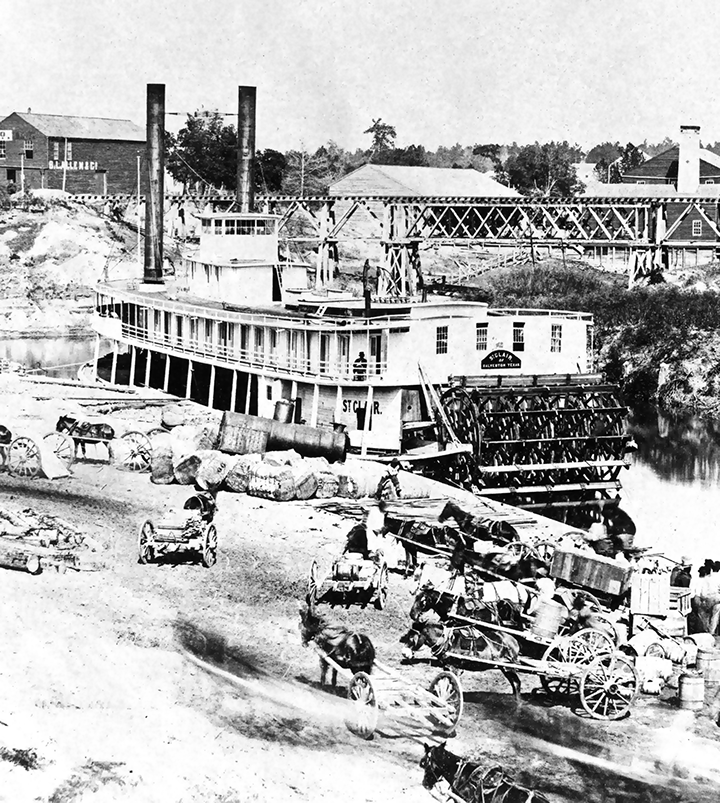

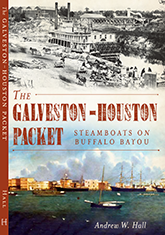
I’m pleased to announce that I’ll be speaking on the Galveston-Houston steamboat trade in the mid-19th century on Monday evening, April 30, at 6:30 p.m. at the Julia Ideson Building in downtown Houston. My presentation will be based on my 2012 History Press book, The Galveston-Houston Packet: Steamboats on Buffalo Bayou. It should be a fun event, and it’s an opportunity to present on the subject in the same place where much of the research was done. I hope my friends in the Houston-Galveston area can attend, and will behave themselves, ’cause it’s a swank deal.
______
Image: The sternwheel packet St. Clair at the Houston landing, c. 1867. Houston Public Library image.
The Passing of Neil Caldwell
 A colleague told me today of the passing last month of Neil Caldwell, a former District Court Judge in Brazoria County from 1977 until his retirement in 1995. He served in the Texas House of Representatives from 1960 to 1977. He was twice named one of the ten best legislators in the House (1973 and 1975) by Texas Monthly magazine, the first time being described as “probably the all-around best member of the Legislature.”
According to his obituary, one of the things Caldwell was most proud of during his time in Austin was being a member of the “Dirty Thirty,” a group of legislators who tried in 1971 to force the then-Speaker of the Texas House, Gus Mutscher, to publicly address his business ties to a Houston developer caught up in a bribery deal. Caldwell and his colleagues failed, but they took a stand for public transparency in one of the more infamous public corruption cases in Texas in that era. Mutscher lost his subsequent re-election campaign, and was later convicted of bribery.
I never met Judge Caldwell, but he did one other thing that I’m very grateful for. In 1969 he authored the House Bill that established the Texas Antiquities Code, that provided protection for both historic- and prehistoric archaeological sites on state lands, including coastal and inland waterways. My colleague who told me of Caldwell’s passing, who knew him well, said Caldwell was himself a metal-detecting enthusiast who joked that he introduced the legislation to “to protect sites from guys like him.” That’s funny, right there.
Then again, he was said to have a special knack for Aggie jokes, and that’s always a popular thing in Austin.
I would have liked to have known the judge. For sure, all Texans, and particularly Texans who love our state’s history and want to see it protected and preserved, owe a debt to Neil Caldwell.
God speed, Judge Caldwell.
______
Image: Neil Caldwell in the 62nd Texas Legislature, at the time of the “Dirty Thirty” confrontation.
Virginia Flaggers Salute Yankee Soldiers
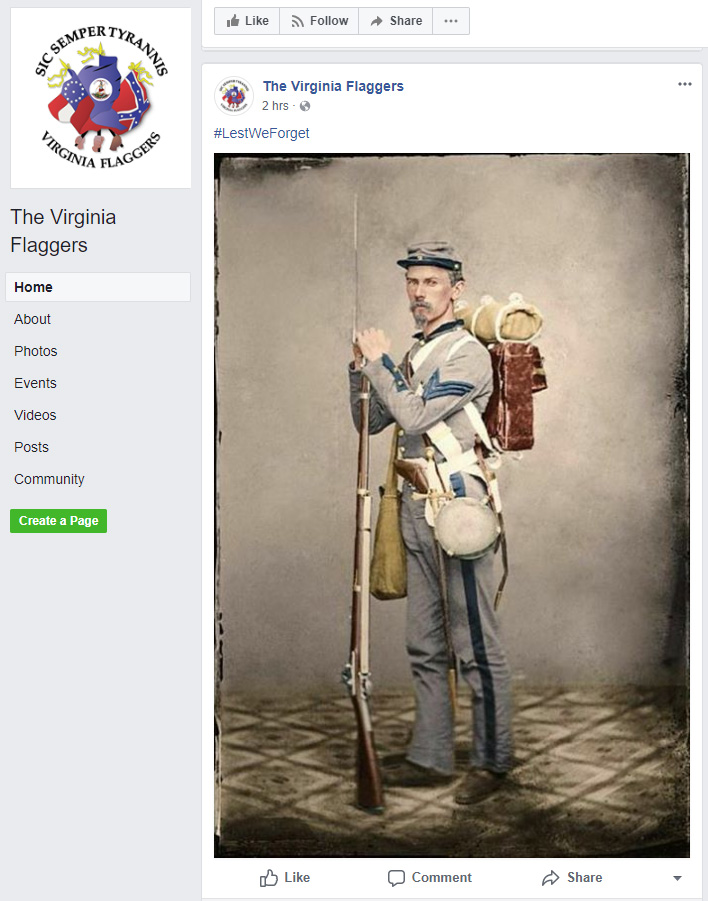
The man in question is Sergeant Joseph Dore, Company C, Seventh New York State Militia.
I, for one, applaud the Virginia Flaggers in their new initiative to celebrate the sacrifice, courage, and honor of U.S. soldiers who fought to preserve the soul of the nation and Union, and crush the wickedness of rebellion. I’m sure this will be the first of many similar posts by the Virginia Flaggers to come.
_______
Guns of USS Harriet Lane

- One 30-pound rifle
- One X-inch pivot
- Two IX-inch guns on Marsilly carriages
- Two 24-pounder howitzers.
I’m presuming that the rifle is a Parrott rifle, and IX- and X-inch guns are Dahlgrens, both of which were standard armament types aboard U.S. Navy vessels.
Tucker is, in fact, one of the more detailed and generally reliable sources for the battle and, aside from the terminology he uses to describe the guns, his description matches the U.S. Navy’s report quite well. Therefore, based on Tucker’s description, here’s my revised graphic showing the positions of the guns. This arrangement would require removable or folding bulwarks forward to clear the arc of the X-inch Dahlgren, but that would hot have been a difficult thing to do.
_________





 Dead Confederates, A Civil War Era Blog
1 comment