Canister!

Small stories that don’t warrant full posts:

- CW buffs who use Google Earth may have noticed that Richmond was recently upgraded with LIDAR data (above), that includes individually-textured buildings, trees and even some road vehicles.
- The USS Monitor Center’s wet lab reopened in May, based on a verbal agreement by all parties. The contracts still need to be sorted out.
- As part of the previously-announced plan for establishment of the American Civil War Museum in Richmond, the Museum of the Confederacy will begin transferring stewardship (but not ownership) of its archival materials to the Virginia Historical Society, where they will be scanned, indexed and made available to the public digitally.
- Saturday was the 213th birthday of David Glasgow Farragut.
- Robert M. Browning’s long-awaited volume on the Union blockade in the Gulf of Mexico, Lincoln’s Trident, will be released on January 15. It ain’t cheap, so start looking for loose change in the couch cushions now.
- The History Detectives had a show on the other day about the Sultana Disaster. Kinda interesting, but it’s almost all ground covered by Jerry Potter years ago.
- A tip for summer — after a long day at the beach, be sure to empty the hot coals out of your barbecue grill before loading it in the pickup for the drive home.
- Keith Harris has some observations about Shelby Foote as a storyteller, and as an historian. Hint: they’re not the same thing.
- And last, congratulations to my former Denbigh Project colleague Eric VanVelzen, who was recently promoted to Lieutenant Commander in the U.S. Coast Guard. Van is a former Marine and a Desert Storm veteran.
Got anything else? Put it in the comments below.
______________

It’s Not a Bug, It’s a Feature
I see from Brooks’ blog that Billy Bearden, who not long ago said he would “hope and pray” for the gang rape of a federal judge whose decision he disagreed with, is at it once again. Then we have Carl “Amanda Buncle” Roden, Josephine “Shoot Up Your Kid’s School” Bass — all active voices in the Confederate Heritage™ movement whose violent fantasies bubble up to the surface every now and then.
Also, mark your calendars, it’s just 25 more days before James Montgomery-Ryan says he’s going to make sure “that the yankees [sic.] will be wiped from the earth,” through exile (to where, exactly?) or by firing squad.
It’s easy to point and laugh at silly people like John Hall, who a few months ago worked up the courage to stand for “Dixy” by stabbing a sheet of paper when no one else was around, but underneath it all runs a culture that rewards angry rhetoric and fosters a pathology of violent fantasy, actively abetted by their friends who ignore, defend or explain it away.
These are the Defenders of Southron Honour. Know them for who they are.
____________
Celebrating Independence Day in Vicksburg, 1877


It’s an old saw that the citizenry of Vicksburg, Mississippi, did not celebrate the Fourth of July until well into the 20th century. While it’s certainly true that the anniversary of the fall of that city to Grant in 1863 continued to resonate with Vicksburg residents down through the years, in fact the date was observed by plenty of local residents, white and black, even if the celebration was unofficial and somewhat more muted there than elsewhere. And they were celebrating it even when the war itself was a recent memory. From the Vicksburg Daily Commercial, July 3, 1877:
To-morrow being the anniversary of our Nations independence, all patriotic citizens of this great Republic are expected to observe it as a holiday. We desire to be reckoned among this class of patriotic citizens, consequently no paper will be issued from this office to-morrow. The glorious Fourth happens to come in hot weather this year, and we are glad to be able to observe it ‘neath the shade of country forests.
And a follow-up, on July 5:
The people of Vicksburg came nearer celebrating the glorious Fourth yesterday than they have done for several years. True, there was no general suspension of business, as indicated by closed doors, but so far as the profits of trade were concerned doors might as well have been closed, for the salesrooms were deserted almost entirely. Everybody was out of town, apparently, enjoying the holiday in some way. Several hundred people attended the Hibernian picnic at Newman’s Grove, and not withstanding the extreme heat, all seemed to enjoy the festivities of the day. The colored population turned out in large force, fully one thousand men of them going down the river on excursion boats to picnic-grounds, yet there were enough of them left in the city to form a very respectable procession of colored Masons, and a very large audience to listen to the oration of Judge J. S. Morris, and to assist in laying the corner-stone of King Solomon’s Church. There was no prolific display of fire-works on the streets, but occasional reports from fire-crackers and large torpedoes could be heard, accompanied now and then by a patriotic cry, “rah for the Fourth of July!” We do not wonder at the lack of patriotic enthusiasm displayed on our streets. No amount of patriotism could have induced any sane man to exert himself very considerably on such a day when the thermometer registered very nearly 100° Farenheit [sic.] in the shade. However, the observance of Independence Day yesterday, slight as some may have thought it, was yet sufficient to indicate the prevalence of a broader National sentiment and a determination to at least partially forget the past which renders the Fourth of July especially distasteful to Vicksburgers, and make it in future “The Day We Celebrate” as much as any other National holiday.
To be sure, the Fourth of July remained a bitter date for many Vicksburg citizens, for a long time. Undoubtedly there are some who still reject the date as one for celebration. But in this, as in so much else about the legacy of the war, the reality is more complex than some would have us believe.
_____________
A version of this post originally appeared here on July 4, 2011.
Friday Night Concert, Thursday Edition — “The Devil Made Texas”
Great old song, performed here by Ed Miller. The audio isn’t great, but he adds some lines I’d never heard before.
____________

Thanks!
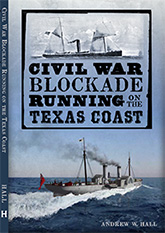
 I’d like to extend my thanks to the folks who came out to my book events at the Brazoria County Historical Museum on Thursday, the Galveston Bookshop on Saturday, and Eighteen Seventy-One on Sunday. I enjoy meeting people with similar interests. In the last few days I’ve met some very interesting people, including the owner of a fishing camp called “Blockade Runners,” whose sailboat he named Rob Roy, after William Watson’s schooner, and the author of a wonderful new field guide to Texas lighthouses, Richard Hall (no relation), whose work I was unaware of until Sunday but I bought it on the spot. Maybe more about that later.
It was especially nice to meet the family (right) of one blockade runners I mention in the book, David McCluskey. Captain Dave, as he was known, was one of the more audacious blockade-running masters I’ve encountered, in a profession where audacity is a prerequisite. You’ll definitely be hearing more about him.
Finally, I got to do a Q&A about the book with Galveston.com blogger Richard Varr, that you can read here.
___________
CS Navy Yard Marker Goes Missing in Shreveport

Via my colleague Craig Swain, a Louisiana historical marker at the site of a Confederate Navy shipyard has gone missing:
It’s not entirely clear whether this was an intentional act of vandalism, or if maybe someone knocked it down and hauled off the evidence before he could get caught. Here’s hoping it turns up or gets replaced soon.
__________
Image via Richard Taylor Camp, SCV
CW Preservation Trust to Buy Lee’s Gettysburg HQ
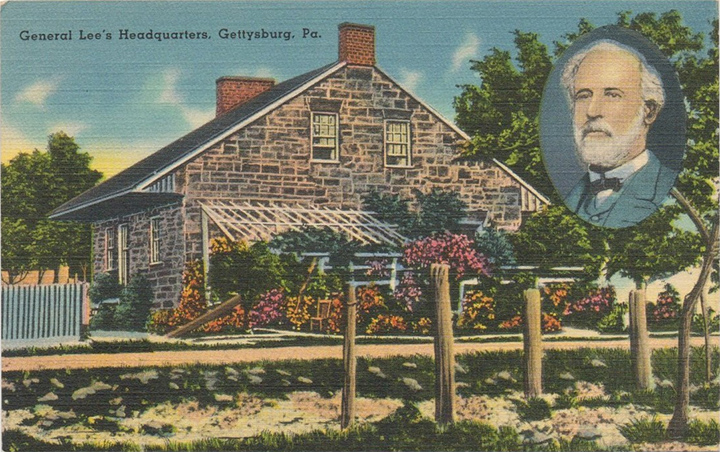
Via user Barrycdog at CW Talk, comes news that the Civil War Preservation Trust will purchase the property where Robert E. Lee made his headquarters during the Battle of Gettysburg, 151 years ago this week.
I had no idea about that bit about Thaddeus Stevens. Small (19th century) world. Congrats to the Civil War Preservation Trust and all its members! You can help contribute to this project here.
Blockade Running “Headquarters” Discovered in Scotland

An Appledore Sub Aqua Club diver over the forward boilers of the blockade runner Iona 2. Photo by James Wright, via The Independent.

Via Civil War Talk user Daywalker, researchers in Scotland have identified what they view as the central “headquarters” of Civil War blockade running:
My own view is that Graham — whose book Clyde Built is outstanding — is overstating a bit both the role of the site in Bridge of Allan and the effect of blockade running on the prolongation of the war itself. The researchers do seem to have zeroed in on the center of blockade-running interests’ ship acquisition activities, but once selected vessels left the Clyde the site’s role must have been largely done. Blockade running was necessarily a decentralized business with lots of different players competing against each other, with the capital concentrated in and around Liverpool and (to a lesser degree) London. It was not a military operation with a central command; merchants operated through their agents and representatives in Halifax, Bermuda, Nassau and Havana. The story also focuses solely on the importation of munitions (“gun-running,” ugh), when a probably half or more of the cargoes carried by runners into the Confederacy were civilian goods, destined for private sale to the highest bidder.
Still, Graham and his colleagues are helping to fill in the blanks of the blockade-running story, and that’s all to the good. Be sure to click through and check out the images of the wreck of Iona 2 — quite spectacular, and very representative of runners like those that operated in the Gulf of Mexico, including Will o’ the Wisp, Banshee (II) and Owl.
_____________
Talkin’ Blockade Runners
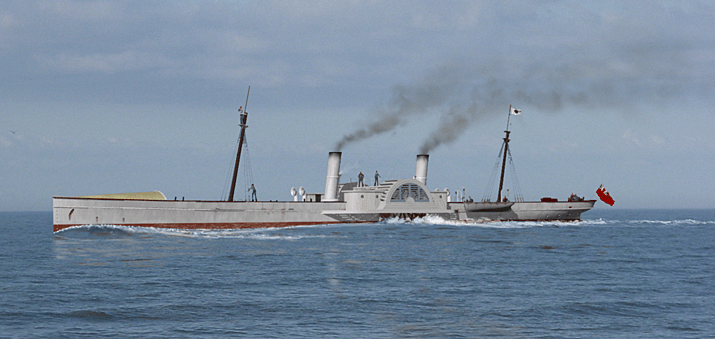
The blockade running book got a strong review by Mark Lardas in the Galveston County Daily News this past weekend. The full text is paywalled, but it begins and ends,

I have three book events coming up this week. On Thursday evening at 6:30, I’ll be doing a talk and book-signing at the Brazoria County Historical Museum 100 E. Cedar Street in Angleton.
On Saturday I’ll be signing books at the Galveston Bookshop, 317 23rd Street in Galveston, from 2 to 4 p.m.
On Sunday I’ll be signing books at Eighteen Seventy-One, 2217 Strand in Galveston, from 1 to 3 p.m.
Hope to see y’all there!
___________
A Juneteenth Follow-Up

Saturday’s Juneteenth marker unveiling was impressive. I’ve been to a lot of marker dedications, but never one as big or as well-organized as this one. Kudos to everyone involved in putting this together. Both the chairman and executive directors of the Texas Historical Commission came down from Austin (rare for them to travel to the same function), as well as our U.S. Representative and State Senator. They all said the right things and the elected officials, who are all up for re-election this year, didn’t veer off topic. The most important address, one not on the program, was by 83-year-old Rev. Virgil A. Wood, who described his own experience as a seventeen-year-old kid in the 1940s, interviewing an old man who recalled the Federal soldiers coming to the plantation to deliver the news of emancipation, when the man had been ten years old. It wasn’t that long ago, in purely human terms.
This being Texas, though, the attendee who got the most attention was former local high school football player Mike Evans, recently selected by Tampa Bay as the No. 7 in the NFL draft:

Juneteenth arose out of the unique situation of Texas and the Trans-Mississippi at the end of the war, so it’s a little difficult to explain to anyone unfamiliar with that — which is to say, almost everyone among the general public.
The Confederate Trans-Mississippi Department did not formally surrender until June 2, 1865 — TWO MONTHS after the fall of Richmond. During that whole time, except for a few isolated areas, Texas was not occupied by Union troops and the whole area was in a sort of limbo, still officially in rebellion but without a clear course and without a national leadership. The U.S. Navy officially took possession of Texas on June 5, but did not have soldiers to establish a formal presence. General Granger arrived with troops at Galveston on June 17, and two days later issued a series of administrative notices formally notifying all of Texas that the state was now under formal military occupation, who the key officers and departments were, and so on. The third of these notices was General Order No. 3, that formally announced emancipation under the terms of the Emancipation Proclamation of January 1, 1863. These notices were published in papers around the state, first in Galveston (below) and then elsewhere as the news was carried inland by telegraph and railroad.

The wording of Granger’s order was not happenstance; it was carefully crafted based on other officers’ orders and experiences elsewhere. Granger’s order, though, is most famous because it was the last and covered the largest territory. A colleague who’s been researching this subject has found also that this notice was not just pro forma — it really did have a profound and immediate effect as it spread across Texas, and enslaved persons received word of it in various ways, and within a short time June 19, the original date of Granger’s order, had become an important commemoration day among Freedmen. The African American community in Houston pooled its funds to buy and establish Emancipation Park in 1872. Juneteenth is mentioned in several LoC slave narratives, and the word “Juneteenth” itself was established by the 1890s, even as the celebration was being brought by Texans to other states. Parsons, Kansas Weekly Blade, June 22, 1895:

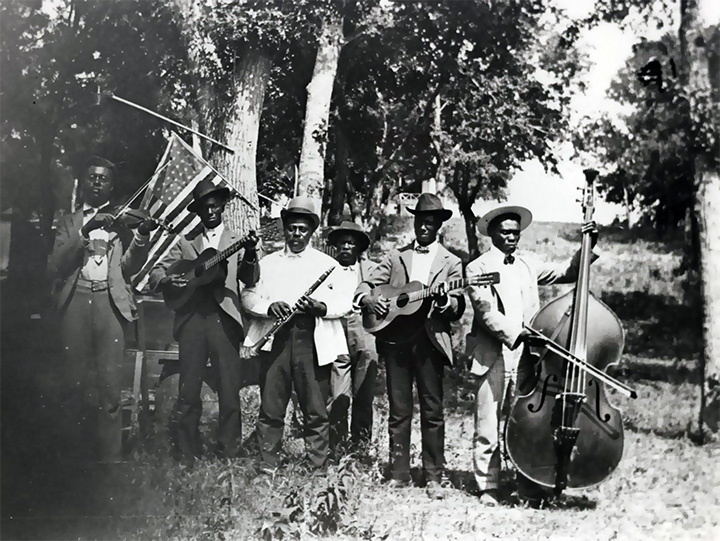
Emancipation celebration band, Austin, Texas, June 19, 1900. Austin History Center, Austin Public Library, via University of North Texas Portal to Texas History.
Planning gets underway now for a proper sesquicentennial celebration of the end of the war and Juneteenth next year. The Civil War didn’t end at Appomattox in April 1865; it ended here in Texas in June, with the paired events of the surrender of of the Trans-Mississippi Department and Granger’s General Order No. 3. It’s a part of the story that needs a better telling and wider recognition. Here’s looking forward to a grand 2015!

__________




 Dead Confederates, A Civil War Era Blog
leave a comment