The Christmas Truce of 1914, Sponsored by Sainsbury’s

Sainsbury’s, the big UK supermarket chain, has released an advert based on the 1914 Christmas Truce during World War I. The short film was done in cooperation with the Royal British Legion, a support organization for service members, veterans, and their families. Sales of replica chocolate bars like that featured in the ad benefit the Legion.
The ad has brought a good bit of criticism in the UK, both for commercializing a wartime event, and for supposedly “sanitizing” the grim reality of World War I trench warfare.
That last comparison strikes me as equal parts lazy and fatuous, as Nazi/Holocaust analogies generally are. Nonetheless, there are criticisms to be made. Furthermore, there are a number of similar stories from the American Civil War, where small groups of Union and Confederate soldiers met and fraternized between the lines.
What do you think of the Sainsbury’s ad, or the prospect of something similar set in 1861-65?
____________

Little Phil Walks It Back
My colleague Ed Cotham tipped me to this little gem, from the time in the spring of 1880 that former President Grant and his family passed through Galveston on a tour through Texas. Phil Sheridan was with them, and at a grand dinner at the Tremont Hotel, the former Union general took the opportunity to clarify some intemperate remarks he’d made years before. Galveston Daily News, March 25, 1880, p. 8:
 Speaking so kindly about Texas — and I speak from my heart — probably I ought to explain a remark I once made about it [loud applause], and I can do it this way: It was in 1866. At that time we had some trouble with Mexico, and I went down to the border …. 0n my return to San Antonio I found a dispatch there which required me to go with the greatest haste to New Orleans. I remember that I hired relays and coaches from San Antonio to Galveston . … 1 traveled day and night. It was in August and very warm, the dust being about as deep as it is in Mexico, where it has not rained in several months. One or two officers fell sick and I left them. I arrived in Galveston covered with dust. My eyes and ears and throat were filled with it, and I think I had about as much of the soil of Texas on me as would have raised a cotton crop. I went to a little hotel [the Washington]; and in that condition, as I went up to register, one of these newspaper men rushed up to me and said he: How do you like Texas?” I was mad, and said if I owned Texas and all hell, I would rent out Texas and live in hell. Now I want to assure you that by that expression I only meant to convey how much I was disgusted with that newspaper man. It did not represent my opinion of Texas … , and I have always had the highest regard for Texas. Every time I visit Texas I think a little more of it than ever before ….
I’ve never ridden in a hired coach non-stop from San Antonio to Galveston, but I did once drive from El Paso to Galveston, in a single day, in the summer, in a car with no A/C, with 100-pound dog that was prone to car sickness. I say we cut Little Phil some slack on this one.
__________
Update, November 21: Over at Civil War Talk, author Eric Wittenberg, who knows a thing or two about the subject, says that “Sheridan was a horrid human being, just wretched. He was a pathological liar and a hypocrite–all of which is well-documented–so nothing along these lines surprises me in the least.”
I do wish he would say what he really thinks.
__________
The Texas Homefront, 1861
This account is taken from Marc-William Palen’s 2012 article, “A Canadian Yankee in King Cotton’s Court” (Civil War History 58:2, 224-261). The unknown author, a Canadian, was traveling across Texas in the late spring or summer of 1861, on his way back to Ottawa.
The country from Waco to Nacogdoches, passing through the towns of Crockett and Rusk, as monotonous enough . . . the horrors of civil war could now be painfully realized in the sight of many abandoned settlements and small farms, and private residences either in a state of neglect or closed up. There was a sullenness amongst the population, and a suspicion of all men, which let a sad impression on the mind. In some of the towns and villages two-thirds of the white male population had gone of to join distant detachments of the Southern army; and, though there was no open insubordination, or expressed discontent at the war by those let behind, there was decidedly no enthusiasm manifested auguring either of future hope or satisfaction at the Secession steps already taken. A slight incident will show the state of public feeling. As the road was very heavy and sandy, the passengers in the stage coach got out and walked for about a mile and a half. In company with a gentleman who, like myself, felt thirst, we let the main road about a quarter of a mile, to call at a farm house, in order to procure some water. As we approached, the premises seemed to be abandoned; but, ater knocking and calling, a colored man came to the door and asked our business, but almost immediately in his footsteps followed a woman and a couple of formidable looking dogs. She immediately ordered the “chattel” into the house, seemingly afraid that he might hold any communication with two white strangers. After considerable coaxing she left us to bring the desired beverage, but the dogs were left behind, and to judge from their occasional sulky growling were intended as our custodians for the time the good woman was absent. After the water was drank and paid for, (at the moderate rate of 50 cents!) and we returned to join the stage, we found ourselves followed by two armed men on horseback who did not seem satisfied until they had seen us safely in the coach, and assured from our passes, and the information of the driver, that we were not incendiaries, kidnappers, or secret agents of those “D—d Abolitionists!”
_________
Robert E. Lee’s “lack of a core of greatness”
In this interview from the Civil War Monitor, well-known Civil War author Glenn LaFantasie further fleshes out his recent cover article from the magazine, “Broken Promise,” in which he argued that in his moment of national and professional crisis, Lee failed to measure up to his own role models, George Washington and his own father, “Lighthorse Harry” Lee.
I’m sure this will cause some heartburn in certain quarters.
Have a great weekend, everybody.
___________
Captain Dave versus the Yankees

I’m off this bright Saturday to give a couple of presentations in Houston. The first, “Captain Dave versus the Yankees,” should be a fun one, although a little rough because it’s new material that I haven’t presented before. It’s the outgrowth of an anecdote I told in the blockade running book, about a local mariner who successfully recaptured his schooner from a Federal boarding party. (He may even have done it on two separate occasions, although affirming that requires more digging.) I met some of Captain Dave’s descendants over the summer, which has served as an impetus to dive further into his story. It should be a lot of fun.
Then in the afternoon I’ll be at the Houston History Book Fair, at the Julia Ideson Building downtown. Lots of good authors and publications there.
The image above is by Michael Codd, from Mark Lloyd’s Combat Uniforms of the Civil War. It’s supposed to depict a Confederate privateer, although apart from the revolver it would serve nicely for a blockade-running master, as well. The civilian clothes and lantern are particularly appropriate. Blockade runners generally went unarmed, although in the struggle for Sting Ray, Captain Dave did take trouble to relieve the Union officer of his pistol.
____________
Update and Correction on “Go back to Africa!”
Earlier today I put up a blog post about a confrontation between members of the Southern Christian Leadership Conference and members of the local SCV camp in Danville, over the display of the Confederate flag there. The news story I used as a source quoted an SCV member as saying to one of the SCLC members, “go back to Africa!”
At the suggestion of a reader from Danville, I reviewed the video of the news story, and that shows clearly that the SCV member was inaccurately quoted. What he was saying was, “. . . then you need to go back to Africa and tell them to stop.” Who they are, and what they need to stop doing, I can only guess.
In any event, the news station clearly misquoted the SCV member in the written story that accompanied the video, and I failed to do due diligence in verifying their quote on the video. That’s on me, and I’m sorry. I apologize for putting up a post that was inaccurate and unduly critical. Getting it right is important, and this time I didn’t.
___________
Blue Water Ships, Brown-Water Bayou
 My new feature article on Liberty ship construction in Houston during World War II will be hitting local newsstands shortly. I’m especially honored to have it included in the new issue of Houston History Magazine (right), dedicated to the centennial of the formal opening of the Houston Ship Channel. The full article won’t be online for some months yet, but you can read the opening grafs here. Houston has never had the reputation of a major shipbuilding center, but it accomplished remarkable things during the war. Two hundred eight Liberty ships were pushed off the ways into Buffalo Bayou between 1942 and 1945. For those of you familiar with Houston geography, if placed end-to-end those ships would stretch more than seventeen statute miles, from the San Jacinto Battleground to City Hall downtown.
There are some wonderful articles in this issue, many of them supplemented by the photography of Captain Lou Vest, a Houston pilot and one of the best maritime photographers working today. (Don’t miss Steve Nelson’s photos, either.) I’d like to give special thanks to the managing editor of Houston History, Debbie Harwell, for her enthusiasm and encouragement. She’s great to work with.
____________
“The Better Angels”
Via John McKee Barr’s blog, Loathing Lincoln, a new film with a different angle in Lincoln:
Opens next Friday.
__________
Price: Battle of First Deep Bottom
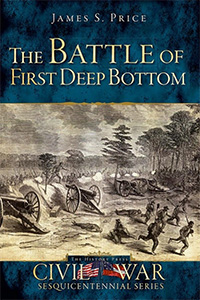 Congratulations to my fellow blogger, Jimmy Price, on the recent publication of his second book, The Battle of First Deep Bottom. From the description at History Press:
This looks to be a fine addition to any library of books on the latter part of the war in the Eastern Theater. If First Deep Bottom is anywhere near as good as Jimmy’s first book on New Market Heights, readers will be in for a treat. Jimmy will be signing books at the Henrico Theatre at the November 9 screening of Glory; enjoy a good movie and get a good book (or two) at the same time!
____________
The Flagger Road Show Comes to Danville
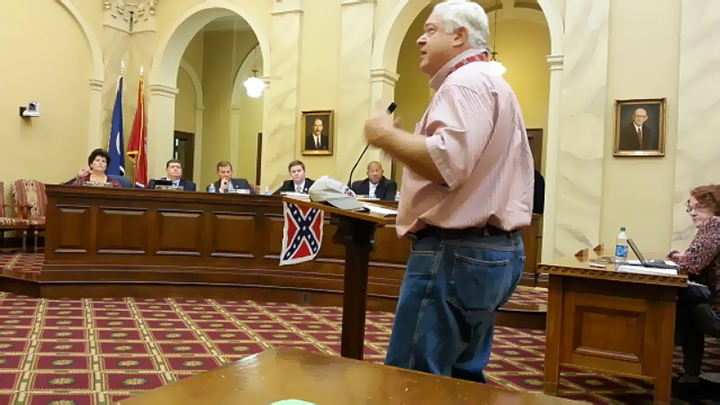
As some of you know, the City of Danville, Virginia announced recently that it would leave in place a Confederate flag on the grounds of the Danville Museum of Fine Arts and History. The museum is housed in the Sutherlin Mansion that, for a week in the spring of 1865, was home to Jefferson Davis and the Confederate government, after their midnight skedaddle from Richmond. This decision is naturally being heralded as a big win for Confederate Heritage™, although city’s announcement was based on a close reading of Virginia state law, not on the actual merits of the flag supporters’ case. Indeed, a Danville political blogger who attended the public hearing on Tuesday felt that the flag supporters did their cause more harm than good. One local SCV member, Glen Scearce, gave a rambling harangue that was
Another reportedly asked “if [the Danville City] council will be the next Hitler and the Nazis, rewriting history.” They do love them some Nazi analogies, those folks.
Anyway, one of the speakers was outside agitator Virginia Flagger Barry Isenhour (above), who reportedly said that (in the blogger’s words) “Lexington has a high unemployment rate because they have ran off tourism.” That would be a compelling argument if it were true, but even a cursory look at the actual suggests it’s not.
The Virginia Flaggers have been claiming for a long while now that their boycott of Lexington, initiated shortly after the city council there voted to bar all non-official flags from city-owned display poles, has had a dramatic effect on the city’s economy. They typically latch on to some bit of bad news about business in Lexington, and proudly claim credit for it. Most recently, they were crowing about a report that in June, Lexington had the highest unemployment in the commonwealth. But as I’ve pointed out before, actual economic data shows that tourism-related business in Lexington has been on the upswing all through the Flagger boycott.
Flaggers like Isenhour, Susan Hathaway, Brandon Dorsey and others are good at tossing off anecdotal examples of Very Bad Things happening in Lexington. But anecdotes aren’t data, and economic impact is rarely (if ever) reflected in a single datum point. It’s about trends. And, contra Isenhour’s assertion about unemployment, the overall trend is quite clear:
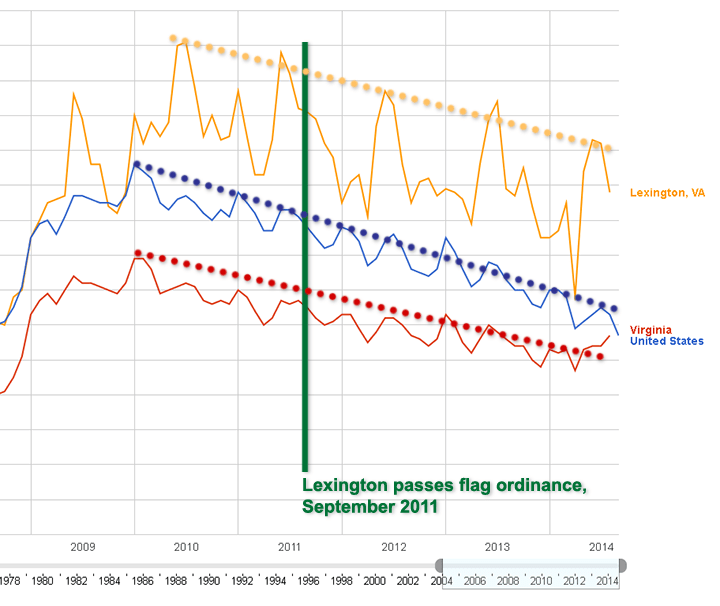
Since peaking in 2010, more than a year before passage of the city’s flag ordinance and the beginning of the Flagger’s boycott of the town, unemployment trends for Lexington, the Commonwealth of Virginia and the United States as a whole have all moved steadily downward.
There are some important takeaways here. The first is that unemployment in Lexington is high, higher than both the Commonwealth of Virginia and the United States as a whole, and it’s inordinately seasonal, spiking consistently every summer. But these are also patterns that have been consistent for years, well before the Virginia Flaggers began their boycott campaign. Any effect that campaign has on employment statistics for Lexington doesn’t appear to move the overall trends at all. The big picture is quite clear — unemployment in Lexington, as in Virginia and the rest of the country, is getting steadily better, not worse.
As for the recent talking point that Lexington had the highest unemployment rate in the commonwealth in June, that’s true, and it’s an unfortunate designation. But it’s also not really surprising, given that Lexington has had much higher unemployment than Virginia as a whole, going back to the winter of 1999-2000, when it shot upward and has never since come back down relative to the rest of the state. Again, this is not something attributable to the Flaggers; it’s been the “normal” course of things in Lexington for well over a decade. The Flaggers won’t tell you that. What else won’t they tell? Among other things, that that horrible peak unemployment in Lexington in the summer of 2014 (11.3%) was lower than the peak in 2013 (12.4), which was lower than the peak in 2012 (12.7%), which was lower than the peak in 2011 (13.8%), which was. . . well, you get the idea.
I don’t need to belabor the point, but the data is clear that when it comes to the effectiveness of the Virginia Flaggers’ boycott of Lexington businesses, they’re not only claiming credit for something they didn’t do; they’re claiming credit for something that hasn’t even happened. I honestly don’t know if they’re too dumb or lazy to see this for themselves, or know better but assume that their audience will believe anything that sounds good for their cause. It doesn’t really matter, though, because the effect is the same.
Anyway. I’m off to San Marcos to talk about how we identified a famous Civil War blockade runner wrecked here 150 years ago next February. Y’all be good to each other while I’m gone.
____________





 Dead Confederates, A Civil War Era Blog
8 comments