Piracy and World Maritime Day

Today, Thursday, is World Maritime Day. I recently received this infographic on modern-day piracy around the world, and efforts to combat it. Although it’s presented in a fun format, it contains some useful information about what remains a serious problem in some parts of the world. You can view a slightly larger version here.
This graphic was sent me by Tom Murphy of Nature’s Water Ltd., a water treatment and filtration company in Ireland. Thanks for the graphic, Tom!
___________

Blue Water Ships, Brown Water Bayou

My feature article from last fall in Houston History Magazine, “Blue-Water Ships, Brown-Water Bayou:Wartime Construction of the EC-2 ‘Liberty’ Type Cargo Ship at Houston, 1941-1945,” is now available as a preview here, and the full article in PDF here.
_________
Thanks, Temple!

I’d like to thank the folks in Temple, Texas, for hosting me this weekend to present at a dinner held at the Temple Railroad & Heritage Museum, in conjunction with the opening of their new exhibition, Kings of the River. They’ve got a great museum there, housed in the 1910 Santa Fe depot. Temple was — and very much still is — a railroad town, with both passenger service via Amtrak and a Santa Fe locomotive yard and maintenance facility just adjacent to the museum. I’d particularly like to thank Angela McCleaf, Steve Wolley, and the museum curator, Stephanie Long, with making my visit a memorable one.
A couple of interesting things I didn’t know before. The big health network in that part of the state is Baylor Scott & White. It turns out that Arthur C. Scott and Raleigh R. White were both contract physicians to the Gulf, Colorado and Santa Fe Railroad in Temple in the 1890s. The GC&SF had established one of their hospitals for the road’s employees there, but there was no similar facility for the citizens. Drs. Scott and White set up a private practice together, and eventually founded a civilian hospital which, ultimately, became Baylor Scott & White.
The other thing I discovered is that Temple had a Harvey House in the 1920s and early ’30s. Harvey Houses were restaurants and cafes, set up alongside railroad depots, to provide meals for passengers. They first appeared in the 1870s, and are generally credited as the first “chain” restaurants in the United States. (Take that, Ray Kroc!) Harvey Houses were staffed primarily by young women — “Harvey girls” — who signed a six-month or one-year contract and lived in dormitories under strict supervision. In a time when single women had very few respectable options for earning their own living, Fred Harvey’s chain of restaurants was a rare opportunity. Although I’d been aware of Harvey House restaurants for many years, I never really associated them with Texas. That was a mistake, now corrected.
Anyway, thanks to the good folks in Temple for hosting me. I hope to see y’all again soon.
_______
New in the Civil War Monitor


The Fall 2015 issue of the Civil War Monitor debuted online last week, and will be appearing in subscribers’ mailboxes and on newsstands shortly. It’s a bang-up issue, as many of us have come to expect from Terry Johnston and his team.
The cover story in this issue is an appropriate one, that takes on the dispute over Confederate symbols that has flared since the shooting in Charleston almost three months ago. Pulitzer-prize-winning author Tony Horwitz, who famously tackled the subject of Civil War remembrance in Confederates in the Attic, reflects on the current debate, and the ways in which the South has changed since he began working on Confederate twenty years ago.
Other articles include a scathing profile of the U.S. Secretary of War, Edwin Stanton, by William Marvel; the effect of climate and weather on the Battle of First Manassas, by Ken Noe; an essay on the Confederados of Brazil by Ron Soodalter, a look at the mythology surrounding Robert E. Lee’s decision to cast his lot with the South by Mark Grimsley, and a look at the work of one of the lead conservators on the H. L. Hunley Project, Paul Markidian, by Jenny Johnston.
Good stuff, all of it. Do yourself a favor and subscribe now.
____________
Showing the Flag in Dee Cee
Thirteen hundred people said they were going to attend the big Confederate Heritage™ rally on Capitol Hill in Washington today. A few dozen actually showed up, which is getting to be par for the course on these things. Money quote:
“I am restraining myself because I am a southern belle,” said Ginny Meerman, a beauty pageant consultant and former “Mrs. Maryland” winner who sported a Confederate flag tattoo across her upper back.
Apparently the white nationalist League of the South was represented, too. Who’d a thunk it?
Various factors have been suggested for the low turnout at these events, but it’s nothing new — several years ago the SCV held what was supposed to be a national rally in Richmond, and announced that a thousand marchers were expected; about a third of that number actually participated. And then there are the rallies that get announced and cancelled again before they happen.
Personally I think it’s the biscuits and gravy.
___________
Excavation May Locate Texas’ Only Steam Warship

Employees with HRA Gray & Pape excavate a trench near the cruise port as they try to locate the wreckage of the Zavala, a Texas Navy streamship that was run aground and forgotten 174 years ago, shown Monday, Aug. 31, 2015, in Galveston. Port leaders must make sure the cruise port expansion plans won’t disturb the historic wreck. Photo by Melissa Phillip, Houston Chronicle.

As part of a Port of Galveston expansion to accommodate more and larger cruise ships, excavations are being done this week to ensure that the project doesn’t impinge on the wreck of one of the more unusual vessels of the Republic of Texas Navy of the 1840s, the steamship Zavala:
In 1986, novelist and adventurer Clive Cussler set out to discover the remains of the Republic of Texas’ armada. Cussler determined that the Zavala was the only Texas Navy wreck left that he had a chance of discovering. He dug into what was then a parking lot and found what he believed were the Zavala‘s remains, then reburied them; the expedition lacked the money to excavate the wreckage.
Thirty years later they have become a headache for the Port of Galveston, which has hired archaeologists who began digging again Monday to make sure that cruise port expansion plans won’t disturb the historic wreck.
Port leaders want to expand the wharf at Cruise Terminal 2 by 95 feet and install two mooring bollards, posts sunk into the ground deep enough to secure the 138,279-ton Navigator of the Seas, a Royal Caribbean cruise ship, Port Director Michael Mierzwa said. After receiving the plans from his engineer, Mierzwa realized that the posts would be placed in the area where Cussler had dug for the Zavala. The U.S. Army Corps of Engineers, which permits maritime construction, told Mierzwa he would need a permit from the Texas Historical Commission as well.
Cussler’s account of where he found the wreckage is imprecise, so without excavation there is no way to know whether the bollards would be sunk into a historical artifact.
“I’ve seen drawings that had it one in part and in about two or three other locations,” Mierzwa said.
Adding to Mierzwa’s difficulty is the possibility that more wrecks are in the area. Although Cussler’s findings strongly suggested that he had found the Zavala, he never found an artifact that proved it, said Jim Hughey, regional manager for HRA Gray & Pape LLC’s Houston office. The company is supplying the archaeologists for the port.
Michael Tuttle, marine archaeologist and historian for HRA Gray & Pape, said the Confederate Neptune [No. 2], sunk in the 1864 Battle of Galveston, also went down in the area. He said the historical commission believes several other ships of lesser renown also may be nearby.
Cussler is certain that he found the Zavala.
“I don’t know what the hell else it would be,” Cussler said, noting that the head of the Texas Antiquities Committee was present and agreed that it was the Zavala. Cussler said he believes the Neptune sank farther out, and there were no other wrecks close enough to the dig site to be confused with the Zavala.
Well, no; the very document that showed Cussler where to look for Zavala also shows Neptune No. 2 very close by, where she settled in shallow water after the Battle of Galveston. The wreck was subsequently salvaged in place. So the presence of the old cottonclad nearby is highly likely.

The cottonclad Neptune No. 2 lies sunk in shallow water after the Battle of Galveston, New Years Day, 1863. The dark, cylindrical object near the boat’s stern (arrow) is identified on the original drawing (bottom right) as the wreck of the Texas Navy steamship Zavala. It’s definitely close. Image via Rosenberg Library, Galveston.
To be fair, I think it’s more likely that the adventure author located Zavala thirty years ago, rather than Neptune No. 2, given that his coring included what appeared to be copper sheathing, which the converted riverboat almost certainly wouldn’t have had. Still, I’m glad they’re back looking again.
_________

The Dixie Cafe, Reconstructed


As I mentioned in a comment on Kevin’s blog, I recently made a long road trip of almost 1,200 miles across Texas and back, mostly through rural counties and small towns, and saw only a handful of Confederate flags — literally, few enough to count on both hands. That’s a little surprising, given the assurances being made in some quarters about a widespread, popular, groundswell of support for the Confederate flag. Maybe it’s happening in other places, but not so much in Texas.
One place I expected to see a Confederate flag, but didn’t, came early in the trip, at Johnny Reb’s Dixie Cafe in Hearne. Sure enough, they changed their signage last month (above), dropping both the flag and the Johnny Reb reference in favor of a more generic Lone Star.
One of the restaurant’s partners, Sharon Zeig, said the change was simply a business decision that had “nothing to do” with the most recent controversy over the symbol, and had been planned for months. That’s undoubtedly true, but it’s also true that Confederate iconography doesn’t square anymore with promoting one’s business to the widest possible range of potential customers. You can ask Lloyd Bessinger about that. Now Dixie can focus on what they seem to do extremely well — namely, chicken fried steak and sweet tea.
________
Image via KAGSTV.com
Harriet Tubman, Confederate Scout
Today’s history lesson comes via Kevin Jolley of Southern Heritage News & Views:
There was black regiments that fought in the Civil War for the south to. Don’t for get Harriet Tubman who scouted for the 2d South Carolina.
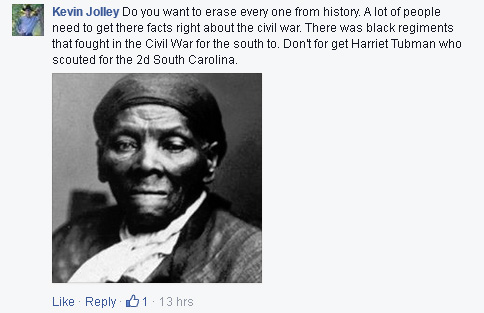
The Second South Carolina Volunteer Infantry (African Descent) was one of the first African American units in the Union army, organized in early 1863, and composed of former slaves from the coasts of Georgia and South Carolina. The regiment was made somewhat infamous by its commanding officer, former Kansas Jayhawker James Montgomery. I’m pretty sure the folks in Darien, Georgia didn’t view that regiment as as fighting “for the south [sic.].”
On the positive side, though, I’m sure we can count on Mr. Jolley’s support for putting Tubman on the new $10 bill, right? Right?
___________
UPDATE, July 26: After being challenged about the Second South Carolina on Facebook, Mr. Jolley claims he never suggested they were a Confederate unit:
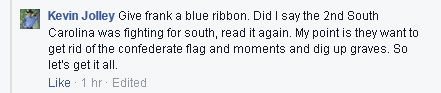
Um, sure. OK.
_________
“My remains shall rest with those of brave men”
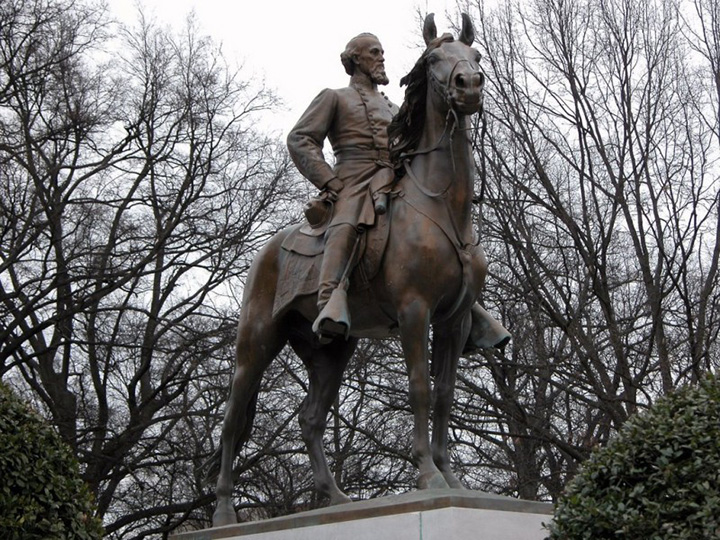
My blogging colleague Rob Baker recently passed along a link to this transcript of Nathan Bedford Forrest’s will:
FIRST I commit my body after death to my family and friends with the request that it may be entered among the Confederate dead in the Elmwood Cemetery near the City of Memphis, it being my desire that my remains shall rest with those of the brave men, men who were my comrades in war and shared with me the danger and peril of battle fields fighting in a cause we believed it our duty to uphold and maintain.
Return Nathan Bedford and Mary Ann Forrest to Elmwood. It’s the right thing to do.
___________
You Were Warned, America!
Jade Helm is here, people. Chris Martin uncovers the irrefutable evidence at the Sam’s Club in San Angelo:
_______




1 comment