Forrest on Decoration Day, 1875
Today, Nathan Bedford Forrest is more popular than ever among the fans of the Confederacy. No doubt that’s because he’s come to represent unyielding defiance, whether in victory or defeat, in the face of the Yankee enemy. More than any other Confederate officer — certainly more than someone like Lee — Forrest is the modern face of the unreconstructed rebel, the pit bull of the Lost Cause.
Unfortunately, that image doesn’t entirely square with reality — at least near the end of the general’s life. From the Galveston Daily News, June 3, 1875:

In Memphis, last week, a number of Federal officers and soldiers participated at the decoration of Confederate graves. As a result, Generals [Gideon Johnston] Pillow and Forrest addressed a letter through the Memphis papers to surviving Confederate soldiers and veterans of 1812, Florida and Mexico, requesting them to participate in the Federal ceremonies on Sunday last [i.e., on Memorial Day]. From this letter the subjoined is extracted:
“However much we differed with them while public enemies, and were at war, we must admit that they fought gallantly for the preservation of the government which we fought to destroy, which is now ours, was that of our fathers, and must be that of our children. Though our love for that government was for a while supplanted by the exasperation springing out of a sense of violated rights and the conflict of battle, yet our love for free government, justly administered, has not perished, and must grow strong in the hearts of brave men who have learned to appreciate the noble qualities of the true soldier.
“Let us all, then, join their comrades who live, in spreading flowers over the graves of these dead Federal soldiers, before the whole American people, as a peace offering to the nation, as a testimonial of our respect for their devotion to duty, and as a tribute from patriots, as we have ever been, to the great Republic, and in honor of the flag against which we fought, and under which they fell, nobly maintaining the honor of that flag. It is our duty to honor the government for which they died, and if called upon, to fight for the flag we could not conquer.”
Forrest offers a lesson that some of his most ardent, present-day fans seem determined to ignore
_________
This post originally appeared at on the Civil War Monitor‘s Front Line blog, May 27, 2012.

Defenders of Southron Honour, cont.
As you may have heard, a judge in Louisville on Wednesday lifted an order protecting the Confederate monument there, allowing the city to proceed with plans to relocate it. Everett Corley, a write-in candidate for the Third Congressional District of Kentucky, isn’t taking it well:
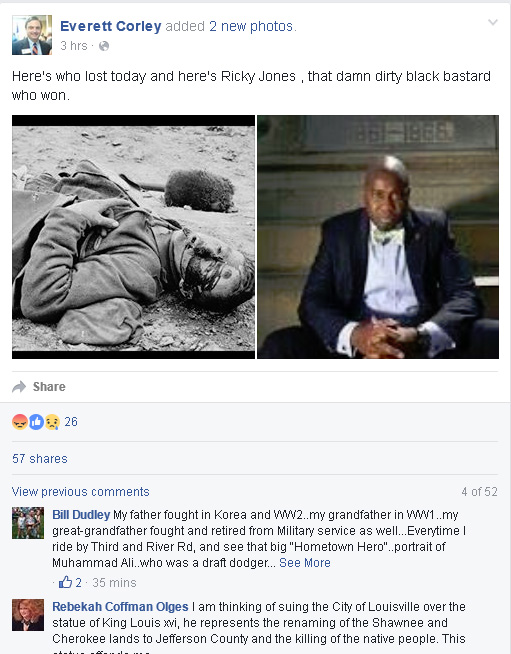
These folks are exactly who you thought they were. Exactly.
_________
Update: Looks like Everett Corley deleted this little bit of nastiness from his Facebook page. He did, however, leave up the one referring to Ricky Jones as “the black Rasputin from Atlanta.” Stay classy!
_________
Update, June 9: Corley apologized for his comments at a public meeting in Louisville on June 8, almost two weeks after originally making them.
_________

A Last Letter to General Hood

The ten surviving Hood children after their parents’ death in 1879.
I was looking through Sam Hood’s The Lost Papers of Confederate General John Bell Hood, and wondered if there was any correspondence between Hood and William Tecumseh Sherman relating to the latter’s visit to New Orleans in 1879, when Hood and Sherman attended the theater together, and the former Confederate general made a speech in Sherman’s honor. Lost Papers doesn’t include correspondence from that visit, but does include a letter Sherman wrote a few months later, upon learning of the death of Hood’s wife, Anna Marie, from that perennial scourge of the Gulf coast, yellow fever:
Headquarters Army of the United States,
Washington D.C., Aug 26, 1879
General J. B. Hood
New Orleans
Dear General-
My family is all in the Allegheny Mountains and I am here alone at breakfast this morning at a hotel nearby. A friend read aloud the notice of the death of Mrs. General Hood.
Even yet though some hours have passed I cannot help thinking of that wonderful and beautiful group of children you paraded before us last winter at your home in New Orleans, and that you took my daughters Lizzie and Elly up to see Mrs. Hood in her sick bed. I know not why but I cannot banish the sight from my mind, and now write you this simple note to tell you that here in Washington there is one who thinks of you in your bereavement, and of those motherless children.
I shall send the paper to my daughter Lizzie to whom you committed the sacred trust of your war papers, which are I assure you absolutely safe and I believe she will write to offer you some words of consolation at a loss which touches the heart more than the loss of a father.
All we can do is to bow to the inevitable, and go on with the duties of life till we ourselves mark the Common destiny the Grave.
Accept the assurance of my heartfelt sympathy and of great respect.
Truly your friend,
W.T. Sherman
John Bell Hood likely never read this letter; he himself succumbed to the fever four days later, on August 30, leaving ten orphaned children behind.
I hope those of you in the Houston area will be able to attend Thursday’s Houston Civil War Round Table Meeting, to hear Sam Hood speak on his famous collateral ancestor. The HCWRT meets at the Hess Club, with a meet-and-greet beginning at 6 p.m., with dinner at 7 p.m. Spaces are available for the meeting, but reservations are required. Costs are $30 for dinner and speaker, and $10 for the speaker/presentation only. E-mail Don Zuckero at Reservations-at-HoustonCivilWar-dot-com by 6:00 p.m. on Monday. The Hess Club’s address is 5430 Westheimer, a short distance west of the Galleria. The club is situated on the corner of Westheimer Way and Westheimer Court. Free, convenient, and handicap-accessible parking is across the street.
________
Sam Hood and “The Lost Papers of John Bell Hood”
Next Thursday, May 19, is the final meeting of the 2015-16 campaign season for the Houston Civil War Round Table. It will be a special evening, with two special guests.
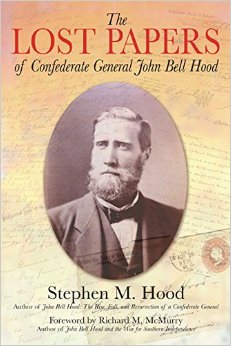 Stephen M. “Sam” Hood will be the main speaker for the evening, presenting on “The Lost Papers of John Bell Hood.” This collection of 200-plus documents sheds important light on some of the war’s lingering mysteries and controversies. For example, letters from Confederate officers help explain Hood’s failure to entrap Schofield’s Union army at Spring Hill, Tennessee, on November 29, 1864. Another letter by Lt. Gen. Stephen D. Lee helps to explain Maj. Gen. Patrick Cleburne’s gallant but reckless conduct that resulted in his death at Franklin. Lee also lodges serious allegations against Confederate Maj. Gen. William Bate’s troops. Other papers explain, for the first time, the purpose and intent behind Hood’s “controversial” memoir Advance and Retreat, and validate its contents. While these and others offer a military perspective of Hood the general, the revealing letters between he and Anna, his beloved and devoted wife, help us better understand Hood — the man and husband.
In addition, the HCWRT will present its annual Frank E. Vandiver Award of Merit, in recognition of an individual or an organization making a substantial contribution to the preservation of Civil War heritage. The Vandiver Award is named for the late Civil War historian and former President of Texas A&M University, the University of North Texas, and Rice University, who also was one of the earliest members of the HCWRT. This year, the Vandiver award will be presented to Eric A. Jacobson, Chief Executive Officer and Historian for the Battle of Franklin Trust, which manages the Carter House and Carnton Plantation in Franklin, Tennessee.
The HCWRT meets at the Hess Club, with a meet-and-greet beginning at 6 p.m., with dinner at 7 p.m. Spaces are available for the meeting, but reservations are required. Costs are $30 for dinner and speaker, and $10 for the speaker/presentation only. E-mail Don Zuckero at Reservations-at-HoustonCivilWar-dot-com by 6:00 p.m. the Monday preceding the Thursday meeting (i.e., by the 16th). The Hess Club’s address is 5430 Westheimer, a short distance west of the Galleria. The club is situated on the corner of Westheimer Way and Westheimer Court. Free, convenient, and handicap-accessible parking is across the street.
Preliminary speaker schedule for the 2016-17 Campaign Season:
Oct. 18, 2016, A. Wilson Greene: “Civil War Petersburg” (Note: This is a TUESDAY Night!)
Nov. 17, 2016, Susannah J. Ural: “Hood’s Boys”
Dec. 8, 2016, Donald S. Frazier: “Blood on the Bayou: Vicksburg, Port Hudson, and the Trans-Mississippi”
Jan. 19, 2017, Edwin C. Bearss: “The Camden Expedition and Battle of Jenkin’s Ferry, AR”
Feb. 16, 2017, Edward H. Bonekemper III: “The Myth of the Lost Cause”
Mar. 16, 2017, Brian Steel Wills: “George Thomas at Nashville”
Apr. 20, 2017, Elizabeth R. Varon: “Legacies of Appomattox: Lee’s Surrender in History and Memory”
See you there.
_____
“. . . as far as Boston is from heaven.”
Recently I had the great pleasure of attending a presentation at the Houston CWRT by Caroline Janney, based on her book, Remembering the Civil War: Reunion and the Limits of Reconciliation. It was a fantastic presentation. I came across this passage where a former officer of the First Texas Infantry chafed at the idea, becoming popular around the turn-of-the-century, of events combining delegations of both former U.S. and Confederate veterans:
More than a few, however, could do without the brotherly handshaking. “I don’t like these blue and gray reunions,” Col. R. J. Harding, the president of Hood’s Texas Brigade Association, declared on June 28, 1905; “something unpleasant always happens.” But Harding had a simple solution to the problem: “The quickest way to stop sectional feeling is to let each other alone. We are as far apart in what we fought for as we ever were, that is,” he quipped, “as far as Boston is from heaven.” No one wished for more strife and dissensions, he assured his comrades, but neither had they ever given up their view of the war.
I wonder what Cousin Katie — the only female member of the Hood’s Texas Brigade Association — thought about that.
_______
The Russians

I’m reading Constantine Pleshakov’s The Tsar’s Last Armada, about the Russian Squadron that sailed from the Baltic, around Africa and across the Indian Ocean, ultimately to meet the Japanese at the Battle of Tsushima in 1905. I was reminded of this fairly well-known image (above) of Russian seamen from the steam corvette Variag, taken in New York City in 1863 or 1864, during the American Civil War. At least four of the men are boatswain’s mates, as indicated by the calls (whistles) worn on chains around their necks. These are tough, experienced seamen, with probably fifty years or more of seagoing experience between them.
I thought of this image when I came across this passage in Last Armada, describing life aboard a Russian warship in 1904. Navies being what they are, I doubt that much had changed in the intervening 40 years:
Class tensions were much worse in the navy than in the army. A soldier would meet his officers exclusively during service hours. He had no idea how they ate or drank or spent their free time. Ships were another story. Sailors watched their superiors constantly. There was not much that an officer could conceal from their prying eyes.
In theory, men ate well. Meals were to be cooked with fresh meat, but it was impossible to stock enough cows or pigs to feed eight hundred men for several weeks. When the livestock supply on board was exhausted, meat had to be taken from the refrigerator of the Esperance. After the Esperance’s stock was emptied, crews were fed solonina — meat preserve of a yellowish color, often stinking and generally nauseating. On such days some sailors refused to take meals at all.
Officers had their own supply of everything. Each meal consisted of several dishes. Good cooks prepared them. Probably no officer in the Imperial Navy had ever eaten solonina — except when obliged to check the crew’s menu. Fine wine and elaborate spirits were served in the officers’ wardroom. It was both a restaurant and a club. Sounds of opera arias and Chopin mazurkas mixed with smells of exquisite sauces, coffee, liqueurs, and cigars. These sounds and smells told men of an infinitely better life. If this ignited anything in their hearts it was bitterness, if not outright hatred. No sailor could hope to become a commissioned officer. For that, he had to be born into a privileged class.
Some officers still beat their men. Many captains discouraged or prohibited this, but everybody knew that [Admiral] Rozhestvensky himself rarely felt guilty about giving a man a thrashing. When an officer was impressed with a sailor’s performance, he would buy him an extra shot of vodka or two. It was commonly believed this was the only kind of encouragement the brutes would appreciate.
For men on a warship, the day started at five o’clock in the morning, announced with a shriek of a flute on the upper deck. Immediately after that, non-commissioned officers started rousting the men. They never hesitated to use obscenities or fists; bullies by design, they usually made the point of being deliberately cruel. For this they were rewarded; some of them even shared a cabin for just two. Hundreds of sailors hastily jumped from their berths and hammocks. They had only a few minutes to dress and turn hammocks into neat, numbered cocoons. Then the cocoons had to be taken to the upper deck and put into special niches. The crew was ordered to wash. Elbowing each other, they hastily rinsed their faces with harsh seawater. The next order was “To prayer!” A priest arrived to sing the day’s hymns. Hundreds of voices on deck accompanied him.
Breakfast of bread, butter, and tea took half an hour. At seven o’clock the cleaning-up started. Decks had to be washed, brass polished, walls brushed. Shortly before eight, everybody had to be on deck in a solemn formation. The captain received reports from his senior officer, the doctor, and others. At eight o’clock sharp, simultaneously with Rozhesrvensky’s Suvorov, all ships raised the St. Andrew’s Flag, a blue cross on white that was the trademark of the Russian navy. Officers and crewmen took their caps off. Horns and drums played. The day was launched.
For two and a half hours, training proceeded. Then the cook brought a portion of the crew’s lunch to the captain: a bowl of meat soup, slices of bread, and salt. The captain had to taste the soup, and if he approved, the senior officer and head of watch had to taste it, too. All used the same spoon.
At eleven o’clock, flutes announced lunch. Men rushed to the deck where vessels with vodka already stood. Each was poured half a glass. If the meat was fresh, the soup was good: meat, cabbage, potato, beet, carrot, onion, pepper, and some wheat flour. After lunch, the crew rested for two hours, took tea for thirty minutes, and then returned to work. At half past five, all labors were finished. At six o’clock, dinner arrived, and vessels with vodka were brought to the deck again. After that the crew was free to relax. The only ceremonies remaining were the lowering of the flag and evening prayer.
Normally, crews were well fed and worked only eight hours a day, with a three-hour break in the middle. However, if something went wrong — be it the interruption of food supplies or some other emergency — the crew was the first to suffer.
A hard life, particularly when one knows the gruesome fate that awaited most of them in the Tsushima Strait .
________
Canister!
Small stories that don’t warrant full posts:
- Congratulations to Brian Matthew Jordan, who recently joined the faculty at Sam Houston State University in Huntsville, on being named a finalist for the 2016 Pulitzer Prize in History for his book, Marching Home: Union Veterans and Their Unending Civil War.
- My colleague Rob Baker continues his series on dealing with the Confederate flag in the classroom. Wish I’d had a teacher like that.
- Over at Buzzfeed, Adam Serwer has an essay that neatly summarizes the story of Andrew Chandler and Silas Chandler, and shows how the oft-told story of “the Chandler Boys” ignores both the historical record and Silas’ own family tradition in favor of the version passed down in the white Chandler family.
- Suzanne Sherman went with her family to Virginia last year, and took a tour called “Slave Life at Monticello.” Imagine her shock and dismay when she discovered the tour was about slave life at Monticello.
- Jefferson Davis is being moved from the hall of presidents to the Civil War section in the oldest, and possibly saddest, wax museum in the United States.
- H. K. Edgerton wants you to donate to support his upcoming campaign in Florida.
- It has nothing to do with the Civil War, but Vimeo has a really good mini-documentary on the Battle of Jutland, a century ago next month.
- More apropos, the Civil War Trust has a great animated map outlining the Vicksburg Campaign (h/t Al Mackey).
- A display of state flags in an underground hallway in the U.S. Capitol complex will be replaced, over concerns about Confederate imagery used in them. Mississippi is getting most of the heat these days, but in fact the flags five other states — Alabama, Florida, Arkansas, Georgia, and Tennessee — also use elements of the Confederate flag in designs adopted after the war in 1861-65.
- Speaking of Alabama, it turns out that family-values, fiscal-conservative Governor Robert Bentley had a state police helicopter and crew spend the day after Christmas 2014 flying from Montgomery to Tuscaloosa to Gulf Shores (and then presumably back to Montgomery) to deliver his wallet after his soon-to-be-ex-wife kicked his cheatin’ ass out of the house. Sorry, I don’t have a punch line for this one.
Got any more? Put ’em in the comments.
_______
Garrison Gives Up on Colonization
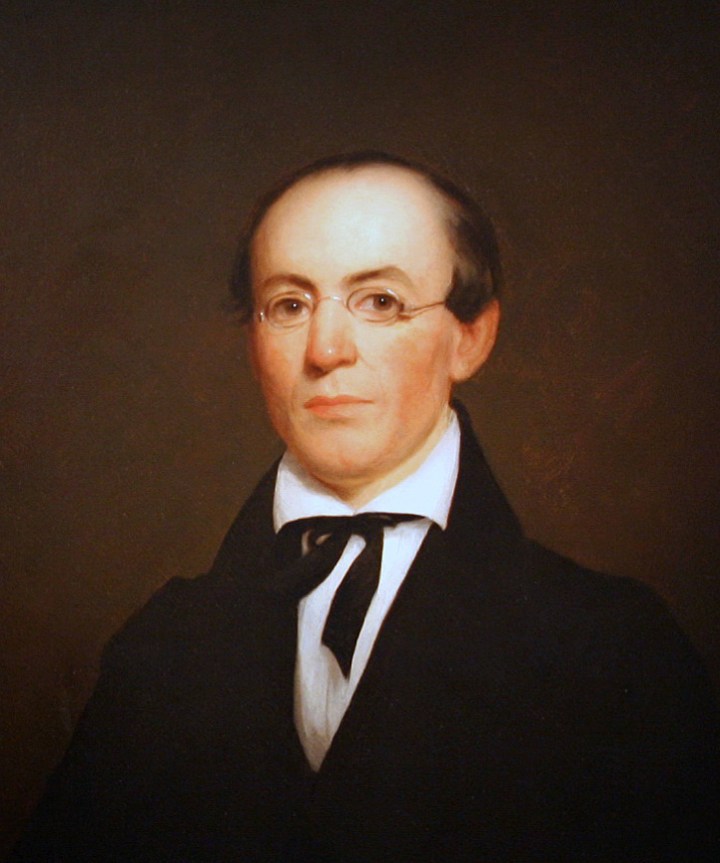
I happened upon this item from just the fourth issue of William Lloyd Garrison’s abolitionist paper, The Liberator, from January 22, 1831:
Garrison is writing here five years before the Alamo and the Texas Revolution, and thirty years before secession and Sumter.
Notice also that for Garrison, using a “compulsory process” of colonization of African Americans, free or (formerly) enslaved, was a deal-breaker. Like Lincoln, whose interest in colonization schemes waffled back and forth over the years, before finally being rejected completely, it was always a matter of voluntary resettlement rather than expulsion.
From the online collection at Fair-Use.org, that includes what looks to be the entire 35-year run of The Liberator. Check it out.
__________
Garrison portrait via National Portrait Gallery.

But Is His Torch Still at Thy Temple Door?

In Maryland, they’re looking to remove the phrase “northern scum” from their official state song. And yes, like the Mississippi state flag, it was a decades-after-the-fact embrace of Confederate symbolism as an official representation of the state:
“Maryland, Oh Maryland,” which is sung to the tune of “O Tannenbaum,” wasn’t adopted as the state song until 1939, although it was penned in 1861. The AP reports it is unclear why the song was adopted at that particular historical moment but notes there had been two recent lynchings in the state and the NAACP was then advocating for equal pay for black teachers.
“By enshrining a Confederate war anthem, the General Assembly may have been seeking symbolically to challenge such efforts,” according to the AP.
Could be.
______




 Dead Confederates, A Civil War Era Blog
4 comments