Also, They Really Hate Negative Stereotypes About Southerners


Good Heavens, I may start a GoFundMe drive to buy these folks a spell-checker.
Update, February 18: I’ve been requested to remove this blog post in deference to the person who put it up on Facebook. While I’m not inclined to remove the post entirely, I have removed that person’s name from it, and deleted the link to the original.
________

Snowflakes, Claybanks, and Charcoals in Wartime Missouri
In Missouri in the early 1860s, a “Snowflake” was a person who was opposed to the abolition of slavery—the implication of the name being that such people valued white people over black people. The Snowflakes hoped slavery would survive the country’s civil war, and were contrasted with two other groups. The Claybanks (whose name came from the colorless color of the local terrestrial clay) wanted a gradual transition out of slavery for slaves, with eventual freedom accompanied by compensation to slave owners; the Charcoals—who were also called Brown Radicals—wanted immediate emancipation and for black people to be able to enlist in the armed forces.
The available evidence suggests that this particular use of snowflake never moved much beyond the borders of Missouri or the era.
________
Gary Gallagher: Robert E. Lee and the Question of Loyalty
Here’s a really superb talk by Gary Gallagher on Robert E. Lee, and the deeply-conflicted loyalties he had — to Virginia, to the United States, to the slaveholding South, and to the Confederacy.
______
“You need to give the Austrians a safe word.”
Update, January 23: Civil War Talk user Thomas Aagaard challenged what I wrote about the Danish Jylland‘s armament being all rifled guns, saying that most of them, like those of the Austrian ships, were relatively small smoothbores. And he’s right — Conway’s All the World’s Fighting Ships, 1860-1905 gives Jylland‘s original armament as forty-four 30-pounder smoothbores, with the all-rifle armament coming at some later date. The ship’s data in the game simply appears to be incorrect for 1864, giving Jylland a much longer-range, harder punch than she actually had..
___________
The Danish squadron (upper left) turns to intercept the Austrians (lower right).

Sunday afternoon the group I game with fought out a scenario based on the Battle of Heligoland in May 1864. The action was fought between the Danes and a squadron of Austrian ships, acting on behalf of their Prussian allies, with three ships to a side. The real battle essentially ended in a draw, with both sides (of course) later claiming victory. The battle is famous for allegedly being the last major action that did not involve armored warships. It’s interesting from the perspective of the American Civil War because it’s a good example of what could happen when traditional wooden ships faced modern, heavy rifled artillery and exploding shells.
For this scenario we used the old Yaquinto game Ironclads (1979), along with its expansion set that brings in non-US ships and scenarios. Ironclads leans heavily toward the simulation end of the spectrum; it’s definitely not a beer-and-pretzels game. on Sunday there were six of us playing, with our host acting as game master, navigating the myriad charts and tables required in keeping track of the detailed bookkeeping. In Ironclads, every single shot is tracked and damage accounted for; the six of us would all be considered novice players, so we were slow, but even so it took us four hours or more to get to the middle of turn seven. Ironclads is a good example of tactical game design as it was in the late 1970s, when there was no end to the amount of fine-grained detail that designers tried to shoehorn into their games, even if the final product was damn near unplayable (e.g., Air War).
Every turn included a vigorous discussion about firing arcs. Every. Single. Turn.
With six of us playing, each player commanded one ship. Mine was the Austrian screw frigate Radetsky, second in the Austrian line. The Danish ships were bigger and more heavily armed than the Austrians, but more important, they had heavy guns that could outrange the Austrians. My teammates and I recognized that our only chance was to get in close, where we could use the small, 30-pounder smoothbore guns that comprised most of our armament. (In the game, the Danish screw frigate Jylland is entirely fitted with 6- and 8-inch rifles, with up to four times the range of the craptastic Austrian 30-pounders.) It didn’t go well for the Austrians; the flagship, Schwarzenberg, was set afire early in the action and I got pummeled in Radestky as I tried to close the range to the Danish line. Radestky came under fire from all three Danish ships, and was very quickly reduced to a floating wreck in the space of just three turns — which represents maybe ten minutes of real time. One lucky shot took out my steam plant, shutting down the propulsion, and in the next turn my steering was disabled, leaving Radetsky dead in a water and on fire, surrounded by Danish ships at close range. We were getting beat so badly that my friend playing the admiral quipped to our host, “if you ever run this scenario again, you need to give the Austrians a safe word.”
My ship, the screw frigate Radetsky (center), dead in the water and ablaze. This will not end well.
While this recreation of the Battle of Heligoland was not particularly fun for those of us playing the Austrian side, it did provide some insight into how devastating naval artillery had become over the preceding few decades, and in particular the deadly combination of rifled artillery and explosive shells when used against unarmored, traditional wooden warships. if this had been a real fight, it would have been a bloodbath, with both of the larger Austrian ships destroyed in short order and the third, a small paddle steamer, having to make a run for it.
Ironclads is a solid game, but it’s also a high-friction design that wears out the players pretty quickly, given the necessity of cross-referencing eleventy-four different tables every time a ship fires a gun. It would be hard to imagine fighting out a big action like the Battle of Mobile Bay using this game, although I know it has been done many times. On the plus side, for the naval buff it includes all sorts of granular detail that is appealing. I think we may do this again soon, although someone else can play the Austrians next time.
_________
Texas Military Forces Museum, Camp Mabry, Austin


Assorted images from my recent visit to the Texas Military Forces Museum at Camp Mabry, in Austin. Above, a “Forty and Eight” box car from World War I. Never expected to see one of those in Texas. Full gallery here.
__________
Crated Enfield Rifles Found 200 Miles Off Newfoundland
h/t Civil War Talk user CMWinkler.
_________
Houston CWRT: Ed Bearss on Camden and Jenkins Ferry
The Camden Expedition
and Battle of Jenkin’s Ferry, Arkansas
Considered a part of the overall Red River Campaign in the spring of 1864, with the invasion of Texas by Union forces as one of the key objectives, the Arkansas portion of the campaign also is known as the Camden Expedition. It became a failed attempt by Union troops in Arkansas to converge on Shreveport and link up with General Banks’ forces advancing northward through Louisiana and then toward Texas. Maj. Gen. Frederick Steele’s Union forces retreated from Camden after being mauled in fierce engagements at Poison Spring and Marks’ Mills. On the afternoon of April 29, 1864 the Union troops reached Jenkins’ Ferry to begin crossing the Saline River, which was swollen by heavy rain. Gen. Edmund Kirby Smith’s Confederate army caught Steele’s men and launched a succession of Confederate attacks on April 30. Many of the soldiers (including Texans) had fought at the battle of Mansfield, Louisiana only 22 days earlier. The Federals repulsed the attacks and finally crossed with all their men and supply wagons, many of which they were compelled to abandon in the swamp north of the Saline. The Confederates missed the opportunity to destroy Steele’s army, which after crossing the river, regrouped to the north at Little Rock. Their failure at the Battle of Jenkins’ Ferry cost the Confederates any chance they may have had to capture the Union army or retake Little Rock.
Edwin C. Bearss authored the in-depth book documenting Steele’s part of the ill-fated Red River Campaign (Steele’s Retreat from Camden & The Battle of Jenkins’ Ferry). Ed Bearss will speak about the events and impact of this expedition and its final battle on the Trans-Mississippi theater and Texas.
Reservations required for both dinner ($30) and lecture only ($10)E-Mail Reservation is Preferred; Email Don Zuckero at drzuckero-at-sbcglobal.net, or call (281) four seven nine-one two three two by 5 p.m. Monday, January 16.
_______
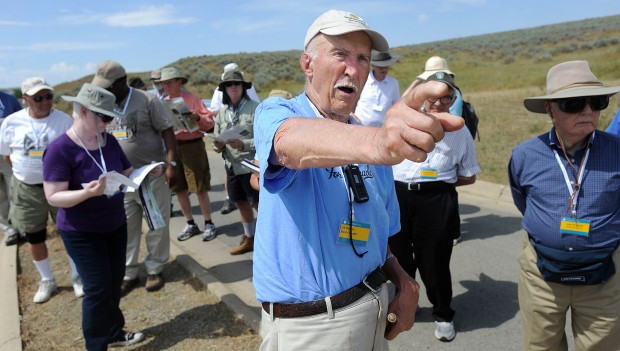
Photo by David Grubbs, Billings Gazette.

“Underground Railway to Pensacola,” Houston Maritime Museum, January 24
The “Underground Railway” to Pensacola:
Slaves, Abolitionists, and Florida’s Gulf Coast
January 24, 2017 | 7:00 PM – 8:00 PM
2204 Dorrington
Houston, TX 77030
$5 FOR ADULTS (12 AND UP) | FREE FOR MEMBERS AND CHILDREN UNDER 12
REGISTRATION REQUIRED
In the decades before the Civil War, Pensacola, Florida was a maritime and military community that shared little in common with other seaports along the South’s Atlantic and Gulf Coasts. Indeed, because of arid soil, shallow waters, and an extraordinary multiracial, multiethnic, and international population, Pensacola remained on the margins of antebellum southern society. As a result, the city earned a reputation as a gateway to freedom for enslaved people across the Deep South who found the northernmost routes of escape inaccessible. Through an examination of Pensacola during the antebellum era, this lecture tells the forgotten story of fugitive slaves and their allies along Florida’s Gulf Coast.
Matt Clavin is an award-winning teacher and historian of the United States and Atlantic world at the University of Houston. He received his Ph.D. at American University in Washington, D.C., and is the author of Aiming for Pensacola: Fugitive Slaves on the Atlantic and Southern Frontiers, which was published by Harvard University Press in 2015. He is currently working on several research projects, including a retelling of the Battle of Negro Fort, a deadly conflict between the United States Army and Navy and hundreds of fugitive slaves and Choctaw Indians in Spanish Florida, and an examination of both the meaning and memory of the Declaration of Independence in nineteenth-century America.
______
Christmas Picket
 [This post originally appeared on December 25, 2011.]
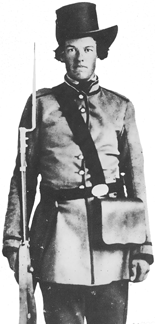
One hundred fifty years ago today, a nineteen-year-old Confederate soldier named Valerius Cincinnatus Giles (right, 1842-1915) went out on picket duty along the Potomac.
On Christmas morning a detail of twenty men was sent from the Fourth Texas Regiment to relieve the picket guard along the river. This detail was commanded by Lieutenant R. J. Lambert.
The post assigned me was on Cock Pit Point, about 100 yards from the masked battery. This battery of four guns was planted twenty feet back from the edge of the bluff. completely hidden from view by an abatis of pine brush felled and stacked, with the sharpened ends of the trunks pointing outward. as a crude defense. From my post I had a splendid view of the river for two or three miles in each direction. The low range of hills on the Maryland side opposite were covered with white tents and log cabins, the winter quarter of General Daniel E. Sickles’s New York Brigade.
The war had just fairly begun, and this was new to me. The novelty of the situation, the magnificent view before me, the river rolling majestically along between white hills and evergreen pines so charmed and captivated me at first that I felt not the bitter cold. The snow was gently and silently falling. deepening 011 the hills and valleys, melting as it struck the cold bosom of the dark river. I had been on post but a short time when I beard the signal corps man sing out from the crow’s-nest high up in a sawed-off pine tree, saying to the officer in charge: “Look out, Lieutenant, a gun boat is coming down the river!”
I could hear the artillery officer giving orders to his men, but from my position I could not see them. Looking up the river I saw a cloud of black smoke rising above the tops of the trees. All was excitement at the battery. and I could hear the artillerymen ramming home their shells, preparing to sink the approaching boat. Directly the steamer turned a bend in the river with volumes of black smoke pouring from her smokestacks. She was in the middle of the stream, coming dead ahead under full steam. It was really a disappointment to the fellows at the battery as well as myself, when the soldier in the crow’s-nest called out again: “0h, pshaw, Lieutenant, don’t shoot! She’s nothing but an old hospital boat, covered over with ‘yaller’ flags.”
Of course a Confederate battery would not fire on a yellow flag any more than on a white one.
The boat came steadily on down the river until she got nearly opposite Cock Pit Point, when she blew her whistle and turned toward the Maryland shore. As she made the turn she came within 200 yards of the Virginia bank and I could distinctly read her name on the wheel house. It was the old Harriet Lane. named in honor of the accomplished niece of President James Buchanan, who was queen of the White House during the administration of that eccentric old bachelor. In the winter of 1861 the Harriet Lane was in the employ of the Hospital Corps of the Army of the Potomac. A few days after that, she left her mooring on the Maryland side and pulled out down the river. She subsequently became a warship of some kind and met defeat at the Battle of Galveston in January, 1863.
After the boat bad landed and the excitement was over, a melancholy stillness settled around me. The novelty and fascination of my surroundings soon lost their charm. The lowering clouds above me and the white silence about me became monotonous and I began to feel restless and uneasy. If you are in a forest or on a prairie on a still summer day and will stop and listen attentively, you can bear the songs of birds, the chirping of crickets or the drowsy hum of insects. hut in a piney woods in midwinter, when the earth and green branches of the trees are covered with snow, with not a breath of air blowing, the stillness is oppressive. I must have bad a slight attack of homesickness, for I began to think of home and my mother and father away out in Texas waiting and praying for the safe return of their three boys, all in the army and all in different parts of the Confederacy — one in the Tenth Texas Infantry at an Arkansas post, one in Tennessee or Kentucky with Terry’s Rangers, and one in the Fourth Texas Infantry in Virginia. . . .
While I stood at my post on the banks of the Potomac I knew I was perfectly safe from any personal danger, yet something seemed to warn me of approaching evil. I tramped through the snow, half-knee-deep, although I was not required to walk my beat. I tried to divert my mind from the gloomy thoughts that possessed me, but all in vain. Suddenly I was startled from my sad reflections of home and kindred by distinctly hearing a voice I new — my brother Lew’s voice — calling my name. I turned quickly, looked in every direction, heard nothing more and saw nothing but the white world around me and the dark river below me. He was two years my senior, had been my constant companion and playmate up to the beginning of the war.
It was then 4 P.M., December 25, 1861. I was not sleeping or dreaming. and firmly believed at the time that I heard my brother calling me, but it must have been a delusion of the imagination.
However, Lewis L. Giles of Terry’s Texas Rangers, Troop D, Eighth Texas Cavalry, was mortally wounded at the battle of Mumfordsville, [Woodsonville] Kentucky, December 17, 1861, in the same charge in which Colonel Terry was killed. He was removed by his comrades to Gallatin, Tennessee. and died at the residence of Captain John G. Turner, a lifelong mend of my father. He breathed his last precisely at four o’clock on Christmas Day. 1861, while I stood picket on the banks of the Potomac.[1]

[1] Mary Lasswell, ed., Rags and Hope: The Memoirs of Val c. Giles, Four Years with Hood’s Texas Brigade, Fourth Texas Infantry, 1861-1865 (New York: Coward-McCann, 1961), 59-62. The compiled service record of Private Lewis L. Giles, Co. D, 8th Texas Cavalry, gives his date of death as Christmas Eve, December 24.
___________
Image: Private Val Giles in the spring of 1861, at the time of his enlistment in the Tom Green Rifles, a company later rolled into the Fourth Texas Infantry. From Voices of the Civil War: Soldier Life.

Christmas Eve Concert: John Hartford, “On Christmas Eve”
Here’s hoping all of you have a wonderful holiday season and a Happy New Year.
______




 Dead Confederates, A Civil War Era Blog
5 comments